
Picture a 37 year old man stepping off a ship in Philadelphia in November 1774. He is broke. He has failed at almost everything he has tried back home in England. He has no college degree, no family fortune, and barely enough strength to walk down the gangplank because he is recovering from typhoid fever caught during the voyage. Nobody on that dock could have guessed that this half dead immigrant would, in just fourteen months, write the pamphlet that convinced ordinary colonists to do something almost unthinkable. Break from the most powerful empire on earth.
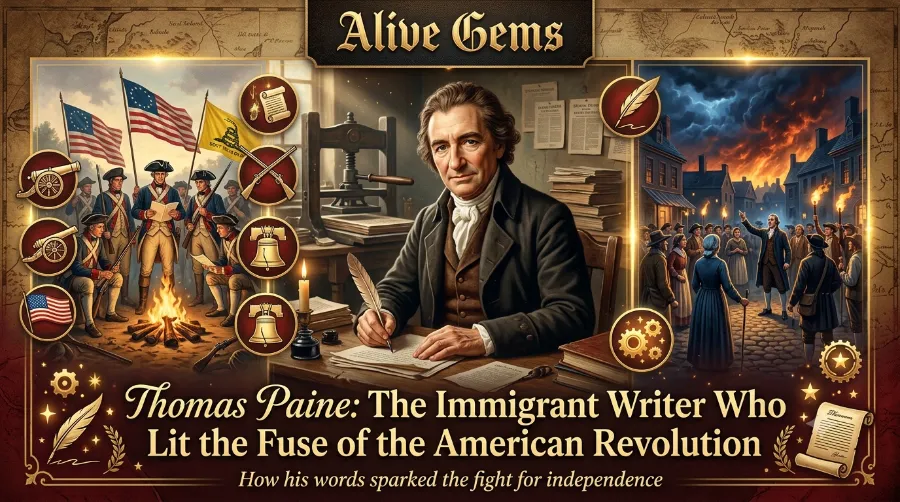
That man was Thomas Paine, and the moment Thomas Paine lit the fuse of the American Revolution is one of the strangest, most human stories in all of history. This is not a tale about a polished aristocrat in a powdered wig. It is a story about a corset maker, a tax collector, a twice divorced failure who found his voice at the exact moment history needed it, and 2026 marks 250 years since he did it. Read: Rosa Luxemburg: The Revolutionary Economist Who Frightened Every European Government
TL;DR
Thomas Paine was a struggling English immigrant who arrived in America in 1774 with almost nothing but a letter of introduction from Benjamin Franklin. In January 1776 he published Common Sense, a plain spoken pamphlet that sold roughly 500,000 copies and turned a fight over taxes into a full blown demand for independence. Without Paine’s words, historians widely agree the road to July 4, 1776 would have looked very different.
Key Takeaways
| Fact | Detail |
|---|---|
| Full name | Thomas Paine |
| Born | January 29, 1737, Thetford, Norfolk, England |
| Arrived in America | November 30, 1774, with a letter from Benjamin Franklin |
| Famous pamphlet | Common Sense, published January 10, 1776 |
| Copies sold | Roughly 500,000 in its first year, an enormous number for a colonial population of about 2.5 million |
| Second famous work | The American Crisis, starting December 1776 |
| Later works | Rights of Man (1791), The Age of Reason (1793 to 1807) |
| Died | June 8, 1809, in New York City, largely forgotten by the public |
| 2026 milestone | Common Sense turned 250 years old on January 10, 2026 |
Who Was Thomas Paine Before He Lit the Fuse of the American Revolution?
Before he became one of the most persuasive American Revolution writers in history, Thomas Paine was, by most measures, a man who could not catch a break. He was born in Thetford, a small market town in Norfolk, England, in 1737. His father was a corset maker, a trade Paine himself trained in but never grew to love.
He tried his hand at several careers and none of them stuck. He worked as an excise officer, a kind of tax collector chasing smugglers along the English coast. He got fired, twice, once for claiming he had inspected goods he never actually checked. His first wife died within a year of their marriage. His second marriage ended in a legal separation. By his late thirties he was bankrupt, and his furniture had been auctioned off to pay his debts.
Here is the part that matters most for anyone learning founding fathers real stories instead of the sanitized textbook version. Paine was not destined for greatness. He was falling apart in his own country, and that failure is exactly what pushed him toward the ship that would change everything.
The Meeting That Changed Everything
In 1774, Paine met Benjamin Franklin in London. Franklin, already famous as a scientist and diplomat, recognized something sharp and useful in this failed tax collector who could argue with real fire. Franklin wrote him a letter of introduction to his son in law in Philadelphia, describing Paine as an ingenious worthy young man.
That single letter was Paine’s ticket to a new life. He sailed for America in October 1774 and nearly died of typhus during the crossing. He had to be carried off the ship. Six weeks later, still recovering, he began working as a magazine editor in Philadelphia. He had found his city, and his moment was closer than anyone realized.
(internal link, woven into the sentence) If this kind of remarkable turnaround story grips you, you will find similar patterns of ordinary people forced into extraordinary roles across our full collection of the most charismatic revolutionary rebels history has ever produced.
Common Sense: The Pamphlet That Truly Lit the Fuse of the American Revolution
By late 1775, most American colonists were angry about taxes, angry about British troops, but still hoping for reconciliation with King George III. Independence felt radical, even dangerous, to talk about out loud. Paine changed that conversation almost overnight.
On January 10, 1776, he published Common Sense anonymously. It was a 47 page pamphlet, and it did something nobody else had managed to do. It used plain, direct, almost conversational English instead of the formal Latin flavored language of the educated elite. A farmer, a blacksmith, or a shopkeeper could read it in an evening and understand every single word.
Paine attacked the very idea of monarchy itself, not just King George’s specific policies. He argued that hereditary rule was, in his own blunt phrasing, an absurdity. He said common sense alone should tell any reasonable person that a small island had no natural right to rule an entire continent. That argument, delivered in everyday language, is precisely how Thomas Paine lit the fuse of the American Revolution in a matter of weeks.
Frederick Douglass: The Escaped Slave Who Became America’s Greatest Orator
The Numbers Behind the Bestseller
The scale of Common Sense is genuinely hard to grasp today, so a quick comparison helps put it into perspective.
Chart: Common Sense Sales Compared to Colonial Population, 1776
Colonial Population (approx.)         ################################  2,500,000
Copies of Common Sense Sold            ########                             500,000
Estimated Readers or Listeners         ##########################         2,000,000+
Historians at institutions like the University of Michigan’s Clements Library, which held a 250th anniversary exhibit on the pamphlet in early 2026, note that Common Sense was reprinted more times in colonial America than any other title of its era. To put that sales figure in modern terms, if a book sold at the same rate relative to today’s United States population, it would need to sell somewhere around 40 million copies in a single year. No modern bestseller comes close to that kind of market penetration.
Table: Common Sense by the Numbers
| Metric | Figure |
|---|---|
| Publication date | January 10, 1776 |
| First print run | About 1,000 copies |
| Estimated copies sold in year one | Roughly 500,000 |
| Colonial population at the time | Approximately 2.5 million |
| Price of a single copy | 2 shillings |
| Editions printed before 1800 | Dozens across America, Britain, and continental Europe |
What Made Common Sense One of the Most Persuasive American Revolution Writings Ever Published
A few specific choices explain why this pamphlet worked when so many earlier arguments for independence had fallen flat.
- Paine wrote in short, punchy sentences instead of long legal paragraphs, which made the ideas feel urgent rather than academic.
- He appealed directly to religious colonists by using biblical references to argue that monarchy itself contradicted scripture.
- He gave ordinary readers a clear, practical plan for what independence and a new government could actually look like, not just a complaint about grievances.
- He priced the pamphlet cheaply and allowed it to be reprinted freely, which meant it spread through taverns, churches, and army camps far faster than anything sold for profit alone.
According to the Cato Institute’s own coverage of the pamphlet’s 250th anniversary, Major General Charles Lee wrote to George Washington in January 1776 calling Common Sense a masterly and irresistible performance, and told Washington he had been fully convinced by its arguments. That single letter, from a hardened military commander, tells you everything about how fast Paine’s words moved through the highest levels of the Continental Army.
That same blend of stubborn patience and quiet conviction shows up again in the story of Ho Chi Minh, whose patience alone beat two global superpowers, one of the more overlooked endurance stories in modern revolutionary history.
The American Crisis: Words That Kept an Army Fighting
Winning independence on paper was one thing. Keeping soldiers loyal through a brutal winter was another problem entirely, and this is where Paine proved his fuse lighting reputation was not a one time accident.
By December 1776, Washington’s army was in terrible shape. Morale had collapsed after a string of defeats around New York. Enlistments were about to expire, and desertions were climbing every single week. Paine, who had joined the army himself as a volunteer, wrote the first essay in his American Crisis series during this exact crisis.
He opened with a line that is still quoted in classrooms across the United States and Europe today: “These are the times that try men’s souls.” Washington was reportedly so moved by the essay that he ordered it read aloud to his exhausted troops at Trenton just before their famous crossing of the Delaware River on December 25, 1776.
Days later, on December 26, 1776, Washington’s forces won the Battle of Trenton, a victory historians consistently point to as the turning point that revived American morale after months of losses. Paine’s words did not fire a single musket, but they helped hold together the will to keep fighting when quitting would have been the easier choice.
Founding Fathers Real Stories: How an Immigrant Outwrote the Elite
Most founding fathers came from wealth, land, or established colonial families. John Adams trained as a lawyer. Thomas Jefferson owned a plantation. Paine had none of that. He arrived with almost nothing and a body still weak from typhus, and within a little over a year he had written the single most influential piece of persuasive writing in the entire revolutionary period. Emiliano Zapata: The Peasant Who Became Mexico’s Immortal Soul
That contrast matters for anyone digging into founding fathers real stories instead of the polished version taught in most classrooms. Paine’s outsider status is exactly what let him write so bluntly against monarchy. He had far less personal or financial stake in the existing colonial hierarchy than men like Jefferson or Adams, so he had less to lose by attacking the entire idea of hereditary rule head on.
Adams actually grew uneasy about Paine’s growing fame, reportedly worrying that Paine’s simplistic reasoning might oversimplify the complicated work of building a new government. That tension between the plain spoken immigrant and the more cautious, formally educated founders is one of the more fascinating undercurrents of the revolutionary period, and it shows just how differently people experienced the same historical moment depending on where they started from.
(internal link, woven into the sentence) You can see a similar pattern repeat itself across history whenever an outsider ends up shaping a movement more than the establishment figures around them, something we explore in the story of Simon Bolivar and his fight to liberate an entire continent.
Rights of Man: How the Same Immigrant Writer Shook Europe Too
It is easy to think of Paine purely as an American story, but that misses half of what made him so remarkable. The same voice that lit the fuse of the American Revolution went on to shake the political foundations of Britain and France as well, which is a big part of why his name still carries weight on both sides of the Atlantic.
When Edmund Burke published a scathing attack on the French Revolution in 1790, arguing that tradition and hereditary institutions deserved protection, Paine responded directly with Rights of Man in 1791. The book defended the French Revolution and, more importantly for British readers, argued that ordinary citizens had a natural right to overthrow unjust governments entirely.
The British government did not take that argument lightly. Rights of Man reportedly sold hundreds of thousands of copies across Britain and Ireland within a few years, terrifying a monarchy that was already nervous about revolutionary ideas crossing the English Channel. Paine was charged with seditious libel in England in 1792 and convicted in absentia after he had already fled to France, meaning he could never safely return to the country of his birth again.
That single fact says a lot about the man. He was too dangerous for the country he was born in, celebrated for a time in the country he helped birth, and then, for a period, treated almost like royalty in a country where he barely spoke the language. Few figures in history have swung so wildly between three different nations’ opinions of them within a single lifetime.
A Quick Comparison: Paine’s Three Major Works
| Work | Year Published | Core Argument | Where It Had the Biggest Impact |
|---|---|---|---|
| Common Sense | 1776 | Monarchy is unnatural, America should declare independence | American colonies |
| Rights of Man | 1791 | Citizens have a natural right to overthrow unjust governments | Britain, Ireland, France |
| The Age of Reason | 1793 to 1807 | Organized religion relies too heavily on blind faith over reason | Primarily the United States |
Each book followed the same basic pattern that had worked so well in Common Sense. Paine wrote in plain, direct language aimed at ordinary readers rather than academics, and each time, the ruling establishment of the moment reacted with genuine alarm rather than polite disagreement.
From Revolutionary Hero to Political Outcast
Here is the part of Paine’s story that rarely makes it into American classrooms, and it is arguably the most human part of all.
After American independence, Paine traveled to France and threw himself into the French Revolution, publishing Rights of Man in 1791 in defense of it. The French made him an honorary citizen and even elected him to their National Convention in 1792, despite the fact that he barely spoke French.
But revolutions devour their own, and Paine learned that lesson the hard way. He opposed executing King Louis XVI, arguing for exile instead of the guillotine. That single position turned him into an enemy of the radical Jacobins. He was arrested in December 1793 and imprisoned in Paris for nearly a year, narrowly escaping execution himself, reportedly saved by a clerical mistake involving a chalk mark on his cell door.
While imprisoned, he wrote much of The Age of Reason, a book that questioned organized religion and traditional Christian doctrine. That book cost him dearly back in America. Many former allies, including people who had once quoted his words to their own troops, publicly turned against him over what they saw as attacks on faith itself.
Paine returned to the United States in 1802 at Jefferson’s invitation, but the country that once passed his pamphlets hand to hand now largely shunned him. When he died in New York City on June 8, 1809, only six people attended his funeral. A newspaper obituary reportedly noted, with striking cruelty, that he had lived long, done some good, and much harm. It is a brutal ending for the man who arguably did more than almost anyone to turn colonial grumbling into a full revolution.
(two internal links, woven into the same sentence) For another story of a revolutionary figure whose legacy grew far more complicated than his early heroism suggested, look at Toussaint Louverture, the enslaved man who built an entire republic, or the modern echoes of that same complicated hero worship in the story of Che Guevara and why millions still follow him today.
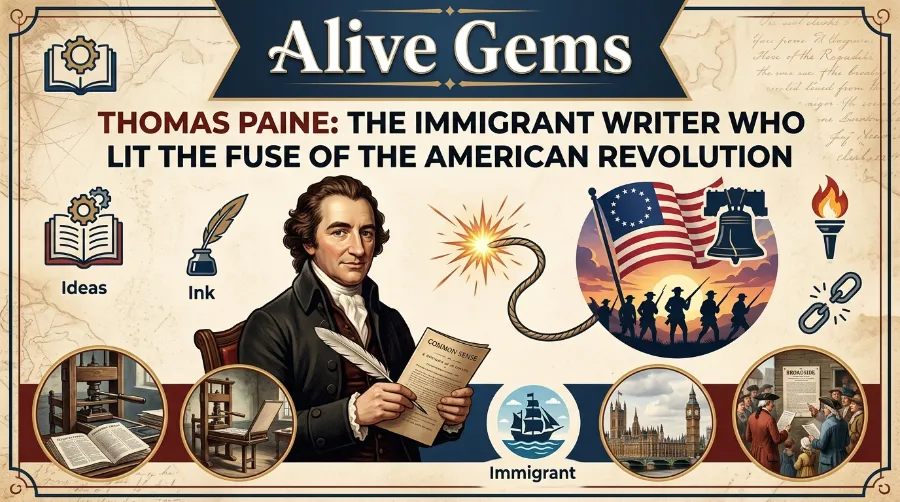
Timeline: The Rise and Fall of Thomas Paine
| Year | Event |
|---|---|
| 1737 | Born in Thetford, Norfolk, England |
| 1774 | Emigrates to Philadelphia with Franklin’s letter of introduction |
| 1776 | Publishes Common Sense on January 10 |
| 1776 | Publishes the first American Crisis essay in December |
| 1791 | Publishes Rights of Man defending the French Revolution |
| 1792 | Elected to the French National Convention |
| 1793 | Arrested in France and imprisoned for nearly a year |
| 1802 | Returns to the United States |
| 1809 | Dies in New York City on June 8, largely forgotten |
| 2026 | Common Sense reaches its 250th anniversary |
What Paine’s Writing Still Teaches Us About Persuasion
After spending years researching revolutionary writers for this site, one pattern shows up again and again, and Paine demonstrates it better than almost anyone else in history. The writers who actually change minds are rarely the most credentialed people in the room. They are the ones willing to say the obvious thing that everyone else is too polite, too cautious, or too invested in the status quo to say out loud.
A few practical lessons from Paine’s career still hold up remarkably well today, whether you are writing a pamphlet, an essay, or a modern blog post.
- Short sentences travel further than long ones, especially when the goal is to reach readers who are busy, tired, or distracted.
- Naming the obvious problem plainly, rather than hedging it in polite language, tends to earn more trust from readers than cautious diplomatic phrasing.
- Ideas spread fastest when they are affordable and easy to share, which is exactly why Paine allowed cheap and even free reprints of Common Sense rather than trying to maximize his own profit.
- Timing matters just as much as the writing itself. Paine published Common Sense at the precise moment colonial opinion was ready to shift, not too early and not too late.
These are not abstract observations pulled from a textbook. They come directly from tracing how one pamphlet, written by a man with no formal education past his early teens, managed to outperform every polished argument produced by far more educated writers of his era.
Why This Story Still Matters in 2026
January 2026 marked 250 years since Common Sense first appeared, and institutions across the United States and Britain marked the occasion with exhibits and conferences, including a joint symposium held at the University of Sussex and at Paine’s former home, Bull House, in Lewes, England. That kind of transatlantic attention, exactly 250 years later, tells you something important. A pamphlet written by a failed corset maker still shapes how both Americans and Europeans think about self government, free expression, and the power of plain language over polished authority.
If you want to go deeper into the wider network of daring, flawed, and endlessly fascinating figures who reshaped their world through sheer conviction, our full guide to the ten most charismatic revolutionary rebels in history is a natural next stop.
For readers who want to read expert historical analysis directly, American Corner has published a detailed profile of Paine’s life and influence, and the Boston Tea Party Ships and Museum has documented his direct connection to that famous protest. Visit Norfolk has also written about how this one man from a quiet English county ended up shaping the fate of an entire continent across the Atlantic.
Quick Quiz: How Well Do You Know Thomas Paine?
Test yourself with these five questions before you move on.
- In what year did Thomas Paine publish Common Sense?
- A) 1774
- B) 1776
- C) 1781
- Roughly how many copies of Common Sense sold in its first year?
- A) 5,000
- B) 50,000
- C) 500,000
- True or False: Thomas Paine was born in the American colonies.
- Which future president reportedly ordered Paine’s American Crisis read aloud to troops before the Battle of Trenton?
- A) John Adams
- B) George Washington
- C) Thomas Jefferson
- True or False: Thomas Paine died a wealthy and widely celebrated public figure.
Answers: 1) B, 2) C, 3) False, he was born in Norfolk, England, 4) B, 5) False, he died largely forgotten with only six people at his funeral.
Frequently Asked Questions
Did Thomas Paine actually light the fuse of the American Revolution?
Historians widely credit Paine’s pamphlet Common Sense with shifting public opinion in early 1776 from seeking reconciliation with Britain toward openly demanding full independence, which is why so many historians describe Paine as having lit the fuse of the American Revolution.
Was Thomas Paine considered one of the founding fathers?
He is usually classified separately from the traditional founding fathers because he never held elected office in the new government, but many historians argue his influence on public opinion was just as important as anything achieved in the Continental Congress.
How many copies of Common Sense were sold?
Estimates generally place first year sales around 500,000 copies, an extraordinary number given a total colonial population of roughly 2.5 million people.
Why did Thomas Paine become unpopular later in life?
His support for the French Revolution, his imprisonment in France, and especially his book The Age of Reason, which criticized organized religion, cost him support among former allies in America.
Where was Thomas Paine born?
He was born in Thetford, in Norfolk, England, in 1737, before emigrating to Philadelphia in 1774.
Conclusion
Thomas Paine never held elected office, never owned a large estate, and spent his final years largely alone and overlooked. Yet somehow, this one failed corset maker and tax collector managed to hand the American colonies exactly the words they needed at exactly the right moment, and that is really the whole point of his story. Revolutions are rarely started by the people who seem destined for greatness. Often they are lit by the ones who have already lost everything and have nothing left to protect. Two hundred and fifty years later, in 2026, historians in America and Europe are still gathering to study a 47 page pamphlet written by an immigrant nobody expected much from, and that alone tells you how completely Thomas Paine lit the fuse of the American Revolution.
References
- Cato Institute, “The Pamphlet Read Round the World: The 250th Anniversary of Thomas Paine’s Common Sense,” 2026.
- University of Michigan, Clements Library, “Common Sense at 250” exhibit coverage, 2026.
- NPR, “The legacy of Thomas Paine’s Common Sense on its 250th anniversary,” January 2026.
- American Corner, “Thomas Paine” historical profile.
- Boston Tea Party Ships and Museum, “Thomas Paine” historical profile.
- Visit Norfolk, “How a Norfolk Man Saved the American Revolution.”
- Institute for Thomas Paine Studies at Iona University and University of Sussex, “Common Sense at 250” conference materials, January 2026.