
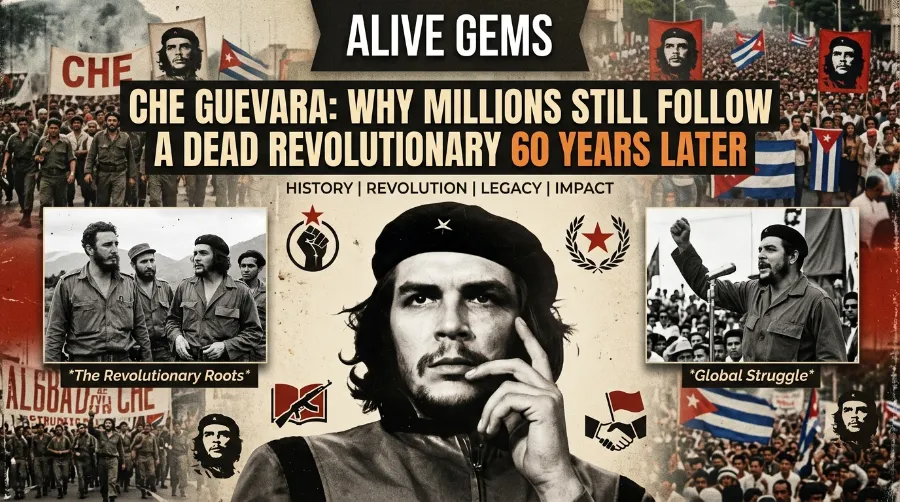
Che Guevara a man has been dead since 1967, executed in a tiny schoolhouse in the Bolivian mountains, and yet his face still hangs on dorm room walls, protest banners, and T shirts sold in shopping malls from Berlin to Los Angeles. That is not normal for a soldier who lost his final battle. It is not normal for anyone, really. Che Guevara millions still follow decades after his death is not a metaphor, it is a literal, measurable fact, and the reasons behind it are far stranger and more human than most people realize.
Thomas Paine: The Immigrant Writer Who Lit the Fuse of the American Revolution
Key Takeaways
| Fact | Detail |
|---|---|
| Full name | Ernesto Guevara de la Serna |
| Born | June 14, 1928, Rosario, Argentina |
| Trained as | Medical doctor, graduated 1953 |
| Key role | Guerrilla commander in the Cuban Revolution, 1956 to 1959 |
| Government roles | President of Cuba’s National Bank, Minister of Industry |
| Left Cuba | 1965, to spread revolution abroad |
| Captured and killed | October 9, 1967, La Higuera, Bolivia, age 39 |
| Remains found | 1997, reburied in Santa Clara, Cuba |
| Global symbol status | Korda’s 1960 photograph is one of the most reproduced images ever taken |
TL;DR: Che Guevara was an Argentine doctor who became Fidel Castro’s most trusted commander during the Cuban Revolution, then left Cuba to spark revolutions elsewhere before being captured and executed in Bolivia in 1967 at age 39. Millions still follow him today not because of his politics alone, but because his image represents rebellion, sacrifice, and the refusal to compromise, themes that outlive any single ideology.
Who Was Che Guevara Before He Became an Icon?
Before he became a poster, Che Guevara was just Ernesto, a middle class kid from Rosario, Argentina, born in 1928 with severe asthma that should have limited him for life. Instead he became an excellent athlete, an avid reader, and eventually a medical student at the University of Buenos Aires.
The Motorcycle Trip That Changed Everything
In 1951 and 1952, Ernesto rode across Latin America on a motorcycle with his friend Alberto Granado, covering thousands of miles through Argentina, Chile, Peru, and Venezuela. He saw mining towns where workers earned almost nothing, leper colonies where patients were treated as outcasts, and indigenous communities crushed by generations of inequality.
This trip, later immortalized in the 2004 film The Motorcycle Diaries, planted the seed of everything that followed. Ernesto finished his medical degree in 1953, but he never really practiced as a small town doctor. He had already decided that curing individual patients meant nothing if the entire system stayed broken.
Che Guevara Personality and Leadership on the Battlefield
Understanding Che Guevara personality and leadership requires looking past the T shirt version of the man and into how he actually behaved under pressure.
Meeting Fidel Castro in Mexico
In 1955, while working in Mexico City, Ernesto met Fidel Castro, a Cuban exile planning to overthrow the dictator Fulgencio Batista. Something clicked instantly between them. Within a year, Guevara joined the small group of 82 fighters who sailed to Cuba aboard a small yacht called the Granma in November 1956, intending to launch a guerrilla war from the mountains.
The landing was a disaster. Government forces ambushed the group almost immediately, and only a small fraction survived to reach the Sierra Maestra mountains. Guevara himself was wounded in the initial fighting. From that near total defeat, over the next two years, this tiny surviving band grew into a force capable of toppling an entire government.
From Battlefield Commander to National Bank President
By January 1, 1959, Batista fled the country, and Castro’s rebels marched into Havana victorious. Guevara had proven himself so valuable during the fighting that Castro handed him extraordinary responsibility afterward. He briefly ran La Cabana prison, then served as president of Cuba’s National Bank, and later became Minister of Industry.
Emiliano Zapata: The Peasant Who Became Mexico’s Immortal Soul
Here is a number that surprises most people. Guevara signed Cuban currency simply as “Che” during his time running the bank, a detail so unusual for a head of a national financial institution that it became a talking point in itself. Few revolutionary fighters ever transition into economic policy roles, and even fewer sign banknotes with a nickname. Read: Rosa Luxemburg: The Revolutionary Economist Who Frightened Every European Government
| Role | Years | Key Detail |
|---|---|---|
| Guerrilla commander, Sierra Maestra | 1956 to 1958 | Helped lead rebel forces to victory over Batista |
| President, National Bank of Cuba | 1959 to 1961 | Oversaw currency and monetary policy |
| Minister of Industry | 1961 to 1965 | Pushed rapid industrialization plans |
| International diplomat | 1959 to 1965 | Represented Cuba at the United Nations in 1964 |
| Guerrilla leader, Congo | 1965 | Attempted to train rebel forces, campaign failed |
| Guerrilla leader, Bolivia | 1966 to 1967 | Final campaign, captured and executed |
Why Che Guevara Became the Most Charismatic Latin Revolutionary
Cuba was never going to be enough for him. By 1965, Guevara had grown increasingly frustrated with Cuba’s dependence on the Soviet Union, and he believed real revolution needed to spread across the developing world, not settle into one comfortable capital city.
The Letter That Shocked Castro
Before leaving Cuba for good, Guevara wrote Castro a farewell letter resigning all his official posts. In it, he said other nations of the world called for his modest efforts, a line that has been quoted endlessly since. He gave up citizenship, government titles, and personal safety in a way almost no political figure of his stature has done before or since.
This decision alone explains a huge part of why historians and everyday readers alike consider him among the most charismatic Latin revolutionaries of the twentieth century. Nobody forced him to leave power. He walked away from it voluntarily to keep fighting on foot in jungles. That same blend of stubborn patience and quiet conviction shows up again in the story of Ho Chi Minh, whose patience alone beat two global superpowers, one of the more overlooked endurance stories in modern revolutionary history.
The Failed Congo Campaign
His first stop was the Congo in 1965, where he tried to train local rebels fighting the government. The mission collapsed within months. Language barriers, poor coordination, and disease crippled the effort, and Guevara left in frustration, later describing it privately as one of his greatest failures.
Rather than retire quietly after this defeat, he pushed forward into an even more dangerous plan, one that would eventually cost him his life.
Why Is Che Icon Today: The Bolivia Campaign and His Death
By late 1966, Guevara had secretly entered Bolivia, hoping to build a guerrilla movement that could eventually spread across the entire continent. The reality on the ground turned brutal fast.
- Local peasants, whom he expected to join his cause, largely distrusted the foreign fighters
- The Bolivian army, trained and supported by American CIA advisers, hunted his small band relentlessly
- Supply lines collapsed, and disease and hunger wore down his remaining fighters
On October 8, 1967, Bolivian forces captured Guevara after a firefight in a ravine. The next day, October 9, 1967, he was executed inside a small schoolhouse in the village of La Higuera. He was 39 years old. Soldiers reportedly cut off his hands afterward to confirm his identity, and his body was buried in a secret, unmarked grave.
Frederick Douglass: The Escaped Slave Who Became America’s Greatest Orator
It took nearly three decades for the truth to surface. In 1997, researchers located his remains near Vallegrande, Bolivia, and his bones were flown back to Cuba for a massive public burial in Santa Clara attended by Fidel Castro himself. That single, delayed homecoming answers a huge part of why is Che icon today rather than simply a footnote in Cold War history. His death was covered up, then reversed publicly on a grand stage, which only deepened the myth.
Timeline of Global Recognition Growth (approximate, based on media and academic references)
1968      |##                (limited, mostly leftist circles)
1980s     |########          (art and pop culture adoption grows)
1997      |################  (remains found, global media coverage spikes)
2000s-now |#####################  (widespread commercial and cultural presence)
The Image That Outlived the Man
None of this explains the T shirts fully on its own. That part of the story belongs to a single photograph.
On March 5, 1960, Cuban photographer Alberto Korda snapped a picture of Guevara during a memorial service in Havana. The photo, later titled Guerrillero Heroico, shows Guevara staring off camera with an intense, almost prophetic expression. Korda never earned significant royalties from the image during his lifetime, despite it becoming, by many estimates, one of the most reproduced photographs in human history.
That photograph did something remarkable. It separated Che Guevara the historical figure from Che the symbol. You do not need to know a single date from the Cuban Revolution to recognize that face. This separation is exactly why the image survives across so many different countries, causes, and generations, often stripped of any specific political meaning at all.
For readers who enjoy tracing how one single image or moment can define a revolutionary’s entire legacy, our pillar collection on history’s most charismatic revolutionary rebels breaks down several similar cases side by side.
Comparing Che to Other Revolutionary Legends
Guevara rarely gets discussed in isolation. He fits into a much larger pattern of leaders who risked everything, and sometimes lost everything, chasing an idea bigger than themselves.
| Leader | Region | Fate | Legacy Symbol |
|---|---|---|---|
| Che Guevara | Cuba and Latin America | Executed 1967 | Korda photograph |
| Toussaint Louverture | Saint Dominique (Haiti) | Died in prison 1803 | First Black republic |
| Simon Bolivar | South America | Died of illness 1830 | Liberator of six nations |
Our earlier feature on Toussaint Louverture, the enslaved man who built history’s first Black republic, makes a fascinating companion read here, since both men proved that a single determined life could reshape an entire region, even when the leader himself did not survive to see the final outcome. The same pattern shows up again in our piece on Simon Bolivar, whose military campaigns liberated multiple nations decades earlier under very different circumstances.
Independent analysis from a widely shared Medium retrospective on Che Guevara draws a similar distinction between the flesh and blood revolutionary and the commercialized icon that followed his death. A personal account published on Boloji, recounting a real meeting with Guevara, offers a rare first hand glimpse of how he carried himself away from cameras and speeches. Meanwhile, a retrospective marking fifty years since his death explores how left wing movements around the world continue to invoke his name in modern political struggles.
What Modern Followers Get Wrong and Right
Having spent years researching revolutionary movements for this publication, one pattern shows up constantly among readers discovering Guevara for the first time. Many assume the T shirt version and the historical version are the same thing, and they are not.
The real man authorized executions during the revolutionary tribunals at La Cabana prison, a fact that complicates any simple hero narrative. He also gave up guaranteed power and comfort not once but twice, first in Cuba and then again in the Congo, to keep fighting for people he had never met. Both of these things are true at once, and pretending otherwise does a disservice to anyone trying to understand him honestly.
- He was a trained physician who chose combat over medicine
- He held one of the most powerful economic posts in Cuba, then walked away from it
- He failed badly in the Congo, then tried again anyway in Bolivia
- He died young, poor, and far from home, by choice
Frequently Asked Questions
Why do millions of people still follow Che Guevara decades after his death?
His image became a global symbol of rebellion and sacrifice, largely thanks to Alberto Korda’s 1960 photograph, which spread across art, fashion, and protest movements independent of strict political affiliation.
Was Che Guevara a doctor?
Yes, he completed his medical degree at the University of Buenos Aires in 1953, though he spent very little of his adult life practicing medicine directly.
How did Che Guevara die?
He was captured by the Bolivian army on October 8, 1967, and executed the following day, October 9, 1967, in the village of La Higuera, Bolivia.
Did Che Guevara know Fidel Castro before the Cuban Revolution?
They met in Mexico City in 1955, shortly before Castro organized the expedition that sailed to Cuba in 1956 aboard the Granma.
Where is Che Guevara buried?
His remains were discovered in Bolivia in 1997 and reburied in a large memorial in Santa Clara, Cuba, the same year.
Quick Quiz: Test What You Just Learned
- What year was Che Guevara born?
A) 1925
B) 1928
C) 1932 - Which famous photograph made Che a lasting global symbol?
A) The Motorcycle Diaries poster
B) Alberto Korda’s Guerrillero Heroico
C) A Cuban government portrait - In which country was Che Guevara executed?
A) Cuba
B) Congo
C) Bolivia - What year were Che’s remains finally located and returned to Cuba?
- What government position did Che hold in Cuba besides Minister of Industry?
(Answers: 1-B, 2-B, 3-C, 4-1997, 5-President of the National Bank of Cuba)
Conclusion
Che Guevara’s story refuses to fit neatly into a single box, and maybe that is exactly why it still grips people sixty years later. He was a doctor who chose war, a powerful government official who walked away from comfort twice, and a man executed in a forgotten mountain village who somehow became one of the most recognizable faces on the planet. Whether you view him as a hero, a flawed idealist, or something in between, one thing is impossible to deny. Very few people in history have managed to die in obscurity and then become immortal within a single photograph. That contradiction, more than any single political belief, is the real reason millions still follow him today.
References
- Britannica, “Che Guevara” biography, and “Che Guevara: Congo, Bolivia, Death”
- History.com, “Che Guevara Is Executed” and “Che Guevara Captured by Bolivian Army”
- EBSCO Research Starters, “Execution of Che Guevara” and “Che Guevara Is Executed”
- Inquirer News, “Cuba, Bolivia Remembering Che 50 Years After Death”
- Medium, “Che Guevara: The Man vs the Icon”
- Boloji, “A Meeting with the Guevara”