
10 Charismatic Revolutionary Rebels, Picture a man on horseback, exhausted, half-starved, riding in front of an army that has lost more battles than it has won. He should not be able to hold that army together. Yet somehow, he does. That is the strange magic behind every entry in this charismatic revolutionary rebels history guide, and it is a magic that has toppled empires, freed millions of people, and rewritten the map of the modern world.
This guide walks through the lives, decisions, and legacies of the most powerful revolutionary figures in history, the rebels who changed world events forever, and asks a simple but important question: what actually makes a rebel charismatic enough to move a nation? Along the way you will meet generals, poets, prisoners, and preachers who somehow became the same thing, a rallying point for people who had nothing left to lose.
Simon Bolivar: How One Man Liberated Six Nations With Sheer Willpower
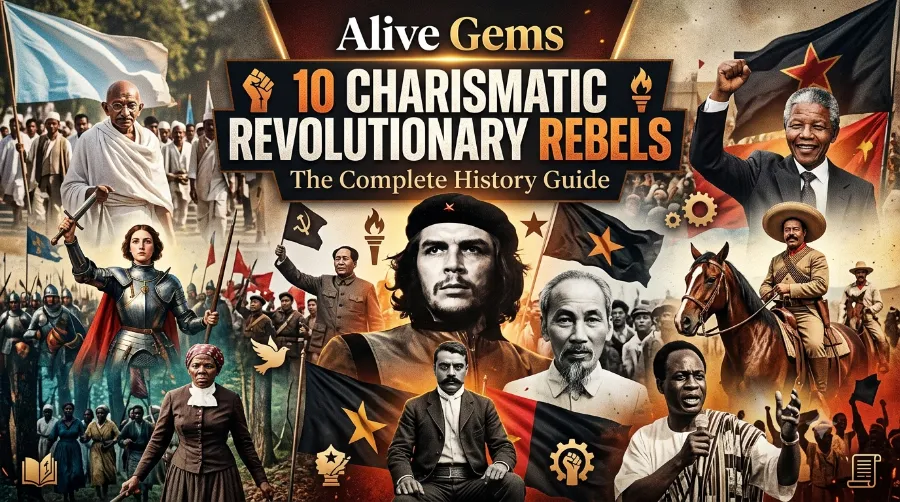
Key Takeaways
| Question | Quick Answer |
|---|---|
| What defines a charismatic revolutionary? | Personal magnetism combined with a clear cause, real physical courage, and the ability to make ordinary people feel part of something bigger |
| Who are the most famous examples? | George Washington, Toussaint Louverture, Simón Bolívar, Napoleon Bonaparte, Mahatma Gandhi, Che Guevara, Nelson Mandela |
| Did charisma always lead to good outcomes? | No, several leaders turned republics into personal power bases after winning independence |
| What time periods does this guide cover? | Roughly 1775 through the late twentieth century, across the Americas, Europe, Africa, and Asia |
| Why do these figures still matter today? | Their strategies for building loyalty and momentum are still studied by historians, political scientists, and business leaders |
TL;DR: History’s greatest revolutionary leaders shared more than just courage. They combined physical presence, storytelling instinct, and timing to turn scattered anger into organized movements. Some, like George Washington, walked away from power once the fight was won. Others held on too tightly and paid for it with exile or worse.
Toussaint Louverture: The Slave General Who Built a Republic
Why Charisma Built Nations That Armies Alone Could Not
Historians used to shy away from crediting individual personalities for massive historical shifts. It felt old-fashioned, almost like hero worship. However, a growing body of academic work is pushing back on that instinct. visit for more like this ALIVEGEMS
Princeton historian David A. Bell makes exactly this case in his book on revolutionary leadership. He argues that four leaders in particular, George Washington, Napoleon Bonaparte, Toussaint Louverture, and Simón Bolívar, shared a rare kind of personal authority that could not simply be replaced by better logistics or a bigger army. That same blend of stubborn patience and quiet conviction shows up again in the story of Ho Chi Minh, whose patience alone beat two global superpowers, one of the more overlooked endurance stories in modern revolutionary history.
As the review of Bell’s work explains, these four charismatic leaders freed two continents from imperial rule, built republics on brand new political principles, redrew state boundaries, ended slavery in the colony that became Haiti, and declared that all men were equal regardless of race, even though that promise did not yet extend to women.
also read Che Guevara: Why Millions Still Follow a Dead Revolutionary 60 Years Later
That is a staggering list of achievements for four individuals. And yet, as researchingtheamericanrevolution.com points out in its detailed review of Men on Horseback, charisma cuts both ways. Three of those four men eventually died in exile, never seeing their original vision fulfilled.
So before we go further, here is a simple framework worth remembering.
What tends to make a revolutionary rebel genuinely charismatic:
- A physical presence that draws attention, whether through height, stamina, or sheer stubborn calm under fire
- A clear, repeatable message that ordinary people can explain to their neighbors in one sentence
- Willingness to share real risk with followers instead of directing from a safe distance
- Symbolic gestures, uniforms, or rituals that followers can copy and rally around
- Timing, since the same personality dropped into a calmer era might never have been noticed at all
George Washington: The Reluctant Rebel Who Refused the Crown
Washington is the strange exception on almost every list like this one. He was not a natural public speaker, and by most accounts he was stiff in conversation. Yet by the time the American War of Independence ended in 1783, he had become something closer to a living symbol than a man.
Contemporaries pointed to his imposing physique and unshakable composure, even during crushing defeats such as the retreat across New Jersey in late 1776. According to the same historical review referenced above, the sources of Washington’s charisma are harder to pinpoint than the other three revolutionaries, but his reputation grew even in defeat until he became the walking embodiment of the American Revolution itself.
Frederick Douglass: The Escaped Slave Who Became America’s Greatest Orator
Here is the detail that surprises most people. After leading the Continental Army to victory and later serving two terms as president, Washington simply stepped down in 1797. He did not need a coup, an exile, or a firing squad to end his political career. He walked away on his own terms, a choice that set the United States apart from nearly every other revolutionary republic that followed.
If you want a deep archive of primary sources, letters, and battle maps from this era, Researching the American Revolution is one of the most thorough resources available online, and novelist Salina Baker’s own collection of Revolutionary War essays offers a more personal, character-driven look at the same period.
Toussaint Louverture: The Rebel Who Ended Slavery in an Empire
Few revolutionary stories are as dramatic as the Haitian Revolution. Toussaint Louverture, born enslaved on the French colony of Saint-Domingue, rose to command an army that defeated Spanish, British, and eventually French forces between 1791 and 1802.
What made him magnetic was not booming speeches. It was proof. He had lived the exact suffering his soldiers had lived, and he backed that shared history with real battlefield skill on horseback, the same trait Bell highlights as common among these four founding-era revolutionaries.
Louverture never lived to see full independence. He was captured through French treachery in 1802 and died in a cold French prison cell the following year, in 1803. Haiti declared independence just months later, in 1804, becoming the first nation founded by a successful slave revolt. His name is still invoked across the Caribbean whenever people discuss self-determination and dignity.
Thomas Paine: The Immigrant Writer Who Lit the Fuse of the American Revolution
Simón Bolívar: El Libertador of South America
Simón Bolívar liberated present day Venezuela, Colombia, Ecuador, Peru, and Bolivia from Spanish colonial rule through a series of grinding campaigns between 1810 and 1825. He crossed the Andes mountains in brutal conditions, a feat that became legendary among his troops and cemented his reputation as nearly superhuman.
Bolívar openly compared himself to Washington and hoped for a similar legacy of graceful retirement. Instead, according to the historical analysis cited earlier, he and the other Latin American and Caribbean leaders began by championing democratic and republican ideals but eventually turned toward authoritarian rule, unlike Washington who gave up power voluntarily. Bolívar died in 1830, largely disillusioned, believing his dream of a unified South American republic had failed.
Yet his legacy only grew after death. As the same review notes, modern political successors have continued burnishing the reputations of leaders like Bolívar and Louverture, commemorating their impact on nations like Venezuela and Haiti long after their deaths.
Mahatma Gandhi: Charisma Without Weapons
Not every revolutionary rebel led with a sword or a rifle. Mahatma Gandhi built one of the most successful independence movements in history using nonviolent resistance against British colonial rule in India.
Gandhi’s tactics, including the famous 1930 Salt March covering roughly 240 miles over 24 days, showed that stamina and moral clarity could substitute for military force. His charisma came from consistency. He lived the simplicity he preached, wore homespun cloth, and fasted publicly to protest injustice.
Read: Rosa Luxemburg: The Revolutionary Economist Who Frightened Every European Government
India achieved independence in 1947. Gandhi did not live to see the country’s first decade of freedom, since he was assassinated in January 1948. Still, his approach directly influenced later civil rights and independence movements around the world.
Che Guevara and the Cuban Revolution
Ernesto “Che” Guevara became a global symbol of revolutionary rebellion after helping Fidel Castro’s guerrilla forces overthrow the Cuban government in 1959. His image, based on a 1960 photograph, remains one of the most reproduced portraits in modern history.
Guevara’s charisma was built on total personal commitment. He gave up a comfortable medical career in Argentina to fight in the Sierra Maestra mountains, and later left a senior government post in Cuba to support revolutionary movements in the Congo and Bolivia. He was captured and executed in Bolivia in October 1967 at the age of 39.
His influence rippled far beyond Cuba. It even shaped grassroots movements in the United States. The Young Lords, a Puerto Rican rights organization founded in Chicago in 1968, often wore Che-style berets as a visual nod to this same revolutionary tradition. As journalist Ed Morales describes in his detailed account of the Young Lords’ history, the group’s stunning presence, often augmented by Che-like berets and street style military formations, shaped how an entire generation interpreted the tumultuous late 1960s.
Nelson Mandela: The Long Walk to Charisma
Nelson Mandela spent 27 years in prison, much of it on Robben Island, before becoming South Africa’s first Black president in 1994. Unlike many rebels on this list, his charisma matured slowly and publicly, forged inside a cell rather than on a battlefield.
Mandela’s genius was patience combined with forgiveness. Instead of seeking revenge against the apartheid government after his release in 1990, he pursued reconciliation, famously inviting former prison guards to his presidential inauguration. That single choice did more to build trust across a divided nation than any speech could have.
A Quick Comparison Chart of Revolutionary Rebel Leaders
| Leader | Region | Peak Years | Signature Trait | Outcome |
|---|---|---|---|---|
| George Washington | United States | 1775 to 1797 | Voluntary retirement from power | Founded a lasting republic |
| Toussaint Louverture | Haiti | 1791 to 1802 | Shared lived experience with followers | Died in exile, nation freed after his death |
| Simón Bolívar | South America | 1810 to 1825 | Physical endurance, sweeping ambition | Died disillusioned, later celebrated as a hero |
| Mahatma Gandhi | India | 1915 to 1947 | Nonviolent moral consistency | Independence achieved, Gandhi assassinated |
| Che Guevara | Cuba and beyond | 1956 to 1967 | Total personal sacrifice | Executed, became a global symbol |
| Nelson Mandela | South Africa | 1962 to 1999 | Patience and forgiveness | Peaceful transition to democracy |
The Dark Side: When Charismatic Rebels Became Tyrants
It would be dishonest to pretend charisma always leads somewhere noble. The same traits that inspire loyalty can also enable authoritarian control once a revolution succeeds. Bell’s research is blunt about this danger. He concludes that charisma is an integral, inescapable part of modern political life and describes it as democracy’s shadow self, meaning it can prop up constitutional government just as easily as it can threaten it.
There is real historical evidence for this warning. Bell notes that John Adams openly worried about excessive Washington idolatry, while his son grew concerned about Andrew Jackson’s despotic tendencies. Even Napoleon’s legacy shows how fast a cult of personality can grow. Remarkably, in the thirty years following Napoleon’s death, biographers published more than 2,500 books about him, many of them flattering rather than critical.
A few patterns worth watching for:
- A leader who starts refusing to hand over power once the original crisis has passed
- Movements that begin to punish internal disagreement instead of debating it
- A shift from shared ideals toward personal loyalty tests
The Young Lords themselves eventually experienced this exact pattern, splintering under internal purges and paranoia in the early 1970s before dissolving entirely by 1974, a cautionary tale about how quickly revolutionary unity can curdle into infighting.
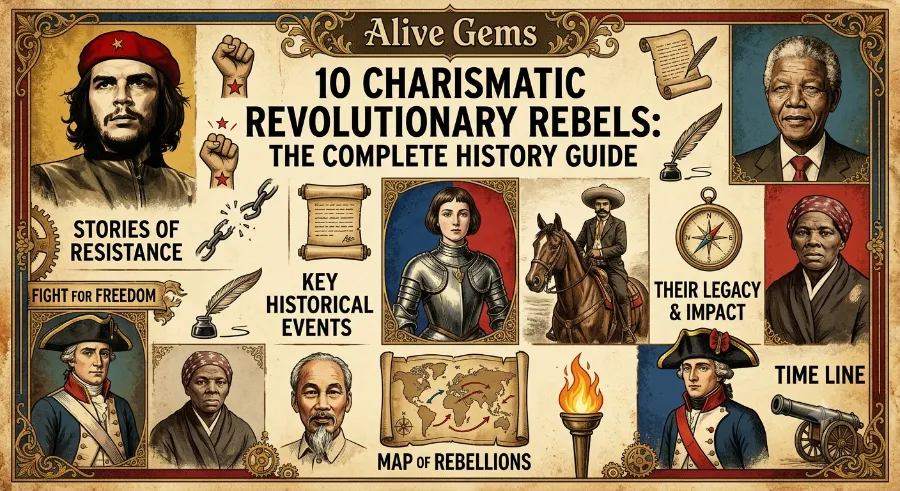
What Modern Leaders Can Learn From Revolutionary Rebels
You do not need to be planning an uprising to learn something useful here. The same traits that built the greatest revolutionaries of all time show up in effective community organizers, startup founders, and even coaches.
- Share risk with your team instead of only issuing instructions from a distance
- Keep your core message simple enough that others can repeat it accurately
- Know when to step back, since holding power too tightly often destroys the very cause it was meant to protect
Frequently Asked Questions: 10 Charismatic Revolutionary Rebels
What is the definition of a charismatic revolutionary leader?
It generally refers to someone who inspires deep personal loyalty and collective action toward political change, often through a combination of physical courage, storytelling, and shared sacrifice with followers.
Were all famous revolutionaries also good long term leaders?
Not at all. Several of history’s most powerful revolutionary figures struggled once the fighting ended, and some turned toward authoritarian control rather than the democratic ideals they originally championed.
Why is George Washington considered unusual among revolutionary leaders?
Because he voluntarily gave up presidential power after two terms in 1797, a decision that was extremely rare among his revolutionary contemporaries and helped establish peaceful transfers of power as a democratic norm.
Did nonviolent rebels have the same kind of charisma as military leaders?
Yes. Mahatma Gandhi is the clearest example, proving that moral consistency and personal sacrifice could build the same kind of devoted following as battlefield heroics.
How did revolutionary movements in the Americas influence each other?
Heavily. Leaders like Bolívar openly modeled themselves on Washington, and later twentieth century movements, including groups like the Young Lords, drew visual and ideological inspiration from the Cuban Revolution.
Emiliano Zapata: The Peasant Who Became Mexico’s Immortal Soul
Test Your Knowledge: Revolutionary Rebels Quiz
- Who was the only major revolutionary leader in this guide to voluntarily give up power?
- In what year did Haiti declare independence?
- Which revolutionary leader crossed the Andes mountains during his campaigns?
- True or false: Che Guevara died of natural causes in Cuba.
- Which nonviolent leader used a 240 mile march to protest colonial rule?
Multiple choice bonus round
A) Which country did Simón Bolívar not help liberate?
- Venezuela
- Colombia
- Brazil
- Peru
B) Nelson Mandela spent approximately how many years in prison?
- 10 years
- 27 years
- 40 years
- 5 years
C) The Young Lords were originally founded in which city?
- New York
- Chicago
- Philadelphia
- San Juan
Conclusion
The rebels who changed world history were rarely perfect, and several of the greatest revolutionaries of all time paid a heavy personal price for their convictions. What connects Washington, Louverture, Bolívar, Gandhi, Guevara, and Mandela is not a shared ideology, since their politics differed enormously. It is a shared understanding that real change requires someone willing to stand at the front, absorb the first blow, and give ordinary people a reason to believe things could actually be different. That is the real definition behind every entry in this charismatic revolutionary rebels history guide, and it is why these stories still move us centuries later.
References
- Procknow, Gene. “Commanding, Charismatic Leaders – A Force for Good or Evil?” Researching the American Revolution, November 21, 2024. 10 Charismatic Revolutionary Rebels
- Baker, Salina. Revolutionary War essay collection, salinabakerauthor.com. 10 Charismatic Revolutionary Rebels
- Morales, Ed. “The Young Lords’ Revolution.” Originally published in The Nation, March 24, 2020. 10 Charismatic Revolutionary Rebels
- Bell, David A. Men on Horseback: The Power of Charisma in the Age of Revolution. Farrar, Straus and Giroux, 2020. 10 Charismatic Revolutionary Rebels