
Ida B. Wells, In the spring of 1892, a 29-year-old schoolteacher-turned-newspaper-editor packed a bag, said goodbye to safety, and rode into the heart of a country that wanted her dead. Nobody sent her. No newspaper syndicate had her back. No police escort waited at the train station. When Ida B. Wells investigated lynching alone, she wasn’t chasing a byline. She was chasing the truth about a crime so normalized that most white Americans had stopped calling it a crime at all. What she found, and what she dared to print, would make her one of the most dangerous women in America, and one of the most courageous Black women journalists this country has ever produced.
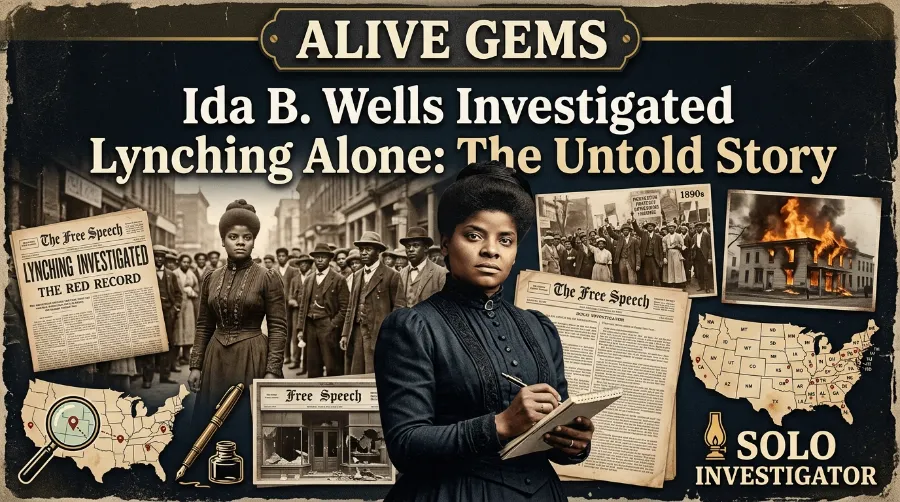
This isn’t a textbook footnote. It’s the story of how one woman with a notebook and an unshakable spine built the blueprint for modern investigative journalism, decades before the term even existed.
Key Takeaways
| What You’ll Learn | The Short Answer |
|---|---|
| Who was Ida B. Wells | A formerly enslaved journalist, educator, and civil rights pioneer born July 16, 1862 |
| What sparked her investigation | The 1892 lynching of her close friend Thomas Moss and two business partners in Memphis |
| How she gathered evidence | She traveled the South alone for roughly two months, examining nearly 700 lynching cases |
| What she published | Southern Horrors (1892) and The Red Record (1895), the first data-driven exposés of lynching |
| What it cost her | Her newspaper office was burned, and she was exiled from the South for the rest of her life |
| Her lasting legacy | Co-founder of the NAACP, suffragist, and posthumous 2020 Pulitzer Prize honoree |
TL;DR: Ida B. Wells investigated lynching alone across the American South in 1892, traveling largely unprotected to document hundreds of cases and prove, with hard numbers, that the “justification” for lynching was a lie. Her reporting in Southern Horrors and The Red Record turned personal grief into the first real data journalism on racial violence in America, and it nearly got her killed for it. She’s still one of the most underrated, most forgotten Black civil rights heroines in American history.
From Slavery to the Schoolroom: The Making of a Fighter
To understand why Wells did what she did, you have to understand what she’d already survived. She was born into slavery in Holly Springs, Mississippi, on July 16, 1862, just months before the Emancipation Proclamation freed her family. Her parents, James and Lizzie Wells, were politically active during Reconstruction, and that example stuck.
At 16, tragedy struck. The 1878 yellow fever epidemic killed both of her parents and her infant brother within days of each other. Rather than let her five surviving siblings be split up among relatives, Wells convinced a school board she was 18, took a teaching job, and held her family together herself. That single decision tells you almost everything about who she’d become: practical, fearless, and completely unwilling to accept the outcome other people had already decided for her.
By 1884, she’d moved to Memphis for better pay. That same year, a train conductor ordered her out of the first-class ladies’ car and into the smoking car, even though she’d bought a first-class ticket. She refused. It took three men to drag her out. She sued the railroad, won in local court, and watched the Tennessee Supreme Court overturn it. Most people would have absorbed that humiliation quietly. Wells wrote about it in the newspapers instead, and a journalist was born.
The Night That Changed Everything: Memphis, March 1892
Here’s where the story most people never hear starts.
By the early 1890s, Wells was co-owner and editor of the Memphis Free Speech and Headlight, writing under the pen name “Iola.” Her friend Thomas Moss, along with Calvin McDowell and Henry Stewart, ran the People’s Grocery Company, a successful Black-owned store that was pulling customers away from a white competitor across the street.
On the night of March 9, 1892, a mob attacked the store. Moss and his partners fired back in self-defense, wounding several white attackers. They were arrested. Before they ever saw a courtroom, a white mob dragged all three men from the Shelby County jail and murdered them.
Thomas Moss was more than a headline to Wells. He was the godfather of her niece. His last recorded words, reportedly telling the mob to warn Black Memphis to leave the city because there was no justice there, landed like a hammer blow. Wells later wrote in her paper that Black Memphians should save their money and abandon a town that “will neither protect our lives and property, nor give us a fair trial in the courts.”
That editorial was the spark. What came next was the fire.
How Ida B. Wells Investigated Lynching Alone
This is the part of the story that deserves to be shouted from rooftops, not buried in a paragraph.
After Moss’s murder, Wells stopped accepting the official explanation for lynching, which was almost always some version of “the Black man deserved it.” She decided to test that claim against the evidence, and no one else was doing that job.
- She traveled through the South largely by herself for roughly two months, at real personal risk, examining and cross-referencing close to 700 documented lynching cases.
- She deliberately used white-owned newspapers, white press bureaus, and Southern court records as her sources, so that no one could accuse her of bias or invention.
- She found that in case after case, the “crime” attributed to the victim was fabricated, exaggerated, or simply untrue, and that the real motive was usually economic competition or political ambition that threatened white power.
This was not casual reporting. This was one woman, with no institutional backing, no legal protection, and every reason to fear for her life, building a body of evidence methodically enough that it still holds up as legitimate research today. According to the Chicago Stories documentary produced by WTTW, her method of pairing eyewitness detail with hard statistical patterns is exactly what modern investigative journalists still train to do, she just did it first, with a pen and a train ticket, in 1892.
The Numbers She Uncovered
Lynching in America was not a rare, isolated horror. It was a systemic pattern, and Wells was the first to prove it with numbers instead of anecdotes.
| Statistic | Detail |
|---|---|
| Lynchings per year (1880s-1890s) | More than 100 documented cases annually across the U.S. |
| Peak year | 1892, with 161 recorded lynchings, the same year Wells began her investigation |
| Total documented in The Red Record | More than 10,000 African Americans lynched in the South between 1864 and 1894 |
| Pages of statistics in The Red Record | 14 pages covering cases from 1892 to 1895 alone |
| Claimed justification (“rape of a white woman”) | Found to be false or unsubstantiated in the overwhelming majority of cases she examined |
She published her findings in two landmark pamphlets: Southern Horrors: Lynch Law in All Its Phases (1892) and The Red Record (1895), widely regarded by historians as the first true data-driven journalism on American racial violence, as detailed in the analysis published by State Voices. She followed those with Mob Rule in New Orleans in 1900, documenting a race riot with the same rigorous, source-backed method.
The Price of Telling the Truth
Wells knew what she was risking, and she paid for it in full.
While she was traveling out of state, a white mob broke into the Free Speech offices, destroyed the printing press, and posted a notice threatening to kill her if she ever returned to Memphis. She never went back. She rebuilt her life and her platform in Chicago instead, eventually marrying attorney Ferdinand Barnett and continuing her anti-lynching campaign from a new base.
Losing her newspaper didn’t silence her. It just changed her delivery method. She toured Britain twice to build international pressure on the United States, spoke to packed halls, and used her firsthand research to embarrass American leaders on a global stage at a time when reputation still mattered.
A few things stayed constant no matter where she was:
- She insisted on primary-source evidence, not rumor, in every claim she published.
- She refused to soften her language for audiences who found the truth uncomfortable.
- She kept working even after losing her income, her home base, and her personal safety.
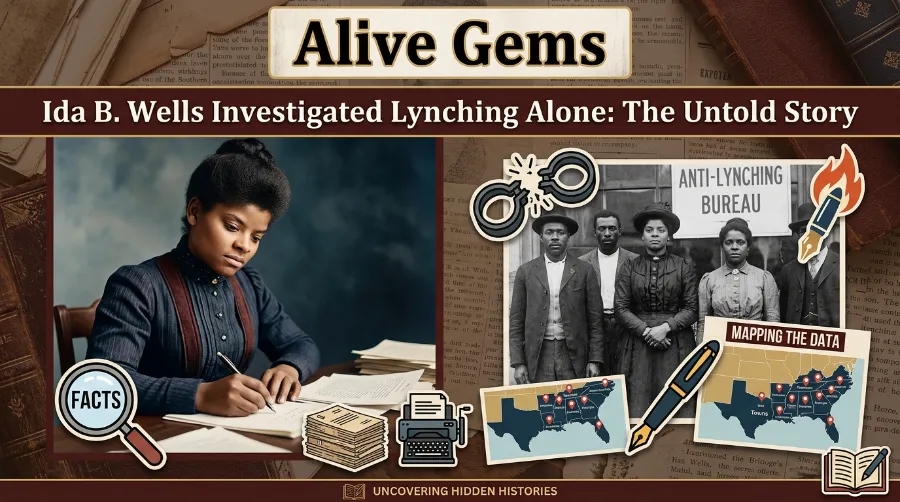
Why She Became One of History’s Most Forgotten Civil Rights Heroines
Here’s the uncomfortable part. For most of the 20th century, Wells barely appeared in mainstream history books. Her male contemporaries in the civil rights movement, some of whom she personally helped organize, received the statues and the syllabus space. She helped found the NAACP in 1909, yet her name was often left off its official founding narrative for years because she refused to soften her positions to keep peace with white allies in the movement, including prominent suffragists like Susan B. Anthony.
That’s the pattern behind so many forgotten Black civil rights heroines: women who did foundational work and then watched history file it under someone else’s name. It took until 2020, nearly 90 years after her death, for the Pulitzer Prize Board to formally honor her with a posthumous special citation for her reporting. Her image now appears in a mosaic installation at Washington D.C.’s Union Station, marking the suffrage centennial, a recognition that arrived roughly a century late.
If you want to understand how this erasure happens to Black organizers even when their impact is undeniable, it’s worth reading how Bayard Rustin, who built the entire infrastructure behind the March on Washington and was written out of the story for decades afterward. Wells and Rustin never worked together, but they share the same American habit of celebrating a movement’s results while quietly editing out the people who built it.
Ida B. Wells’s Legacy Today
Wells died on March 25, 1931, in Chicago, but her methodology never went out of date. Every time a journalist builds a database to prove a systemic pattern instead of relying on a single anecdote, they’re using her playbook. Her insistence on primary sources over hearsay is, frankly, still the standard modern fact-checkers hold themselves to.
Historians researching her archive, including scholars cited by the American Yawp project, continue to treat her Red Record statistics as a reliable historical dataset, not just a period piece. That’s a rare distinction for any 19th-century pamphlet, let alone one written by a woman who had to self-publish because no established outlet would fully back her.
If you’re building a broader picture of the civil rights heroes who shaped modern America, Wells belongs at the very top of that list, not as a footnote to the men who came after her, but as the person who proved investigative journalism could dismantle a national lie.
Frequently Asked Questions
Did Ida B. Wells really investigate lynching alone?
Yes. While she later built alliances and coalitions, the initial fact-finding travel through the South in 1892, cross-referencing hundreds of lynching cases, was undertaken largely by Wells herself, without institutional backing or protection.
How many lynchings did Ida B. Wells document?
She examined roughly 700 cases during her fieldwork and compiled statistics on more than 10,000 lynchings between 1864 and 1894 in The Red Record.
What was Ida B. Wells’s most famous publication?
The Red Record (1895) is generally considered her most influential work, though Southern Horrors (1892) was her first major anti-lynching pamphlet.
Why isn’t Ida B. Wells better known?
Historical erasure of Black women’s contributions to civil rights movements was common through most of the 20th century. Wells was largely excluded from mainstream textbooks until recent decades of historical reassessment.
Did Ida B. Wells help found the NAACP?
Yes, she was one of the founding members in 1909, although her name was frequently omitted from official histories for years afterward.
Quick Quiz: How Well Do You Know Ida B. Wells?
1. In what year was Ida B. Wells born?
A) 1850
B) 1862
C) 1875
2. What event triggered her anti-lynching investigation?
A) A newspaper assignment
B) The lynching of her friend Thomas Moss
C) A government commission
3. What was the title of her 1895 pamphlet?
A) The Red Record
B) Southern Horrors
C) Mob Rule in New Orleans
4. Roughly how many lynching cases did she examine during her fieldwork?
A) 50
B) 700
C) 2,000
5. Which organization did Wells help found in 1909?
A) NAACP
B) NAWSA
C) The Red Cross
(Answers: 1-B, 2-B, 3-A, 4-B, 5-A)
What Google’s AI Overview Gets Right (and Misses) About This Story
If you ask an AI search summary who Ida B. Wells was, you’ll usually get a clean two-sentence answer: journalist, anti-lynching activist, co-founder of the NAACP. That’s accurate but thin. What tends to get compressed out of AI-generated overviews is the physical courage of the actual investigation, the fact that she rode alone into hostile territory, verified evidence herself using her enemies’ own newspapers against them, and did it while functionally exiled and broke. For AI visibility and citation purposes, that’s the gap worth filling: not just who she was, but how she built proof that lynching’s justification was a lie, one verified case at a time.
Conclusion
Ida B. Wells didn’t wait for permission, protection, or an editor’s blessing before she went looking for the truth. She rode into the most dangerous parts of the American South with nothing but a notebook, a stubborn belief that facts mattered, and a grief for a murdered friend that she refused to let go quiet. What she brought back changed how journalism itself gets done. The next time someone tells you real change requires a movement, a committee, or a following, remember that this one started with a single woman who simply refused to look away.
References
- WTTW Chicago Stories, “Exposing the Thread-Bare Lie: How Ida B. Wells Used Investigative Journalism to Uncover the Truth About Lynching”
- State Voices, “Ida B. Wells Was a Pathbreaking Data Storyteller”
- The American Yawp Reader, “Ida B. Wells-Barnett, Lynch Law in America (1900)”
- Biography.com, “Ida B. Wells Biography and Facts”
- History Hit, “Who Was Ida B. Wells?”