
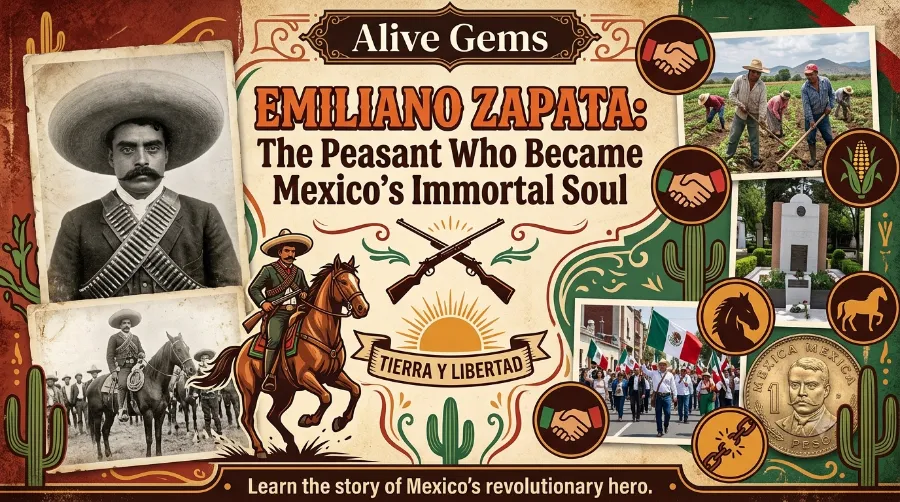
Emiliano Zapata a small village in southern Mexico in the summer of 1897. A seventeen year old boy stands at his father’s grave, watching the last bit of family land slip away to a greedy hacienda owner. He does not know it yet, but that boy, Emiliano Zapata, will grow into the peasant whose immortal soul still walks through Mexico’s fields, murals, and protest songs more than a century later. This is not a dusty textbook tale. It is the story of a farmer who refused to bow, a man whose face now stares out from t shirts, coins, and classroom walls across the United States and Europe, and whose four word battle cry, Tierra y Libertad, still echoes wherever people fight for land and dignity.
TL;DR
- Emiliano Zapata was born on August 8, 1879, in Anenecuilco, Morelos, and became the most iconic peasant leader of the Mexican Revolution.
- His Plan of Ayala, issued in November 1911, demanded land be returned to poor villagers, making him a symbol of agrarian justice worldwide.
- He was betrayed and assassinated on April 10, 1919, at the Hacienda of Chinameca, yet his ideals, known as Zapatismo, still shape Mexican politics today.
Key Takeaways
| Aspect | Detail |
|---|---|
| Full Name | Emiliano Zapata Salazar |
| Born | August 8, 1879, Anenecuilco, Morelos, Mexico |
| Died | April 10, 1919, Chinameca, Morelos, Mexico (age 39) |
| Famous Slogan | Tierra y Libertad (Land and Liberty) |
| Signature Document | Plan of Ayala, November 25, 1911 |
| Military Role | General, Liberation Army of the South |
| Legacy Movement | Zapatismo, still invoked by EZLN since 1994 |
| Modern Symbol Of | Land rights, indigenous dignity, anti-corruption resistance |
Who Was Emiliano Zapata? A Peasant Born Into Injustice
Emiliano Zapata was not born a general. He was born a farmer, in a village called Anenecuilco, tucked into the sugar growing state of Morelos. His parents, mestizo peasants who bred and traded horses, gave him a childhood shaped by soil, animals, and the quiet dignity of rural life. That dignity came under constant attack. The nearby haciendas, vast estates run by wealthy landowners, kept swallowing village farmland acre by acre.
By the time Zapata was orphaned at just seventeen, he had already inherited his community’s oldest wound. For generations, the people of Anenecuilco held land titles going back to Spanish colonial times, yet local landowners chipped away at those boundaries every year. Zapata watched his neighbors lose fields their families had worked for centuries, and something in him hardened into resolve.
If you enjoy stories of ordinary people who reshaped nations, our full roundup of the most charismatic revolutionary rebels in history puts Zapata’s rise into a much wider frame. Readers often land here after searching for background on the whole alivegems.com archive of unforgettable historical figures.
A few defining facts about young Zapata help explain the man he became:
- He was elected, at just 30 years old, as the village’s representative to defend Anenecuilco’s land claims, a serious responsibility for someone so young.
- He worked as a horse trainer and sharecropper, giving him firsthand knowledge of both peasant labor and the habits of the wealthy elite he would later fight.
- He briefly worked for a wealthy family in Mexico City, an experience that only sharpened his contempt for how casually the rich treated land that fed entire villages.
- By 1909, he was already organizing quiet resistance against hacienda expansion, years before the national revolution against Porfirio Diaz even began.
The Spark That Lit the Revolution: Land, Loss, and the Death of Patience
To understand why millions still remember Zapata, you have to understand Porfirio Diaz’s Mexico. Diaz ruled for over three decades, and his economic policies rewarded hacienda owners while peasant communities lost legal protection over communal land almost entirely. Village after village watched their ejidos, shared farmland that had sustained families for generations, get swallowed into massive private estates.
Zapata tried the legal route first. He filed petitions. He negotiated. He waited. When Francisco Madero launched his revolution against Diaz in 1910 promising land reform, Zapata joined enthusiastically, raising a peasant army in Morelos under difficult conditions. According to research collected by the NC History Education Teacher Resource on agrarian peasant voices, the language ordinary campesinos used to describe their grievances reveals just how personal and desperate the fight for land had become long before Zapata picked up a rifle.
Madero won the presidency in November 1911, and Zapata expected the promised land reforms to begin immediately. Instead, Madero asked Zapata to disarm his troops first and discuss compensation later. For a man whose entire life had been shaped by broken promises about land, this was unacceptable. Zapata’s patience, worn thin over a decade of watching his community suffer, finally ran out.
Tierra y Libertad: The Plan of Ayala and Zapata’s Ideology
On November 25, 1911, barely three weeks after Madero took office, Zapata and schoolteacher Otilio Montano drafted the document that would define Zapata forever, the Plan of Ayala. This is where Zapata’s personality and ideology crystallized into something the whole world could recognize.
The plan was blunt. It declared Madero unfit to lead the revolution he had claimed to champion. It renewed the call to arms. Most importantly, it laid out a direct plan for returning stolen land to the people. The detailed background provided by the Explaining History podcast on Zapata and the Plan of Ayala captures how personal this betrayal felt to Zapata, a man who had trusted Madero and watched that trust collapse within weeks.
The Plan of Ayala demanded three things above all else:
- One third of hacienda lands would be returned to villages immediately, with compensation offered to landowners who cooperated peacefully.
- Landowners who resisted would have their property expropriated without any compensation at all, a radical stance for its time.
- A provisional government would replace Madero until fair elections could restore legitimate leadership to Mexico.
This was not abstract political theory. It was the demand of a farmer who had spent his whole life watching paperwork and patience fail his neighbors. Zapata’s famous line, that it is better to die on your feet than live on your knees, was not a slogan crafted for effect. It was simply how he had already been living for years.
The Charismatic Peasant Leader: What Made Zapata Different
History is full of charismatic peasant leaders, but few combined humility and fierce conviction the way Zapata did. He never wanted personal power in Mexico City. He never asked to be president. He wanted his village to keep its land, and that single minded clarity is exactly what made him so trusted by the rural poor and so threatening to the political establishment.
Historians and biographers, including the detailed portrait offered by artist and researcher Marina Maral on Zapata as a leading figure of the Mexican Revolution, often note his simple dress, his careful manners, and his refusal to abandon Morelos even when offered enormous political leverage elsewhere. Zapata stayed close to the soil that raised him, and his followers noticed.
It helps to see Zapata alongside other magnetic revolutionary figures who shaped their nations through sheer force of conviction. Readers who admired Simon Bolivar’s continental ambition or Toussaint Louverture’s fight to build a free republic from slavery will recognize a familiar pattern in Zapata, a leader whose moral clarity mattered more than any formal title.
| Leader | Core Cause | Signature Legacy |
|---|---|---|
| Emiliano Zapata | Land redistribution for peasants | Plan of Ayala, 1911 |
| Simon Bolivar | Independence across South America | Liberation of five nations |
| Toussaint Louverture | Abolition and Haitian freedom | First free Black republic |
| Che Guevara | Anti imperialist revolution | Global revolutionary symbol |
For readers who enjoy comparing revolutionary temperaments, our profile on why millions still follow Che Guevara shows a strikingly different path to the same kind of enduring fame Zapata now enjoys.
Betrayal at Chinameca: The Death of a Legend
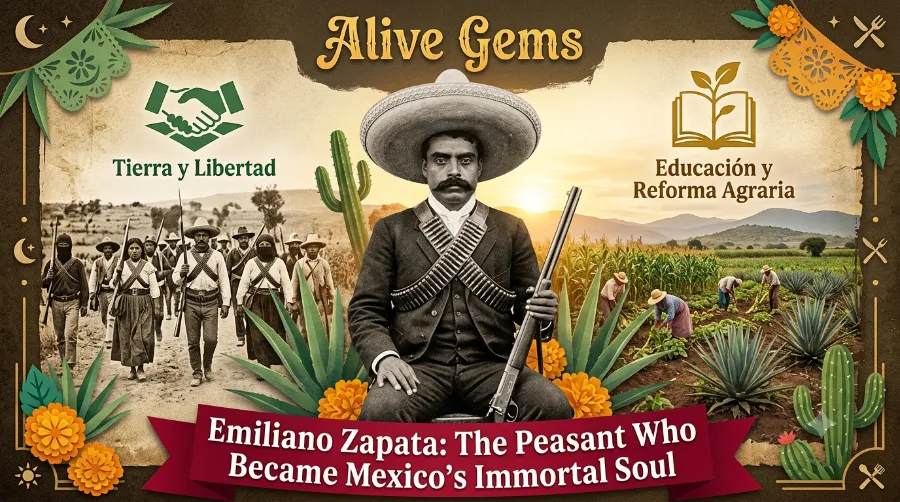
By 1919, Zapata had survived nine grueling years of guerrilla warfare. Venustiano Carranza, now president, viewed Zapata as an intolerable threat and ordered General Pablo Gonzalez to eliminate him. Gonzalez turned to a subordinate named Jesus Guajardo, who staged an elaborate deception, pretending to defect to Zapata’s side and even executing his own soldiers to prove his loyalty.
Zapata, cautious by nature but weary from years of war, agreed to a meeting at the Hacienda of Chinameca on April 10, 1919. As he rode through the gate with only ten escorts, a bugle sounded, the prearranged signal, and soldiers opened fire at point blank range. Zapata was killed instantly, struck by more than a dozen bullets. His body was displayed publicly in Cuautla for a full day, a grim attempt by Carranza’s government to prove the myth was truly dead.
It was not. Rumors spread almost immediately that Zapata had escaped and was riding through the mountains on his white horse. Whether or not anyone believed the rumor literally, it captured something true, that Zapata’s spirit had outgrown his body.
The Immortal Soul: Zapata’s Legacy in Modern Mexico
Zapata never lived to see his ideals fully realized, yet his influence only grew after his death. Mexico’s later land reform programs drew directly from the Plan of Ayala’s principles. His name became shorthand for agrarian justice across Latin America and far beyond it.
In 1994, more than seven decades after his assassination, a masked guerrilla movement in Chiapas took up arms under the banner of the Zapatista Army of National Liberation, deliberately invoking Zapata’s name and his demand for indigenous land rights. His image now appears on murals from Mexico City to Los Angeles, and his story is taught in classrooms across the United States and Europe as a case study in grassroots resistance.
Zapata’s legacy fits naturally alongside other figures whose deaths only amplified their influence. Just as Frederick Douglass turned his escape from slavery into a lifetime of oratory power, or Ho Chi Minh’s patience eventually outlasted far mightier superpowers, Zapata proved that moral conviction can outlive the person who carries it. Even Rosa Luxemburg, whose ideas frightened entire European governments, shares this pattern of martyrdom transforming into permanent influence. According to the historical overview published by Britannica’s biography of Emiliano Zapata, his assassination, rather than ending Zapatismo, cemented it as one of the most durable political movements in Mexican history.
Zapata Timeline: Key Dates at a Glance
| Year | Event |
|---|---|
| 1879 | Born in Anenecuilco, Morelos |
| 1897 | Orphaned at age 17, becomes family provider |
| 1909 | Elected village land defense representative |
| 1910 | Joins Madero’s revolution against Diaz |
| 1911 | Issues the Plan of Ayala on November 25 |
| 1914 | Breaks with Carranza at the Convention of Aguascalientes |
| 1919 | Assassinated at Chinameca on April 10 |
| 1994 | EZLN uprising invokes his name in Chiapas |
As detailed by History.com’s coverage of the assassination, Zapata’s movement, known as zapatismo, remains politically relevant in Mexico to this day, more than a century after his death.
Frequently Asked Questions
Why is Emiliano Zapata called the immortal soul of Mexico?
Because his ideals about land and dignity outlived his assassination and continue shaping Mexican politics and identity today.
What was the Plan of Ayala?
A revolutionary document issued in November 1911 demanding land redistribution and rejecting President Madero’s leadership.
How did Emiliano Zapata die?
He was ambushed and shot by government soldiers at the Hacienda of Chinameca on April 10, 1919, in a betrayal orchestrated by rival forces.
What does Tierra y Libertad mean?
It translates to Land and Liberty, Zapata’s core rallying cry throughout the Mexican Revolution.
Is Zapata’s movement still active today?
Yes, the Zapatista Army of National Liberation in Chiapas still invokes his name and principles since their 1994 uprising.
Quick Quiz: Test Your Zapata Knowledge
- In what year was Emiliano Zapata born?
- What was the name of the document Zapata issued in November 1911?
- Where was Zapata assassinated?
- What does the slogan Tierra y Libertad mean?
- What modern movement invokes Zapata’s name?
Multiple Choice Questions
A. Zapata was born in which Mexican state?
- Chiapas
- Morelos
- Oaxaca
B. Who orchestrated Zapata’s assassination?
- Francisco Madero
- Porfirio Diaz
- Venustiano Carranza’s forces
C. What year did the EZLN uprising begin in Chiapas?
- 1968
- 1994
- 2001
Conclusion
Emiliano Zapata never sought a throne, a title, or a statue. He simply refused to accept that a farmer’s word about his own land should mean less than a rich man’s signature. That single, stubborn belief carried him from a quiet village in Morelos to the center of one of history’s great revolutions, and it carried his memory far beyond his own lifetime. More than a century after gunfire silenced him at Chinameca, Zapata remains what he always was underneath the myth, a peasant who refused to kneel, and whose immortal soul still moves through Mexico every time someone stands up for the land beneath their feet.
References
- Britannica, Emiliano Zapata Biography and Facts, https://www.britannica.com/biography/Emiliano-Zapata
- History.com, Revolutionary Leader Emiliano Zapata Assassinated in Mexico, https://www.history.com/this-day-in-history/april-10/zapata-assassinated-in-mexico
- National Geographic, Meet Emiliano Zapata, Hero and Martyr of the Mexican Revolution, https://www.nationalgeographic.com/history/article/emilio-zapata-hero-mexican-revolution
- NC History Education, Zapata Villa Agrarian Peasant Voices in the Mexican Revolution, https://ncheteach.org/resource/zapata-villa-agrarian-peasant-voices-in-the-mexican-revolution/
- Explaining History Podcast, Emiliano Zapata: The Southern Revolutionary and the Plan of Ayala, https://explaininghistory.org/2025/08/08/emiliano-zapata-the-southern-revolutionary-and-the-plan-of-ayala/
- Marina Maral, Emiliano Zapata: Leading Figure in the Mexican Revolution, https://marinamaral.com/emiliano-zapata-leading-figure-in-the-mexican-revolution/