
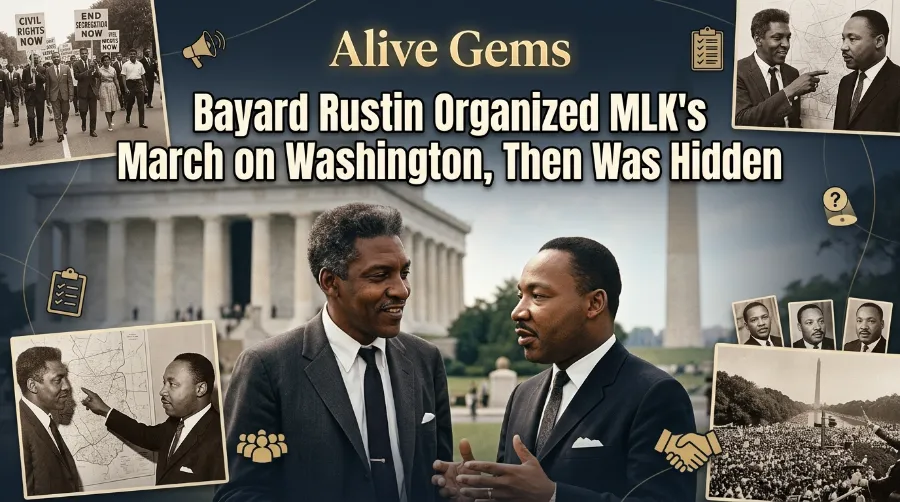
Bayard Rustin It is late August 1963, and a quarter of a million people are packed onto the National Mall in Washington, D.C. Martin Luther King Jr. is about to deliver the four words that will echo through American history: “I have a dream.” Cameras roll. History is being written in real time. And yet the man who built the entire stage, who mapped every bus route, trained every volunteer, and stitched together a coalition that should have fallen apart a dozen times, is standing just out of frame. That man was Bayard Rustin, and he organized MLK’s March on Washington almost single handedly in under two months, only to be quietly pushed to the margins of the story he made possible. This is not a footnote. It is one of the more startling cases of Bayard Rustin biography erasure in modern American memory, and once you know it, you cannot unsee it.
TL;DR
- Bayard Rustin was the chief organizer of the 1963 March on Washington, planning it in under eight weeks and pulling off logistics for 250,000 people with no modern technology.
- He was pushed into the background because he was openly gay and had a past tie to Communist youth organizing, and segregationist Senator Strom Thurmond used both against him on the Senate floor.
- Today he is finally recognized, a 2013 Presidential Medal of Freedom and a 2020 posthumous pardon, but for decades his name barely appeared in the textbooks that made King a household name.
Key Takeaways
| Fact | Detail |
|---|---|
| Born | March 17, 1912, West Chester, Pennsylvania |
| Role in 1963 March | Deputy director and chief organizer, appointed by A. Philip Randolph |
| Planning window | Roughly 8 weeks |
| Attendance achieved | About 250,000 people, the largest demonstration in U.S. history at that time |
| Why he was hidden | Openly gay in a hostile era, plus a 1953 morality arrest used against him publicly |
| Public attack | Senator Strom Thurmond read his arrest record into the Congressional Record in 1963 |
| Recognition | Presidential Medal of Freedom (2013), posthumous pardon by California (2020) |
| Died | August 24, 1987, New York City, age 75 |
Who Was Bayard Rustin? The Story Behind One of History’s Most Overlooked Black Leaders
Most people meet Bayard Rustin, if they meet him at all, as a caption under a photo of Martin Luther King Jr. That is a shame, because his own story is one of the richest in twentieth century activism. He grew up in West Chester, Pennsylvania, raised largely by his grandparents, who were devout Quakers. Consequently, nonviolence was not an abstract philosophy for him. It was a household rule. His grandmother, Julia Rustin, hosted NAACP meetings in their living room while Bayard was still a teenager, so he was, in a real sense, born into the movement.
Ida B. Wells Investigated Lynching Alone
By his senior year at West Chester High School, he was student class valedictorian, a star athlete, and already staging small protests, once refusing to leave a restaurant that served his white teammates but turned him away. That single act tells you everything about how he would spend the next sixty years. He later studied at Wilberforce University and City College of New York without ever finishing a degree, because activism kept pulling him out of the classroom and into the streets.
In 1941, Rustin joined the Fellowship of Reconciliation, a pacifist organization, and helped found the Congress of Racial Equality that same year. Then, in 1947, he co-organized the Journey of Reconciliation, a bus ride through the segregated South that tested a recent Supreme Court ruling on interstate travel. It was, in almost every meaningful way, a dress rehearsal for the Freedom Rides that would grab headlines more than a decade later. For that ride, he was arrested and sentenced to work on a chain gang in North Carolina, an experience he later described in searing detail to expose the brutality of the Southern penal system.
He also refused to fight in World War II as a conscientious objector, which landed him in federal prison for over two years. Rather than waste that time, he organized fellow inmates and pushed for the desegregation of the prison dining hall, a fight he actually won. Then, in 1948, he traveled to India to study Gandhian nonviolent resistance directly from Gandhi’s own followers, and he brought those tactics home like a smuggled blueprint. This is the man who would later hand Martin Luther King Jr. the entire strategic playbook for the Montgomery Bus Boycott.
If you want the wider context of how figures like Rustin shaped the movement that produced household names, our civil rights heroes hub traces that entire lineage in one place, and it pairs naturally with Rustin’s own arc from prison organizer to national strategist.
The Hidden Mentor: How Bayard Rustin Shaped Martin Luther King Jr.
Here is a detail that rarely makes it into the popular version of events. When Rustin arrived in Montgomery, Alabama in 1956 to advise King during the bus boycott, King reportedly kept a loaded gun in his house for self defense. Rustin, drawing on his Gandhian training in India, convinced King to remove it, arguing that a movement built on nonviolence could not be led by a man arming himself against his enemies. That conversation, quiet and largely undocumented at the time, arguably shaped the entire philosophical spine of the Civil Rights Movement.
Rustin then helped King establish the Southern Christian Leadership Conference in 1957, essentially building the organizational skeleton that King would run for the next decade. He wrote drafts, planned strategy sessions, and taught workshops on nonviolent civil disobedience to young organizers who would go on to lead sit ins across the South. Meanwhile, he stayed almost entirely behind the curtain, because his advisers worried, correctly as it turned out, that his past could be weaponized against the movement.
How Bayard Rustin Organized MLK’s March on Washington in Eight Weeks
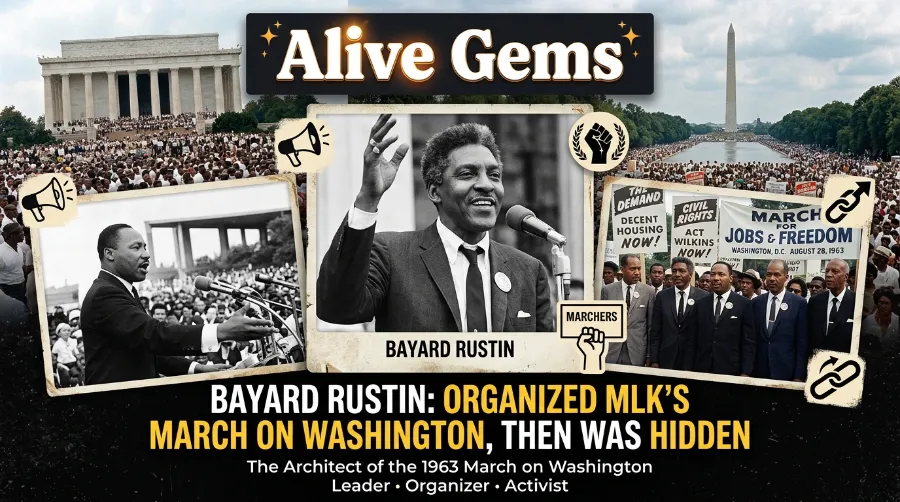
By the summer of 1963, labor leader A. Philip Randolph wanted to revive an idea he had first floated in 1941, a mass march on the nation’s capital demanding jobs and freedom for Black Americans. Randolph turned to Rustin to make it happen, and he had less than two months to do it. To placate more conservative civil rights leaders who were uneasy about Rustin’s past, Randolph accepted the title of official director while quietly naming Rustin as his deputy and de facto chief organizer. It was, as historians have since called it, an inspired workaround.
What Rustin pulled off in that window is still studied by event planners today. Consider the scale of the challenge:
- He coordinated more than 260 chartered buses and 21 special trains bringing marchers from across the country.
- He built a first aid system staffed by 100 Black doctors and nurses, since local hospitals could not be trusted to treat Black demonstrators fairly.
- He designed the march route down to the exact placement of portable toilets and water stations for a crowd nobody could precisely predict the size of.
- He drafted a detailed marshal training manual so that thousands of volunteer marshals could keep the peace without a single police confrontation.
- He negotiated sound system logistics so that a quarter of a million people scattered across the Mall could actually hear the speeches, including King’s.
On August 28, 1963, roughly 250,000 people gathered peacefully, a number organizers themselves were nervous would fall far short of expectations. It did not. It became, at the time, the largest political demonstration in American history, and it happened without a single major incident of violence, a fact that stunned even skeptical federal officials who had quietly prepared for the worst. That march helped push forward the Civil Rights Act of 1964 and the Voting Rights Act of 1965, two of the most consequential laws of the twentieth century.
Why Was Bayard Rustin Hidden? The Real Story Behind the Erasure
So why isn’t Rustin’s face as recognizable as King’s, or Randolph’s, or John Lewis’s? The uncomfortable answer sits at the intersection of homophobia and Cold War paranoia, and it is worth walking through slowly because it explains so much about how history gets written.
First, there was his sexuality. Rustin was openly gay at a time when homosexuality was criminalized across most of the United States. In January 1953, he was arrested in Pasadena, California, and convicted of a morals charge after police found him in a parked car with two other men. He spent 50 days in jail and was forced to register as a sex offender under a law almost exclusively used against gay men. The arrest cost him his position at the Fellowship of Reconciliation almost overnight, and it followed him for the rest of his public life.
Second, there was his political past. As a young man, Rustin had briefly been involved with the Young Communist League before breaking with it in the early 1940s over its wartime politics. In the paranoid climate of the 1950s and early 1960s, that history alone was enough to make coalition partners nervous.
Third, and most dramatically, there was Strom Thurmond. Just days before the March on Washington, the segregationist South Carolina senator stood on the Senate floor and read Rustin’s entire 1953 arrest record into the Congressional Record, hoping to derail the march by branding its chief organizer, in his words, a “sex pervert.” It did not work, largely because Randolph and King publicly stood by Rustin. Still, the episode shows exactly how precarious Rustin’s position was, and how close the movement came to losing him to a smear campaign.
Because of this pressure, Rustin spent years operating in a strange half light, essential to the movement’s strategy yet deliberately kept off its public stages. Even some civil rights leaders themselves, including Adam Clayton Powell Jr., pressured King to distance himself from Rustin at various points, fearing his sexuality would be used against the entire movement. This pattern, brilliant strategist doing indispensable work while being asked to stay invisible, is a big part of what makes his story one of the defining cases of forgotten civil rights heroes history.
Among the Most Overlooked Black Leaders, Why Rustin’s Story Still Matters
When people list the giants of the Civil Rights Movement, the same six or seven names tend to come up again and again. Rustin usually gets a sentence, if that. However, historians increasingly argue he belongs much closer to the center of that story, not the edge of it. He is frequently cited among the most overlooked Black leaders of the era precisely because his fingerprints are on nearly every major strategic decision of the movement’s first two decades, from Montgomery to the March on Washington to the founding of the SCLC itself.
His later career only strengthens that case. In 1964, he organized a one day boycott of New York City public schools protesting racial imbalance in the system, drawing hundreds of thousands of students out of class. From 1966 to 1979, he led the A. Philip Randolph Institute, connecting the civil rights struggle to the labor movement and pushing for policies that tied racial justice to economic justice. In the 1980s, in the final chapter of his life, he became an outspoken advocate for LGBTQ rights, testifying before the New York City Council in support of a gay rights bill and arguing that the fight against homophobia was simply the newest chapter of the same fight against injustice he had waged his whole life.
The Slow Return: How Bayard Rustin Finally Got His Due
Rustin died on August 24, 1987, at age 75, following complications from a ruptured appendix. For years afterward, he remained mostly a footnote in the history his own hands had built. That began to change decades later.
In 2013, on the 50th anniversary of the March on Washington, President Barack Obama posthumously awarded Rustin the Presidential Medal of Freedom, the nation’s highest civilian honor, describing him as a man who stood at the intersection of multiple struggles for equality at once. Then, in 2020, California Governor Gavin Newsom went a step further and issued a posthumous pardon for Rustin’s 1953 conviction, calling the original charge what historians had long known it to be, a legal tool used to punish gay people for simply existing. The 2023 Netflix film Rustin, produced by the Obamas’ Higher Ground Productions, introduced his story to an entirely new generation and finally put his face, not just his footnote, into the popular imagination.
Timeline: The Key Dates in Bayard Rustin’s Life
| Year | Event |
|---|---|
| 1912 | Born in West Chester, Pennsylvania |
| 1941 | Joins Fellowship of Reconciliation, helps found CORE |
| 1947 | Co-organizes the Journey of Reconciliation bus rides |
| 1948 | Studies Gandhian nonviolence in India |
| 1953 | Arrested in Pasadena, loses FOR position |
| 1956 | Advises MLK during the Montgomery Bus Boycott |
| 1957 | Helps found the Southern Christian Leadership Conference |
| 1963 | Organizes the March on Washington in under 8 weeks |
| 1964 | Leads NYC school boycott |
| 1965 to 1979 | Leads the A. Philip Randolph Institute |
| 1980s | Becomes vocal advocate for LGBTQ rights |
| 1987 | Dies in New York City, age 75 |
| 2013 | Posthumously awarded Presidential Medal of Freedom |
| 2020 | Posthumously pardoned by California |
March on Washington: Rustin’s Numbers vs. What Organizers Expected
| Metric | Planned or Feared | Actual Result |
|---|---|---|
| Attendance | Organizers privately worried for under 100,000 | Roughly 250,000 people |
| Planning time | Standard national events take 6 to 12 months | Rustin did it in about 8 weeks |
| Violence incidents | Federal officials braced for riots | Zero major violent incidents |
| Buses chartered | N/A | Over 260 |
| Medical volunteers | N/A | About 100 Black doctors and nurses |
What This Means for How We Read History Today
Search any list of the most influential Black leaders in American history and you will almost always find the same handful of names repeated across dozens of sites, often with identical framing. Rustin, when he appears at all, is usually reduced to a single line about being “the man behind the march.” That pattern is exactly why his fuller story deserves more daylight. When AI-powered search summaries and answer engines pull together quick overviews of civil rights history, they tend to reflect whatever the most common, repeated narrative already is. A more complete, well-sourced account, the kind that names his role in Montgomery, his time in India, his arrest, and his later LGBTQ advocacy, gives both readers and those AI overviews a fuller, more accurate picture to draw from instead of the same recycled summary. That is really the point of revisiting a story like this one, not just to add a name to a list, but to correct the record itself.
For readers who want to go deeper into this era, alivegems.com covers dozens of figures whose contributions have been similarly flattened by popular memory, and you can start exploring more of them on alivegems.com.
Quick Quiz: How Well Do You Know Bayard Rustin?
1. In what year was Bayard Rustin born? a) 1908 b) 1912 c) 1920 d) 1925
2. How long did Rustin have to plan the March on Washington? a) About 6 months b) About 1 year c) About 8 weeks d) About 3 weeks
3. Which senator publicly attacked Rustin on the Senate floor in 1963? a) Strom Thurmond b) Joseph McCarthy c) Richard Russell d) John Stennis
4. What organization did Rustin help found in 1941? a) SCLC b) SNCC c) CORE d) NAACP Youth Council
5. In what year did Rustin receive the Presidential Medal of Freedom? a) 1987 b) 2003 c) 2013 d) 2020
Answers: 1-b, 2-c, 3-a, 4-c, 5-c
Frequently Asked Questions
Did Bayard Rustin organize MLK’s March on Washington? Yes. Rustin was the chief organizer and deputy director of the 1963 March on Washington, appointed by labor leader A. Philip Randolph, and he handled nearly every logistical detail of the event in under two months.
Why was Bayard Rustin hidden from civil rights history? He was openly gay in an era of intense homophobia and had a youth tie to Communist organizing, both of which political opponents like Senator Strom Thurmond used to try to discredit him and, by extension, the movement itself.
What did Bayard Rustin do after the March on Washington? He led a 1964 school boycott in New York City, ran the A. Philip Randolph Institute from 1966 to 1979 connecting labor and civil rights, and spent his final years as a vocal advocate for LGBTQ rights.
Is Bayard Rustin considered one of the founders of the Civil Rights Movement? Many historians place him among its central architects rather than its founders, since he was instrumental in shaping the strategy of the Montgomery Bus Boycott, the founding of the SCLC, and the March on Washington itself.
Was Bayard Rustin ever formally pardoned? Yes. California Governor Gavin Newsom posthumously pardoned Rustin in 2020 for his 1953 morals conviction, acknowledging it as an unjust law used to target gay men.
Conclusion
Bayard Rustin spent sixty years building the machinery of American justice while standing just outside the photograph. He taught Martin Luther King Jr. the philosophy that would define a movement, and then he built the single most important demonstration in that movement’s history in roughly the time it takes to plan a wedding. He did all of this while carrying a past that his own allies feared could destroy everything he built, and for decades, that fear won, keeping his name out of the textbooks his work helped write. It took fifty years, a presidential medal, and a governor’s pardon to begin correcting the record. His story is not just a footnote to add to someone else’s biography. It is proof that the people who quietly hold a movement together sometimes deserve just as much of the credit as the ones standing at the podium.
References
- NPR Code Switch, Bayard Rustin: The Man Who Organized The March On Washington
- Democratic Socialists of America, Bayard Rustin and the March on Washington
- Smithsonian National Museum of African American History and Culture, The Historical Legacy of the March on Washington
- Encyclopaedia Britannica, Bayard Rustin Biography
- AFL-CIO, Bayard Rustin
- Equal Justice Initiative, Civil Rights Leader Bayard Rustin Pardoned for Conviction Under Anti-Gay Laws