
Tesla vs Edison a summer night in 1893 Chicago. Nearly 200,000 electric lamps flicker on at once, turning the World’s Fair into a glowing “White City” that people can see from miles away. Grown adults weep. Children scream in delight. And somewhere in that crowd, a quiet Serbian immigrant named Nikola Tesla watches his invention light up the sky, while the man who once tried to destroy his reputation, Thomas Edison, watches his own dream slowly go dark.
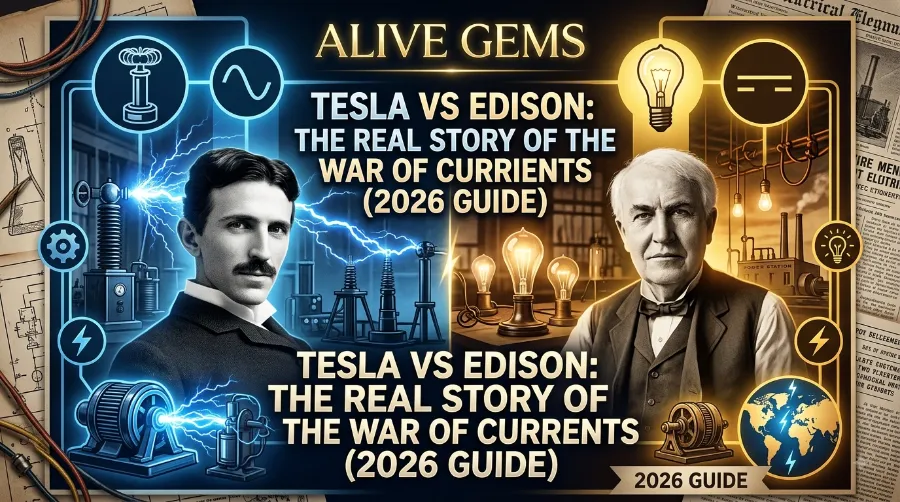
This is not a fairy tale. It is the true story of the Tesla Edison war currents real story, one of the most dramatic rivalries in American history, and honestly, one of the most misunderstood. Most people think they know it: brilliant immigrant genius versus greedy corporate villain. The truth is messier, more human, and in some ways even more fascinating than the myth.
Leonardo da Vinci 500 Years Ahead: The Real Genius Story (2026)
Key Takeaways
| Fact | Detail |
|---|---|
| The core conflict | Edison backed direct current (DC), Tesla and Westinghouse backed alternating current (AC) |
| The turning point | Westinghouse won the 1893 Chicago World’s Fair contract with a bid nearly $155,000 lower than Edison’s company |
| The real winner | AC won because it could travel farther and cheaper, not because of a single dramatic showdown |
| Tesla’s fate | He sold his AC patents to Westinghouse in 1888 but died largely broke in 1943 |
| Today’s grid | The world now uses a hybrid of AC and DC, proving neither man was entirely right |
TL;DR
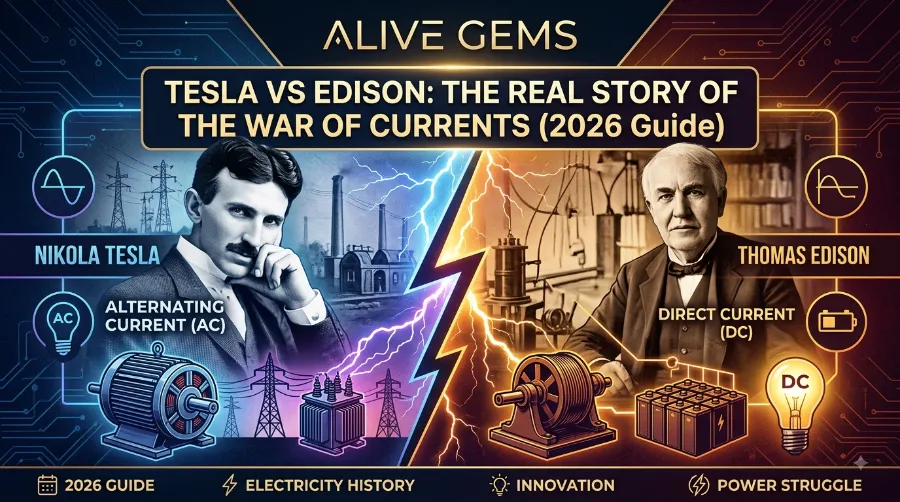
- Edison did not “lose” to Tesla in one moment. It was a years long business and PR battle over which electrical current, AC or DC, would power the world.
- Edison ran a fear campaign against AC, including public animal electrocutions, because he stood to lose royalties from his DC patents.
- Tesla’s AC system, licensed to George Westinghouse, ultimately won because it could send electricity across long distances far more efficiently and cheaply than DC ever could.
Two Men, Two Very Different Minds
Before we get into the sabotage and the scandal, you need to understand who these two men actually were, because their personalities explain almost everything that happened next.
Thomas Edison was, above all, a businessman. He opened his first commercial power plant in New York City in 1882, and he built an empire around direct current, the kind of electricity that flows steadily in one direction, like from a batteryEdison developed the direct current system, in which electrical current flows steadily in one direction, like in a battery or a fuel cell, and he opened his first power plant, in New York City, in 1882. He was relentless, media savvy, and fiercely protective of his patents and his public image. He filed over a thousand patents in his lifetime, and he was not shy about defending every single one of them, sometimes ruthlessly.
Isaac Newton Secret Alchemist: History’s Greatest Hidden Genius 2027 Guide
Nikola Tesla was almost his opposite. He was a dreamer, a perfectionist, and honestly, a bit of an eccentric genius who could visualize entire machines in his head before ever touching a wrench. He believed alternating current, which reverses direction dozens of times per second, was the real answer to powering entire cities, not just single buildingsTesla believed that alternating current reverses direction a certain number of times per second, sixty in the United States, and can be converted to different voltages relatively easily using a transformer. Where Edison thought in terms of factories and patents, Tesla thought in terms of physics and possibility. PBS
Tesla actually worked for Edison briefly in 1885, hired to improve Edison’s DC generators. According to popular legend, Edison promised Tesla fifty thousand dollars if he could redesign the company’s dynamos. Tesla did it. When he asked for the money, Edison reportedly laughed it off as an American joke. Whether every detail of that story is exact is debated by historians, but the underlying tension it describes, a young immigrant genius being underpaid and dismissed by his powerful boss, is very real and it set the tone for everything that followed.
Marie Curie: The Woman Science Tried to Destroy Three Times 2027 guide
What Was the War of Currents, Really?
The war of currents was not a single battle. It was a slow, brutal, multi year fight between two competing visions of how electricity should reach your home.
- DC (Direct Current): Edison’s system. Safe at low voltage, but it lost power quickly over long distances, meaning power plants had to be built every mile or so.
- AC (Alternating Current): Tesla’s system, backed by industrialist George Westinghouse starting in 1886. It could travel dozens of miles at high voltage, then get stepped down safely with a transformer before entering a homeIn 1886, the Edison system was faced with new competition, an alternating current system introduced by George Westinghouse’s company that used transformers to step down from a high voltage so AC could be used for indoor lighting, allowing power to be transmitted over longer distances. Biography
Here is the part most articles skip. Edison did not simply lose an honest technical debate. He knew AC was more efficient, and that terrified him financially, because his entire company was built on DC patents and DC infrastructure. So instead of racing to out innovate Tesla, Edison chose a different strategy: fear.
Galileo vs the Church: The Man Rome Tried to Silence and Failed 2027 Guide
Edison’s Fear Campaign
Starting around 1887 and 1888, Edison’s company began publicly claiming that high voltage AC was simply too dangerous for ordinary useIn early 1888, the Edison Electric Light Company claimed that high voltages used in an alternating current system were hazardous and inferior to their own. This was not just a press release. It got dark, fast. Biography
Edison and his associates staged public electrocutions of stray dogs and cats using alternating current, trying to prove in front of journalists that AC was a killerEdison spread misinformation saying that alternating current was more dangerous, even going so far as to publicly electrocute stray animals using alternating current to prove his point. One of his employees, Harold P. Brown, even helped develop the electric chair using AC generators, specifically to link Westinghouse’s technology to death in the public imagination. It is a chilling example of how far corporate rivalry can go when money and ego are on the line. PBS
A popular myth claims Edison personally electrocuted Topsy the elephant at Coney Island to smear AC. Historians have largely debunked Edison’s direct involvement in that particular event, since it happened in 1903, well after his campaign against AC had already failedThe famed death by electrocution of Topsy the elephant was not actually Edison’s doing. It is a good reminder that even a true story like this one has been exaggerated over time, and part of doing this topic justice means separating the documented facts from the dramatic embellishments. HISTORY
Archimedes: The Ancient Genius Whose Inventions We Still Cannot Explain
Tesla’s Patents and the Deal That Changed Everything
Tesla’s real breakthrough came in late 1887, when he filed for seven US patents covering a complete polyphase AC system, generators, transformers, transmission lines, and motors, all working togetherIn November and December of 1887, Tesla filed for seven US patents in the field of polyphase AC motors and power transmission, comprising a complete system of generators, transformers, transmission lines, motors and lighting. These patents were so original that they were approved almost without objection. Time
In 1888, George Westinghouse bought Tesla’s AC patents outright, giving Westinghouse control over the transformers and motors needed to make AC commercially viableIn 1888 Tesla sold his patents to the industrialist George Westinghouse, whose company had become Edison’s great rival, and the battle stopped being between ideas and became a fight between two companies. This single deal is arguably the most important business transaction in the entire history of electricity, and it is why Westinghouse, not Edison, ended up building the modern power grid. Department of Energy
You can read a wonderfully detailed breakdown of this exact turning point over at Neomano’s history of the War of the Currents, which walks through how a purely technical rivalry became a full blown corporate war.
The 1893 Chicago World’s Fair: The Real Turning Point
If there is one single moment that decided the war of currents, it is this one, and it had nothing to do with animals or electric chairs. It was a business bid.
The organizers of the 1893 World’s Columbian Exposition in Chicago needed someone to electrify the entire fairground. General Electric, formed in 1892 from a merger of Edison’s companies, bid $554,000 using direct currentGeneral Electric bid to electrify the fair using Edison’s direct current for $554,000, but lost to George Westinghouse, who said he could power the fair for only $399,000 using Tesla’s alternating current. Westinghouse undercut them by nearly $155,000, and he won. PBS
The result was staggering. Almost 200,000 lamps lit up the fairground using AC power, and the sight left millions of visitors in awe of what electricity could really doNearly 200,000 lamps turned the exposition into a White City that left the public awestruck, and millions saw with their own eyes that alternating current not only worked, but was spectacular and safe. In a single summer, Edison’s fear campaign lost its power, because the public had now seen AC do something DC never could. Department of Energy
That same year, 1893, Westinghouse also won the contract to build a hydroelectric power plant at Niagara Falls, using Tesla’s polyphase motor designThat same year, Westinghouse’s company signed a contract to install AC generators at Niagara Falls, and in 1895, the first hydro-electric power plant launched there. If you want a great side by side breakdown of how these two events sealed AC’s victory, Praxilabs has a solid technical explainer on how the physics behind the transformer made this outcome basically inevitable once people understood it. Wikipedia
Quick Comparison Table: DC vs AC in the 1890s
| Category | Edison’s DC | Tesla and Westinghouse’s AC |
|---|---|---|
| Transmission distance | About 1 mile before power loss | Dozens of miles with transformers |
| Voltage safety at delivery | Low, considered safer at the time | High during transmission, stepped down before homes |
| Cost to build citywide | Very high, needed many plants | Much lower, fewer plants needed |
| 1893 World’s Fair bid | $554,000 | $399,000 |
| Long term outcome | Phased out for grid transmission | Became the global standard for power grids |
Did Edison Really “Steal” From Tesla?
This is where I want to be honest with you, because a lot of blog posts oversimplify this for clicks. Edison did not steal Tesla’s patents. He never used AC technology, and there was no lawsuit where Tesla legally proved theft of intellectual property.
What Edison did do was arguably worse in some ways: he tried to bury a superior technology through fear, misinformation, and financial pressure, purely to protect his own income. He also, according to well documented accounts, underpaid and dismissed Tesla’s early contributions while Tesla worked directly under him in 1885. That combination, financial betrayal plus a smear campaign, is really where the “genius theft” reputation comes from. It is less about stolen blueprints and more about a powerful man trying to crush an idea he could not control.
Hedy Lamarr: The Actress Who Invented WiFi Technology
If you want another angle on this rivalry, including some of the lesser known personal disputes between the two men, Historiqly’s piece on the Tesla Edison rivalry covers some interesting details worth reading.
What Happened to Each Man Afterward
Here is something that surprises a lot of readers. AC winning the war of currents did not make Tesla rich, and DC losing did not ruin Edison.
- Tesla continued inventing for decades, including major work on radio technology and wireless power, but he struggled financially for most of his later life and died in 1943 in a New York hotel room, largely broke and increasingly reclusive.
- Edison simply pivoted. His company, now General Electric, still profited enormously from AC infrastructure even though he personally opposed it, and Edison himself moved on to other massive successes like the motion picture cameraEdison’s career as an inventor was far from over, his moving-picture camera and Kinetoscope viewer helped establish him as one of the inventors of movies. Wikipedia
It is a strange, almost bittersweet ending. The man who was proven wrong kept getting richer, and the man who was proven right kept struggling. History is rarely as clean as the story we tell about it. you can read : Alan Turing: The Genius Who Won the War and Paid With His Body
Why This Rivalry Still Matters Today
You might be wondering why any of this history matters in 2026. Here is the honest answer: almost every home you have ever lived in runs on the AC system Tesla and Westinghouse fought to build. But here is the twist most people never learn.
Modern technology has quietly brought DC back into the picture. Solar panels, batteries, electric vehicles, and long distance underwater power cables all rely on high voltage direct current in specific situations, because DC actually loses less energy over extremely long stretches when using modern converter technology. In other words, over a century later, engineers realized both men were right, just in different contexts. The grid you use today is a hybrid, not a pure victory for either side.
That nuance rarely makes it into pop culture retellings, but it is one of the most important lessons in this entire story: genius rivalries are rarely about one person being completely right and the other completely wrong.
Quick Quiz: Test What You Just Learned
Multiple Choice
- Who bought Tesla’s AC patents in 1888?
A) Thomas Edison
B) George Westinghouse
C) J.P. Morgan
D) Alexander Graham Bell - How much did Westinghouse’s AC bid undercut General Electric’s DC bid at the 1893 World’s Fair?
A) About $50,000
B) About $100,000
C) About $155,000
D) About $300,000 - What year did the first hydroelectric plant at Niagara Falls launch using Tesla’s system?
A) 1888
B) 1893
C) 1895
D) 1901
Short Answer
- What was the main technical advantage of AC over DC in the 1890s?
- Why did Edison launch a fear campaign against alternating current instead of simply improving his own technology?
(Answers: 1-B, 2-C, 3-C, 4: AC could travel much farther at high voltage and be safely stepped down with transformers, 5: He wanted to protect the royalties and infrastructure he had already built around his direct current patents.)
Frequently Asked Questions
Did Tesla and Edison ever work together?
Yes, briefly. Tesla worked for Edison’s company in 1885 improving DC generator designs before their relationship broke down over pay and recognition.
Did Edison actually electrocute an elephant to discredit Tesla?
No, that is a common myth. The Topsy the elephant electrocution happened in 1903, years after the War of Currents had already ended, and Edison was not directly responsible for it.
Who actually won the War of Currents?
Alternating current won for power transmission, largely thanks to the 1893 Chicago World’s Fair contract and the Niagara Falls hydroelectric project, though modern grids now use a hybrid of AC and DC technology.
Was Tesla richer than Edison?
No. Despite AC winning the technological battle, Tesla struggled financially for most of his life, while Edison’s businesses, including General Electric, remained highly profitable.
Is the movie The Current War historically accurate?
It captures the broad strokes fairly well, including the fear campaign and the 1893 World’s Fair bidding war, but like most historical films, it compresses timelines and dramatizes certain personal conflicts for storytelling purposes.
The Bigger Picture: Charisma, Conflict, and Genius
This rivalry is really a case study in something bigger than electricity. It shows how genius alone rarely wins in the real world. Tesla had the better idea, but Edison had the better marketing machine, at least for a while. If you enjoy stories like this one, about brilliant, complicated people who shaped history through sheer force of personality, you will love our full guide on charismatic visionary scientists throughout history, where we break down other larger than life minds who changed the world through equal parts brilliance and stubbornness.
You can also explore more untold stories like this one over on our homepage at alivegems.com, where we cover the most magnetic, complicated, and unforgettable figures in history.
Conclusion
The real story of Tesla versus Edison is not a simple tale of good versus evil. It is a story about two brilliant, flawed men, one driven by vision, the other by survival, colliding over a question that would define the modern world. Edison fought dirty because he had everything to lose. Tesla won the technical argument but lost the financial one. And in the end, the technology that actually reached your home today borrows from both of their legacies. That, more than any myth about a stolen invention or an electrocuted elephant, is the real, human, and far more interesting story of the War of Currents.
References
- Energy.gov, “The War of the Currents: AC vs. DC Power” – https://www.energy.gov/articles/war-currents-ac-vs-dc-power
- History.com, “How Edison, Tesla and Westinghouse Battled to Electrify America” – https://www.history.com/articles/what-was-the-war-of-the-currents
- Wikipedia, “War of the currents” – https://en.wikipedia.org/wiki/War_of_the_currents
- Biography.com, “Why Thomas Edison and Nikola Tesla Clashed During the Battle of the Currents” – https://www.biography.com/inventors/thomas-edison-nikola-tesla-feud
- TIME, “The Real History That Inspired the Movie ‘The Current War'” – https://time.com/5698700/current-war-real-history/
- PBS, “Tesla: Master of Lightning, War of the Currents” – https://www.pbs.org/tesla/ll/ll_warcur.html
- Neomano, “The War of the Currents” – https://neomano.com/en/the-war-of-the-currents/
- Historiqly, “Rivalry: Tesla vs Edison” – https://blog.historiqly.com/blog/rivalry-tesla-edison
- Praxilabs, “Currents War and Its History” – https://praxilabs.com/en/blog/2019/08/29/currents-war-and-its-history/