
Hedy Lamarr a woman so famous that Hollywood called her “the most beautiful woman in the world,” yet so brilliant that she spent her nights sketching torpedo guidance systems on a drafting table in her trailer. That is not fiction. That is the real, almost unbelievable story of Hedy Lamarr, the actress who invented WiFi technology decades before anyone alive today ever streamed a video or sent a text message. While the world watched her light up movie screens, she was quietly solving one of the toughest communication problems of World War II, and in doing so, she laid the groundwork for WiFi, Bluetooth, and GPS. This is her story, told the way it deserves to be told.
Archimedes: The Ancient Genius Whose Inventions We Still Cannot Explain
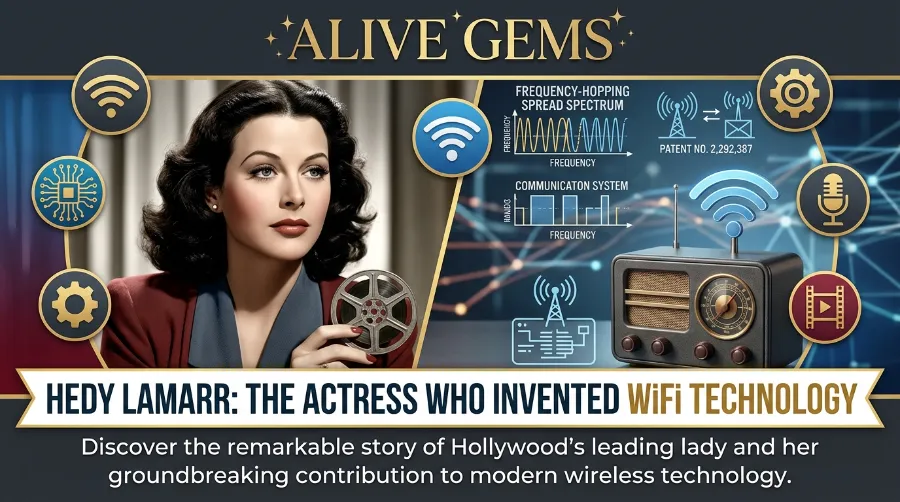
Key Takeaways Table
| Fact | Detail |
|---|---|
| Born | November 9, 1914, Vienna, Austria |
| Real name | Hedwig Eva Maria Kiesler |
| Co-inventor | George Antheil, American composer |
| Invention | Frequency hopping spread spectrum, 1941 |
| Patent number | U.S. Patent 2,292,387, granted August 11, 1942 |
| Recognition | Electronic Frontier Foundation Pioneer Award, 1997 |
| Hall of Fame induction | National Inventors Hall of Fame, 2014 |
| Legacy technology | WiFi, Bluetooth, GPS |
| Died | January 19, 2000, Florida, age 85 |
TL;DR
- Hedy Lamarr was a Hollywood actress who invented WiFi technology through her wartime frequency hopping patent, filed with composer George Antheil in 1941.
- The idea, meant to stop Nazi forces from jamming Allied torpedo signals, sat unused for decades until engineers realized it could carry secure wireless data.
- She received almost no credit or money during her lifetime and was only properly honored in her 80s, decades after the patent expired.
Who Was Hedy Lamarr Before She Became a Technology Icon
Long before she was a movie star, Hedy Lamarr was simply a curious little girl in Vienna. Her father, a bank director, used to walk her through the city and explain how machines worked, from printing presses to street cars. By age five, she was already taking apart her music box just to see how it made sound, then putting it back together again. That habit of pulling things apart to understand them never really left her.
As a teenager, she was pushed toward acting instead of engineering, simply because that was considered the acceptable path for a young woman in her position. She became famous fast, starring in controversial European films in her late teens. However, her personal life took a darker turn when, at nineteen, she married Fritz Mandl, a wealthy Austrian arms dealer with close ties to fascist leaders.
That marriage, though miserable and controlling, accidentally gave her a technical education money could not buy. She sat through countless dinners where Mandl discussed weapons systems, radio guidance, and military technology with generals and engineers. She absorbed it all, quietly, the way she absorbed everything. Eventually she fled that marriage, first to Paris, then London, where she met MGM studio head Louis B. Mayer and negotiated a Hollywood contract that would change her name and her life forever.
The Hollywood Star Who Invented WiFi Technology During Wartime
By the early 1940s, Lamarr was one of the biggest names in American cinema, but she was restless. World War II had begun, and she wanted to do more than sell war bonds or entertain troops. She wanted to actually help win the war. This is the point where her story stops being a typical Hollywood biography and becomes something far more remarkable.
She had learned, through her first marriage, that Allied radio controlled torpedoes had a serious weakness. They transmitted on a single, fixed radio frequency, which meant German forces could easily detect and jam the signal, sending the torpedo off course. Lamarr understood the problem clearly, and more importantly, she started imagining a solution.
How Frequency Hopping Actually Worked
In 1940, Lamarr met George Antheil, an American composer known for experimental works involving synchronized player pianos. The two became friends and quickly realized they shared an unusual passion for solving technical problems. Together, they developed an idea that sounds almost poetic in its simplicity.
- Instead of broadcasting a torpedo guidance signal on one frequency, the transmitter and receiver would hop between 88 different radio frequencies together, matching the 88 keys on a piano.
- The hopping pattern would be synchronized using a mechanism inspired directly by player piano rolls, an idea Antheil brought from his musical background.
- Because the signal never stayed on one frequency long enough to be jammed, enemy forces would have almost no chance of blocking or intercepting it.
This concept, now known as frequency hopping spread spectrum, was genuinely ahead of its time. With help from Caltech engineer Samuel Mackeown, the pair refined the mechanics and filed their patent application in June 1941.
The Patent Nobody Believed In
On August 11, 1942, Lamarr and Antheil were granted U.S. Patent number 2,292,387 for what they called a “Secret Communication System.” They donated the patent to the U.S. Navy for free, hoping it would immediately help the war effort. Instead, Navy officials reportedly suggested Lamarr could better serve the country by continuing to sell war bonds through her celebrity rather than her engineering.
It is a painful irony that still stings today. A woman offers the military a working solution to a real battlefield problem, and instead of adopting it, they send her back to being decorative. The patent expired in 1959, decades before frequency hopping technology became commercially useful, meaning Lamarr and Antheil never earned a single dollar from an idea that would eventually be worth billions.
From Secret Torpedo Guidance to the WiFi in Your Pocket
Here is where the story becomes genuinely inspiring rather than just tragic. Although the Navy shelved the idea during the war, it did not disappear forever. In the 1950s, engineers rediscovered the concept and began experimenting with it for secure military transmissions. By 1962, frequency hopping technology was actually used to transmit signals between U.S. ships during the Cuban Missile Crisis, a full two decades after Lamarr first sketched the idea.
From there, the technology quietly spread through military and then commercial systems. By the 1980s and 1990s, frequency hopping spread spectrum had become a foundational standard for secure wireless communication. Engineers who built early WiFi and Bluetooth protocols drew directly from the same principle Lamarr and Antheil patented back in 1942. Similar to how Nikola Tesla’s early wireless experiments quietly shaped modern power grids, as explored in our piece on the Tesla vs Edison war of currents, Lamarr’s frequency hopping idea sat dormant before finally reshaping an entire industry.
Why It Took 50 Years for the World to Catch Up
Honestly, the biggest reason nobody connected the dots sooner is simple. Nobody expected the woman behind the “Secret Communication System” patent to be the same Hedy Kiesler Markey who starred in Samson and Delilah opposite Victor Mature. It was not until Lamarr was in her eighties that a group of engineers, digging through old patents, realized the inventor listed was the Hollywood legend herself.
By then, frequency hopping technology already powered:
- Early cordless phones and military radios
- Bluetooth wireless connections used in headphones and speakers
- GPS systems that guide everything from cars to airplanes
- WiFi networks that quietly run in nearly every home and office
Most Surprising Scientists in History: Where Hedy Lamarr Fits In
When people picture the most surprising scientists in history, they usually imagine lab coats and chalkboards, not glamorous film stars. That is exactly why Lamarr’s story tends to shock people the first time they hear it. She was self taught, worked without formal engineering training, and squeezed her inventing sessions between film shoots and press appearances.
In many ways, she fits into a small, remarkable club of thinkers who were dismissed, doubted, or outright ignored by the institutions that should have supported them. Marie Curie faced her own brutal fight for recognition in a male dominated scientific world, a struggle we cover in depth in our article on Marie Curie and the science establishment that tried to destroy her. Lamarr’s experience was quieter but just as unjust. Nobody tried to destroy her reputation. They simply refused to believe an actress could also be an inventor.
It is also worth noting she was not the only technically minded genius hiding behind a completely different public image. Alan Turing, whose codebreaking work we explore in our feature on Alan Turing, similarly had his contributions buried by secrecy and bureaucratic indifference for decades. History has a strange habit of undervaluing the people who move it forward the most.
The Personality Behind the Invention: Hedy Lamarr Biography and Personality
Reading about her Hedy Lamarr biography and personality paints a picture of someone who genuinely did not fit into a box. She reportedly said the brains of people interested her far more than their looks, a comment that feels almost rebellious coming from someone the world had labeled purely as a beauty icon. Friends and colleagues described her as endlessly curious, someone who could not look at a problem without wanting to solve it.
She kept a drafting table at home covered in engineering books, and according to biographer Richard Rhodes, inventing was a serious hobby for her, not a passing interest. Beyond frequency hopping, she tinkered with smaller everyday inventions too:
- A tissue box attachment designed to dispense used tissues more hygienically
- A glow in the dark dog collar for nighttime walks
- Improvements to traffic light systems for safer driving
These smaller projects reveal something important about her personality. She was not chasing fame through invention. She simply could not stop noticing problems and imagining fixes, a trait shared by many of history’s quiet geniuses.
Comparing Hedy Lamarr to Other Charismatic Minds of Science
What makes someone like Lamarr so magnetic across generations is the same quality that defines every truly charismatic scientific mind throughout history, a topic we explore fully in our guide to charismatic visionary scientists in history. These are people who refused to accept the limits placed on them by their era, their gender, or their profession.
Leonardo da Vinci, centuries earlier, blurred the line between artist and engineer in a way that still feels ahead of its time, something we dig into in our piece on Leonardo da Vinci and the real genius behind the myth. Isaac Newton similarly hid an entire secret life pursuing alchemy alongside his more famous physics work, a story covered in our article on Isaac Newton the secret alchemist. Even Galileo, whose conflict with religious authority we detail in Galileo versus the Church, fought institutions that refused to accept an inconvenient truth. Lamarr belongs firmly in that lineage of brilliant outsiders.
Why Hedy Lamarr’s Story Still Matters Today
Every time you connect to WiFi at a coffee shop, unlock your phone using GPS, or pair wireless earbuds over Bluetooth, you are using a distant descendant of an idea sketched out by a Hollywood actress who changed technology more than eighty years ago. That fact alone should be taught in every technology classroom, not just as trivia, but as a genuine lesson about who gets believed and who gets ignored.
According to the Smithsonian archives and the U.S. National Archives, Lamarr’s contribution went largely unrecognized for most of her life. The Electronic Frontier Foundation finally honored her and Antheil jointly with their Pioneer Award in 1997, and she became the first woman to receive the Bulbie Gnass Spirit of Achievement Award. She was posthumously inducted into the National Inventors Hall of Fame in 2014, fourteen years after her death, according to the National Archives account of her legacy.
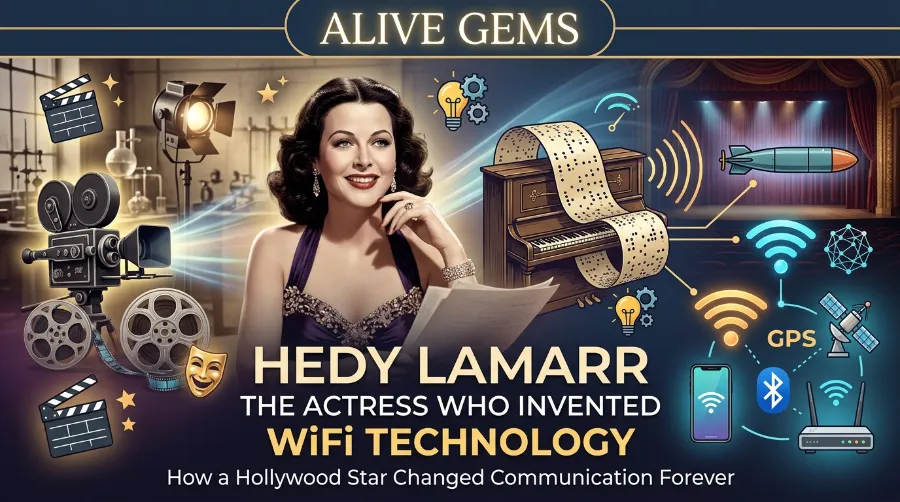
Timeline Chart: Hedy Lamarr’s Invention to Modern WiFi
Copy and paste this quick reference chart wherever useful.
| Year | Milestone |
|---|---|
| 1914 | Hedy Kiesler born in Vienna, Austria |
| 1933 | Stars in controversial European film Ecstasy |
| 1937 | Escapes to Paris then London, signs with MGM |
| 1940 | Meets composer George Antheil |
| 1941 | Frequency hopping patent application filed |
| 1942 | U.S. Patent 2,292,387 granted, patent donated to Navy |
| 1962 | Technology used during Cuban Missile Crisis |
| 1997 | EFF Pioneer Award given to Lamarr and Antheil |
| 2000 | Hedy Lamarr passes away at age 85 |
| 2014 | Inducted into National Inventors Hall of Fame |
Adoption Chart: How Frequency Hopping Spread Across Industries
| Decade | Primary Use |
|---|---|
| 1940s | Military torpedo guidance concept, patent granted |
| 1950s to 1960s | Secure U.S. Navy ship to ship communication |
| 1980s | Foundation for early spread spectrum radio standards |
| 1990s | FCC adopts frequency hopping for secure wireless communication |
| 2000s to today | Core principle inside WiFi, Bluetooth, and GPS systems |
Quick Knowledge Quiz
Test yourself before you scroll further.
- What was Hedy Lamarr’s birth name?
a) Hedwig Eva Maria Kiesler
b) Eva Marie Kiesler
c) Hedwig Marlene Lamarr - Who co-invented frequency hopping alongside Lamarr?
a) Nikola Tesla
b) George Antheil
c) Alan Turing - In what year was the frequency hopping patent granted?
a) 1935
b) 1942
c) 1955 - How many radio frequencies did their original system hop across?
a) 44
b) 66
c) 88 - When was Hedy Lamarr inducted into the National Inventors Hall of Fame?
a) 1997
b) 2014
c) 1962
Answers: 1-a, 2-b, 3-b, 4-c, 5-b
Frequently Asked Questions
Did Hedy Lamarr actually invent WiFi?
Not literally, but she co-invented frequency hopping, the core principle that modern WiFi, Bluetooth, and GPS technology are built on, which is why she is often credited as the mother of WiFi.
Why didn’t the Navy use her invention during World War II?
Military officials at the time doubted a Hollywood actress could contribute meaningful technical work and suggested she support the war effort through her celebrity instead, according to accounts from the Women’s History Museum.
Did Hedy Lamarr ever make money from her invention?
No. The patent expired in 1959, years before the technology became commercially valuable, so neither she nor Antheil ever received royalties.
When did people finally recognize her contribution?
Recognition came very late in her life, starting with the Electronic Frontier Foundation’s Pioneer Award in 1997, when she was in her eighties.
Is frequency hopping still used in WiFi today?
Modern WiFi mostly uses different but related spread spectrum techniques, though frequency hopping remains central to Bluetooth technology, as noted by Thales Group’s research.
Conclusion
Hedy Lamarr’s life refuses to fit neatly into one category, and that is exactly what makes her story so unforgettable. She was a movie star who spent her free hours solving military communication problems, and an inventor whose work was dismissed simply because of how she looked and what she did for a living. Her frequency hopping patent sat quiet for decades, yet it eventually became the invisible backbone of WiFi, Bluetooth, and GPS, technologies billions of people rely on every single day without ever knowing her name. Her story is not just history trivia. It is a reminder that brilliance rarely announces itself the way we expect, and that the people history overlooks often turn out to be the ones who shaped it the most.
References
- National Archives: The World War II Era Actress That Invented Wi-Fi
- V-HR: How Hedy Lamarr Invented the Internet
- National Women’s History Museum: Hedy Lamarr Biography
- History.com: How Hollywood Star Hedy Lamarr Invented the Tech Behind Wi-Fi
- National Geographic: Who Was Hedy Lamarr
- Forbes: Hedy Lamarr, The Incredible Mind Behind Secure WiFi, GPS And Bluetooth