
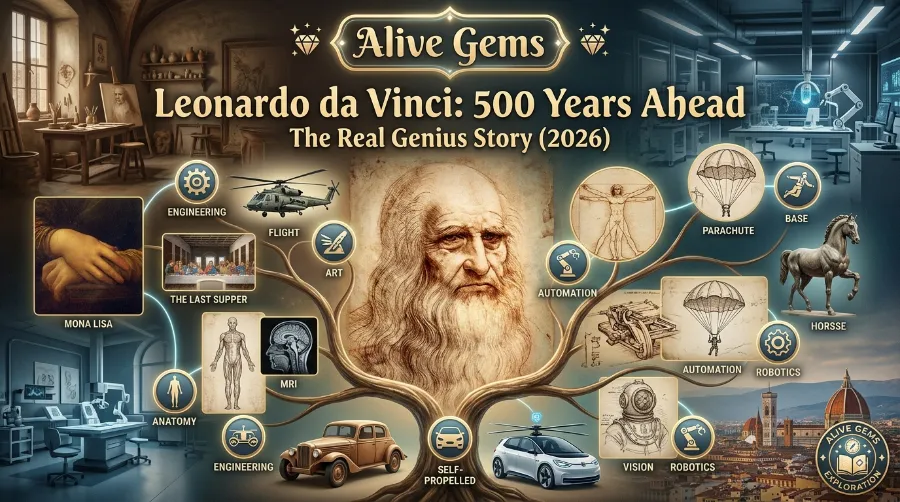
Leonardo da Vinci, Imagine sitting in a candlelit workshop in Milan around the year 1495, sketching a machine with a spiraling rotor that could theoretically lift a person straight into the sky. No one around you has ever seen an engine. Electricity does not exist yet. And yet you draw it anyway, because in your mind, it already works. That is not science fiction. That is a real afternoon in the life of Leonardo da Vinci, the man whose notebooks make him feel less like a Renaissance painter and more like a time traveler who forgot to go home.
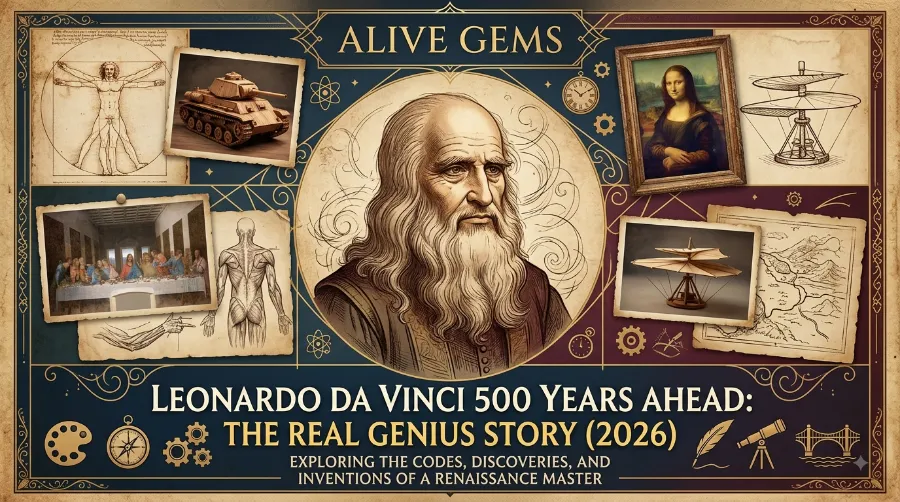
This is the real story of Leonardo da Vinci 500 years ahead of everyone around him, told the way it should be, not as a dusty textbook entry, but as the genuinely strange and moving story of a man who saw the future before the rest of humanity even had the tools to imagine it.
Marie Curie: The Woman Science Tried to Destroy Three Times 2027 guide
Key Takeaways
| Fact | Detail |
|---|---|
| Flying machines | Leonardo produced over 35,000 words and 500 sketches on flight, roughly 400 years before the Wright brothers |
| The aerial screw | Often considered a conceptual ancestor to the modern helicopter |
| The robotic knight | A mechanical humanoid designed around 1495, rediscovered about 450 years later |
| Anatomy work | His human dissections and drawings anticipated modern medical illustration by centuries |
| Personal side | He was famously a perfectionist who left many works, including some inventions, unfinished |
TL;DR
- Leonardo da Vinci was not just a painter. He was an engineer, anatomist, and inventor whose notebooks describe flying machines, robots, and war vehicles centuries before the technology existed to build them.
- His flying machine research alone included more than 500 sketches, created around 400 years before powered flight became a reality.
- What made him “500 years ahead” was not magic. It was an almost obsessive habit of observing nature, especially birds, water, and the human body, more closely than anyone else of his era.
Who Was Leonardo da Vinci, Really?
Most people know Leonardo da Vinci as the man behind the Mona Lisa. That is true, but it is also a little like knowing Einstein only as “the hair guy.” Leonardo was born in 1452 near Florence, and he trained as a painter under the master Andrea del Verrocchio, but even from those early years, his curiosity spilled far beyond the canvas.
He studied anatomy, geology, botany, and mechanics with the same intensity most people reserve for their actual job. He lived during the Italian Renaissance, a period when cities like Florence, Milan, and Venice were bursting with wealth, ambition, and competition among rulers to attract the sharpest minds available. Leonardo did not just benefit from that environment. He became its defining symbol.
Isaac Newton Secret Alchemist: History’s Greatest Hidden Genius 2027 Guide
The Flying Machines That Predicted Aviation
Here is where the phrase 500 years ahead stops being a marketing hook and starts being literally true. Around 400 years before the Wright brothers achieved powered flight, Leonardo was already designing flying machines based on the anatomy of birds and bats. He studied how wings generated lift, how feathers moved, and how air itself behaved around a moving body.
His research on flight alone filled more than 35,000 words and over 500 sketches, an almost unbelievable volume of work for a single obsession. He even created an entire manuscript in 1505 dedicated only to bird flight, known today as the Codex on the Flight of Birds. That level of focused, evidence based observation is exactly why modern engineers still study his notebooks today.
- The ornithopter: A flying device with flapping wings powered by human muscle, inspired directly by birds and bats.
- The aerial screw: A design with a giant spiral rotor, widely considered a conceptual ancestor of the modern helicopter, even though it could never have actually lifted off using Renaissance era materials.
- The glider concept: Unlike the flapping designs, this one used fixed wings to generate lift, an idea that quietly anticipated the basic principle behind every airplane flying today.
None of Leonardo’s flying machines actually left the ground, mainly because the human body cannot generate enough power, and Renaissance materials were simply too heavy. But the thinking behind them, the aerodynamics, the observation of nature, the mechanical logic, was centuries ahead of anything else being produced at the time.
Hedy Lamarr: The Actress Who Invented WiFi Technology
Why His Flying Machines Never Flew
It is worth pausing here, because this is the part people usually skip, and it says a lot about who Leonardo really was. He was not wrong about the physics, exactly. He was limited by his era’s technology. A human powered wing simply cannot generate enough thrust for takeoff, a limitation that engineers only fully understood centuries later.
Manned flight with flapping wing machines was not actually achieved until the second half of the twentieth century, and even then, it remained extremely difficult. In other words, Leonardo was not just ahead of his century. In some ways, he was ahead of ours too.
Galileo vs the Church: The Man Rome Tried to Silence and Failed 2027 Guide
The Robotic Knight: A Machine That Should Not Have Existed
If flying machines feel impressive, this next one feels almost impossible. Around 1495, under the patronage of the powerful Sforza family in Milan, Leonardo designed a mechanical humanoid known today as the robotic knight. It could wave its arms, move its neck, and even open and close its mouth, all controlled through an internal system of cables and gears, along with an external hand crank.
This was not a toy. It was a functioning automaton built almost 450 years before the modern robotics industry existed. His detailed sketches of the design were rediscovered centuries later, and in the early twenty first century, a roboticist actually used those notes as inspiration for a modern anthropomorphic robot design. Think about that for a moment. A machine drawn by hand in the 1490s directly influenced real robotics research more than five hundred years afterward.
Archimedes: The Ancient Genius Whose Inventions We Still Cannot Explain
Anatomy, War Machines, and the Mind That Never Stopped Working
Leonardo’s genius did not stop at flight and robotics. His notebooks, created roughly between 1478 and 1519, cover an almost dizzying range of subjects, all connected by the same relentless curiosity.
- Human anatomy: He personally dissected human bodies and produced detailed, remarkably accurate drawings of muscles, tendons, and organs, work that quietly shaped the future of medical illustration.
- Military engineering: He sketched an early armored tank, a giant crossbow, and various cannon designs, imagining warfare technology that would not exist for centuries.
- Hydraulic engineering: He studied canals, flood control, and water lifting devices, applying the same nature based problem solving he used for flight.
- Diving equipment: He designed early underwater breathing systems, essentially conceptual scuba gear, hundreds of years before recreational diving existed.
Quick Comparison Table: Leonardo’s Concepts vs When They Actually Arrived
| Invention Concept | Sketched Around | Actually Achieved | Gap |
|---|---|---|---|
| Flying machine principles | 1480s to 1490s | Wright brothers, 1903 | About 400 to 420 years |
| Aerial screw (helicopter concept) | Around 1493 | First practical helicopter, 1939 | About 445 years |
| Robotic knight (humanoid automaton) | Around 1495 | Modern humanoid robotics, 1940s onward | About 450 years |
| Anatomical dissection drawings | 1489 onward | Modern medical illustration standards | Centuries of influence |
You can find a beautifully detailed exploration of these timelines and their real world engineering context in Biltmore’s feature on Leonardo’s 500 years of genius, which puts his work in context with what modern engineers now understand about his sketches.
The Human Side of the Genius
Here is what most articles about Leonardo miss completely, and honestly, it is the part that makes him feel real instead of mythical. He was not a flawless machine of pure genius. He was famously, almost painfully, a perfectionist. He left an enormous number of projects unfinished, including paintings, inventions, and entire engineering ideas, simply because his standards for himself were nearly impossible to meet.
He often worked in secret, reportedly writing many of his notes in mirror writing, right to left, possibly to protect some of his more sensitive ideas, including certain weapon designs, from prying eyes. That habit alone tells you something important. This was a man who understood that some of his ideas were powerful enough to be dangerous in the wrong hands, five hundred years before “dangerous new technology” became a modern headline.
For a genuinely moving look at how his personal struggles and self doubt shaped his legacy, this Medium piece on da Vinci’s legacy five hundred years after his death does a wonderful job humanizing him beyond the myth.
Why “500 Years Ahead” Is Not Just a Clickbait Phrase
It would be easy to assume that “500 years ahead” is just a dramatic marketing line, the kind of thing history blogs slap on a headline for clicks. In Leonardo’s case, it happens to be almost mathematically accurate. His robotic knight sketches were rediscovered roughly 450 years after he drew them. His flying machine research predated powered flight by roughly 400 years. His helicopter concept predated the first practical helicopter by well over four centuries. you can read : Alan Turing: The Genius Who Won the War and Paid With His Body
What made this possible was not some supernatural gift. It was an absolutely obsessive commitment to observation, watching birds for years, dissecting bodies by candlelight, studying how water moved through a canal, and then connecting all of it together into working mechanical logic. Genius, in Leonardo’s case, looks a lot like curiosity that simply refused to stop.
If you enjoy stories about brilliant, complicated minds who reshaped how humanity understands the world, our full guide to charismatic visionary scientists throughout history covers several more figures cut from the same cloth, including our deep dive into the Tesla vs Edison war of currents, another story about a genius fighting to be understood by his own era.
Quick Quiz: Test What You Just Learned
Multiple Choice
- About how many years before the Wright brothers did Leonardo begin designing flying machines?
A) 100 years
B) 200 years
C) 400 years
D) 600 years - Around what year did Leonardo design his robotic knight?
A) 1450
B) 1495
C) 1519
D) 1600 - What manuscript did Leonardo write in 1505 focused entirely on flight?
A) Codex Atlanticus
B) Codex on the Flight of Birds
C) Codex Leicester
D) Codex Arundel
Short Answer
- Why did none of Leonardo’s flying machines actually fly during his lifetime?
- What personal trait is often cited as the reason Leonardo left so many projects unfinished?
(Answers: 1-C, 2-B, 3-B, 4: Human muscle could not generate enough thrust, and Renaissance materials were too heavy for powered flight, 5: His extreme perfectionism, which made him constantly revise and rarely consider a project truly complete.)
Frequently Asked Questions
Was Leonardo da Vinci really centuries ahead of his time?
Yes, in a very literal sense. His flying machine research predated powered flight by around 400 years, and his robotic knight sketches were rediscovered roughly 450 years after he drew them.
Did any of Leonardo’s inventions actually work during his lifetime?
Most remained unbuilt or unworkable due to the limits of Renaissance materials and engineering, though some smaller models and mechanisms are believed to have been constructed and demonstrated in his lifetime.
Why is Leonardo considered a scientist and not just an artist?
He conducted hands on human dissections, studied hydraulics and mechanics rigorously, and used detailed observation and testing rather than pure imagination, which mirrors the scientific method centuries before it was formally established.
What is the most famous example of his ideas being rediscovered centuries later?
His robotic knight design is one of the clearest examples, since it directly influenced a modern robotics project roughly 450 years after it was originally sketched.
Is the Mona Lisa connected to his scientific work?
Indirectly, yes. His anatomical studies of the human face and expression directly informed the lifelike subtlety of his paintings, including the Mona Lisa’s famously ambiguous smile.
Conclusion
Leonardo da Vinci was not simply a talented painter who happened to dabble in science. He was a man whose curiosity refused to respect the boundaries of his own century, sketching helicopters before engines existed, robots before electricity, and anatomical detail before modern medicine had the language to describe it. What makes his story so powerful is not that he was superhuman. It is that he was deeply, stubbornly human, a perfectionist who left work unfinished, who hid his ideas in mirror writing, and who simply never stopped asking how things worked. That relentless curiosity is exactly why, five hundred years later, we are still catching up to him.
References
- Smithsonian National Air and Space Museum, “Codex on the Flight of Birds” – https://airandspace.si.edu/exhibitions/codex
- History Facts, “5 Visionary Inventions by Leonardo da Vinci” – https://historyfacts.com/famous-figures/article/5-visionary-inventions-by-leonardo-da-vinci/
- The Collector, “The Genius Behind Da Vinci’s Inventions” – https://www.thecollector.com/da-vinci-inventions/
- Live Science, “5 Da Vinci Designs That Were Ahead of Their Time” – https://www.livescience.com/49210-leonardo-da-vinci-futuristic-inventions.html
- Ancient Origins, “Five Da Vinci Inventions That Could Have Revolutionized Technology” – https://www.ancient-origins.net/artifacts-ancient-technology/da-vinci-inventions-020145
- Biltmore, “Leonardo da Vinci: 500 Years of Genius” – https://www.biltmore.com/blog/leonardo-da-vinci-500-years-of-genius/
- Medium, “Leonardo da Vinci’s Legacy 500 Years After His Death” – https://medium.com/@federicabocco/leonardo-da-vincis-legacy-500-years-after-his-death-5f40d2c86557
- Interalia Magazine, “Leonardo da Vinci: 500 Years After His Death, His Genius Shines as Bright as Ever” – https://www.interaliamag.org/articles/gabriele-neher-leonardo-da-vinci-500-years-after-his-death-his-genius-shines-as-bright-as-ever/