
Alan Turing saving millions of lives, shortening a world war by years, and inventing the very concept that your smartphone runs on today. Now imagine your own government repaying you by injecting you with hormones designed to chemically alter your body, simply because of who you loved. That is not a dramatic movie plot. That is exactly what happened to a shy, brilliant mathematician from London, and it is one of the most devastating true stories in modern history. This is the real account of Alan Turing won war chemically castrated reward, and once you understand it fully, you will never look at a computer the same way again.
Alan Turing was not just a codebreaker. He was the architect of an idea that eventually became the machine you are reading this on right now. The Turing Enigma real story is far stranger and more painful than most people realize, and his personal story remains one of the most searched Alan Turing biography tragedy topics across the United States and Europe. By the time you finish reading, you will understand exactly why so many historians now call him one of the most brilliant persecuted scientists the modern world has ever produced.
Hedy Lamarr: The Actress Who Invented WiFi Technology
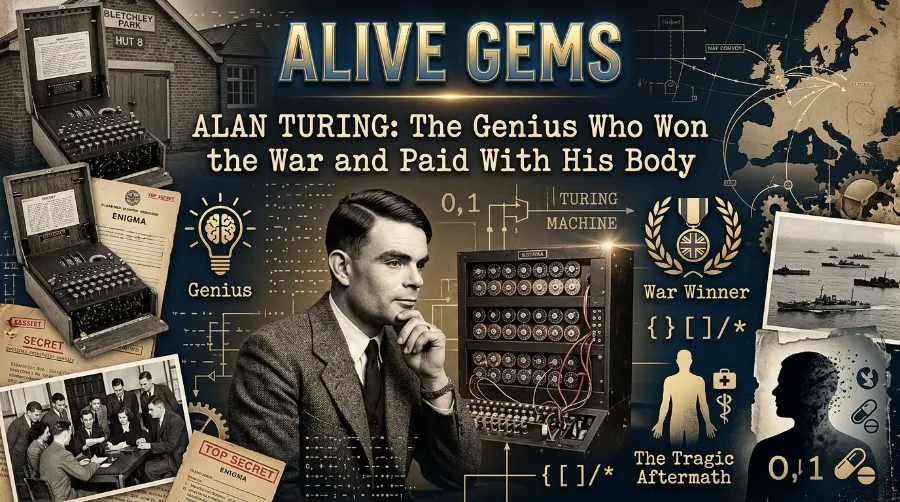
Key Takeaways
| Fact | Detail |
|---|---|
| Born | June 23, 1912, in Paddington, London |
| Died | June 7, 1954, at age 41 |
| Key wartime role | Led codebreaking efforts at Bletchley Park |
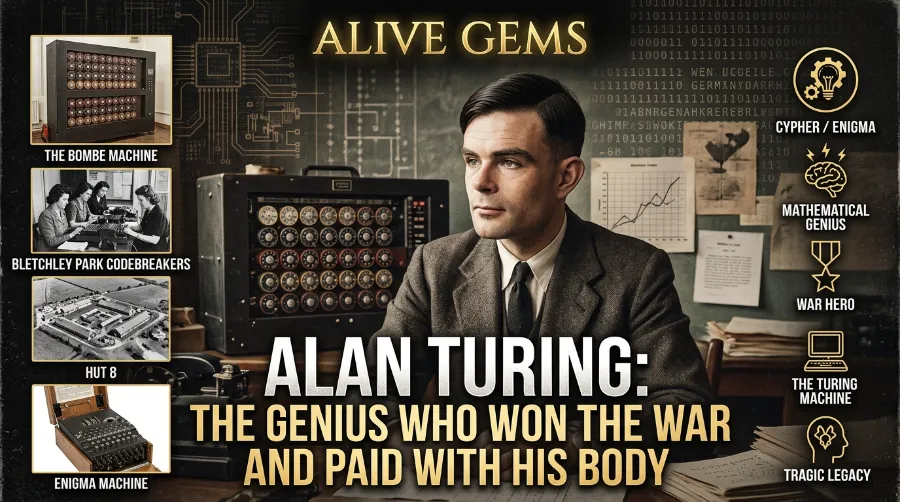
| Machine he built | The Bombe, which cracked Enigma cipher messages |
| Conviction | 1952, charged with gross indecency for being gay |
| Punishment | Chemical castration through estrogen injections |
| Government apology | 2009, official apology issued |
| Royal pardon | Granted December 24, 2013 |
| Modern honor | Face of the Bank of England fifty pound note since 2021 |
TL;DR
- Alan Turing built the machine that cracked Nazi Germany’s Enigma code, work historians say shortened World War II by roughly two years.
- In 1952, he was convicted for being gay and chose chemical castration over prison, a punishment that permanently altered his body.
- He died in 1954, and it took until 2013 for Britain to formally pardon him, decades after the world had already recognized his genius.
The Quiet Boy Who Would Rewrite the Future
Alan Turing was not the confident, chest thumping hero you see in war films. According to biographers, he was often described as an awkward, lonely child. He spent much of his early life fostered in various English homes with his elder brother John, while his parents lived abroad in India where his father worked in the Indian Civil Service, which left him often feeling isolated. CBS News
That isolation, oddly enough, may have shaped the way his mind worked. Turing became obsessed with numbers, patterns, and pure logic at a young age. By his twenties, he was already writing groundbreaking papers on what would eventually be called computer science, years before an actual computer existed anywhere in the world. He described a theoretical device, now called the Turing Machine, that could follow a set of instructions and solve virtually any calculable problem. That single idea is the foundation every computer on Earth still runs on today.
Bletchley Park and the Machine That Beat Hitler
When World War II broke out in 1939, Britain faced an almost impossible problem. Nazi Germany was using a device called Enigma to encrypt military communications, and the number of possible combinations was so enormous that human codebreakers alone could never keep up. Turing was recruited to Bletchley Park, a secret facility north of London, and what happened next changed the entire trajectory of the war.
Working alongside fellow mathematician Gordon Welchman, Turing designed a machine that could mechanically test thousands of possible Enigma settings far faster than any human. The device, known as the bombe, mimicked the workings of Enigma’s rotors to test potential ciphers, and within a few years these machines were cracking roughly two Enigma messages every single minute. CBS News
Here is what made this achievement genuinely historic, not just impressive:
- German U-boats sinking Allied supply ships across the Atlantic could suddenly be tracked and avoided.
- Military commanders gained advance knowledge of Nazi troop movements before major operations.
- Historians generally agree the work at Bletchley Park shortened the war in Europe by an estimated two years.
- Turing later developed additional techniques to crack an even more complex German device called Lorenz. CBS News
Most historians estimate that shortening the war by two years saved somewhere between fourteen and twenty one million lives. Sit with that number for a moment. A shy mathematician working in near total secrecy may have single handedly saved more lives than almost anyone else in the entire twentieth century, and for decades, almost nobody was even allowed to know his name.
Betrayed by the Country He Saved
Fast forward to 1952. The war had been over for seven years. Turing was working as a respected academic at the University of Manchester, still quietly pushing the boundaries of what machines could do, including early explorations into artificial intelligence. Then his personal life became a criminal matter.
Turing reported a burglary at his home to the police. During the investigation, officers discovered he was having a relationship with another man. He had been arrested after having an affair with a nineteen year old Manchester man. Homosexuality was illegal in Britain at the time, and Turing was charged with what the law called gross indecency. bbci
He was given a brutal choice. He pleaded guilty to the criminal act of gross indecency, admitted the affair, and agreed to chemical castration treatment as an alternative to prison. Rather than lose everything, including his career and his freedom, Turing agreed to the treatment. He agreed to undergo chemical castration by taking estrogen injections meant to curb his libido, a treatment that eventually rendered him impotent. The National WWII MuseumCBS News
What Chemical Castration Actually Did to Him
The details of this treatment are genuinely disturbing once you understand the science behind it. The doctors treating Turing believed that if male hormones increased sexual drive, then female hormones might decrease or eliminate it entirely. The reality was far worse than they anticipated. The estrogen they administered did more than physically alter him, it could also act as a cerebral depressant, affecting his mind alongside his body. bbcibbci
Doctors eventually inserted a hormone implant directly into his thigh, and although Turing removed it himself, the physical effects by that point were already irreversible. This was not a temporary punishment. It was permanent, government sanctioned harm inflicted on the very man whose intelligence had helped defeat fascism just a decade earlier. bbci
Much like Marie Curie was pushed aside by the same scientific establishment that later celebrated her, Turing’s story proves how often brilliant, defiant minds get punished by the very institutions their work protected.
A Death That Still Raises Questions
In 1954, Turing was found dead from cyanide poisoning, and an inquest ruled that it was suicide. He was only forty one years old, and a partially eaten apple was found beside his bed, which many believe he laced with cyanide before eating it. However, some point to the lasting side effects of chemical castration, and it is worth noting he died a full year after the treatment itself had ended. The Daily BeastThe National WWII Museum
<cite name=”24-1″>Because he used cyanide in his home laboratory, this leaves open the possibility of accidental exposure rather than deliberate suicide, and even his own biographers have questioned the official conclusion.</cite> Historians continue to debate the exact circumstances, but one thing remains certain. A man who had given his country one of the greatest intelligence victories in modern history died alone, disgraced, and largely unrecognized for what he had actually accomplished.
Archimedes: The Ancient Genius Whose Inventions We Still Cannot Explain
Justice, Decades Too Late
For nearly six decades, Turing’s story remained mostly buried, partly because his wartime work stayed classified for so long that the public simply had no idea what he had done. That slowly began to change.
- 2009 — Then Prime Minister Gordon Brown issued a formal public apology, calling Turing’s treatment appalling and describing it as a truly horrifying account.
- 2012 — Classified details about his codebreaking work were finally released to public scrutiny, allowing historians to fully appreciate his wartime contributions.
- 2013 — Turing received a posthumous royal pardon under the Royal Prerogative of Mercy, following a request from Justice Minister Chris Grayling. bbci
- 2019 — The Bank of England announced Turing would appear on the new fifty pound note, calling him the father of computer science and artificial intelligence. Imperial War Museums
Chris Grayling stated at the time that Turing’s later life was overshadowed by a conviction for homosexual activity, a sentence society would now consider unjust and discriminatory, which had since been repealed. It is a remarkable, almost unbelievable sentence to read. The country that punished him eventually put his face on its currency. bbci
The Legacy Nobody Saw Coming
Here is the part of Turing’s story that deserves far more attention than it usually gets. Long before his conviction, Turing had already been quietly laying the groundwork for artificial intelligence. In 1950, he proposed what became known as the Turing Test, a method for determining whether a machine could exhibit intelligent behavior indistinguishable from a human. That single question, can a machine think, still drives research at every major technology company in the world today.
His impact on computer science has been so widely acknowledged that the annual Turing Award has served as the highest accolade in the computing industry since 1966. Every time engineers at companies across California, London, or Berlin build a new artificial intelligence system, they are, in some very real sense, still walking the path Turing carved out alone. The Daily Beast
His story also connects to a broader pattern we explore across our entire charismatic visionary scientists history guide, where brilliant minds like Isaac Newton, who hid an entire secret life as an alchemist, or Leonardo da Vinci, whose genius was centuries ahead of his era, all shared one trait. They saw the world differently, and the world often made them pay for it. Even Galileo, who the Church tried and failed to silence, faced the same brutal pattern of persecution following genuine genius.
Chart: Turing’s Life and Public Recognition Timeline
| Year | Event |
|---|---|
| 1912 | Born in Paddington, London |
| 1936 | Publishes theoretical concept of the Turing Machine |
| 1939 to 1945 | Leads codebreaking work at Bletchley Park |
| 1950 | Proposes the Turing Test |
| 1952 | Convicted of gross indecency, sentenced to chemical castration |
| 1954 | Dies at age 41 from cyanide poisoning |
| 2009 | British government issues formal public apology |
| 2013 | Receives posthumous royal pardon |
| 2021 | Becomes face of the Bank of England fifty pound note |
Comparing Wartime Impact and Personal Treatment
| Category | Reality |
|---|---|
| Estimated lives saved through his codebreaking | Fourteen to twenty one million |
| Estimated years shaved off the war in Europe | Roughly two years |
| Years his wartime work stayed classified | Nearly three decades |
| Years between his death and official pardon | Fifty nine years |
Why His Story Still Hits So Hard Today
You do not need to understand cryptography to feel the weight of this story. Turing represents something almost every reader instinctively understands, the fear of being punished for simply being who you are, even after doing everything right. His story resonates deeply across both the United States and Europe today precisely because societies on both sides of the Atlantic are still actively reckoning with how they have historically treated LGBTQ individuals.
What makes Turing’s story so uniquely powerful is the sheer contrast involved. This was not an ordinary citizen facing discrimination. This was the single person most responsible for one of the greatest intelligence victories of the twentieth century, and his own government still chose to chemically alter his body rather than simply let him live his life. That contradiction is exactly why his story continues generating conversation, documentaries, and films decades after his death.
Quick Quiz: How Well Do You Know Alan Turing
Test yourself before moving on to the FAQ section below.
- What machine did Turing help design to crack Enigma codes?
A) The Turing Test
B) The Bombe
C) The Colossus - In what year was Turing convicted of gross indecency?
A) 1945
B) 1952
C) 1961 - How did Turing die?
A) Natural causes
B) Cyanide poisoning
C) Illness related to old age - In what year did Turing receive his royal pardon?
A) 1954
B) 2009
C) 2013 - What British currency note now features Turing’s face?
A) Ten pound note
B) Twenty pound note
C) Fifty pound note
Answers: 1-B, 2-B, 3-B, 4-C, 5-C
Frequently Asked Questions
Did chemical castration actually work as intended?
The estrogen treatment did physically alter Turing’s body and left him impotent, but historians and doctors at the time did not fully understand its broader effects on mood and mental health.
Was Alan Turing’s death definitely a suicide?
The official inquest ruled it suicide, but the evidence was largely circumstantial, and some biographers argue accidental poisoning in his home laboratory remains possible.
What is the difference between the 2009 apology and the 2013 pardon?
The 2009 apology was a public statement of regret from the government with no legal effect, while the 2013 pardon formally overturned his criminal conviction under royal authority.
Did Turing’s wartime work stay secret his whole life?
Yes. Most details of his codebreaking work remained classified until decades after his death, which is part of why his contributions went largely unrecognized during his lifetime.
Is the Turing Test still used today?
Concepts from the Turing Test still influence how researchers evaluate artificial intelligence systems, even though modern AI evaluation has grown far more complex than his original proposal.
Conclusion
Alan Turing gave everything to a country that, at the exact moment he needed protection most, chose to punish him instead. He cracked a code the Nazis believed was unbreakable, helped save millions of lives, and quietly invented the theoretical foundation for every computer that exists today. In return, his own government chemically altered his body over something as basic as who he loved. It took until 2013, fifty nine years after his death, for that same country to formally say he was wronged. His story is not just history. It is a permanent reminder of how easily brilliance can be crushed by prejudice, and how long it can take the world to say sorry.
References
- The World, WWII codebreaker helped win the war, only to be chemically castrated by his own government
- CNN, Alan Turing receives royal pardon
- The Atlantic, Alan Turing saved my life
- HISTORY.com, Alan Turing biography
- Imperial War Museums, Alan Turing and the Enigma code
- BBC News, Royal pardon for codebreaker Alan Turing