
Teresa of Avila a sixteenth century woman, sick for most of her adult life, living in a country obsessed with controlling female behavior, and somehow she becomes one of the boldest religious reformers Europe has ever produced. That is the almost unbelievable true story of how Teresa Avila mystic rewrote Christianity interior, turning private prayer into something the entire Western spiritual tradition still leans on today. She was not a quiet nun who simply followed rules. She argued with priests, reformed a corrupt convent system, and wrote one of the most influential spiritual books in history while technically being watched by the Spanish Inquisition. This is the story of a woman who took the terrifying risk of trusting her own inner experience in an age when doing so could get you burned.
Read our blog on: Akhenaten the Pharaoh Who Destroyed Egypt’s Gods and Nearly Won
Key Takeaway Table
| Fact | Detail |
|---|---|
| Real name | Teresa Sanchez de Cepeda y Ahumada |
| Birth | March 28, 1515, Ávila, Spain |
| Entered convent | Age 20, at the Carmelite convent of the Incarnation |
| Major illness | Paralysis for roughly three years starting around 1539 |
| Reform movement founded | Discalced Carmelites, beginning 1562 |
| Convents founded | 17 reformed convents across Spain |
| Most famous book | The Interior Castle, written in 1577 |
| Sainthood | Canonized 1622, declared Doctor of the Church in 1970 |
| Death | October 4, 1582, Alba de Tormes, Spain |
TL;DR
- Teresa of Ávila was a Spanish nun who overcame years of illness and self doubt to become one of Christianity’s most influential mystics and reformers.
- She founded 17 reformed convents and wrote The Interior Castle, a book that mapped the soul’s journey toward God in seven stages.
- Her courage to trust personal spiritual experience, even under Inquisition scrutiny, reshaped how millions of Christians understand prayer and inner life to this day.
Teresa of Avila Sickly Girl Who Would Not Stay Quiet
Teresa was born on March 28, 1515, in Ávila, a walled city in central Spain, into a large and devout family. As a child, she was dramatic and imaginative, once trying to run away from home with her brother because they wanted to be martyred by Moors, a plan their uncle intercepted before they got far. That single childhood story tells you almost everything about her personality. She was intense, fearless, and completely unwilling to live a small life.
At age 20, she entered the Carmelite convent of the Incarnation, partly out of genuine devotion and partly, by her own later admission, out of fear of an unhappy marriage. Convent life in that era was far from the disciplined image people imagine today. Many convents functioned more like social clubs for noble families, with visitors, gossip, and minimal spiritual rigor, and Teresa spent years feeling spiritually restless inside that comfortable but shallow routine.
Around 1539, she became seriously ill, eventually suffering a paralysis so severe that she could barely move for close to three years. Doctors of the time had no real answers. It was during this prolonged physical suffering that her inner spiritual life began deepening in ways she had never experienced before, and this connection between physical vulnerability and spiritual awakening appears again and again in the stories of history’s most transformative religious figures.
The Visions That Nearly Got Her in Trouble
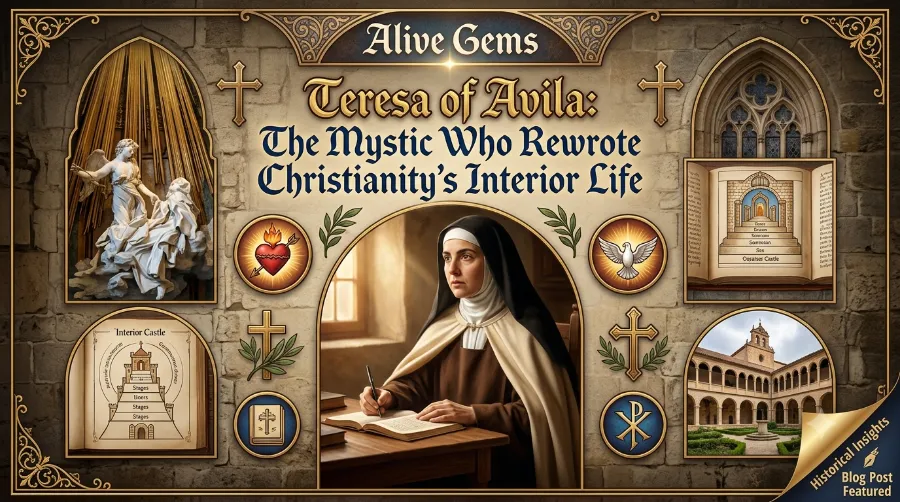
In her forties, Teresa began experiencing intense mystical episodes, including visions and what she described as moments of complete spiritual union with God. One of the most famous, often called the Transverberation, involved a vision of an angel piercing her heart with a golden spear, an image later immortalized in Bernini’s sculpture in Rome.
Here is where her story becomes genuinely dangerous rather than simply inspiring. Sixteenth century Spain was gripped by the Inquisition, and women claiming direct spiritual experiences were viewed with deep suspicion, sometimes accused of demonic influence or heresy. Teresa’s own confessors sent her writings to theologians for scrutiny multiple times.
- She was investigated informally by Church authorities concerned about the authenticity of her visions
- Her writings were reviewed by the Inquisition after her death, though she was ultimately cleared and celebrated
- She was required to write detailed spiritual autobiographies partly to prove her orthodoxy to skeptical clergy
Despite this pressure, she refused to stay silent about her experiences. As the reflection piece on The Interior Castle from The Green Door points out, Teresa’s radical contribution was insisting that ordinary people, not just clergy, could access profound intimacy with God through prayer, a claim that quietly challenged the Church’s entire spiritual hierarchy.
Reforming a Broken System
By her late forties, Teresa decided the relaxed Carmelite lifestyle she had lived for decades needed serious reform. In 1562, she founded the first convent of what became known as the Discalced Carmelites, meaning barefoot or reformed Carmelites, emphasizing poverty, silence, and deep contemplative prayer.
This was not a popular decision. Many established Carmelite nuns and local officials in Ávila actively opposed her, viewing the reform as an insult to existing convents. She faced legal challenges, public criticism, and resistance from powerful clergy who saw her as overstepping her role as a woman in the Church.
She pushed forward anyway. Over the next two decades, Teresa personally traveled across Spain, often by mule over rough terrain, and founded 17 reformed convents before her death. She worked closely with John of the Cross, a young friar who helped extend her reform movement to Carmelite men as well, creating a parallel branch of male Discalced Carmelites.
This pattern of quiet defiance against institutional resistance echoes through history in other spiritual reformers too. Francis of Assisi faced similar pushback centuries earlier when he insisted on radical poverty within a wealthy Church structure, and Guru Nanak challenged rigid religious hierarchies in an entirely different part of the world with the same stubborn conviction that ordinary people deserved direct access to the sacred.
The Interior Castle: Her Masterpiece
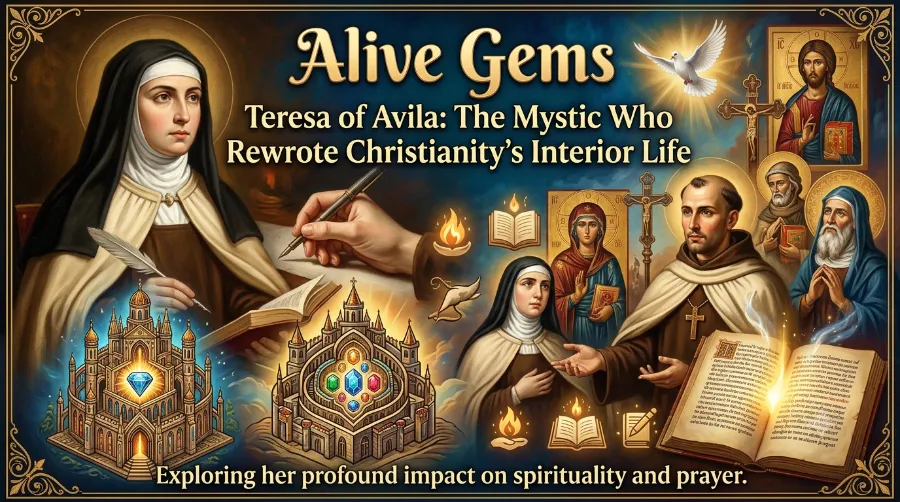
Teresa of Avila In 1577, near the end of her life, Teresa wrote her most enduring work, The Interior Castle. She wrote it quickly, reportedly in under six months, describing the soul as a crystal castle containing seven concentric mansions, each representing a deeper stage of spiritual growth toward union with God. you can also read our blog related: Zoroaster: The Forgotten Prophet Hiding Inside Every Major Religion. Meister Eckhart: The Mystic Too Radical Even for the Pope
What makes this book remarkable is not just its theology but its honesty. Teresa wrote in plain, conversational Spanish rather than formal Latin theology, describing doubt, dryness in prayer, and moments of feeling completely abandoned by God alongside her descriptions of ecstatic union. This vulnerability is exactly why the book still resonates with readers who are not even religious, since it reads more like an honest map of inner struggle than a polished sermon.
The seven mansions, briefly, describe stages such as:
- Beginning self examination and turning inward
- Practicing humility and recognizing personal weakness
- Developing disciplined virtue and devotion
- Experiencing the first supernatural consolations in prayer
- Feeling a deepening union, described as a kind of spiritual betrothal
- Enduring intense trials alongside spiritual gifts
- Reaching full spiritual marriage with the divine
A recent short video breakdown of her legacy on Instagram shows just how much modern audiences, including younger viewers with no formal theological background, are rediscovering her ideas about interior life in an age dominated by distraction and noise.
Why Her Charisma Still Works Centuries Later
Teresa’s influence was never about political power or wealth, since she had neither. Her authority came almost entirely from personal transformation that people could see and feel when they were around her, and from writing that felt startlingly direct for its era.
According to a helpful overview from FaithLead, what makes Teresa genuinely approachable even today is that she never pretended to be perfect, openly describing her own laziness, distraction, and years of half hearted prayer before her deeper transformation began. That honesty is rare in religious writing from any century, and it remains one of the clearest reasons her work still sells widely in bookstores across the United States and Europe.
Her leadership style, if you can call it that, included several traits worth naming directly.
- She led through personal example rather than command, often doing the hardest physical labor herself when founding new convents
- She wrote with radical emotional honesty instead of polished perfection
- She combined deep spiritual authority with practical, almost businesslike organizational skill
- She mentored younger reformers like John of the Cross rather than keeping her insights to herself
This same pattern, personal transformation translating into a movement that outlives the founder, appears throughout history’s most charismatic spiritual figures. Hildegard von Bingen built similar lasting influence in medieval Germany through visionary writing centuries before Teresa, and even further east, the story of how the Buddha left his palace to save everyone shows the same core pattern of personal crisis transformed into a teaching others could carry forward long after the founder’s death.
Teresa’s Global Influence By the Numbers Teresa of Avila
To understand her lasting reach, a few figures help put things in perspective.
| Metric | Figure |
|---|---|
| Discalced Carmelite convents founded by Teresa | 17 |
| Current Discalced Carmelite communities worldwide (2024 estimates) | Over 800 monasteries globally |
| Year declared Doctor of the Church | 1970 |
| Number of women declared Doctors of the Church (as of 2024) | 4, including Teresa |
| Editions of The Interior Castle in print | Continuously published for over 400 years |
| Feast day | October 15, observed globally in the Catholic Church |
Teresa remains one of only four women ever named a Doctor of the Church, a title recognizing significant contribution to theology, alongside Catherine of Siena, Thérèse of Lisieux, and Hildegard of Bingen. That she achieved this recognition in a Church system that spent much of her lifetime suspicious of women’s spiritual authority says everything about the strength of her legacy.
Death and Lasting Legacy
Teresa died on October 4, 1582, in Alba de Tormes, worn out from decades of travel and convent reform work. She was 67 years old. Her final recorded words reportedly expressed joy at finally being united with God, a fittingly direct end for a woman who spent her entire adult life writing about exactly that union.
She was canonized in 1622, just 40 years after her death, remarkably fast by Church standards. In 1970, Pope Paul VI named her a Doctor of the Church, officially recognizing her theological writing as authoritative teaching for the entire Catholic tradition, an honor almost never given to women up to that point in history.
What Teresa Still Teaches About Courage and Inner Life
If you remove the specifically Catholic framing for a moment, Teresa’s story is really about trusting inner experience in a world constantly telling you not to. She lived in a system that punished women for claiming spiritual authority, yet she wrote, organized, and reformed anyway, because she believed what she had discovered inside herself was too important to stay silent about.
Modern conversations about mindfulness, inner work, and psychological depth owe more to figures like Teresa than most people realize. Long before therapy existed, she was mapping stages of inner growth with a level of psychological precision that still holds up today.
If this kind of quiet spiritual courage interests you, it connects naturally with our full collection on spiritual icons who changed the world, where reformers, mystics, and founders across very different traditions share this same thread of personal transformation becoming lasting change. You can browse more stories like hers across the alivegems.com archive as well.
Quiz: How Well Do You Know Teresa of Ávila?
Test yourself with these five quick questions.
- In what year was Teresa of Ávila born?
- What illness struck Teresa in her twenties, leaving her partially paralyzed for years?
- What is the title of Teresa’s most famous written work?
- How many reformed convents did Teresa personally found?
- In what year was Teresa declared a Doctor of the Church?
Multiple Choice Bonus Round
Question A: What does “Discalced” mean in the context of Teresa’s reform movement?
a) Highly educated
b) Barefoot or reformed
c) Royally funded
Question B: Who was Teresa’s close collaborator in extending reform to Carmelite friars?
a) Francis of Assisi
b) John of the Cross
c) Ignatius of Loyola
Question C: How many stages, or mansions, does The Interior Castle describe?
a) Three
b) Five
c) Seven
(Answers: 1. 1515, 2. Paralysis, roughly three years, 3. The Interior Castle, 4. 17, 5. 1970. Multiple choice answers: A is b, B is b, C is c.)
Frequently Asked Questions
Why is Teresa of Ávila considered so important in Christian history?
She reshaped how ordinary Christians understand personal prayer and inner spiritual life, moving away from a purely ritual based faith toward something deeply personal and experiential, all while surviving intense institutional suspicion during her lifetime.
Was Teresa ever formally accused of heresy?
She was never formally condemned, though her writings and visions were reviewed multiple times by Church authorities and the Inquisition during and after her life, and she was ultimately cleared and later celebrated as a saint.
What makes The Interior Castle different from other religious writing of its time?
Its honesty and plain language set it apart, since Teresa wrote openly about spiritual doubt and difficulty rather than presenting only polished, confident devotion, which makes it feel remarkably modern even centuries later.
Is Teresa of Ávila still relevant outside Catholic circles today?
Yes, her writing on stages of inner growth and honest self examination is widely read by people interested in psychology, mindfulness, and personal development, regardless of religious background.
How many women have been named Doctors of the Church, and where does Teresa rank?
As of 2024, only four women hold this title, and Teresa was the first, named in 1970, opening the door for later recognitions of Catherine of Siena, Thérèse of Lisieux, and Hildegard of Bingen.
Final Thoughts
The story of how Teresa Avila mystic rewrote Christianity interior is ultimately a story about the risk of trusting your own inner voice when everyone around you says that voice does not count. She lived through illness, institutional suspicion, and outright opposition, yet she still built something that has quietly shaped Christian spirituality for over four centuries. Whatever your own beliefs, there is real courage worth noticing in a woman who turned her private inner struggles into a map that millions of people still use to understand their own.
References
- The Green Door, Teresa of Avila: The Interior Castle Teresa of Avila, https://thegreendoor.substack.com/p/teresa-of-avila-the-interior-castle
- FaithLead, Teresa of Avila: An Approachable Saint, https://faithlead.org/blog/teresa-of-avila-an-approachable-saint/
- Instagram, Teresa of Ávila legacy video, https://www.instagram.com/reel/DP10PIoEak3/?hl=en
- alivegems.com, Spiritual Icons Who Changed The World, https://alivegems.com/spiritual-icons-who-changed-the-world-charismatic-religious-figures/
- alivegems.com, Rumi The Sufi Poet, https://alivegems.com/rumi-the-sufi-poet/
- alivegems.com, Francis of Assisi, https://alivegems.com/francis-of-assisi/
- alivegems.com, Guru Nanak Founded Egalitarian Sikhism Faith, https://alivegems.com/guru-nanak-founded-egalitarian-sikhism-faith/
- alivegems.com, Hildegard von Bingen Medieval Genius Prophet, https://alivegems.com/hildegard-von-bingen-medieval-genius-prophet/
- alivegems.com, Buddha: The Prince Who Left Everything Saved Everyone, https://alivegems.com/buddha-the-prince-left-everything-saved-everyone/