
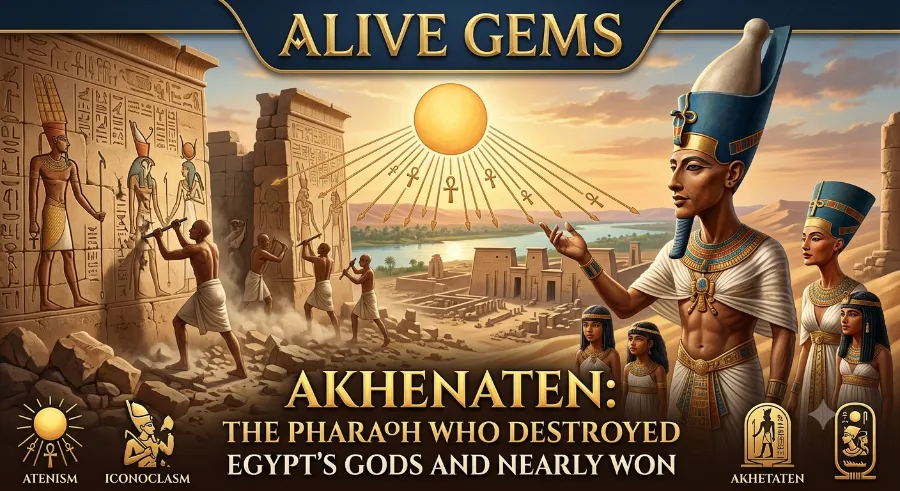
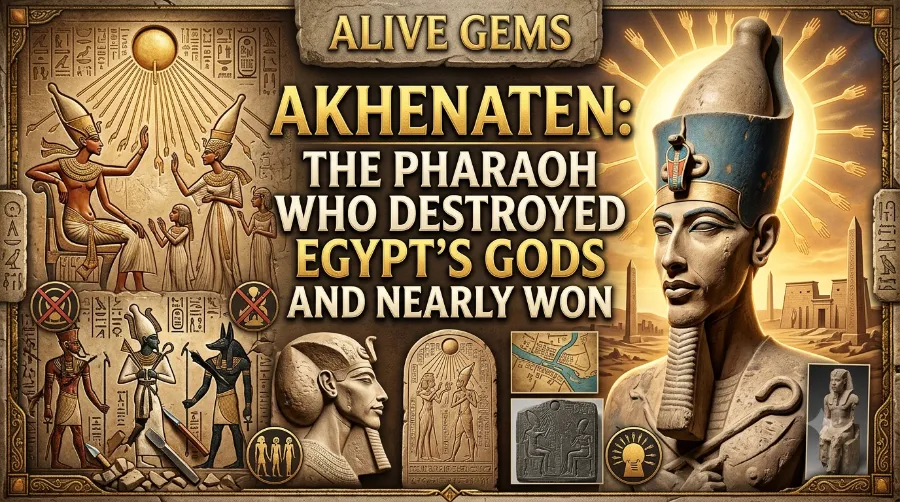
Akhenaten the Pharaoh, Imagine waking up one morning in the richest kingdom on earth and being told that every god your family has worshipped for a thousand years is now a lie. That is exactly what happened to the people of ancient Egypt when Akhenaten destroyed Egypt’s gods, closed a thousand temples, and told his entire nation to worship one invisible sun instead. He was not a madman shouting in the desert. He was the most powerful man alive, and for almost two decades, he nearly rewrote the spiritual DNA of an entire civilization. This is the true story of how one pharaoh tried to erase every god but his own, and how close he actually came to winning.
Meister Eckhart: The Mystic Too Radical Even for the Pope
Key Takeaways
| Fact | Detail |
|---|---|
| Real Name | Amenhotep IV, later changed to Akhenaten |
| Reign | Around 1353 to 1336 BCE, roughly 17 years |
| Dynasty | 18th Dynasty, New Kingdom Egypt |
| Main Reform | Replaced Egypt’s many gods with one sun god, Aten |
| New Capital | Akhetaten, modern day Amarna, built around 1346 BCE |
| Wife | Nefertiti, one of the most famous queens in history |
| Successor’s Fate | His son Tutankhamun restored the old gods after his death |
| Historical Erasure | His name was deliberately removed from Egyptian records for over 3,000 years |
TL;DR
- Akhenaten destroyed Egypt’s gods by banning traditional worship and forcing the country to follow one sun god named Aten.
- He built an entirely new capital city, Akhetaten, just to support his new religion.
- His revolution collapsed within a decade of his death, but it briefly became the closest thing to monotheism the ancient world had ever seen.
Who Was Akhenaten Before He Turned Against Egypt’s Gods?
Before he became the most controversial pharaoh in Egyptian history, he was simply Amenhotep IV, the second son of Amenhotep III and Queen Tiye. His older brother was expected to inherit the throne, so nobody prepared him for absolute power. However, his brother died young, and suddenly a boy who had grown up in the shadow of the crown was staring straight at it.
He inherited a kingdom that was, without exaggeration, the wealthiest and most stable empire on the planet around 1353 BCE. Egypt controlled gold mines, international trade routes, and a priesthood so powerful that some historians compare it to a second government. That last detail matters more than people realize, because it explains almost everything that happened next.
A Kingdom Run by Priests, Not Just Pharaohs
By the time Amenhotep IV took the throne, the priests of Amun in Thebes had grown incredibly rich and politically influential. They controlled enormous farmland, gold reserves, and thousands of workers. Consequently, a young pharaoh trying to assert his own authority had a very real rival sitting inside his own temples.
This tension is often overlooked in casual retellings of Akhenaten’s story, yet it is the missing piece that turns him from a religious fanatic into a shrewd political strategist. Similar to how spiritual reformers throughout history clashed with entrenched religious institutions, Akhenaten’s fight was never purely theological. It was also, quietly, a fight for control.
How Akhenaten Destroyed Egypt’s Gods
Around year five of his reign, everything changed. He abandoned his birth name, Amenhotep IV, which literally means “Amun is satisfied,” and took the name Akhenaten, meaning “effective for the Aten.” This single name change was a declaration of war against the old order.
He then did something no pharaoh had ever attempted on this scale. Rather than simply promoting a favorite god, he moved to eliminate the others entirely. Here is what that actually looked like in practice:
- He ordered the closure of temples dedicated to Amun and other traditional gods across Egypt.
- He redirected temple income and land, which had funded thousands of priests, toward his own new religion.
- He removed the plural word “gods” from official inscriptions wherever possible.
- He commanded workers to physically chisel out the names of Amun and other deities from monuments.
- He declared that only he, as pharaoh, could communicate directly with the divine, cutting priests out of the picture almost completely.
This was not gentle reform. This was a calculated demolition of Egypt’s religious infrastructure, and it remains one of the most radical religious reformers history has ever recorded, ancient or modern. According to the American Research Center in Egypt, Akhenaten came to power around 1353 or 1351 BCE and ruled for roughly 17 years during Egypt’s 18th dynasty, using that time to reshape the country’s entire spiritual identity. You can see a detailed breakdown of that revolution here.
Why Aten and Not Just Another Familiar God
Aten was not a brand new invention. Sun worship already existed in Egypt, often tied to the god Ra. However, Akhenaten stripped Aten of nearly all mythology, images, and animal symbolism that other gods carried. Aten was represented simply as a sun disc with rays reaching down, often ending in tiny hands.
This stripped down symbolism mattered because it made Aten harder to merge with other traditions. Many scholars now describe this shift as Akhenaten monotheism Egypt’s first true attempt at worshipping a single, formless divine power, even though debate continues over whether it was true monotheism or an extreme form of monolatry, meaning worship of one god while not fully denying others existed.
The City Built for One God: Akhetaten
Perhaps the boldest move of Akhenaten’s reign was abandoning Thebes entirely. Around 1346 BCE, he built a brand new capital from scratch on virgin land roughly 200 miles north, naming it Akhetaten, meaning “Horizon of the Aten.” Today archaeologists call this site Amarna, and it gives its name to the entire Amarna Period of Egyptian history.
This was not a modest relocation. Akhenaten described the site as chosen by Aten itself, and he built massive open air temples designed for direct sunlight rather than the dark, mysterious sanctuaries other gods received. If you want to see how dramatically this city looked compared to traditional Egyptian design, this documentary walkthrough offers a striking visual reconstruction.
A Capital With No Old Gods Allowed
Unlike Thebes or Memphis, Akhetaten had almost no shrines to Egypt’s traditional pantheon. Everything from the layout of the royal palace to the artwork on tomb walls centered on Aten and the royal family. In fact, one of the strangest features of Amarna art is that Akhenaten and his family, not any god, became the central figures worshippers looked toward.
- The city covered roughly eight miles along the Nile’s east bank.
- It included massive open air temples with no roofs, allowing full sunlight to reach the altars.
- Workers’ villages, palaces, and administrative buildings were built at astonishing speed, in under a decade.
Nefertiti and the Human Side of a Religious Earthquake
No conversation about Akhenaten is complete without Nefertiti, his primary wife and one of the most iconic women in ancient history. She appears constantly in Amarna art, sometimes even performing rituals typically reserved for the pharaoh alone, which was almost unheard of in Egyptian tradition.
Their family portraits, discovered on temple walls and in tombs, show something startlingly intimate for royal Egyptian art: children being kissed, casual affection, and relaxed body language. This softer, more human artistic style is one of the lasting legacies of the Amarna Period, regardless of how you judge the religious politics behind it.
Interestingly, the drive to reshape spiritual life around one central figure or one unseen power echoes patterns found in other transformative religious movements throughout history. You can explore how Buddha the prince gave up everything to seek a different kind of truth, or how Guru Nanak built an entirely new egalitarian faith in a world dominated by rigid religious hierarchy, both strikingly different journeys, yet both born from a hunger to break inherited tradition.
Why This Religious Revolution Almost Succeeded
Here is the part most people miss. Akhenaten’s reforms were not some fringe experiment ignored by the population. For close to two decades, an entire empire operated under his new religious order. Temples stayed closed. A new capital city functioned as the political and spiritual center of the world’s most powerful nation. Children were born, raised, and buried under a completely different belief system than their grandparents knew.
| Before Akhenaten | During Akhenaten’s Reign |
|---|---|
| Dozens of major gods worshipped | Only Aten officially recognized |
| Powerful independent priesthoods | Priesthood income redirected to the crown |
| Capital in Thebes | Capital moved to Akhetaten |
| Traditional formal art style | Softer, naturalistic Amarna art style |
| Afterlife tied to Osiris and traditional judgment | Afterlife increasingly tied to the pharaoh and Aten |
This table shows just how deep the changes ran. It was not one temple closing. It was the entire operating system of Egyptian religion, government, and art rewritten within a single generation.
A Pattern Seen Again and Again in History
Radical religious reformers rarely succeed completely on their first attempt, yet many leave permanent cracks in the old order even when their movement is later suppressed. Similar to how Francis of Assisi challenged the wealth and comfort of the medieval church, or how Teresa of Avila quietly rewrote the inner spiritual life of Christianity from within a convent, Akhenaten proved that a single determined figure with enough authority can genuinely threaten a religious system that seemed permanent. You can read more about figures like this on our pillar guide to spiritual icons who changed the world.
How Egypt’s Gods Came Back After Akhenaten
Akhenaten’s revolution did not survive his death around 1336 BCE. His young son, originally named Tutankhaten, meaning “living image of Aten,” took the throne as a child. Within just a few years, his advisors guided him toward a stunning reversal.
He changed his own name to Tutankhamun, meaning “living image of Amun,” publicly restoring the god his father had tried to erase. Temples reopened. Priesthoods regained their land and influence. The capital moved back toward Thebes and Memphis, and workers began dismantling Akhetaten, reusing its stone blocks for new construction elsewhere.
Later pharaohs went even further. Horemheb, who took power around 1319 BCE, backdated his own reign in official records to erase Akhenaten, Tutankhamun, and their immediate successors from history almost entirely. For centuries, most Egyptians had no idea this entire episode had ever happened.
Numbers That Show the Scale of the Erasure
- Akhenaten’s name disappeared from official Egyptian king lists for roughly 3,000 years.
- His memory was only rediscovered after the Rosetta Stone was deciphered by Jean-François Champollion in 1824.
- Excavations at Amarna, properly mapped in the 18th and 19th centuries, revealed just how large and short-lived his city truly was.
For a deeper visual sense of what remains at the site today, this overview of Akhenaten’s story and ruins is genuinely worth a look if you enjoy walking through ancient locations virtually.
What Modern Science Has Revealed About Akhenaten’s Family
Modern research has added layers to this story that ancient scribes could never have imagined. In 2010, a landmark DNA and CT scan study led by Egyptian archaeologist Zahi Hawass examined mummies believed to belong to Akhenaten’s immediate family. The results suggested that Tutankhamun’s parents were Akhenaten and one of his own sisters, a practice not unusual among Egyptian royalty at the time.
The same study found evidence that Tutankhamun suffered from a bone disorder and had contracted malaria, which likely contributed to his death as a teenager. This research reshaped how historians understand the physical and genetic pressures placed on a royal family that had already turned its back on centuries of religious tradition.
More recent scholarship continues to debate whether Akhenaten’s Aten worship should be classified as true monotheism or an early, unstable form of it. Either way, most historians now agree it stands as one of the earliest recorded ancient religious revolutionaries movements where a single ruler attempted to impose one god onto an entire civilization by force of law. you can also read our blog related: Zoroaster: The Forgotten Prophet Hiding Inside Every Major Religion
A Simple Timeline Chart of Akhenaten’s Reign
| Year (Approx.) | Event |
|---|---|
| 1353 BCE | Amenhotep IV becomes pharaoh of Egypt |
| 1348 BCE | Begins major religious reforms, elevating Aten |
| 1346 BCE | Founds new capital city, Akhetaten (Amarna) |
| 1338 BCE | Peak of Atenism, temples to other gods remain closed |
| 1336 BCE | Akhenaten dies, succession crisis begins |
| 1332 BCE | Tutankhamun restores worship of Amun and traditional gods |
| 1319 BCE | Horemheb begins erasing Akhenaten from official records |
| 1824 CE | Rosetta Stone deciphered, reopening Akhenaten’s forgotten story |
Frequently Asked Questions About Akhenaten
Did Akhenaten really destroy Egypt’s gods completely?
Not entirely. He closed major temples and suppressed public worship of most gods, but full destruction of every religious tradition across Egypt in just seventeen years was practically impossible, even for a pharaoh.
Was Akhenaten the first monotheist in history?
Many historians consider him one of the earliest examples of monotheistic or near monotheistic worship, though scholars still debate whether his system fully denied other gods’ existence or simply refused to worship them.
Why did Tutankhamun undo his father’s religious reforms?
Tutankhamun took the throne as a child and was heavily guided by advisors and priests who wanted stability restored. Reviving Amun worship helped legitimize his young rule and calm a nervous population.
How was Akhenaten’s city, Akhetaten, eventually lost?
After the royal court left, later pharaohs and builders dismantled much of the city, reusing its stone for other construction projects, which left the site largely buried until modern archaeological excavation.
Why was Akhenaten’s name erased from Egyptian history?
Later rulers, particularly Horemheb, wanted to distance Egypt from the chaos associated with Akhenaten’s reign and rebuild the traditional religious order without any reminder of the disruption.
Quick Quiz: Test What You Learned About Akhenaten
- What was Akhenaten’s original birth name before he changed it?
- A) Tutankhamun
- B) Amenhotep IV
- C) Horemheb
- What was the name of the new capital city Akhenaten built?
- A) Memphis
- B) Thebes
- C) Akhetaten
- Which god did Akhenaten elevate above all others?
- A) Osiris
- B) Aten
- C) Anubis
- True or False: Akhenaten’s religious reforms survived for centuries after his death.
- Who was Akhenaten’s famous wife, frequently shown in Amarna art?
(Answers: 1-B, 2-C, 3-B, 4-False, 5-Nefertiti)
Conclusion
Akhenaten destroyed Egypt’s gods with a boldness that still stuns historians thousands of years later, and for nearly two decades, he came remarkably close to permanently rewriting the spiritual foundation of one of history’s greatest civilizations. His story is not simply about ancient religion. It is about what happens when one person, given absolute power, decides tradition itself is the enemy. Egypt eventually pulled itself back from the edge of that transformation, yet the fact that it came this close remains one of the most fascinating turning points in ancient history.
References
- American Research Center in Egypt, “Akhenaten: The Mysteries of Religious Revolution”
- World History Encyclopedia, “Amarna Period of Egypt”
- Egypt Tours Portal, “King Akhenaten”
- Biblical Archaeology Society, “Akhenaten and Moses”
- Zahi Hawass et al., DNA and radiological study of the Amarna royal mummies, 2010