
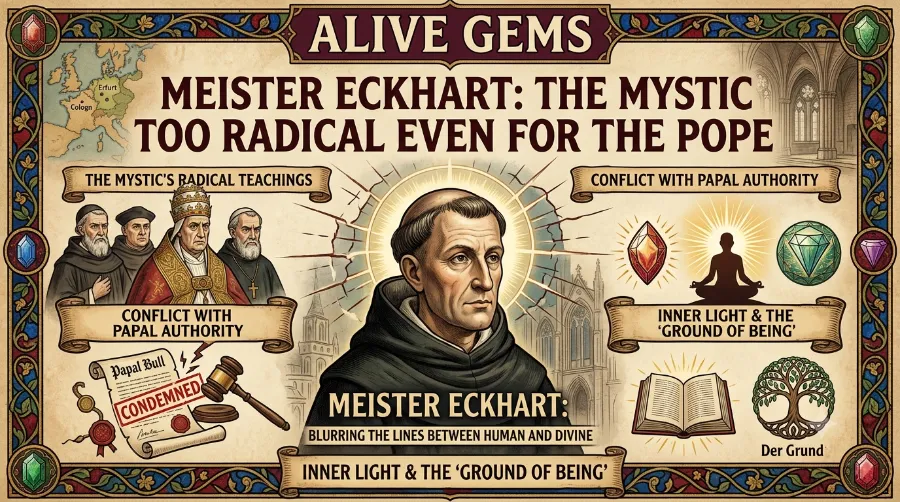
Meister Eckhart a preacher standing in a crowded German church in the year 1320. He tells ordinary farmers, merchants, and nuns that God is not far away in some distant heaven. God, he says, is being born inside your own soul right now, today, in this very moment. The crowd leans in. Somewhere, a church official writes down every word. Within a decade, those words will land on the desk of the Pope himself. This is the strange, thrilling, and genuinely heartbreaking story of Meister Eckhart, a man whose name still shows up constantly in conversations about medieval Christian mystics history, and whose ideas were, quite literally, too radical for the pope who eventually condemned them.
If you love stories about spiritual icons who changed the world, Eckhart belongs right alongside the boldest names in that tradition. He was not a rebel for the sake of rebellion. He was a brilliant, deeply trained theologian who simply refused to stop asking the biggest question a human being can ask: how close can a person actually get to God? That question got him investigated, put on trial, and ultimately condemned by Pope John XXII, just months after his own death. And yet, seven centuries later, his sermons are quoted by monks, therapists, poets, and spiritual seekers who have never set foot in a church.
Key Takeaways
| Fact | Detail |
|---|---|
| Full name | Eckhart von Hochheim, known as Meister Eckhart |
| Lived | Around 1260 to around 1328 |
| Order | Dominican friar and theologian |
| Trained at | University of Paris, the intellectual heart of medieval Europe |
| Roles held | Provincial of Saxony, preacher in Strasbourg and Cologne |
| Condemned by | Pope John XXII |
| Bull that condemned him | In agro dominico, issued March 27, 1329 |
| Propositions condemned | 28 total, with roughly 15 to 17 labeled heretical and 11 labeled suspect |
| Was he declared a heretic personally? | No, only specific statements were condemned after his death |
| Legacy today | Widely studied as a foundational figure in Christian mysticism and interfaith spirituality |
TL;DR
- Meister Eckhart was a respected Dominican scholar and preacher whose sermons about the soul’s direct union with God went further than church authorities could accept.
- Pope John XXII condemned 28 of his teachings in the 1329 bull In agro dominico, though Eckhart himself died before the final verdict and was never formally branded a heretic as a person.
- His writing survived the condemnation and today he is regarded as one of the most influential and most controversial spiritual thinkers Christianity ever produced.
Who Was Meister Eckhart? A Quick Look at the Man Behind the Legend
Meister Eckhart, born Eckhart von Hochheim around 1260 in the region of Thuringia in what is now Germany, was not some fringe wandering preacher. He joined the Dominican order as a young man and rose through one of the most rigorous academic systems Europe had ever built. He studied and later taught at the University of Paris, the same intellectual proving ground that shaped Thomas Aquinas. The word “Meister” itself is simply German for “Master,” a title he earned through formal academic achievement, not mysticism alone.
Eckhart spent much of his career teaching and administering within the Dominican Order, serving as a master of theology in Paris, provincial of Saxony, and preacher in Strasbourg and Cologne. He was, in every practical sense, a company man. He held leadership positions. He trained other friars. He was trusted with real administrative power at a time when the church did not hand that out casually. This Day
But something else was happening alongside the paperwork and the sermons. Eckhart was translating the driest, most technical scholastic philosophy into raw, intimate German, the language regular people actually spoke at home. He wanted farmers and nuns and merchants to feel what theologians argued about in Latin. That decision, more than any single doctrine, is part of what got him into trouble.
If you enjoy this kind of deep dive into the spiritual icons who changed the world, Eckhart fits naturally beside figures like Rumi the Sufi poet, whose ecstatic verses pushed the boundaries of Islamic mysticism in much the same decade Eckhart was pushing the boundaries of Christian theology.
The World That Shaped a Radical Mystic
To understand why Eckhart’s ideas felt so dangerous, you have to picture fourteenth century Europe. The church was not just a religion. It was the government, the courts, the universities, and the only source of truth most people ever encountered. Questioning church hierarchy was not like questioning a company policy today. It could end a career, a reputation, or a life.
At the same time, a wave of independent religious movements was rising across Germany, France, and the Low Countries. Groups of laywomen called Beguines lived in community, prayed intensely, and sought direct experience of God without going through official church channels. The Council of Vienne had already condemned some of their teachings back in 1312, years before Eckhart’s own trial. Eckhart also suffered from suspicion directed toward these more or less unofficial mystic groups. He was preaching, teaching, and writing in exactly the atmosphere where church leaders were already nervous about anyone claiming a shortcut to divine union. Scribd
Meanwhile, political tension was boiling. Eckhart’s real conflict was not simply with Pope John XXII but with Franciscan rivals who had never fully accepted the recent canonization of the Dominican theologian Thomas Aquinas, along with supporters of Louis of Bavaria, who was openly hostile to the pope while most Dominicans stayed loyal to him. In other words, Eckhart was a Dominican caught in the crossfire of an order rivalry and a political fight between the papacy and the emperor. His theology gave his enemies the ammunition, but the war itself was bigger than any one sermon. Scribd
If this era of spiritual daring interests you, it is worth reading about Francis of Assisi, whose radical embrace of poverty a century earlier also unsettled a comfortable church establishment, or Hildegard von Bingen, the medieval genius and prophet who somehow managed to preach visionary theology and survive with her reputation largely intact.
The Ideas That Made Him Dangerous
Eckhart’s core teaching sounds almost simple on the surface, and that simplicity is exactly what made it explosive.
The Birth of God in the Soul
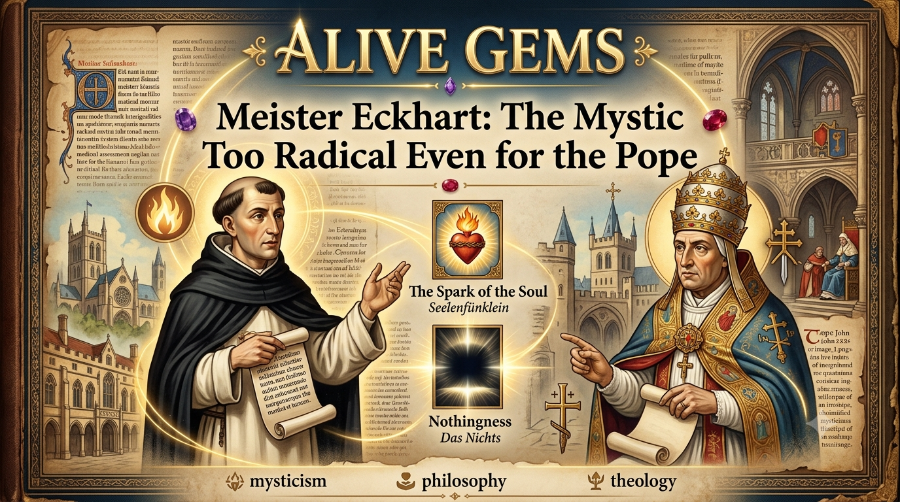
Eckhart preached that God is continuously being born within every human soul, right now, not just at Christmas and not just symbolically. He described a “spark” or “ground” of the soul that is so deeply united with God that, in certain moments, the distinction between creature and creator seems to dissolve. To modern ears this sounds beautiful. To fourteenth century church officials, this sounded like Eckhart was erasing the line between humanity and God entirely, which is one of the oldest fears in Christian theology.
Detachment Above All Else
He taught a concept he called “gelassenheit,” often translated as detachment or letting go. For Eckhart, true spiritual freedom meant releasing attachment not just to sin, but to good works, to images of God, and even to the idea of wanting anything from God at all. Real union, he argued, only happens when the soul stops grasping.
Preaching in German, Not Latin
This point does not get enough credit in most retellings. Latin was the language of theological control. By preaching his most daring ideas in vernacular German sermons to ordinary Dominican nuns and laypeople, Eckhart was effectively democratizing access to advanced mystical theology. He had to build a brand new mystical vocabulary in German, and his enemies later took statements from those German sermons and compared them unfairly against his more careful Latin academic writing, without accounting for the difference in genre and audience. Scribd
Why This Felt So Threatening
Here is a short list of what church officials genuinely worried Eckhart’s teaching might do:
- Undercut the necessity of the sacraments and the priesthood as the required path to God
- Blur the difference between the creator and the creation itself
- Suggest that a person could reach spiritual perfection without ongoing moral effort
- Give ordinary, untrained people access to ideas the church believed only trained theologians should handle safely
For more on how mystics elsewhere handled similarly dangerous territory, the story of Teresa of Avila, who rewrote the interior landscape of Christian prayer roughly two centuries later, makes for a fascinating comparison. So does Guru Nanak, who built an entirely new faith around the idea that direct connection with the divine should not require priestly gatekeeping.
The Trial: How a Respected Theologian Became One of History’s Most Controversial Spiritual Thinkers
By 1326, Eckhart was in Cologne, and the whispers had become formal accusations. An inquisitional proceeding opened against him that year, and Eckhart submitted a written response defending himself while also protesting the legitimacy of the proceeding, which was then moved to the papal court at Avignon. This was no small local squabble. The case traveled all the way to the pope’s own residence in France, where John XXII personally oversaw the final stage of judgment.
Theologians in Avignon assembled a report listing 28 propositions drawn from Eckhart’s work, a much smaller and more carefully filtered list than the earlier accusations he had faced, and the report also noted that Eckhart had denied ever teaching two of the statements attributed to him. Crucially, the pope took Eckhart’s cooperative attitude and stated good intentions into account, condemning the propositions strictly according to their surface meaning rather than declaring Eckhart himself a personal heretic. ScribdScribd
Eckhart never lived to hear the final verdict. He died sometime around 1327 or 1328, while the case was still pending, on his way to formally defend himself before the church. The bull condemning his writing, called In agro dominico, was issued afterward.
The Bull In Agro Dominico, By the Numbers
| Detail | Figure |
|---|---|
| Date issued | March 27, 1329 |
| Issued by | Pope John XXII |
| Total propositions condemned | 28 |
| Labeled outright heretical | 15 to 17, depending on the source list |
| Labeled suspect of heresy | 11 |
| Eckhart declared a heretic personally? | No |
| Eckhart’s status at time of ruling | Already deceased |
The bull acknowledged that Eckhart had retracted any errors and submitted himself to the Holy See before his death, and it condemned specific censured statements rather than the man himself. That distinction matters enormously and gets lost in a lot of popular retellings. Eckhart was never burned, imprisoned, or excommunicated. His words were condemned. His character, according to the church’s own final ruling, was not. This Day
Scholars have also pointed out that the bull frequently quoted Eckhart’s propositions out of their original context, without including the full surrounding passages, which has made it genuinely difficult for later researchers to match each condemned line back to his surviving texts with total certainty. This is one reason modern theologians increasingly treat the condemnation as a product of thirteenth and fourteenth century politics and translation problems as much as pure doctrine. This Day
What Happened After the Condemnation
Here is where the story gets genuinely moving. Despite an official papal condemnation, Eckhart’s writings did not disappear. Quite the opposite happened.
- His students, including the mystics Johannes Tauler and Henry Suso, carried his ideas forward in gentler, less legally risky language
- Handwritten copies of his German sermons continued circulating quietly across convents and lay religious communities for generations
- By the twentieth century, scholars including Bernard McGinn led a full academic reexamination that concluded much of Eckhart’s theology was fundamentally orthodox, just poorly understood by the commission that judged him
- Modern scholarship now largely agrees that Eckhart was misunderstood by the commission that examined his work, which is part of a broader theological rehabilitation of his reputation over recent decades. Encyclopedia.com
Numbered simply, his path from condemned heretic to celebrated mystic looked something like this:
- 1326: Formal inquisitional proceedings open against him in Cologne
- 1327 to 1328: Eckhart appeals, defends himself, and dies before a verdict is reached
- March 27, 1329: Pope John XXII issues In agro dominico, condemning 28 propositions
- 1300s to 1800s: His writing survives underground through students and quiet manuscript circulation
- 1900s to today: Full academic rehabilitation, widespread study, and popular spiritual influence across denominations and even beyond Christianity entirely
Why Eckhart Still Matters in the Modern World
Here is something that genuinely surprised me while researching medieval mystics for this piece. Eckhart is one of the very few condemned medieval theologians whose original sermons are still printed in ordinary bookstores today, sitting on shelves next to contemporary spirituality authors rather than being locked away in academic archives. His concept of detachment quietly influenced later thinkers in psychology, contemplative Christianity, and even secular mindfulness practice, decades before mindfulness became a mainstream word.
Teachers of Zen Buddhism have pointed to striking parallels between Eckhart’s writing on emptiness and Buddhist teachings on non attachment, which is remarkable given he almost certainly never encountered Buddhist texts himself. If you want to see how a completely different tradition arrived at similar insight through its own path, it is worth reading about the Buddha’s own journey away from wealth and toward inner liberation, or the older Persian roots explored in the story of Zoroaster, whose ideas quietly shaped major world religions long before Eckhart was born.
As one modern spiritual commentary puts it, Eckhart’s writings explored the nature of God, the human soul, and detachment from worldly attachments in a way that many readers still find deeply profound and transformative, even without the specific medieval Catholic framework it was originally written inside. Antilogicalism
Quick Answer for Readers in a Hurry
If someone asked you at a dinner party why Meister Eckhart got in trouble with the church, here is the honest one sentence answer: he preached that ordinary people could experience direct, intimate union with God without needing every step of official church mediation, and that idea felt threatening enough to powerful rivals and a nervous papacy that 28 of his statements were formally condemned in 1329, months after he had already died.
Meister Eckhart Quiz: Test What You Just Learned
Multiple Choice
- In what year was the bull In agro dominico issued against Eckhart’s teachings?
a) 1229
b) 1329
c) 1429 - Which religious order did Meister Eckhart belong to?
a) Franciscan
b) Benedictine
c) Dominican - How many propositions from Eckhart’s work were officially condemned?
a) 12
b) 28
c) 40
Short Answer
- What German word did Eckhart use to describe his concept of spiritual letting go?
- Was Eckhart personally declared a heretic by the final papal ruling, yes or no?
(Answers: 1-b, 2-c, 3-b, 4-gelassenheit, 5-no, only specific statements were condemned)
Frequently Asked Questions
Was Meister Eckhart ever officially declared a heretic?
No. The final ruling condemned specific statements drawn from his teaching, not Eckhart as a person, and it acknowledged his cooperative attitude during the proceedings.
When exactly was Meister Eckhart condemned by the pope?
The condemnation came through the papal bull In agro dominico, issued by Pope John XXII on March 27, 1329.
Did Meister Eckhart know he had been condemned?
No. He died before the final ruling was issued, while the case was still under review at the papal court in Avignon.
Why is Eckhart still considered one of history’s most controversial spiritual thinkers?
Because his teaching on the soul’s direct union with God challenged the church’s role as a required intermediary, a tension that still shows up in debates about institutional religion versus personal spirituality today.
Is Meister Eckhart considered a saint or an official church figure today?
He has never been formally canonized, though many modern theologians and even some church scholars now treat his core teaching as fundamentally orthodox and worth studying seriously.
A Few Honest Reflections
Having spent real time with Eckhart’s sermons rather than just summaries of them, what stands out is how little his language resembles fire and brimstone preaching. He sounds patient. He sounds like someone genuinely trying to hand people a gift, not provoke a fight. That gentleness is part of why the condemnation still feels so unfair to many modern readers, myself included. Political rivalries, translation gaps between his German and Latin work, and an anxious institutional moment all combined against a thinker who, by most contemporary readings, was not trying to tear anything down. He was trying to bring people closer to something he genuinely believed was already inside them.
You can trace a similar quiet defiance through other figures who reshaped how ordinary people related to the divine, including the pharaoh Akhenaten, who upended an entire religious system centuries before Eckhart was ever born, proving that this tension between institutional religion and personal spiritual conviction is far older than medieval Europe.
Conclusion
Meister Eckhart never set out to become a rebel. He was a trained scholar, a trusted administrator, and a devoted friar who simply followed his own theology further than the institution around him was ready to go. The condemnation he received in 1329 says as much about the political anxieties of fourteenth century Europe as it does about anything genuinely dangerous in his ideas. Seven hundred years later, his sermons are still read, still quoted, and still capable of making a reader stop and reconsider what closeness to the divine actually means. That kind of staying power is rare, and it is exactly why Eckhart remains one of the most fascinating figures in the entire history of Christian mysticism.
References
- Bull In Agro Dominico, Pope John XXII, March 27, 1329, Denzinger’s Sources of Catholic Dogma
- The Heresies of Meister Eckhart, Medium, Catholicism for the Modern World
- Women of Grace, commentary on Meister Eckhart’s teaching and trial
- Patheos, Meister Eckhart and today’s spiritual but not religious readers
- Encyclopedia.com, biographical entry on Meister Eckhart
- Philopedia, philosophical overview of Meister Eckhart von Hochheim
- Cambridge Core, New Blackfriars, Why Were Eckhart’s Propositions Condemned