
Buddha the Prince a young man who has never known hunger, never seen a wrinkle, never watched anyone die. Now picture that same man walking away from his palace, his wife, his newborn son, and every comfort he has ever known, just to sit under a tree until he understands why people suffer. That is the real story behind the phrase Buddha prince left everything saved everyone, and it is one of the most quietly radical decisions in human history. This is not a fairy tale about a saint born glowing with wisdom. It is the story of a curious, restless, deeply human prince named Siddhartha Gautama, and how his personal crisis turned into a movement that would eventually touch nearly a third of the world’s population.
want to know interesting facts about Teresa of Avila: The Mystic Who Rewrote Christianity’s Interior Life
Key Takeaway Table
| Fact | Detail |
|---|---|
| Real name | Siddhartha Gautama |
| Birth | Around 563 BCE, Lumbini (modern day Nepal) |
| Family status | Prince of the Shakya clan |
| Turning point | The Four Sights and the Great Departure, around age 29 |
| Years of searching | 6 years of extreme practices before enlightenment |
| Enlightenment | Under the Bodhi tree, Bodh Gaya, India |
| Teaching career | 45 years, traveling on foot |
| Followers today | Over 500 million practicing Buddhists worldwide |
| Death | Around 483 BCE, Kushinagar, at age 80 |
TL;DR
- A pampered prince named Siddhartha Gautama secretly left his palace after witnessing old age, sickness, death, and a wandering monk.
- He spent six years testing extreme spiritual paths before finding a balanced Middle Way, which he taught for 45 years until his death around 483 BCE.
- His charisma was not loud or forceful. It came from radical honesty, deep listening, and a genuine desire to end human suffering, which is exactly why Buddhism spread across continents and still shapes over 500 million lives today.
Buddha the Prince Who Had Everything and Still Felt Empty
Siddhartha Gautama was born around 563 BCE in Lumbini, a small kingdom near the Himalayan foothills in what is now Nepal. His father, King Suddhodana, ruled the Shakya clan and wanted only one thing for his son: greatness as a king, not a spiritual seeker. So the king did something almost obsessive. He built three separate palaces for each season and filled them with music, dancers, gardens, and every luxury imaginable, hoping to shield Siddhartha from anything unpleasant.
For nearly 29 years, it worked. Siddhartha married a beautiful princess named Yasodhara and they had a son, Rahula. From the outside, his life looked complete. Yet according to the earliest Buddhist texts, something inside him kept asking questions that comfort could not answer. This restlessness is the first real clue about his personality, and honestly, it is the part most people skip when they retell this story. A children’s retelling by storyteller Aaron Shepard captures this same quiet unease beautifully, showing a boy who had everything except peace of mind.
He was not a passive figure waiting for enlightenment to fall on him. He was curious almost to a fault, the kind of person who could not simply accept “because that is how it is” as an answer. If you have ever felt uneasy in a life that looks perfect on paper, you already understand the emotional core of this story better than most textbooks explain it.
As the Buddhist Peace Fellowship explains in its reflection on right renunciation, letting go in this tradition was never meant as rejection of the world but as a deeper, more honest way of loving it. The Pluralism Project at Harvard adds further context, describing Siddhartha’s departure as a deliberate search for something more lasting than pleasure or power, not an act of despair.
The Four Sights That Changed Everything
According to tradition, Siddhartha convinced his charioteer, Channa, to take him outside the palace walls on several secret trips. What he saw on these trips is often called the Four Sights, and it completely dismantled the illusion his father had spent decades building.
- An old man, bent and frail, showing Siddhartha that youth does not last
- A sick man, suffering visibly, showing him that health is not guaranteed
- A corpse being carried to cremation, showing him that death spares no one, not even princes
- A wandering ascetic, calm despite owning nothing, showing him that peace might exist outside wealth entirely
This is the emotional turning point of the entire story. A man who had been protected from pain his whole life suddenly saw all of it at once, and instead of running back to his palace comforts, he ran toward the questions.
The Great Departure: Leaving Everything Behind
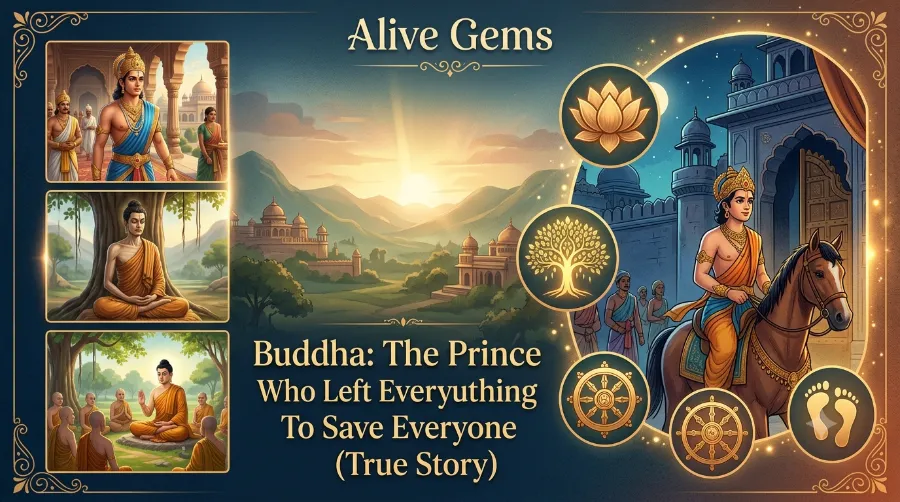
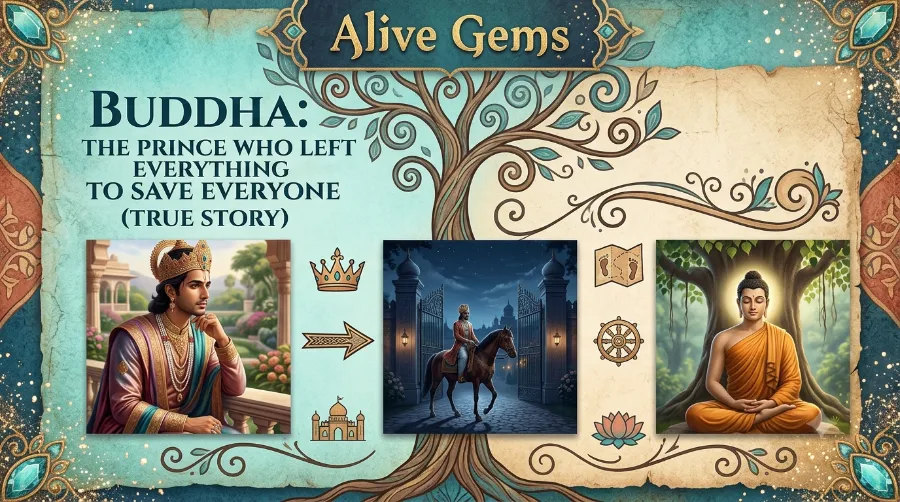
At around age 29, Siddhartha made the decision that gives this story its name. One night, he looked at his sleeping wife and infant son one last time, and then he left the palace on horseback with Channa, quietly, without ceremony or announcement.
This moment is called the Great Renunciation in Buddhist tradition, and it is genuinely one of the boldest personal decisions recorded in ancient history. He gave up a guaranteed kingdom, a loving family, and total financial security, choosing instead complete uncertainty. As the Buddhist Peace Fellowship explains in its reflection on right renunciation, letting go in this tradition was never meant as rejection of the world but as a deeper, more honest way of loving it. The Pluralism Project at Harvard adds further context, describing Siddhartha’s departure as a deliberate search for something more lasting than pleasure or power, not an act of despair.
Think about that for a second. Most people spend their entire lives chasing the security Siddhartha already had, and he walked away from it voluntarily because he sensed something was missing that no palace could provide.
Six Years of Searching, Failing, and Almost Starving
Here is a part of the story that gets glossed over too often. Siddhartha did not become enlightened overnight. He spent roughly six years testing different spiritual paths, many of them extreme.
He studied meditation under respected teachers of his time, mastering their techniques quickly but feeling unsatisfied with the results. Then he joined a group of five ascetics and pushed his body to the edge, reportedly eating as little as a single grain of rice a day. Historical and textual accounts describe him becoming so thin that he could feel his spine by pressing his stomach.
Eventually, weak and nearly dying, he accepted a bowl of rice pudding from a village girl named Sujata. His five companions saw this as a failure of discipline and abandoned him in disgust. This moment matters because it shows something crucial about real leadership. Siddhartha was willing to be publicly wrong, to change course even when it cost him his only remaining supporters. That kind of honesty, even when it is humiliating, is a rare form of charisma that quiet leaders like Francis of Assisi also demonstrated centuries later when he famously stripped himself of wealth and status without caring how it looked to others.
The Night Under the Bodhi Tree
After recovering his strength, Siddhartha sat beneath a fig tree in Bodh Gaya, in present day Bihar, India, and vowed not to move until he understood the root of suffering. According to tradition, he meditated through the night, facing waves of temptation, fear, and doubt, often personified as the demon Mara.
By dawn, he had reached enlightenment. He was now the Buddha, meaning “the awakened one.” He was around 35 years old.
What he realized became the foundation of the Four Noble Truths:
- Suffering exists in life
- Suffering has a cause, usually craving or attachment
- Suffering can end
- There is a path that leads to that ending, known as the Eightfold Path
This is not abstract philosophy dressed up in religious language. It is closer to an early form of psychological insight, and it is one reason modern psychologists and therapists still reference Buddhist concepts like mindfulness and non attachment in secular treatment today.
Why People Actually Followed Him: The Charisma Behind the Robes
This is where the story becomes about leadership, not just religion. The Buddha spent the next 45 years walking across northern India on foot, teaching anyone who asked, regardless of caste, gender, or wealth. That last point alone was revolutionary in a deeply caste based society.
His charisma did not come from wealth, armies, or political power, since he had already given all of that up. Instead, it came from a specific set of traits that modern leadership researchers would recognize instantly.
- He listened before he taught, often answering questions with more questions
- He adapted his teaching style to the audience, using simple farming metaphors for villagers and precise logic for scholars
- He admitted uncertainty rather than pretending to know everything
- He built community structures, like the Sangha, that could survive without depending on his personal presence
This last point explains how Buddhism spread through charisma even after his death. He was not building a personality cult around himself. He built systems, communities, and teachings that other people could carry forward independently, which is exactly why the movement did not collapse when he passed away. Read our blog on: Akhenaten the Pharaoh Who Destroyed Egypt’s Gods and Nearly Won
You can see similar patterns in other spiritual movements from history. Rumi, the Sufi poet, used verse instead of sermons to create an emotional bridge that let Sufism spread far beyond his hometown centuries after his death. Around the same era in a different region, Guru Nanak founded Sikhism on a promise of equality that outlived him by hundreds of years. Even in medieval Europe, Hildegard von Bingen built lasting influence not through armies or politics but through visionary teaching that communities chose to preserve long after she was gone. Charisma that lasts is rarely about the individual. It is about what they leave behind for others to build on.
The Numbers Behind Buddhism’s Spread
To understand just how far this movement traveled, it helps to look at some real figures.
| Region | Estimated Buddhist Population (2024 estimates) |
|---|---|
| China | Over 240 million |
| Southeast Asia (Thailand, Myanmar, Cambodia, Laos, Vietnam) | Roughly 190 million |
| Sri Lanka | Around 14 million |
| Japan | Approximately 46 million (including syncretic practice) |
| United States | Around 5 million |
| Europe | Approximately 3 to 4 million |
Globally, estimates place the number of practicing Buddhists somewhere between 500 million and 535 million people, making it the fourth largest religion in the world by most counts. That growth started with one man walking barefoot between villages for less than five decades. Meister Eckhart: The Mystic Too Radical Even for the Pope
Buddhism’s expansion did not happen through conquest, unlike many other religious movements in history. It spread largely through trade routes, missionary monks, and royal patronage, most famously under Emperor Ashoka of India around 260 BCE, who converted after witnessing the brutality of his own military campaigns and then sponsored the spread of Buddhist teaching across Asia. you can also read our blog related: Zoroaster: The Forgotten Prophet Hiding Inside Every Major Religion
Death Without Drama
The Buddha died around 483 BCE in Kushinagar at the age of 80, reportedly after eating a meal that disagreed with him, possibly spoiled pork or mushrooms depending on the translation. Even in his final moments, accounts describe him comforting his grieving followers rather than the other way around, reminding them that everything conditioned is impermanent and that they should be a light unto themselves.
There is something deeply human and almost anticlimactic about that ending, and I think that is exactly the point. He never claimed to be a god. He claimed to be someone who found a path and was now showing others where to walk.
What This Story Still Teaches Leaders Today
If you strip away the religious framing for a moment, the Buddha’s story is genuinely one of the earliest documented case studies in emotionally intelligent leadership. He questioned inherited privilege instead of defending it. He tested his own beliefs to the point of near death rather than accepting comfortable answers. He built something designed to outlast him rather than something that depended on his personality.
Modern leadership training often talks about servant leadership, active listening, and psychological safety as if these are new corporate inventions. The Buddha was practicing versions of all three roughly 2,500 years ago, without a single management textbook to guide him.
If you enjoy exploring how spiritual charisma shaped entire civilizations, this piece connects closely with our broader guide on spiritual icons who changed the world, where we look at several religious founders whose personal magnetism reshaped history far beyond their own lifetimes. You can also explore the full alivegems.com archive for more stories of the world’s most magnetic historical figures.
Quiz: How Well Do You Know the Buddha’s Story?
Test yourself with these five quick questions.
- What was Siddhartha’s birth name before he became the Buddha?
- How many years did Siddhartha spend searching before reaching enlightenment?
- What tree was he sitting under when he reached enlightenment?
- Which Indian emperor helped spread Buddhism through royal patronage?
- At what approximate age did the Buddha pass away?
Multiple Choice Bonus Round
Question A: Where was Siddhartha Gautama born?
a) Beijing, China
b) Lumbini, near modern day Nepal
c) Kyoto, Japan
Question B: What are the Four Noble Truths primarily about?
a) Military strategy
b) The nature and end of suffering
c) Trade and agriculture
Question C: What is the name given to the Buddhist community structure he established?
a) The Sangha
b) The Senate
c) The Caravan
(Answers: 1. Siddhartha Gautama, 2. About six years, 3. The Bodhi tree, 4. Emperor Ashoka, 5. Around 80 years old. Multiple choice answers: A is b, B is b, C is a.)
Frequently Asked Questions
Why did the Buddha leave his family?
He left in search of an answer to human suffering that he felt his comfortable palace life could never provide, though Buddhist tradition also holds that he intended to return once he found real understanding, which he eventually shared with his son and former wife years later.
Was the Buddha considered a god?
No. He explicitly rejected the idea of being worshipped as a deity and described himself as a teacher who had simply found a path that others could also walk.
How long did it take Buddhism to spread beyond India?
Within roughly 300 years of the Buddha’s death, Emperor Ashoka’s missionary efforts had already carried Buddhist teaching into Sri Lanka, Central Asia, and parts of the Mediterranean world.
Is the story of the Four Sights historically verified?
It comes from traditional Buddhist scripture rather than independent historical record, though most scholars agree it reflects the real psychological and spiritual crisis that pushed Siddhartha to leave his royal life.
Why is his story still relevant to charisma and leadership today?
Because his influence came from consistency, humility, and community building rather than force or wealth, which remains one of the most durable forms of leadership across every century since.
Final Thoughts
The story of Buddha prince left everything saved everyone is not really about religion first. It is about a young man who had every reason to stay comfortable and chose discomfort instead, because he could not unsee human suffering once he witnessed it. That single decision, made quietly on a horse in the middle of the night, eventually reshaped the spiritual lives of hundreds of millions of people across centuries and continents. Whatever your own beliefs, there is something worth sitting with in a story about a person who had absolutely everything and still walked away, simply because he wanted to help everyone else find peace too.
References
- Buddhist Peace Fellowship, Right Renunciation and the Beautiful World of Our Dreams, https://www.bpf.org/blog/right-renunciation-and-the-beautiful-world-of-our-dreams
- Aaron Shepard, Prince Siddhartha, https://www.aaronshep.com/stories/033.html
- Pluralism Project, Harvard University, Prince Siddhartha Renouncing the World, https://pluralism.org/prince-siddhartha-renouncing-the-world
- alivegems.com, Spiritual Icons Who Changed The World, https://alivegems.com/spiritual-icons-who-changed-the-world-charismatic-religious-figures/
- alivegems.com, Rumi The Sufi Poet, https://alivegems.com/rumi-the-sufi-poet/
- alivegems.com, Francis of Assisi, https://alivegems.com/francis-of-assisi/
- alivegems.com, Guru Nanak Founded Egalitarian Sikhism Faith, https://alivegems.com/guru-nanak-founded-egalitarian-sikhism-faith/
- alivegems.com, Hildegard von Bingen Medieval Genius Prophet, https://alivegems.com/hildegard-von-bingen-medieval-genius-prophet/