
Rosa Parks Refused to Move and Changed America a tired seamstress sitting quietly on a city bus after a long day at work. Now picture that single, quiet moment turning into one of the loudest turning points in American history. That is exactly what happened when Rosa Parks refused to move, and that refusal changed America in ways nobody could have predicted that evening in December 1955. Her story is not just a textbook paragraph. It is proof that one ordinary person, on one ordinary day, can shift the direction of an entire nation.
If you have ever wondered how a single act of quiet defiance grew into a movement that reshaped a country, you are about to get the real story, not the shortened version taught in schools.
Key Takeaways
| Fact | Detail |
|---|---|
| The Spark | Rosa Parks refused to move from her bus seat on December 1, 1955, in Montgomery, Alabama |
| The Response | Her arrest triggered the Montgomery Bus Boycott, which lasted 381 days |
| The Scale | Roughly 40,000 Black residents, about 75 percent of the bus system’s riders, stayed off the buses |
| The Outcome | The Supreme Court ruled bus segregation unconstitutional through Browder v. Gayle on November 13, 1956 |
| The Legacy | Parks became known as the mother of the civil rights movement and received the Presidential Medal of Freedom in 1996 and the Congressional Gold Medal in 1999 |
Who Was Rosa Parks? The Real Story Behind an American Icon
The Rosa Parks real story biography is far richer than the tired woman on a bus that most people remember. She was born Rosa Louise McCauley on February 4, 1913, in Tuskegee, Alabama, and grew up watching Jim Crow laws control nearly every part of daily life. She married Raymond Parks in 1932, a barber who was already active with the NAACP, and his quiet activism nudged her toward her own.
By 1943, Rosa Parks had joined the Montgomery chapter of the NAACP and was elected its secretary. This is where the popular myth falls apart. She was not a random passenger who snapped from exhaustion. She was an experienced organizer who had spent over a decade investigating cases of racial violence, including the brutal assault case of Recy Taylor, long before she ever sat down on that bus.
In the summer of 1955, months before her arrest, Parks attended workshops at the Highlander Folk School in Tennessee, where she studied nonviolent resistance under veteran organizer Septima Clark. In other words, when Rosa Parks refused to move, she was not improvising. She was prepared, informed, and ready to become the test case the movement needed.
Her courage did not appear out of nowhere either. Women throughout history have shown this same steady defiance in the face of impossible odds, from Joan of Arc leading the French army at just seventeen to Queen Nzinga outsmarting Portuguese colonizers centuries earlier. Parks belongs firmly in that lineage of women who simply refused to back down.
December 1, 1955: The Day Rosa Parks Refused to Move
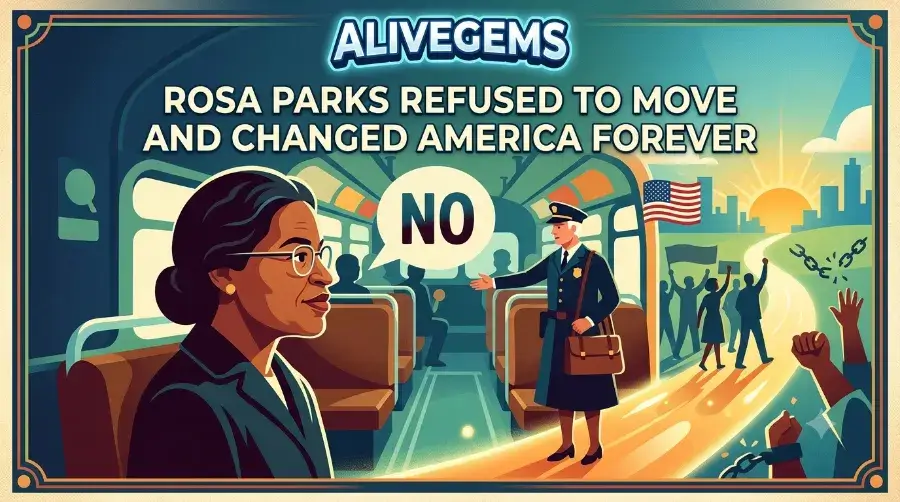
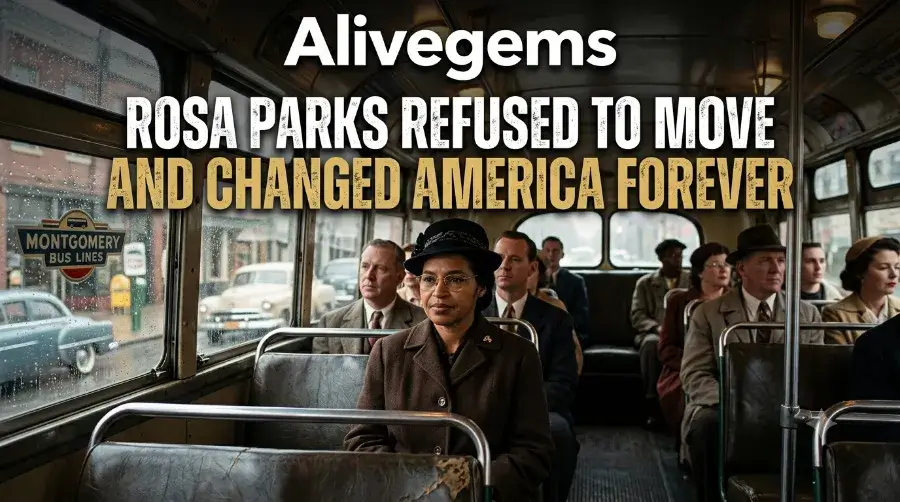
On the evening of December 1, 1955, Rosa Parks boarded a Montgomery City bus after a full day working as a seamstress. When the bus filled up and a white passenger needed a seat, the driver, James Blake, ordered Parks and three other Black riders to give up their row. The other three stood. Parks did not.
She was 42 years old at the time, calm, and completely clear about what she was doing. She later explained that she was simply tired of giving in, not physically tired from work. That distinction matters, because it turns the story from an accident into a decision.
Blake called the police, and Parks was arrested for violating Montgomery’s segregation ordinance. She was fined 10 dollars plus 4 dollars in court costs. It sounds small on paper, yet that arrest is the exact moment when Rosa Parks refused to move and changed America, because local NAACP leader E.D. Nixon and attorney Clifford Durr recognized instantly that her case was the one they had been waiting for.
Notably, Parks was not the first. A 15 year old student named Claudette Colvin had refused to give up her seat months earlier in March 1955. However, organizers felt her age and circumstances made her a harder case to build public support around, so they waited for the right moment. Parks, respected and steady, became that moment.
The Montgomery Bus Boycott: 381 Days That Reshaped a Nation
Within hours of Parks’ arrest, Jo Ann Robinson of the Women’s Political Council was mimeographing thousands of flyers calling for a one day boycott to coincide with Parks’ trial on December 5, 1955. That single day of protest never really ended. That night, Black leaders gathered at Holt Street Baptist Church and voted to extend the boycott indefinitely under a new organization, the Montgomery Improvement Association, led by a then unknown 26 year old pastor named Martin Luther King Jr.
How the Boycott Was Sustained
Keeping tens of thousands of people off the buses for over a year required serious planning, not just willpower. Montgomery’s Black community built an entire alternative transportation network almost overnight.
- Carpools were organized daily, with volunteer drivers covering set routes across the city
- Black owned taxi companies lowered their fares to match the standard 10 cent bus fare
- Thousands of residents simply walked, sometimes for miles, rather than ride a segregated bus
- Regular mass meetings kept spirits high and coordinated logistics week to week
The numbers behind this effort are staggering when you actually look at them.
Boycott Impact Data
| Metric | Figure |
|---|---|
| Boycott duration | 381 days (December 5, 1955 to December 20, 1956) |
| Estimated daily participants | Approximately 40,000 Black residents |
| Share of bus ridership lost | Around 75 percent of total riders |
| Leaflets distributed on night one | Over 35,000, some estimates put it near 52,500 |
| Key legal case | Browder v. Gayle, decided November 13, 1956 |
| Buses officially integrated | December 21, 1956 |
The Supreme Court Steps In
While the boycott ground on, a separate federal lawsuit, Browder v. Gayle, challenged Montgomery’s bus segregation laws directly. On November 13, 1956, the Supreme Court affirmed a lower court ruling that segregated seating violated the 14th Amendment. The city fought the decision until December 20, 1956, when the order finally reached Montgomery officials, and the boycott ended the next day after 381 days of walking, waiting, and refusing to give up.
The cost to the city was not just symbolic either. Because Black riders made up roughly three quarters of the bus system’s paying customers, the boycott drained the transit company’s revenue for over a year straight, which is exactly the kind of economic pressure that forces institutions to change faster than moral arguments alone ever could.
Civil Rights Women Leaders in the USA Who Stood Beside Rosa Parks
One of the most overlooked parts of this story is how many civil rights women leaders in USA history made the boycott actually work behind the scenes. Rosa Parks gets the headline, but she was surrounded by an entire network of determined women.
- Claudette Colvin refused to move months before Parks did, at just 15 years old, showing that resistance was already brewing across Montgomery
- Jo Ann Robinson led the Women’s Political Council and personally organized the first day of the boycott before King had even agreed to lead it
- Septima Clark trained Parks in nonviolent resistance tactics at the Highlander Folk School
- Virginia Durr, a white ally, helped sponsor Parks’ trip to Highlander and supported the legal defense fund
This pattern of women driving change from behind the scenes shows up again and again throughout history. You can see the same fierce persistence in figures like Harriet Tubman, who combined an iron will with real espionage work, or Boudicca, who terrified the Roman Empire itself. If this kind of overlooked female leadership fascinates you, our full guide to charismatic women who changed history digs into many more stories just like this one.
Why Rosa Parks Is Remembered as One of the Most Courageous American Women in History
Calling Rosa Parks one of the most courageous American women in history is not an exaggeration, it is simply the record. Her recognition grew steadily over the following decades, and the honors she received reflect just how far her influence reached.
Honors and Recognition Timeline
| Year | Honor |
|---|---|
| 1979 | NAACP Spingarn Medal |
| 1996 | Presidential Medal of Freedom, presented by President Bill Clinton |
| 1999 | Congressional Gold Medal, approved unanimously by the Senate |
| 2005 | First woman to lie in honor in the U.S. Capitol Rotunda after her death on October 24 |
| 2013 | First full length statue of a Black American unveiled in National Statuary Hall, exactly 100 years after her birth |
The 2013 statue detail deserves a closer look. Sculpted by Eugene Daub and Rob Firmin, it stands nearly nine feet tall and depicts Parks seated calmly, the same posture she held the night she was arrested. President Obama, who unveiled it, said her single act of disobedience had launched an entire movement, and standing in that room, it is genuinely hard to disagree.
Her courage also connects to a broader lineage of powerful women across world history. Think of Cleopatra commanding real power while speaking nine languages, or Hatshepsut ruling as ancient Egypt’s most successful female pharaoh. Rosa Parks belongs in that same conversation, not as a footnote, but as a central figure.
Rosa Parks’ Legacy Today: Lessons for Modern Civil Rights Movements
The Montgomery Bus Boycott proved something that still matters today, sustained, organized pressure works better than a single dramatic moment. Because Rosa Parks refused to move and changed America through a long, coordinated campaign rather than one viral moment, her example offers a genuine blueprint rather than just inspiration.
Modern movements for equality still study the boycott’s structure closely. The carpool logistics, the mass meetings, the legal strategy running alongside the street level protest, all of it shows up again in later civil rights efforts and even in labor organizing today. According to historians who have revisited the boycott, the focus on Martin Luther King as the sole hero has sometimes obscured how many people, especially women, made the boycott actually function. Si
This willingness to keep working quietly, without needing personal credit, echoes through other stories we cover too, including Marie Curie breaking through barrier after barrier in science and Frida Kahlo turning a shattered body into powerful art. Real change rarely comes from one person alone, it comes from someone willing to start, and enough people willing to keep going.
For readers who want to go deeper into the primary sources, the Brookings Institution has published a thoughtful analysis of the lessons Rosa Parks offers the future of civil rights, while the National Women’s History Museum maintains a detailed biography worth reading in full. Oxford University Press also offers a shorter academic reflection on her legacy that is worth ten minutes of your time.
Frequently Asked Questions
Why is Rosa Parks called the mother of the civil rights movement?
Because her arrest directly triggered the Montgomery Bus Boycott, a 381 day protest that became the first large scale, sustained demonstration against segregation in the United States and helped launch Martin Luther King Jr. into national leadership.
Was Rosa Parks really just tired from work that day?
No. Parks herself clarified that she was tired of giving in, not physically tired. She was an experienced NAACP organizer who had trained in nonviolent resistance months before her arrest.
How long did the Montgomery Bus Boycott last?
It lasted exactly 381 days, from December 5, 1955, until December 20, 1956, when the Supreme Court’s ruling against bus segregation finally reached Montgomery officials.
Did anyone refuse to move before Rosa Parks did?
Yes. Claudette Colvin, then 15, refused to give up her seat in March 1955, but organizers felt her circumstances made her a harder public case to rally around at the time.
What lasting honors has Rosa Parks received?
She received the Presidential Medal of Freedom in 1996, the Congressional Gold Medal in 1999, and became the first Black American honored with a statue in the U.S. Capitol’s National Statuary Hall in 2013.
Quick Quiz: How Well Do You Know Rosa Parks?
- On what date did Rosa Parks refuse to give up her bus seat?
A) December 1, 1955
B) January 1, 1956
C) February 4, 1913
D) October 24, 2005 - How many days did the Montgomery Bus Boycott last?
A) 100 days
B) 250 days
C) 381 days
D) 500 days - Who refused to give up her bus seat months before Rosa Parks?
A) Claudette Colvin
B) Harriet Tubman
C) Septima Clark
D) Coretta Scott King - True or false: Rosa Parks was the first Black American honored with a statue in the U.S. Capitol’s National Statuary Hall.
- In what year did Rosa Parks receive the Presidential Medal of Freedom?
Answers: 1-A, 2-C, 3-A, 4-True, 5-1996
Conclusion
Rosa Parks refused to move, and that refusal changed America permanently, not because of one dramatic protest, but because of 381 days of quiet, coordinated persistence backed by a woman who had spent over a decade preparing to stand her ground. Her story reminds us that history is rarely made by luck. It is made by ordinary people who decide, on one ordinary evening, that enough is enough. If her courage moved you, explore more stories of charismatic women who changed history right here on Alive Gems, where history stops feeling like a textbook and starts feeling like it actually happened to real people.
References
- Wikipedia, Rosa Parks Rosa Parks Refused to Move and Changed America
- Wikipedia, Montgomery Bus Boycott Rosa Parks Refused to Move and Changed America
- Library of Congress, Rosa Parks: In Her Own Words exhibition Rosa Parks Refused to Move and Changed America
- History.com, Montgomery Bus Boycott Rosa Parks Refused to Move and Changed America
- Architect of the Capitol, Rosa Parks Statue Rosa Parks Refused to Move and Changed America
- Brookings Institution, Rosa Parks: Lessons Learned for the Future of Civil Rights Rosa Parks Refused to Move and Changed America
- National Women’s History Museum, Rosa Parks Biography Rosa Parks Refused to Move and Changed America
- Oxford University Press Blog, Rosa Parks Rosa Parks Refused to Move and Changed America