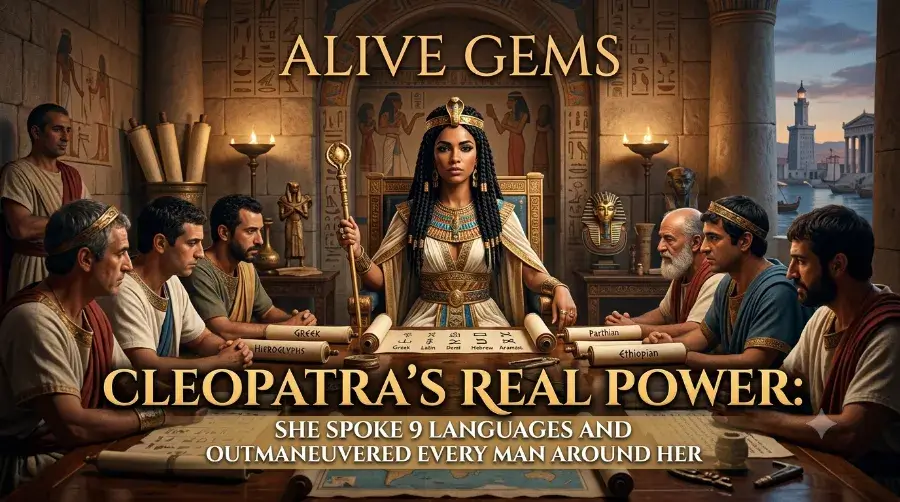
Cleopatra real power 9 languages Picture a twenty one year old woman sitting across from the most feared general in the ancient world, and she is the one steering the conversation. That woman is Cleopatra, and honestly, most of what you learned about her in school barely scratches the surface. Forget the seductress myth for a second. Cleopatra real power came from something far more impressive than beauty, it came from her mind, her tongue, and her nerve. She reportedly mastered up to nine languages, ran a kingdom during chaos, and consistently got the upper hand on men who thought they were smarter than her. This is the story Rome did not want you to remember.
To get a better understanding of Boudicca burned London terrified Rome our guide breaks down exactly what to expect.
Before we go further, here is a quick snapshot of what makes this story so remarkable.
Key Takeaways at a Glance
| Fact | Detail |
|---|---|
| Reign | 51 BCE to 30 BCE, last active ruler of Egypt |
| Languages spoken | Up to 9, including Egyptian, Greek, Aramaic, Hebrew, Ethiopic, Parthian |
| First Ptolemy to speak Egyptian | Yes, the only ruler in her dynasty to learn it |
| Political allies | Julius Caesar, Mark Antony |
| Final defeat | Battle of Actium, 31 BCE |
| Death | August, 30 BCE, age 39 |
| Legacy | Widely regarded as the most powerful ancient female ruler |
Now let us dig into the woman behind the legend. Read our latest blog Marie Curie broke every barrier
Who Was Cleopatra, Really?
Cleopatra, Ancient Egypt, Ptolemaic Dynasty, Female Rulers, Ancient History, Julius Caesar, Mark Antony, Ancient Rome, Alexandria, History Blog Cleopatra VII was born around 69 BCE into the Ptolemaic dynasty, a Greek family that had ruled Egypt since Alexander the Great’s death. Her family spoke Greek at home, ate Greek food, and mostly ignored the Egyptian people they governed. That detail matters more than people realize.
get a better understanding of Frida Kahlo shattered body art our guide breaks down exactly what to expect.
Because here is the twist. Cleopatra broke that pattern completely. According to Plutarch, the Roman historian who wrote extensively about her life, she was the very first member of her dynasty in nearly three hundred years to actually learn the Egyptian language. Meanwhile, her ancestors ruled an entire nation without bothering to speak to the people in it.
That single choice tells you everything about her actual leadership skills. She did not just want a throne, she wanted a connection with the millions of Egyptians who lived along the Nile. As a result, she could walk into a temple in Memphis and speak directly to priests, without a translator standing awkwardly between them.
If you are curious about other extraordinary women who reshaped history the same way Cleopatra did, our related feature on charismatic women who changed history covers several names you probably never learned about in class.
Cleopatra Real Power 9 Languages: What Did She Actually Speak?
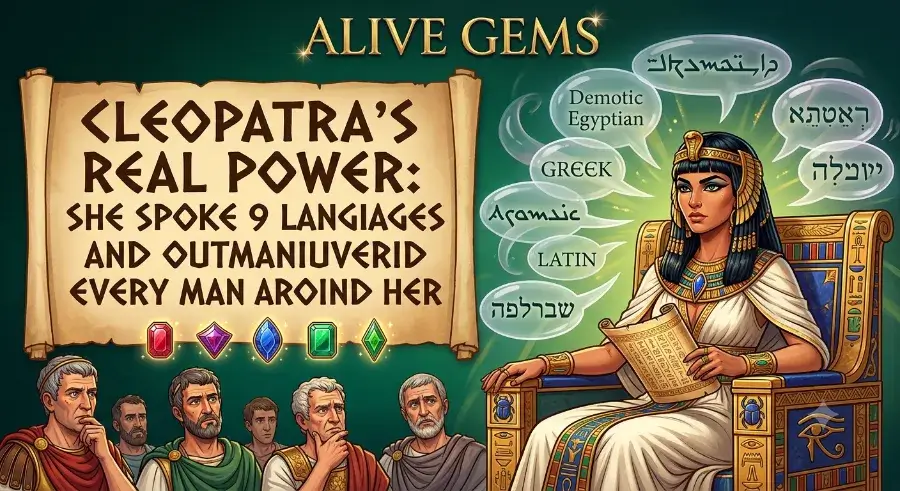
This is the detail that turns heads every single time. Plutarch wrote that her voice was like an instrument with many strings, meaning she could shift her tone and language depending on who she was speaking to. Consequently, she rarely needed an interpreter, which was almost unheard of for a ruler in that era.
Historians still debate the exact number, but most agree it falls between eight and nine languages. Below is a breakdown based on classical sources and modern historical analysis.
If you want to learn more about Hatshepsut most successful female pharaoh check out our detailed guide for practical tips and expert advice.
| Language | Purpose |
|---|---|
| Koine Greek | Native tongue, court and administrative language |
| Egyptian | Connecting with local priests and citizens |
| Aramaic | Diplomacy across the Near East |
| Hebrew | Communication with Judean leaders |
| Ethiopic | Trade and southern alliances |
| Parthian | Dealing with the Parthian Empire |
| Syriac | Regional trade and politics |
| Median | Diplomatic contact in Persia’s former territories |
| Troglodyte dialects | Communication with southern desert tribes |
It is worth noting that some modern historians argue Plutarch’s list may have been more symbolic than literal, essentially naming the various peoples of the region rather than confirming nine distinct fluent languages. In fact, a well documented discussion on this exact debate exists on Reddit’s history community, where users dig into the ancient sources sentence by sentence. Similarly, a fascinating academic breakdown from ANE Today explores how Cleopatra likely used language as a deliberate political weapon rather than a personal hobby.
Either way, one thing remains true. Even skeptical historians admit she knew far more languages than any of her predecessors, and that alone gave her a massive advantage at the negotiating table.
Cleopatra Actual Leadership Skills That Rome Underestimated
Rome loved painting Cleopatra as a manipulative foreign queen who simply seduced her way to power. However, that narrative conveniently ignores the fact that she inherited a bankrupt kingdom, survived a civil war with her own brother, and still managed to rule for two decades.
Let us walk through a few examples that show her actual leadership skills in action.
- 51 BCE, Cleopatra took the throne at just 18 years old, co ruling with her younger brother Ptolemy XIII.
- 48 BCE, after being forced out of Alexandria by her brother’s advisors, she smuggled herself back into the palace to meet Julius Caesar directly.
- 47 BCE, with Caesar’s support, she regained her throne and had her brother removed from power.
- 41 BCE, she met Mark Antony in Tarsus, arriving on a golden barge designed to overwhelm him with spectacle and confidence.
- 34 BCE, she expanded Egyptian territory through the Donations of Alexandria, granting land to her children with Antony.
Notice the pattern here. Every single move was calculated. She did not wait for permission, she created leverage and used it.
Additionally, Cleopatra managed Egypt’s economy during a severe famine caused by low Nile floods, something historians rarely give her credit for. She adjusted grain distribution and tax policies to prevent widespread starvation, which shows she was thinking about her people, not just her throne. If you want to learn more about Joan of Arc 17 led French army check out our detailed guide for practical tips and expert advice.
Most Powerful Ancient Female Ruler? The Case for Cleopatra
So why do so many historians call her the most powerful ancient female ruler in the ancient Mediterranean world? Simply put, no other woman of her era held that much influence over two of Rome’s biggest power players.
Consider this. Julius Caesar was arguably the most powerful man alive when they met. Yet Cleopatra secured his backing, had a son with him named Caesarion, and used that alliance to stabilize her kingdom.
Then came Mark Antony. Rather than becoming his puppet, she negotiated as an equal, gained territory for Egypt, and built a partnership that terrified Roman senators back in Rome. That fear eventually led to full scale war.
The Battle of Actium in 31 BCE ended it all. Antony and Cleopatra’s combined fleet was defeated by Octavian’s forces, and both fled back to Alexandria. Antony took his own life first, believing false reports of her death. Shortly after, Cleopatra followed, reportedly in August of 30 BCE, at just 39 years old. To get a better understanding of Harriet Tubman iron will spy our guide breaks down exactly what to expect.
Even in defeat, though, her influence never disappeared. Octavian, who later became Emperor Augustus, spent years afterward shaping propaganda specifically to discredit her, which honestly tells you how threatening she truly was.
For more lesser known details about her daily life, education, and personality, this piece on surprising Cleopatra facts is genuinely worth a read.
Cleopatra True Personality Story: Beyond the Beauty Myth
Here is something that might surprise you. Ancient coins and busts show Cleopatra with a strong nose and sharp jawline, nothing like the softened Hollywood version we usually picture. Historians now agree her power was never really about physical beauty. To get a better understanding of Queen Nzinga outsmarted Portuguese colonizers our guide breaks down exactly what to expect
Instead, her true personality combined sharp intelligence, theatrical confidence, and an unmatched ability to read people. She studied philosophy, mathematics, and medicine at the Musaeum in Alexandria, home to the legendary Library of Alexandria. That education shaped how she approached every political decision afterward.
Furthermore, she understood something most rulers of her time completely missed, which is that perception matters just as much as military strength. Her golden barge entrance, her fluent conversations with foreign dignitaries, and her careful public image all served a single purpose. She wanted people to see her as untouchable, and for nearly two decades, it worked.
Quick Quiz: Test Your Cleopatra Knowledge
Try answering these before scrolling further.
- How many languages did Cleopatra reportedly speak?
- Which Roman general did she first ally with?
- What made her different from every previous Ptolemaic ruler?
- In what year did the Battle of Actium take place?
- How old was Cleopatra when she died?
Multiple Choice Round
Question 1: Which language was Cleopatra’s native tongue?
A) Egyptian
B) Latin
C) Koine Greek
D) Aramaic
Question 2: Who defeated Antony and Cleopatra at Actium?
A) Julius Caesar
B) Octavian
C) Ptolemy XIII
D) Mark Antony’s son
Question 3: Where did Cleopatra study as a young woman?
A) The Library of Alexandria
B) Rome’s Senate archives
C) A temple in Jerusalem
D) A private estate in Cyprus
Answers: 1) Nine, though some historians say eight. 2) Julius Caesar. 3) She learned Egyptian, unlike her ancestors. 4) 31 BCE. 5) 39 years old. Multiple choice: 1-C, 2-B, 3-A.
Frequently Asked Questions
Did Cleopatra really speak nine languages fluently?
Most historians agree she spoke somewhere between five and nine languages with varying fluency. Plutarch is the main ancient source confirming this, though some scholars believe his list described peoples rather than exact languages.
Was Cleopatra Egyptian or Greek?
She was ethnically Greek, descended from the Ptolemaic dynasty founded after Alexander the Great’s conquests. However, she was the only ruler in her family line who learned to speak Egyptian.
Why is Cleopatra considered the most powerful ancient female ruler?
Because she maintained independent control of Egypt for roughly two decades while negotiating directly with Rome’s most powerful men, something no other woman of her era achieved at that scale.
How did Cleopatra die?
Historical accounts state she died by suicide in August of 30 BCE, shortly after Mark Antony’s death, following their defeat at the Battle of Actium.
Did Cleopatra actually seduce Julius Caesar and Mark Antony?
Romantic involvement did exist with both men, but modern historians argue political strategy played a far bigger role than romance alone in shaping those alliances.
Conclusion
Cleopatra’s story is not really about romance, golden barges, or dramatic Hollywood scenes. At its core, it is about a young woman who understood power better than almost anyone around her. She learned languages her own family refused to learn, she negotiated with the most powerful men on earth, and she held onto her throne through war, betrayal, and famine. That is the real story behind Cleopatra real power, and honestly, it deserves far more attention than the myths we grew up hearing. If this kind of history fascinates you, explore more untold stories on Alive Gems, where we dig into the real people behind the legends.
References
Plutarch, Life of Antony, translated editions via classical archives Cleopatra real power
ANE Today, academic analysis on Cleopatra’s linguistic abilities Cleopatra real power
Reddit r/history community discussion on Cleopatra’s languages
Unreal Rooms, surprising facts about Cleopatra’s lifeCleopatra real power
Missed History, editorial coverage on Cleopatra’s education and reign Cleopatra real power