
Hatshepsut most successful female pharaoh Picture this. A woman sits on a throne meant only for men. She wears a fake beard strapped to her chin. She calls herself king, not queen. And for twenty two years, she runs the richest kingdom on earth so well that trade routes reopen, temples rise from the desert, and her people eat better than they have in decades. Then she dies. And someone spends years trying to chip her name off every wall in Egypt.
That someone almost succeeded. If you have never heard of Hatshepsut, that is not an accident. It is the point. Hatshepsut, Egypt’s most successful female pharaoh, ruled longer and built more than almost any king in her dynasty, yet for centuries her story was buried under broken statues and scratched out cartouches. This is the story of how she rose, why she mattered, and how historians finally pieced her back together.
get a better understanding of Frida Kahlo shattered body art our guide breaks down exactly what to expect.
If you love stories about women who refused to stay small, you will also want to read about Cleopatra and how she ruled in nine languages, or how a teenage girl named Joan of Arc led an entire army at seventeen. Hatshepsut belongs right beside them, and honestly, she came first.
Key Takeaways
| Fact | Detail |
|---|---|
| Who she was | Hatshepsut, 5th pharaoh of Egypt’s 18th Dynasty |
| Reign length | About 22 years, roughly 1479 to 1458 BC |
| Claim to fame | One of the most prosperous and peaceful reigns in Egyptian history |
| Famous project | The Deir el-Bahri mortuary temple near Luxor |
| Trade achievement | Reopened trade routes to the Land of Punt |
| Erasure | Her name and images were chiseled off monuments after her death |
| Rediscovery | Modern Egyptology pieced her identity back together starting in the 1800s and 1900s |
| Latest research | A 2025 tomb discovery and a new statue study reshaped how experts view her legacy |
Who Was Hatshepsut, Really
Hatshepsut was born into royalty around 1507 BC, the daughter of Thutmose I, one of Egypt’s most respected warrior kings. She married her half brother, Thutmose II, which was normal for Egyptian royal families at the time. When he died young, the throne technically belonged to his son, a boy named Thutmose III, who was still a child.
Instead of stepping quietly aside as a regent, Hatshepsut did something almost nobody had done before. She declared herself pharaoh in her own right. Not queen. Not regent. Pharaoh. She took on the full titles, the crook and flail, and eventually even the ceremonial false beard that symbolized kingship in Egyptian art.
This single decision is why she is remembered today as Egypt’s most successful female pharaoh. She did not rule in her husband’s shadow or as a placeholder for her stepson. She ruled as the actual king of Egypt, and she ruled well.
Read our latest blog Marie Curie broke every barrier
Why This Was Such a Big Deal
Ancient Egypt was not entirely closed to powerful women. Queens had influence, and some, like Nefertiti, held real political weight. But a woman claiming the full title of pharaoh, with all its religious and political authority, was different. It meant she was seen as a living god on earth, a role reserved almost exclusively for men.
To make this work, Hatshepsut leaned on clever propaganda. She commissioned inscriptions claiming the god Amun himself had chosen her to rule, even suggesting a divine birth story similar to those used by earlier male kings. It sounds dramatic, but it worked because it followed the rules of Egyptian belief while quietly rewriting who could hold power.
The Golden Age Under Hatshepsut’s Rule
Here is where the female pharaoh biography of Hatshepsut gets genuinely impressive. Her reign, which lasted around 22 years, is often described by historians as one of the most stable and prosperous periods in the entire history of ancient Egypt.
She did not spend her rule fighting endless wars like many pharaohs before and after her. Instead, she focused on something rarer in ancient history, building instead of destroying.
- She launched a famous trade expedition to the Land of Punt, believed to be somewhere near modern day Eritrea or Somalia, bringing back gold, ebony, ivory, and myrrh trees that were replanted in Egypt.
- She commissioned hundreds of construction projects, more than almost any pharaoh before her, including obelisks at Karnak that still stand today.
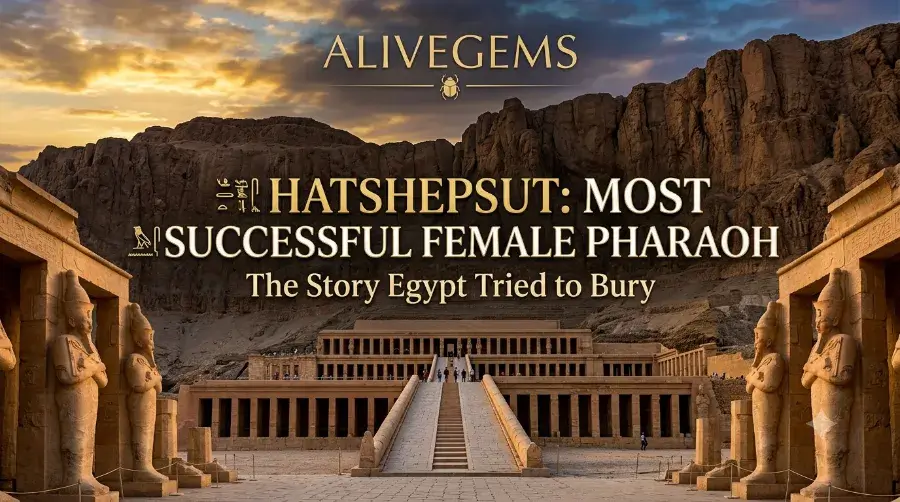
- She built her stunning mortuary temple at Deir el-Bahri, a masterpiece cut directly into the cliffs near Luxor that still leaves visitors speechless.
According to a feature from the UCLA Egyptology program, archaeologists have continued reconstructing the history of her temple site, including recent finds tied to the ongoing excavation of her funerary complex. This kind of active, ongoing research is exactly why her story keeps getting richer even thousands of years later. Substack
The Punt Expedition, By The Numbers
| Item Brought Back | Approximate Value To Egypt |
|---|---|
| Gold | Strengthened royal treasury and temple offerings |
| Myrrh trees | First recorded transplant of foreign trees to Egyptian soil |
| Ebony and ivory | Luxury goods for royal and religious use |
| Exotic animals | Symbols of Egypt’s reach and prestige |
This expedition alone tells you everything about her leadership style. She was not chasing conquest. She was chasing prosperity, and it worked.
Hatshepsut Charisma and Power Story
What made her different from other rulers was not just political skill. It was presence. Hatshepsut understood something that modern leadership coaches still teach today, image is power.
She controlled how she was portrayed in art with total precision. Early in her reign, some statues show her as a woman. Later, she is shown fully as a male pharaoh, complete with the ceremonial beard and broad shoulders. This was not vanity. It was strategy. She needed her people, her priests, and her enemies to see her as a legitimate king, and Egyptian visual language only had one template for that.
A wonderful summary of this balancing act appears in a piece from Ancient Now, which describes new research into how her statues were later treated after her death, showing a far more complicated picture than a simple revenge story. arxiv
If Hatshepsut’s ability to bend the rules of an entire empire without breaking them fascinates you, you will probably also enjoy reading about Queen Nzinga, who outsmarted Portuguese colonizers using the exact same kind of strategic brilliance centuries later.
Why They Tried to Erase Her
This is the part of the Hatshepsut story that hits hardest. After her death around 1458 BC, her stepson Thutmose III eventually took full control of Egypt. Decades later, near the end of his reign, a strange campaign began. Her statues were smashed. Her cartouches, the oval symbols carved with a ruler’s name, were chiseled off temple walls. Her image was replaced or destroyed in dozens of locations.
For a long time, historians believed this was simple revenge, a stepson erasing the woman who had denied him the throne for years. But newer research tells a more layered story.
A 2025 study published in the journal Antiquity, covered by Ancient Now, found that Hatshepsut’s statues were not smashed at random out of rage but were systematically taken apart in a ritual pattern, cut at the neck, waist, and feet, which matches how Egyptians traditionally deactivated the symbolic power of a statue rather than simply destroying it out of hate. arxiv
In other words, the erasure may have been less about personal hatred and more about neutralizing her supernatural authority as a former king, a practice historians now believe was tied to religious custom rather than pure spite. It does not make the erasure less real. It just makes the reason more complicated, and honestly, more human.
This idea connects beautifully to the broader theme covered in our pillar guide on charismatic women who changed history, where you can see this exact pattern repeat again and again across centuries.
A Pattern That Repeats Through History
Hatshepsut is far from the only powerful woman whose story was buried or twisted after her death.
- Cleopatra’s reputation was rewritten by Roman propaganda to paint her as reckless rather than the shrewd diplomat she actually was.
- Boudicca’s rebellion against Rome was recorded almost entirely through the eyes of the very empire she fought against.
- Harriet Tubman’s military intelligence work during the Civil War was underplayed for generations compared to her role in the Underground Railroad alone.
You can read more about how Boudicca burned London and terrified Rome, and how Harriet Tubman’s iron will made her a brilliant spy, both stories that echo the same erasure and rediscovery pattern seen with Hatshepsut.
The Rediscovery of Egypt’s Most Successful Female Pharaoh
For centuries, Hatshepsut’s identity was essentially a mystery hiding in plain sight. Early archaeologists in the 1800s found her name on monuments but assumed it belonged to a male king, since the art showed her with a beard and male body.
It was not until the late 1800s and early 1900s that Egyptologists began piecing together the truth, that this so called king was actually a woman who had ruled with full royal authority. The gender confusion in her own carved history became one of the great detective stories of modern archaeology.
Recent discoveries keep adding new chapters. In January 2025, archaeologists working near her funerary temple at Deir el-Bahri uncovered a major cache of artifacts described by officials as one of the most significant finds since the discovery of King Tutankhamun’s tomb, according to coverage from Egypt Independent. Separately, in 2025 a team also confirmed the long lost tomb of her husband, Thutmose II, thanks to inscribed alabaster jars naming both him and Hatshepsut, as reported by Archaeology Magazine.
These are not small footnotes. They are proof that even 3,500 years later, Hatshepsut’s story is still being written.
A Quick Timeline Chart Of Her Life And Legacy
| Year (Approx) | Event |
|---|---|
| 1507 BC | Born into the royal family of Thutmose I |
| 1492 BC | Marries her half brother, Thutmose II |
| 1479 BC | Becomes regent for young stepson Thutmose III |
| 1473 BC | Declares herself full pharaoh |
| 1470s to 1460s BC | Punt expedition and major temple building era |
| 1458 BC | Dies after roughly 22 years of rule |
| Decades later | Statues defaced and name removed under Thutmose III |
| 1800s to 1900s | Modern Egyptologists rediscover her true identity |
| 2025 | New tomb and temple discoveries reshape understanding of her reign and legacy |
Women Erased Ancient History, And Why It Still Matters
Hatshepsut’s story is not just ancient trivia. It is a mirror. Throughout history, powerful women have often been remembered as exceptions rather than rulers, footnotes rather than founders. Their achievements get quietly folded into the accomplishments of the men around them.
According to a study covered by Greek Reporter, scholars for nearly a century assumed Hatshepsut’s destroyed statues were the target of a deliberate revenge campaign by her successor to wipe her from memory, a theory that newer evidence has now challenged. This shows how even the story of her erasure had to be re-examined and corrected over time, which says a lot about how history treats women who dared to lead. Egypt Independent
Understanding Hatshepsut is not just about learning one queen’s biography. It is about recognizing a pattern that shows up across cultures and centuries, and learning to ask better questions when history seems to have a woman shaped gap in it.
What Modern Leaders Can Learn From Hatshepsut
You do not need to run an empire to learn from her playbook. Her success came down to a few simple habits that still apply today.
- She prioritized long term stability over short term glory, choosing trade and building over war.
- She controlled her own narrative instead of letting others define her.
- She respected existing traditions while quietly reshaping them to fit her goals.
- She invested heavily in projects that would outlast her, literally carving her legacy into stone.
That last point turned out to be the smartest move of all. Even when people tried to erase her name, they could not erase the buildings, the trade routes, or the ripple effects of her decisions.
Frequently Asked Questions About Hatshepsut
Was Hatshepsut really the most successful female pharaoh in Egyptian history?
Most Egyptologists agree she stands out for the length, stability, and prosperity of her reign, making her one of the most successful rulers of any gender in the 18th Dynasty, not just among female pharaohs.
Why did Hatshepsut wear a fake beard?
The false beard was a symbol of pharaonic power in Egyptian art. Wearing it in official depictions helped reinforce her legitimacy as a true king rather than simply a queen or regent.
Who tried to erase Hatshepsut from history?
Her stepson and successor, Thutmose III, is traditionally linked to the removal of her name and images, though newer 2025 research suggests the process may have followed religious ritual customs rather than pure personal revenge.
How was Hatshepsut rediscovered?
Modern Egyptologists in the 1800s and 1900s pieced together evidence from surviving inscriptions, eventually realizing that the pharaoh depicted with a beard on many monuments was actually a woman.
What is Hatshepsut most famous for building?
Her mortuary temple at Deir el-Bahri, carved into cliffs near modern Luxor, remains her most iconic and celebrated architectural achievement.
Quick Quiz, Test What You Learned
- What was Hatshepsut’s official title, not queen but what?
- True or false, Hatshepsut led Egypt into a period of frequent war.
- Which distant land did her famous trade expedition reach?
- Who is traditionally linked to the removal of her name after her death?
- Where is her most famous temple located?
Multiple choice bonus round
A. Hatshepsut’s reign lasted approximately how long?
- 5 years
- 22 years
- 60 years
B. What did archaeeologists confirm belonged to her husband in 2025?
- His crown
- His tomb
- His chariot
C. What did the 2025 statue study suggest about her destroyed statues?
- They were destroyed purely out of rage
- They were ritually deactivated following custom
- They were never actually damaged
(Answers: 1. Pharaoh or king, 2. False, 3. The Land of Punt, 4. Thutmose III, 5. Deir el-Bahri near Luxor. Bonus: A2, B2, C2)
Conclusion
Hatshepsut’s story is proof that real power does not need permission to exist, even when the world is built to deny it. She took a throne that was never meant for her, ran one of Egypt’s most prosperous eras, and left behind temples, trade routes, and a legacy that outlasted every attempt to chip it away. They tried to erase her name from stone, but they could never erase what she actually built. That, more than any title, is what makes Hatshepsut Egypt’s most successful female pharaoh, and one of history’s most quietly powerful women.
If her story moved you, you will want to explore our full collection on the charismatic women who changed history at alivegems.com, where queens, warriors, and spies get the recognition they were denied for far too long.
References
- UCLA Newsroom, UCLA Egyptologist Gives New Life To Female Pharaoh From 15th Century BC Hatshepsut most successful female pharaoh
- Medium, Time Chronicles, The Queen Who Would Be King, The Remarkable Tale Of Hatshepsut Hatshepsut most successful female pharaoh
- American University in Cairo Press, Hatshepsut Explored, 2025 Hatshepsut most successful female pharaoh
- Archaeology Magazine, Top 10 Discoveries Of 2025, The Case Of The Missing Pharaoh Hatshepsut most successful female pharaoh
- Greek Reporter, Archaeologists Finally Uncover Why Pharaoh Hatshepsut’s Statues Were Destroyed, 2025 Hatshepsut most successful female pharaoh
- Egypt Independent, Egypt Announces Astounding New Archaeological Discoveries, January 2025 Hatshepsut most successful female pharaoh
- Ancient Now Substack, Hatshepsut’s Revenge, 2026 Hatshepsut most successful female pharaoh