
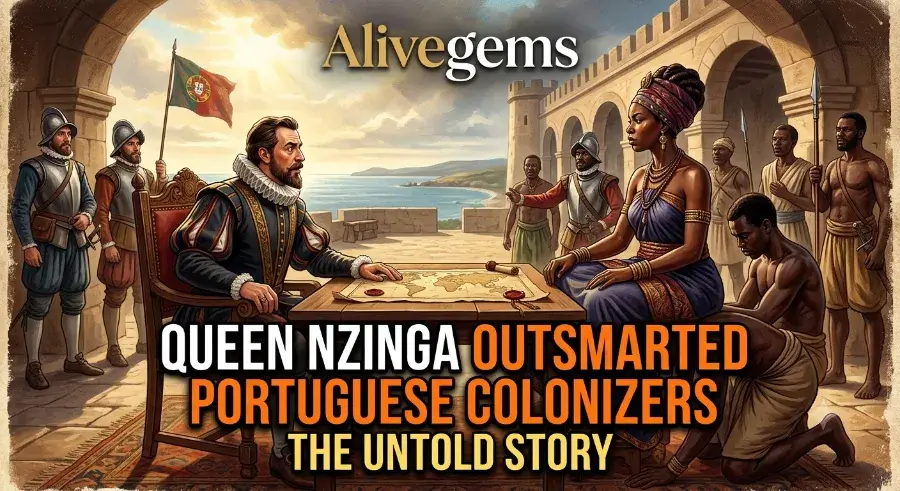
Queen Nzinga outsmarted Portuguese colonizers Picture a woman walking into a room full of men who expect her to sit on the floor. Instead, she claps her hands, and one of her own servants drops to all fours to become her human chair. That single moment tells you almost everything you need to know about why Queen Nzinga outsmarted Portuguese colonizers again and again, for nearly four decades, in a war most rulers would have lost in months.
This is not a dusty textbook tale. This is the story of a queen who turned humiliation into leverage, who used baptism as a bargaining chip, and who led troops into battle in her sixties. If you love stories about African queens who changed history, you are about to meet the boldest one of them all.
get a better understanding of Frida Kahlo shattered body art our guide breaks down exactly what to expect.
Key Takeaways
| Fact | Detail |
|---|---|
| Full name | Nzinga Mbande, later baptized Ana de Sousa |
| Reign | Ndongo (1624 to 1663) and Matamba (1631 to 1663) |
| Famous moment | Refused to sit on the floor during 1622 peace talks with Portugal, per an account where Portuguese officials failed to offer her a chair and she used a kneeling servant as her seat instead TangietwoodsBlackhistoryheroes |
| Core strategy | Diplomacy, guerrilla warfare, and shifting alliances with the Dutch and the Imbangala |
| War with Portugal | Roughly 30 years of active conflict, per accounts describing a thirty year war she initiated after 1627 Blackhistoryheroes |
| Death | December 17, 1663, in Matamba, at around 80 years old |
| Legacy | Celebrated in Angola as the mother of the nation and a symbol of anti-colonial resistance |
Who Was Queen Nzinga, Really
Long before she became a queen, Nzinga was a princess born around 1583 in Kabasa, the capital of the Ndongo kingdom in what is now Angola. Her father was the Ngola, or ruler, and he clearly saw something special in his daughter. Instead of keeping her away from politics, he brought her into war councils and legal hearings that most girls of her time never saw. To get a better understanding of Harriet Tubman iron will spy our guide breaks down exactly what to expect.
That early exposure mattered enormously later on. When she needed to negotiate with hardened Portuguese governors, she already understood how power actually worked in a room. Her name itself carries meaning too, since it comes from the Kimbundu word for the umbilical cord, tied to a belief that she was born for greatness.
This part of her story connects to a wider pattern you can see across charismatic women who changed history, where early access to power often shaped how these women later ruled. Nzinga simply took that access further than almost anyone expected.
The Chair That Changed Everything
In 1622, Nzinga traveled to Luanda as an ambassador for her brother, King Ngola Mbande, who was losing ground fast against Portuguese forces. The Portuguese governor, João Correia de Sousa, offered her no chair, only a mat on the floor, a calculated insult meant to remind her of her lower status.
Nzinga did not argue. She simply had one of her attendants kneel down and sit on the woman’s back for the entire meeting, eye level with the governor the whole time. It was theater, and it worked. This single act still gets compared to how Cleopatra used her intelligence across nine languages to control every room she entered, because both women understood that perception is its own kind of weapon.
During those same talks, Nzinga agreed to be baptized, taking the name Ana de Sousa, with the governor’s wife as her godmother. It looked like submission. It was actually a calculated move to bind the Portuguese to a formal peace treaty.
From Princess to Queen Under Fire
The peace did not last. Her brother’s rule collapsed under Portuguese pressure, and in 1624 Ngola Mbande died, leaving Nzinga to take the throne herself. Within two years, Portugal had already broken the treaty and backed a rival claimant to Ndongo, and by 1626 open war had returned.
By 1628, her army had been badly weakened and she was pushed into exile. Most rulers would have quit there. Nzinga did the opposite.
Here is what she did instead, step by step:
- She allied with the Imbangala, a fierce warrior group known for mobile guerrilla tactics.
- She freed enslaved people escaping the Portuguese and folded them directly into her army.
- She rebuilt her forces around fast, hit and run warfare instead of standing battles.
- She invaded and conquered the neighboring kingdom of Matamba by 1631, giving her a new, defensible base.
This is the heart of why Queen Nzinga outsmarted Portuguese colonizers so consistently. She refused to fight the kind of war her enemy wanted. Every time Portugal expected her to disappear, she reappeared somewhere stronger.
To get a better understanding of Boudicca burned London terrified Rome our guide breaks down exactly what to expect.
Building a New Kingdom in Matamba
Matamba turned out to be the smartest move of her entire reign. Unlike Ndongo, Matamba already had a tradition of female rulers, so her authority faced far less internal resistance. She settled the region with loyal Ndongans and slowly turned it into a genuine trading power.
By the time of her death in 1663, Matamba was dealing with the Portuguese colony on equal footing, according to accounts describing how Matamba had become a formidable commercial state that negotiated with the Portuguese as an equal by the time she died. That is a staggering turnaround for a ruler who had been driven out of her homeland with a shattered army just a few years earlier. Fandom
If you want to learn more about Hatshepsut most successful female pharaoh check out our detailed guide for practical tips and expert advice.
Playing the Europeans Against Each Other
Nzinga understood something many rulers of her era missed completely. Colonizers were not one unified force. They had rivals, and rivals could become allies.
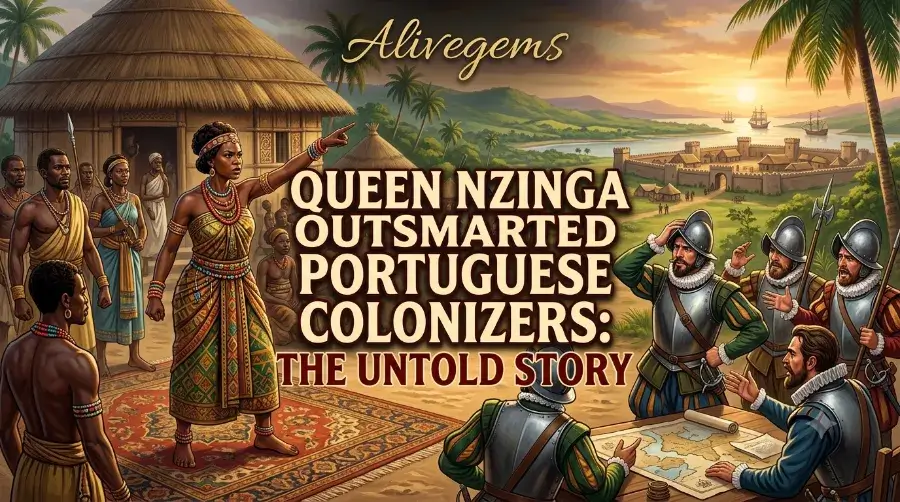
When the Dutch seized Luanda from the Portuguese in 1641, Nzinga jumped at the opportunity and formed an alliance with them. With Dutch support, her combined forces managed to defeat a Portuguese army in 1647, a real and humiliating blow to colonial ambitions in the region. When the Dutch were pushed out again the following year, she simply kept fighting alone, still leading troops personally well into her sixties.
This is exactly the kind of layered, patient leadership you also see when reading about Joan of Arc, who led the French army at just seventeen. Both women proved that age and gender meant nothing next to strategy and nerve.
Comparing Nzinga’s Timeline to Her Contemporaries
| Ruler | Region | Years Active | Signature Tactic |
|---|---|---|---|
| Queen Nzinga | Ndongo and Matamba, Angola | 1624 to 1663 | Guerrilla warfare and shifting alliances |
| Cleopatra VII | Egypt | 51 to 30 BCE | Multilingual diplomacy |
| Joan of Arc | France | 1429 to 1431 | Battlefield leadership at a young age |
| Yaa Asantewaa | Ashanti Empire, Ghana | 1900 uprising | Direct armed resistance to British rule |
Looking at this table, one pattern stands out immediately. The African queens who changed history rarely had the luxury of large standing armies or unlimited resources. They won through timing, alliances, and sheer refusal to give up.
Why Historians Still Argue About Her Legacy
Not every part of Nzinga’s story is comfortable. She used Imbangala warrior customs to build her army, and she expanded the slave trade in Matamba to fund her wars against Portugal, redirecting that profit away from her enemies. Historians like Linda Heywood and John Thornton have written extensively about this complexity, and it is worth reading their fuller analysis on The Collector’s detailed profile of Queen Nzinga if you want the deeper nuance.
This is part of what makes real history so much more interesting than a simplified hero story. Nzinga was not a saint. She was a survivor operating in a brutal system, and she made hard choices that modern readers still debate. Feminist scholars, as detailed in the African Feminist Forum’s piece on Queen Nzinga, tend to focus on how she reshaped gendered power in a region where women were rarely allowed to rule at all.
The Final Peace and Her Death
In 1657, after roughly three decades of near constant conflict, Nzinga finally signed a lasting peace treaty with Portugal that recognized her as ruler of Matamba. She spent her final years focused on trade, diplomacy, and consolidating what she had built rather than fighting new battles.
She died peacefully on December 17, 1663, somewhere around 80 years old, an astonishing outcome for a ruler who had spent most of her life as a direct target of a colonial power. For additional firsthand context on her final years, this Black History piece on Queen Nzinga covers her later diplomacy in more detail.
Read our latest blog Marie Curie broke every barrier
Her Legacy Today
Angola still treats Nzinga as a national hero. A statue of her stands in Kinaxixi Square in Luanda, and she is widely referred to as the mother of the nation. Her resistance is often credited as inspiration for the twentieth century independence movement that finally freed Angola from Portuguese rule in 1975.
If you want to go deeper into stories like hers, our full collection of charismatic women who changed history covers dozens of women who reshaped their world against impossible odds, and Nzinga remains one of the most dramatic examples in that entire archive.
Quick Quiz: Test What You Learned
- In what year did Nzinga famously refuse to sit on the floor during peace talks with Portugal?
- Which neighboring kingdom did Nzinga conquer in 1631 to use as her new base?
- Which European power did Nzinga ally with after they captured Luanda in 1641?
- What year did Nzinga finally sign a lasting peace treaty with Portugal?
- Around what age was Nzinga when she died in 1663?
Multiple choice bonus round:
A. Nzinga’s Christian name after baptism was:
- Maria de Silva
- Ana de Sousa
- Isabella of Kongo
B. Nzinga ruled which two kingdoms during her lifetime?
- Kongo and Benin
- Ndongo and Matamba
- Mali and Songhai
C. Nzinga is most often remembered today as a symbol of:
- Royal ceremony
- Anti-colonial resistance
- Trade regulation
Frequently Asked Questions
How did Queen Nzinga outsmart Portuguese colonizers for so long?
She refused conventional battle and instead used guerrilla tactics, shifting alliances, and sharp diplomatic timing, adapting her strategy every time the Portuguese changed theirs.
Was Queen Nzinga a real historical figure?
Yes, she is one of the most well documented African rulers of the seventeenth century, with records from Portuguese, Dutch, and Capuchin missionary sources.
Did Queen Nzinga ever defeat the Portuguese in direct battle?
Yes, with Dutch support she helped defeat a Portuguese army in 1647, though the war continued for years afterward.
Why is Nzinga considered one of the most powerful African female rulers?
She ruled two kingdoms for nearly forty years, led troops personally into her sixties, and negotiated as an equal with European powers at a time when few women anywhere held that kind of authority.
What is Queen Nzinga’s biography and leadership style best known for?
Her biography is best known for blending military innovation, religious diplomacy, and relentless patience, refusing to surrender even after repeated defeats.
Conclusion
Queen Nzinga’s story proves something simple but powerful. Real strength is not about having the biggest army or the most resources. It is about refusing to accept the terms someone else sets for you, over and over, for as long as it takes. She turned a missing chair into a symbol of equality, turned exile into a new kingdom, and turned decades of colonial pressure into a legacy that still stands tall in Luanda today. Few rulers in history managed to hold their ground against a colonial power for as long as she did, and fewer still did it with her mix of patience, cunning, and raw nerve.
References
- Wikipedia, Nzinga of Ndongo and Matamba
- Britannica, Nzinga
- BlackPast.org, Queen Nzinga (1583-1663)
- The Metropolitan Museum of Art, Women Leaders in African History: Ana Nzinga, Queen of Ndongo
- The Collector, Queen Nzinga of Angola
- African Feminist Forum, Queen Nzinga of Angola