
Archimedes a man so absorbed in a math problem that Roman soldiers had to kill him mid sentence because he refused to stop drawing circles in the sand. That single image tells you almost everything about Archimedes, the ancient genius whose unexplained inventions still confuse engineers, historians, and physicists more than 2,200 years later. He is the reason your bathtub, your ship, and even your irrigation pump work the way they do, and yet nobody has ever fully cracked how a single man in Syracuse got so far ahead of his own century.
This is not a dusty textbook story. It is the tale of one of the most brilliant ancient world scientists ever recorded, a man whose charisma, obsession, and sheer stubbornness turned him into a legend before he was even buried. If you have ever wondered how one person built a death ray, an early odometer, and a working model of the cosmos with nothing but bronze, water, and geometry, you are about to find out.

Key Takeaways
| Fact | Detail |
|---|---|
| Born | Around 287 BC in Syracuse, Sicily |
| Died | 212 BC, during the Roman siege of Syracuse |
| Most famous invention | The Archimedes screw, still used for irrigation today |
| Most debated invention | The “death ray” burning mirrors, replicated but unproven |
| Modern link | Believed by some researchers to have designed the Antikythera mechanism |
| Core discovery | The principle of buoyancy, still taught in every physics class |
| Personality trait | So obsessed with math he reportedly forgot to eat or bathe |
TL;DR
- Archimedes invented tools like the screw pump and compound pulley that modern engineers still use without fully understanding his original methods.
- His war machines, including the Claw of Syracuse and the possible heat ray, held off the Roman army for months and remain partly unexplained.
- Many historians now connect his mathematical mind to the Antikythera mechanism, the world’s first known analog computer.
Who Was Archimedes and Why Does He Still Matter
Archimedes was born around 287 BC in the Greek city of Syracuse, on the island of Sicily, and his father, Phidias, worked as an astronomer. That single detail matters more than it seems, because it means young Archimedes grew up surrounded by numbers, stars, and patterns instead of ordinary childhood distractions. Later, he traveled to Alexandria in Egypt, which was the intellectual capital of the ancient world, and studied under scholars connected to Euclid himself.
Consequently, when he returned home to Syracuse, he did not come back as an ordinary craftsman. He came back as someone who treated the physical world like a giant equation waiting to be solved. This mindset is exactly what separates him from other most brilliant ancient world scientists, because while others observed nature, Archimedes tried to mathematically prove it.
His personality only adds to the legend. He reportedly disliked practical engineering, viewing it as beneath the purity of geometry, yet he still built some of the most sophisticated machines the ancient world had ever seen. If you enjoy stories about brilliant minds who lived by their own strange rules, you will also love the story of Isaac Newton’s secret life as an alchemist, a man who shared that same obsessive, secretive streak centuries later.
The Archimedes Biography Personality That Made Him a Legend
People rarely talk about Archimedes’ personality, yet it is arguably the most fascinating part of his story. He was, by most accounts, a hopeless workaholic who forgot to eat, forgot to wash, and had to be physically dragged to public baths by his own servants. Once there, according to legend, he still drew geometric diagrams in the ashes on his own skin because he could not stop thinking.
This obsessive charisma is part of what makes his Archimedes biography personality so relatable even today. He was not a cold, distant genius. He was a man consumed by curiosity, the kind of person who could not walk past an unsolved problem without stopping. Meanwhile, his closeness to King Hiero II of Syracuse meant he had royal backing to turn his wildest ideas into working machines, something few ancient inventors ever received.
- He reportedly ran naked through the streets of Syracuse shouting “Eureka,” meaning “I have found it,” after discovering the principle of buoyancy in his bathtub.
- He once bragged that with a long enough lever and a place to stand, he could move the entire Earth, and King Hiero actually challenged him to prove it using a ship.
Both stories sound exaggerated, and historians still debate how much is true versus embellishment added centuries later. However, even skeptical scholars agree the underlying science, the golden crown density test and the compound pulley system, was almost certainly real. That blend of showmanship and substance is exactly why ancient scientists charisma stories keep circulating more than two thousand years after his death.
The Archimedes Screw and Other Inventions We Still Use
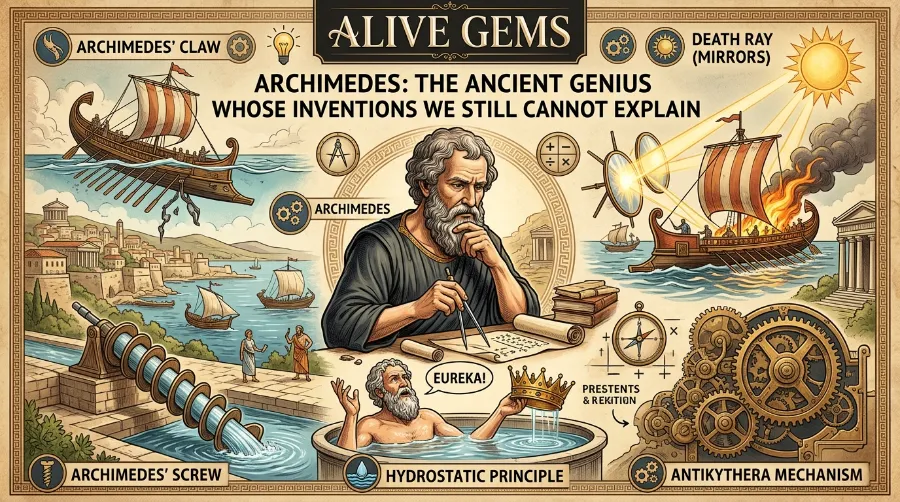
Nothing captures the primary keyword of this article better than the Archimedes screw, arguably his most practical and enduring invention. King Hiero reportedly asked him to design a way to remove water from the hull of a massive ship, and Archimedes responded with a hollow cylinder containing a spiral blade. As the screw turned, water rose steadily from a lower point to a higher one, without needing buckets or manual bailing.
Remarkably, farmers across the developing world still use this exact design for irrigation today, and it also moves grain, sand, and even sewage in modern treatment plants. Few ancient tools have survived nearly 2,300 years of technological change completely intact, yet the Archimedes screw did exactly that.
Beyond the screw, his other verified contributions include:
- The compound pulley system, which allowed one person to move objects far heavier than their own body weight.
- The principle of the lever, formally proven through mathematics rather than guesswork.
- The principle of buoyancy, now known simply as Archimedes’ principle, still taught in every introductory physics course.
- An early odometer, using a wheel of known circumference that dropped a pebble into a container after each rotation, effectively measuring distance traveled.
That odometer detail rarely gets attention, yet a Roman writer named Vitruvius described a device mounted like a wheelbarrow wheel that automatically dropped a pebble into a container at each revolution, giving a measure of distance traveled, in what is considered the first odometer. If a mind this restless fascinates you, the story of Leonardo da Vinci, the genius five hundred years ahead of his time, follows a strikingly similar pattern of obsessive tinkering born from pure curiosity. Ancient Origins
The Unexplained War Machines That Terrified Rome
While the screw made him famous, the war machines made him legendary, and this is where the “unexplained” part of Archimedes’ story truly begins. When Rome laid siege to Syracuse in 214 BC, Archimedes reportedly turned the city walls into a death trap using pure physics.
His most infamous invention was the Claw of Archimedes, sometimes called the “iron hand.” According to ancient sources, it was a crane-like device mounted on the city walls that could reach out, grip an approaching Roman ship, lift it partially out of the water, and then drop it, capsizing the vessel entirely. It was reportedly so effective during the siege of Syracuse in 214 BC that the attacking Romans wondered if the gods of mythology were ambushing them. libguides
Then there is the invention historians still argue about after two thousand years, the so called death ray. Legend claims Archimedes arranged large bronze or copper mirrors along the coastline to focus sunlight onto approaching Roman ships and set them on fire. The earliest surviving account of this weapon was written in the 12th century by Zonaras and Tzetzes, quoting an earlier, now lost work called The Siege of Syracuse. Ancient Origins
Naturally, modern engineers wanted proof. In 2005, a television production challenged a team to recreate the mirror weapon using only techniques and materials that would have existed in the third century BC. Within seven days, the team built their version and actually succeeded in tipping over a model of a Roman ship enough to make it sink. Ancient Origins
However, this success does not settle the debate, because most historians consider a coordinated mirror array under battlefield conditions and weather to be far less reliable than a controlled television experiment. This unresolved tension between legend and physics is precisely why Archimedes remains one of the most debated charismatic scientists in history, similar to how the war between Tesla and Edison over electrical currents still splits opinion between mythmaking and documented fact.
The Antikythera Mechanism: Archimedes’ Possible Final Mystery
Here is where the story gets genuinely strange, and where new research keeps changing the conversation. In 1901, sponge divers discovered a corroded lump of bronze in a shipwreck near the Greek island of Antikythera. Decades later, X-ray scans revealed it was actually an intricate system of gears, now called the Antikythera mechanism, widely considered the world’s first analog computer.
The device could track the sun, moon, and five known planets, predict eclipses, and even follow the four year cycle of the ancient Olympic Games. Some scholars, including researchers who published in Scientific American, believe the mechanical sophistication points directly back to Archimedes himself, since the extraordinary conception of calculating the moon’s variable motion using epicyclic pin-and-slot gears reinforces the idea that the machine was designed by Archimedes.
Yet the mystery deepens further. A 2025 simulation from researchers in Argentina tested how well the device’s gears would have actually functioned given their triangular tooth shape and known manufacturing imperfections. The simulation found that manufacturing inaccuracies may have caused the device to jam so often it would have been very nearly unusable in its current condition. Some researchers even suggested it might have functioned more like an ornate toy than a precise scientific tool, though this claim remains heavily disputed. Smithsonian Magazine
Meanwhile, other 2024 and 2025 research out of the University of Glasgow used statistical techniques borrowed from gravitational wave physics to refine exactly how many holes existed in the device’s calendar ring, concluding strong evidence that the calendar ring contained either 354 or 355 holes, tracking the Greek lunar calendar rather than the Egyptian solar calendar as previously thought. In other words, more than two thousand years later, scientists are still actively publishing new papers trying to fully explain a device possibly connected to Archimedes’ genius. That is not folklore. That is ongoing, peer reviewed science, happening right now. Phys.org
Archimedes vs Other Ancient Geniuses: A Quick Comparison
| Scientist | Era | Most Famous Contribution | Still Debated Today |
|---|---|---|---|
| Archimedes | 287 to 212 BC | Screw pump, buoyancy principle | Death ray, Antikythera link |
| Euclid | Around 300 BC | Foundations of geometry | Limited biographical detail |
| Hipparchus | 190 to 120 BC | Early trigonometry, star catalog | Possible Antikythera connection |
| Ptolemy | 100 to 170 AD | Geocentric astronomical model | Accuracy of ancient star data |
This table alone shows why Archimedes stands apart among the most brilliant ancient world scientists. Unlike Euclid or Ptolemy, whose work was largely theoretical, Archimedes constantly built physical machines to test his own mathematics, essentially functioning as both a scientist and an engineer centuries before those became separate professions.
Why We Still Cannot Fully Explain His Genius
So why, after roughly 2,200 years of study, translation, and technological advancement, do historians and engineers still argue about Archimedes? Several reasons stand out clearly.
- Most of his original writings were lost, and what survives comes through later copies, translations, and the famous Archimedes Palimpsest, a 13th century prayer book that monks accidentally created by scraping his original mathematical text off the parchment to reuse it.
- His war machines were never built to modern engineering standards, so replicating them today involves guesswork about materials, angles, and battlefield conditions that ancient writers never fully documented.
- He left behind ideas centuries ahead of their time, including early concepts of infinity and integral calculus, methods that would not be formally developed again until the era of Isaac Newton nearly 1,900 years later.
Therefore, the gap between what Archimedes clearly proved mathematically and what he allegedly built physically keeps historians divided. Some treat the death ray and the advanced planetarium spheres as pure legend, while others argue his documented genius makes the more extreme claims entirely plausible. Either way, this uncertainty is a major reason his story still generates fresh academic papers in 2025 and 2026, something almost no other ancient scientist can claim.
His Death: A Genius Killed Mid-Equation
Archimedes died in 212 BC when Roman forces, led by General Marcellus, finally broke through the defenses of Syracuse after a siege lasting roughly two years. According to the most repeated account, a Roman soldier found Archimedes deeply absorbed in a mathematical diagram drawn in the sand and ordered him to stop and come meet the general.
Archimedes reportedly refused, insisting the soldier not disturb his circles until he finished the calculation. The soldier, apparently unaware or unconcerned that this man was the same genius who had terrorized the Roman navy for months, killed him on the spot, despite Marcellus having specifically ordered that Archimedes be spared. It is a brutal, almost poetic ending, a man so devoted to pure thought that it cost him his final breath before he could finish one last proof.
This tragic irony echoes throughout history among brilliant minds who clashed with the powers of their time, much like Galileo’s dangerous standoff with the Church nearly 1,800 years later, or Alan Turing’s own tragic downfall at the hands of a society that failed to appreciate his genius while he was alive.
Frequently Asked Questions
What is Archimedes best known for inventing?
Archimedes is best known for the Archimedes screw, a spiral pump used to raise water for irrigation, alongside his mathematical discovery of the principle of buoyancy, now called Archimedes’ principle.
Did Archimedes actually build a death ray?
Historians remain divided. Ancient writers described mirrors used to burn Roman ships, and a 2005 modern experiment successfully replicated a version of the weapon, but no direct ancient evidence confirms it was used in real battle conditions.
Is Archimedes connected to the Antikythera mechanism?
Some researchers believe the mathematical sophistication behind the Antikythera mechanism, the ancient Greek device that tracked planetary motion, points toward Archimedes, though this connection remains a theory rather than a confirmed fact.
How did Archimedes die?
Archimedes died in 212 BC during the Roman siege of Syracuse, reportedly killed by a soldier while he was absorbed in solving a mathematical problem, despite orders from the Roman general to keep him alive.
Why is Archimedes still relevant today?
His screw pump is still used in agriculture and modern machinery, his principle of buoyancy underlies shipbuilding and submarine design, and his mathematical methods anticipated calculus nearly two thousand years before Newton and Leibniz formalized it.
Test Your Knowledge: The Archimedes Quiz
1. In what ancient city was Archimedes born?
A) Athens B) Alexandria C) Syracuse D) Rome
Correct answer: C, Syracuse, on the island of Sicily.
2. What did Archimedes reportedly shout after his bathtub discovery?
A) Genius B) Eureka C) Victory D) Finally
Correct answer: B, Eureka, meaning “I have found it.”
3. Which invention is Archimedes most famous for today?
A) The telescope B) The Archimedes screw C) The printing press D) The compass
Correct answer: B, the Archimedes screw, still used for irrigation.
4. What modern device do some researchers connect to Archimedes’ genius?
A) The Antikythera mechanism B) The abacus C) The sundial D) The astrolabe
Correct answer: A, the Antikythera mechanism, believed by some to reflect his mathematical methods.
5. How did Archimedes reportedly die?
A) Illness B) Shipwreck C) Killed by a Roman soldier during the siege of Syracuse D) Old age
Correct answer: C, killed by a Roman soldier while solving a mathematical problem.
The Lasting Legacy of an Unexplainable Genius
Archimedes remains one of history’s most charismatic figures precisely because his story refuses to sit still. He was a mathematician who proved abstract truths about spheres and circles, an engineer who built machines that terrified an empire, and possibly the mind behind a mechanical computer that modern scientists still cannot fully replicate. Every generation that studies him finds a new mystery buried inside his work, from the Palimpsest that hid his calculus centuries ago, to the 2025 gear simulations questioning whether his greatest machine ever truly worked.
Ultimately, that is the real reason people keep searching for Archimedes’ name online, in documentaries, and in blog posts just like this one. He represents something rare in history, a man whose brilliance was so far ahead of his era that even today, surrounded by satellites and supercomputers, we are still catching up to fully understand what he actually built. If figures like this fascinate you, do not miss the equally astonishing stories of Marie Curie, Hedy Lamarr, and Charles Darwin, fellow members of history’s most charismatic visionary scientists, all profiled on our full guide to history’s greatest scientific minds.
References
- ZME Science, Archimedes’ Legacy: Inventions and Discoveries
- History Is Now Magazine, Archimedes: Greek Genius of the Ancient World
- ThoughtCo, Biography of Archimedes
- Scientific American, An Ancient Greek Astronomical Calculation Machine Reveals New Secrets
- Phys.org, Antikythera Mechanism’s Intricate Gears: Simulations Reveal Potential Jamming Issues
- Archaeology Magazine, New Study Suggests Antikythera Mechanism Had Design Flaws