
Charles Darwin’s Radical Courage carrying an idea so powerful it could upend religion, science, and society, and then sitting on it for two full decades. That is exactly what happened with Darwin’s radical courage and the 20 years it took him to publish his theory of evolution. He was not a loud revolutionary shouting from rooftops. He was a quiet, careful, almost painfully cautious man who spent twenty years gathering proof before he let the world see what he had found. This is the story of how patience, not bravado, became the most radical act of his life.
Archimedes: The Ancient Genius Whose Inventions We Still Cannot Explain
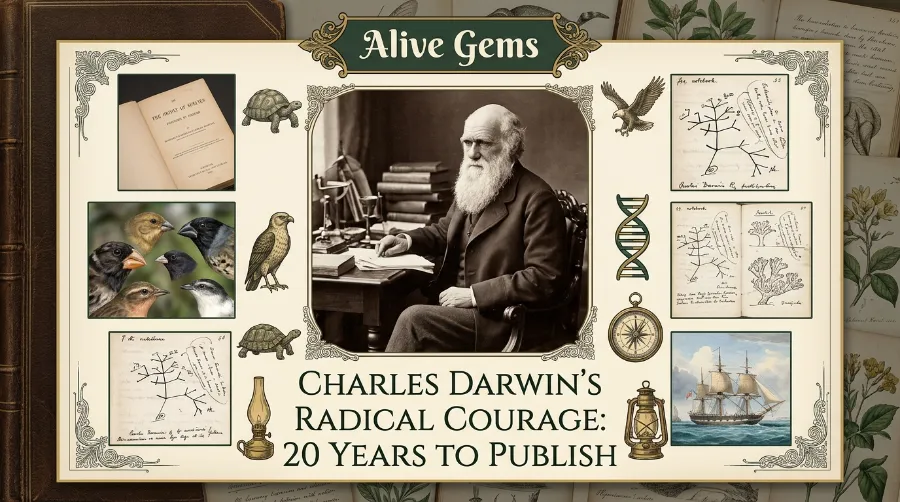
Key Takeaways Table
| Fact | Detail |
|---|---|
| Theory first conceived | 1838, after the HMS Beagle voyage |
| First private essay written | 1842, expanded in 1844 |
| Years between idea and publication | Roughly 20 to 21 years |
| Trigger for publishing | Alfred Russel Wallace’s 1858 letter |
| Joint presentation | Linnean Society of London, July 1, 1858 |
| Book published | On the Origin of Species, November 24, 1859 |
| Related work on human evolution | The Descent of Man, published 1871 |
| Years spent studying barnacles alone | 8 years |
TL;DR
- Darwin’s radical courage in taking 20 years to publish his theory came from a mix of scientific caution, health struggles, and awareness of the religious storm his ideas would cause.
- He only rushed to publish after naturalist Alfred Russel Wallace independently arrived at a nearly identical theory in 1858.
- Modern historians now debate whether Darwin was truly afraid, or simply patient and methodical by nature, and both views reveal something important about his personality.
Who Was Charles Darwin Before the World Knew His Name
Charles Darwin was not the fiery type. As a young man, he was more interested in beetles, rock formations, and long countryside walks than in stirring up controversy. In 1831, at just twenty two years old, he joined the HMS Beagle on a five year voyage around the world, collecting fossils, plants, and animal specimens from South America, the Galapagos Islands, and beyond.
That voyage changed everything. By the time he returned to England in 1836, Darwin had quietly begun connecting dots that no one else had fully connected before. Just two years later, in September 1838, his theory of evolution by natural selection started taking real shape in his private notebooks. Yet he told almost no one outside a small circle of trusted friends.
Darwin’s Radical Courage in Taking 20 Years to Publish His Theory
Here is the part that surprises most people. Darwin did not rush his idea into the world the moment it formed. He wrote a short private essay in 1842, then expanded it into a longer one in 1844, and even left instructions for his wife Emma about publishing it if he died before finishing his work. Then he went quiet again, for over a decade.
This is where Darwin’s radical courage and the 20 years it took him to publish becomes genuinely fascinating, because historians still argue about why he waited so long.
The Traditional View: Fear of the Backlash
For generations, most historians believed Darwin delayed out of pure fear. His theory directly challenged the biblical account of creation, and he knew it would offend the Church, his scientific peers, and even members of his own family. According to Pew Research Center, fear of backlash from Britain’s religious and scientific establishment was long considered the primary reason he delayed sharing his ideas publicly.
His own writings hint at this anxiety. He once compared revealing his theory to confessing a crime, a phrase that shows just how personally risky this felt to him. Darwin also watched what happened to a similar, less rigorous book called Vestiges of the Natural History of Creation, published anonymously in 1844, which was torn apart by critics. That experience likely made him even more cautious about presenting his own ideas before they were airtight.
The Newer View: A Patient Scientist, Not a Frightened One
More recent research complicates that simple fear based story. Cambridge historian Dr John van Wyhe argues there is little solid evidence Darwin was secretly hiding his theory out of fear at all. Instead, van Wyhe’s research into Darwin’s letters and notebooks shows he discussed his ideas fairly openly with friends, colleagues, and even people he barely knew, including botanist J. D. Hooker.
According to this view, Darwin simply had other major projects to finish first. He spent roughly ten years writing up his Beagle voyage findings into five separate books, then spent another eight years on an extraordinarily detailed study of barnacles, a project so thorough it eventually proved his eye for variation within species. Only after establishing his scientific reputation did he feel ready to return fully to his species theory. As his friend, Harvard botanist Asa Gray, reportedly put it, twenty years was not too much time to produce a book of that magnitude.
Both explanations are probably true at once. Fear and diligence rarely cancel each other out. Similar to how Galileo faced institutional resistance while still pushing forward carefully, a story we cover in our piece on Galileo versus the Church, Darwin’s caution and his courage existed side by side.
The Man Who Forced Darwin’s Hand
Everything changed in June 1858. Darwin received a letter and manuscript from Alfred Russel Wallace, a British naturalist working in the Malay Archipelago, who had independently developed a theory strikingly similar to Darwin’s own. For a man who had guarded his ideas so carefully for twenty years, this must have felt like a gut punch.
Rather than compete bitterly for credit, Darwin’s colleagues Charles Lyell and Joseph Hooker arranged something remarkably graceful. They organized a joint presentation of both Darwin’s and Wallace’s work at the Linnean Society of London on July 1, 1858. Neither scientist was even present at the reading.
- Darwin’s excerpts, notes, and an 1857 letter were read alongside Wallace’s essay.
- The joint paper barely caused a stir at the time, largely overlooked by the scientific community.
- Darwin then spent a grueling thirteen months writing a fuller, more persuasive account.
That account became On the Origin of Species, published on November 24, 1859. It sold out completely on its very first day, a detail that still surprises modern readers who assume it was a slow academic slog to acceptance.
What This Reveals About Darwin’s Personality and Leadership
Look closely at Darwin’s personality, leadership, and biography, and a clear pattern appears. He was not the classic image of a bold, confrontational revolutionary. He led through evidence, patience, and relentless preparation instead of charisma or force. That is a quieter kind of leadership, but arguably a more durable one.
He also showed real emotional intelligence in how he handled the Wallace situation. Instead of publicly claiming sole credit or dismissing Wallace’s work, he treated a potential rival with genuine fairness, something historians still praise as remarkably decent for the competitive scientific culture of Victorian England, according to the Origins project at Ohio State University.
His personal life adds even more depth to this picture. Darwin struggled with chronic illness for most of his adult life, reportedly suffering from severe stomach problems and fatigue for decades. He lost several children young, including a daughter whose death deeply affected his religious views. Yet through all of it, he kept working, reading, and refining his theory in the background.
Scientists Who Faced the Most Opposition in History
Darwin certainly belongs on any list of scientists who faced the most opposition in history, but he is far from alone. Marie Curie fought brutal sexism and institutional resistance throughout her career, a story we explore fully in Marie Curie, the woman science tried to destroy three times. Alan Turing’s groundbreaking work was buried under secrecy and later punished by the very government he helped save, a story told in our piece on Alan Turing.
Even Isaac Newton, publicly celebrated as a genius, hid an entire secret life of unconventional research to avoid controversy, something we unpack in Isaac Newton the secret alchemist. What unites all these figures is not just brilliance. It is the willingness to keep working quietly, year after year, even when the world was not ready to listen yet.
Darwin’s Charisma as a Quiet Genius
It might seem strange to call a shy, sickly naturalist charismatic, but Darwin’s charisma as a quiet genius is exactly what made people trust him. He was not persuasive because he shouted the loudest. He was persuasive because he built an overwhelming, patient mountain of evidence that was nearly impossible to dismiss.
This same quality echoes in other figures we have profiled, including Leonardo da Vinci, whose relentless curiosity across art and engineering is detailed in Leonardo da Vinci, 500 years ahead, and Nikola Tesla, whose quiet persistence against Edison’s louder public campaigns is covered in our feature on the Tesla vs Edison war of currents. Interestingly, Hedy Lamarr shared this same trait too, quietly developing frequency hopping technology behind the scenes of her Hollywood career, a story we tell in Hedy Lamarr, the actress who invented WiFi technology. Darwin fits neatly into this larger pattern explored in our guide to charismatic visionary scientists in history, where quiet persistence consistently outlasts loud confidence.
Why This Story Still Matters Today
According to the Royal Society’s own historical analysis, the debate over Darwin’s twenty year delay is far from settled among historians, and that ongoing disagreement is actually part of what makes his story so human. He was not a flawless icon. He was a man wrestling with fear, ambition, illness, and duty all at once, and he still managed to change how humanity understands life on Earth.
According to the Radical Tea Towel history blog, Darwin’s theory continues to shape debates about science, religion, and society more than 160 years after publication. Very few ideas from the nineteenth century remain this relevant today.
Timeline Chart: Darwin’s Path from Idea to Publication
Copy and paste this quick reference chart wherever useful.
| Year | Milestone |
|---|---|
| 1831 | Departs on HMS Beagle voyage, age 22 |
| 1836 | Returns to England after five years at sea |
| 1838 | Theory of natural selection first takes shape |
| 1842 | Writes short private essay outlining the theory |
| 1844 | Expands essay, leaves publishing instructions for his wife |
| 1846 to 1854 | Spends 8 years studying barnacles in depth |
| 1858 | Receives Wallace’s letter, joint paper read at Linnean Society |
| 1859 | On the Origin of Species published, sells out immediately |
| 1871 | Publishes The Descent of Man, addressing human evolution |
Opposition and Reaction Chart
| Group | Typical Reaction |
|---|---|
| Church of England leaders | Strong criticism, viewed theory as heresy |
| Scientific establishment | Mixed, some enthusiastic support, some rejection |
| General public | High interest, book sold out on release day |
| Close colleagues, Lyell and Hooker | Strong support, helped arrange publication |
Quick Knowledge Quiz
Test yourself before you scroll further.
- How long did Darwin wait between forming his theory and publishing it?
a) 10 years
b) 20 years
c) 30 years - Who forced Darwin’s hand by developing a similar theory independently?
a) Charles Lyell
b) Alfred Russel Wallace
c) Joseph Hooker - Where were Darwin and Wallace’s papers jointly presented?
a) Royal Society
b) Linnean Society
c) Cambridge University - How many years did Darwin spend studying barnacles?
a) 3 years
b) 5 years
c) 8 years - When was On the Origin of Species published?
a) 1836
b) 1844
c) 1859
Answers: 1-b, 2-b, 3-b, 4-c, 5-c
Frequently Asked Questions
Why did Darwin really wait 20 years to publish his theory?
Historians point to a mix of reasons, including fear of religious and scientific backlash, the need to gather overwhelming evidence, and other major projects like his barnacle research that came first.
Was Darwin afraid to publish, or simply busy?
Both explanations have strong support. Traditional historians emphasize fear of backlash, while newer research from Cambridge suggests he was mainly focused on finishing other scientific work first.
Who was Alfred Russel Wallace and why did he matter?
Wallace was a British naturalist who independently developed a theory nearly identical to Darwin’s, prompting Darwin to finally publish rather than risk losing credit entirely.
Did On the Origin of Species succeed immediately?
Yes, the book sold out completely on its first day of release in November 1859, despite the intense controversy it caused.
Did Darwin ever publish about human evolution directly?
Yes, he addressed human evolution more directly in a later book called The Descent of Man, published in 1871, twelve years after Origin.
Conclusion
Charles Darwin’s story is not the tale of a fearless rebel storming the gates of tradition. It is something quieter and, in many ways, more admirable. He carried one of the most world changing ideas in scientific history for twenty years, refining it patiently while battling illness, family tragedy, and the very real risk of public humiliation. When Alfred Russel Wallace finally forced his hand, Darwin responded not with panic or ego, but with grace and rigor. That combination of caution and courage is exactly what makes his twenty year wait so remarkable. Sometimes the most radical thing a brilliant mind can do is simply wait until the evidence is undeniable.
References
- Royal Society Publishing: Mind the Gap, Did Darwin Avoid Publishing His Theory
- Origins, Ohio State University: Charles Darwin’s American Adventure
- Radical Tea Towel: 160 Years of Charles Darwin’s Theory of Evolution
- University of Cambridge: Darwin’s Delay, The Stuff of Myth
- NPR: Darwin’s Theory, Too Big to Publish
- Pew Research Center: Darwin and His Theory of Evolution