
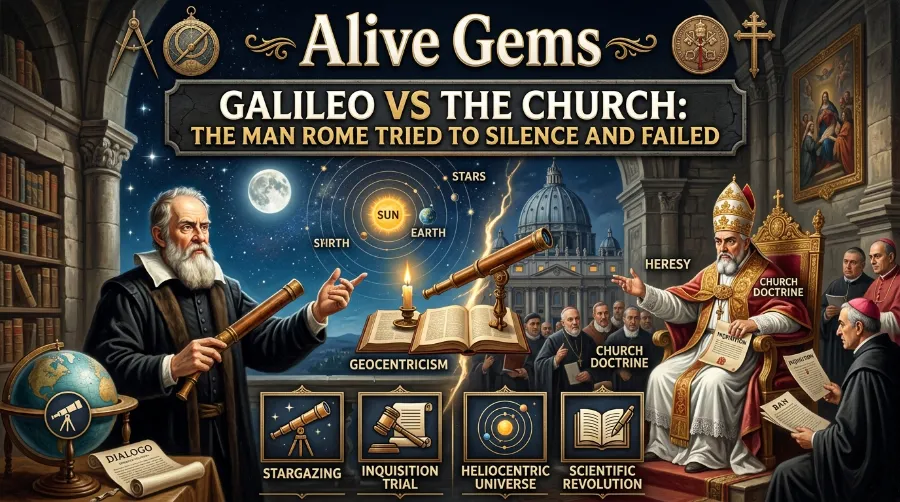
Galileo vs the Church an old, half blind man kneeling on a cold marble floor in Rome, forced to recite words that betray everything he has spent his life proving true. Then picture that same man, moments later, supposedly muttering under his breath, “and yet it moves.” Whether or not he actually whispered it, that single act of quiet defiance became one of the most famous stories in the entire history of science. This is the story of Galileo Church tried silence failed completely, and it remains one of the most talked about clashes between faith and reason that Europe and America still argue about today.
Galileo Galilei was not just a scientist. He was a showman, a father, a devout Catholic, a stubborn genius, and eventually, a prisoner in his own home. The Galileo vs Church history saga is often told as a simple battle between science and religion, but the real story is messier, more human, and honestly, far more interesting than the textbook version. By the end of this article, you will understand exactly why Galileo became one of the most courageous scientists history has ever produced, and why, centuries later, the institution that tried to silence him ended up apologizing to his ghost.
Hedy Lamarr: The Actress Who Invented WiFi Technology
Key Takeaways
| Fact | Detail |
|---|---|
| Born | February 15, 1564, in Pisa, Italy |
| Died | January 8, 1642, at age 77, under house arrest |
| Famous invention | Improved telescope, built in 1609 |
| First trial | 1616, warned not to teach heliocentrism |
| Second trial | 1633, found guilty of “vehement suspicion of heresy” |
| Punishment | Life sentence, commuted to permanent house arrest |
| Vatican apology | Issued in 1992, 359 years after his conviction |
| Legacy title | Often called the father of modern science |
TL;DR
- Galileo proved the Earth orbits the Sun, which directly contradicted official Church teaching in the early 1600s.
- The Church tried twice, in 1616 and 1633, to force him into silence through warnings, trial, and house arrest.
- He never stopped thinking, writing, or influencing science, and the Church formally admitted its error in 1992.
Who Was Galileo Galilei Before the Church Noticed Him
Long before the drama of his trial, Galileo was simply a curious kid from Pisa who was supposed to become a doctor. His father pushed him toward medicine because it paid well, but Galileo kept sneaking into mathematics lectures instead. Eventually he dropped out of the University of Pisa without a degree, which honestly makes his later achievements even more impressive.
By his late twenties, Galileo was teaching mathematics and quietly building a reputation as someone who did not just accept old theories because they were old. He questioned Aristotle. He questioned tradition. He questioned pretty much everyone, and that habit would define the rest of his life.
In 1609, everything changed. Galileo heard about a new Dutch invention, a simple spyglass, and within months he had built his own improved version. His telescope could magnify objects up to twenty times, which was extraordinary for the era. He pointed it at the sky, and the universe was never the same again.
The Discoveries That Made Him Dangerous, Galileo vs the Church
Here is the thing people forget. Galileo was not punished for building a telescope. He was punished for what he saw through it, and for refusing to stay quiet about it.
Between 1609 and 1610, Galileo made a series of observations that quietly demolished the accepted view of the cosmos:
- He discovered four moons orbiting Jupiter, proving that not everything in the sky revolves around Earth.
- He observed the phases of Venus, which only made sense if Venus orbited the Sun.
- He documented sunspots, contradicting the idea of a perfect, unchanging heaven.
- He saw mountains and craters on the Moon, proving it was not a smooth, flawless sphere.
These were not abstract theories. They were things anyone with a telescope could verify with their own eyes, which is exactly what made the Church so uncomfortable. Galileo published his findings in a short book called Sidereus Nuncius, or Starry Messenger, in 1610, and almost overnight he became the most famous scientist in Europe.
Much like Marie Curie faced institutional resistance decades later, Galileo learned that being right does not automatically protect you from powerful people who prefer comfortable lies.
Why the Church Actually Felt Threatened
It is tempting to imagine the Catholic Church as a single villain twirling a mustache, but the real politics were more complicated. Many Jesuit astronomers privately respected Galileo’s work. According to research from UCLA history professor Henry Kelly, who spent years examining the actual judicial records of the case, Church officials were not simply anti-science zealots. His research shows that on February 26, 1616, Cardinal Robert Bellarmine merely warned Galileo not to hold or defend heliocentrism, rather than putting him through a formal trial at that point. Brainly
The deeper issue was authority. The Council of Trent had already declared that Scripture could only be interpreted by the Church, not by individuals. Heliocentrism appeared to contradict certain biblical passages that describe the Sun moving across the sky. So when Galileo insisted his discoveries were literal fact rather than just a useful mathematical model, he was not just challenging astronomy. He was challenging who got to decide what was true, which in the seventeenth century, was an incredibly dangerous thing to challenge.
By 1616, the Catholic Church officially declared heliocentrism “false and contrary to Scripture.” Galileo was told, quite directly, to drop it or defend it only as a hypothesis, never as proven reality.
Archimedes: The Ancient Genius Whose Inventions We Still Cannot Explain
The Trial That Tried to Break Him
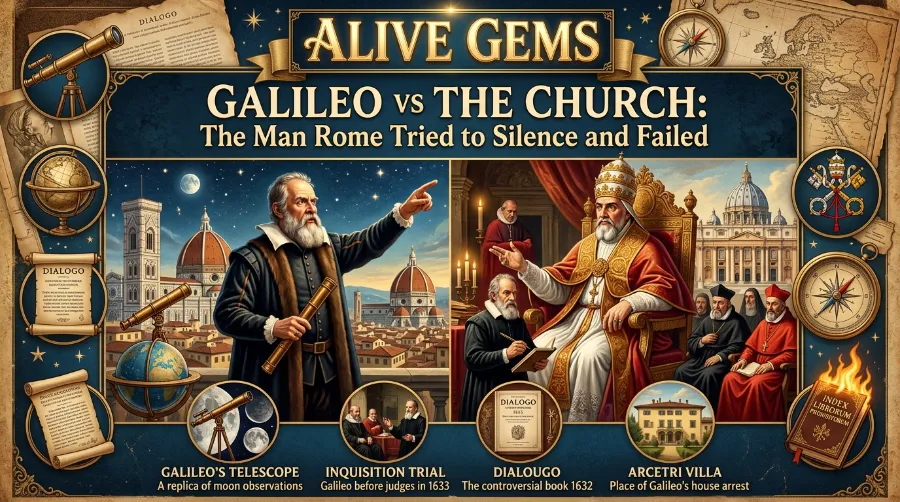
For sixteen years after that first warning, Galileo mostly behaved. He kept working, kept observing, and stayed relatively quiet about the Sun centered universe. Then in 1632, he published Dialogue Concerning the Two Chief World Systems, and everything unraveled.
The book presented arguments for both geocentrism and heliocentrism through a fictional conversation between three characters. The problem was that Galileo made the defender of the old Earth centered view sound foolish, and gave him the name Simplicio, which translates roughly to “simpleton.” Making it worse, Galileo went on to publish the book despite the earlier warnings, deriding those who refused to accept the Copernican system. Many historians, and Pope Urban VIII himself, suspected the character was a thinly veiled mockery of the Pope’s own arguments. HISTORY
That was the final straw. On April 12, 1633, chief inquisitor Father Vincenzo Maculano launched a formal inquisition of Galileo, ordering him to appear before the Holy Office. The trial unfolded across three sessions between April and May of 1633, and the sentence was delivered on June 22. HISTORYHISTORY
Here is a simplified timeline so you can follow exactly how the case escalated:
- 1610 — Galileo publishes Starry Messenger and becomes internationally famous.
- 1616 — First warning from Cardinal Bellarmine not to teach heliocentrism as fact.
- 1632 — Dialogue Concerning the Two Chief World Systems is published and offends Pope Urban VIII.
- 1633 — Formal trial begins, Galileo is found guilty of vehement suspicion of heresy.
- 1633 to 1642 — Galileo spends the rest of his life under house arrest.
The Church demanded he formally renounce heliocentrism, which he did, publicly, on his knees. His Dialogue was banned, and he was forced to humiliate himself publicly by reciting an Abjuration, essentially a statement retracting his own work. Historians still debate the details of what happened behind closed doors. Maurice Finocchiaro, a philosopher of science who spent years studying the case, concluded that Galileo was likely threatened with physical torture but probably did not actually experience it, though psychological pressure almost certainly played a role. UCLAUCLA
House Arrest Was Not Retirement
Galileo never went to a formal prison, but he was placed under house arrest during the trial and for the remaining nine years of his life. By 1633 he was already 69 years old, and within a few years he went completely blind, likely from decades of staring at the Sun through primitive telescope lenses combined with glaucoma and cataracts. UCLA
You would think that would be the end of the story. It was not. This is where Galileo’s real character shines through, and honestly, it is the part of the story that deserves far more attention. Even confined, blind, and technically silenced, he kept working. He dictated his final and arguably most important book, Two New Sciences, to his students, smuggling the manuscript out of Italy to be published in the Netherlands in 1638, safely outside the Inquisition’s reach.
This is exactly the kind of quiet, relentless resistance that connects Galileo to other scientists who defied authority throughout history, from Newton’s secretive alchemical research covered in our piece on Isaac Newton’s hidden obsessions to the fierce currents war fought between Tesla and Edison. you can read : Alan Turing: The Genius Who Won the War and Paid With His Body
The Legend of “And Yet It Moves”
Most people know Galileo through one famous phrase, eppur si muove, or “and yet it moves.” The story goes that immediately after recanting before the Inquisition, he muttered this defiant line under his breath, refusing to fully surrender his belief even while publicly denying it.
Historians are genuinely divided on whether this actually happened. There is no contemporary documentation from 1633 confirming it. The phrase does not appear in writing until more than a century after his death. Still, whether it is fact or folklore, it captures something true about the man. Galileo bent under pressure but he never truly broke. That distinction matters enormously when we talk about what makes someone genuinely courageous rather than simply reckless.
What the Church Got Wrong, According to Historians
It would be easy to paint this as pure science versus pure religion, but modern historians push back on that oversimplified framing. Heterodox Academy published an analysis specifically warning against reducing the Galileo affair to a clean morality tale. The reality involved politics, personal rivalries, wounded pride, and genuine theological anxiety, all tangled together with real scientific evidence.
Even the Catholic Church itself eventually acknowledged the mess it created. In 1992, the Vatican formally acknowledged its mistake in condemning Galileo, nearly 360 years after his original trial. Pope John Paul II specifically stated that the theologians of Galileo’s era failed to properly separate scientific questions from questions of faith. By 1744, Galileo’s Dialogue had already been quietly removed from the Church’s list of banned books, and in the twentieth century, both Pope Pius XII and Pope John Paul II issued official statements of regret over how the Church had treated him. HISTORY
That apology, delivered centuries too late for Galileo himself, remains one of the most searched facts about this entire story, and it is proof that truth has a way of outlasting the institutions that try to bury it.
A Chart of Galileo’s Key Discoveries and Their Impact
| Discovery | Year | Why It Mattered |
|---|---|---|
| Four moons of Jupiter | 1610 | Proved not everything orbits Earth |
| Phases of Venus | 1610 | Only explainable through a Sun centered model |
| Sunspots | 1611 | Disproved the idea of a perfect, unchanging Sun |
| Lunar craters and mountains | 1609 to 1610 | Showed the Moon was not a flawless sphere |
| Law of falling bodies | 1590s | Laid groundwork for Newton’s later laws of motion |
Public Perception Then Versus Now
| Time Period | Common View of Galileo |
|---|---|
| 1633, during the trial | Heretic, threat to Church authority |
| 1700s, Enlightenment era | Martyr for reason and free thought |
| 1992, Vatican apology | Officially recognized as wrongly condemned |
| Today, across USA and Europe | Widely taught as the father of modern science |
Why Galileo Still Matters to Modern Readers
You do not need to care about seventeenth century astronomy to understand why this story resonates. Galileo’s fight was never really about telescopes. It was about whether evidence should matter more than authority, and whether one stubborn, brilliant, occasionally arrogant man had the right to say what he saw was true, even when powerful people demanded he stay quiet.
That question has never really gone away. Every generation produces its own Galileo, someone willing to risk everything because they trust evidence over comfortable consensus. Leonardo da Vinci quietly defied convention through his own secretive notebooks, a story we explore in depth in our piece on Leonardo da Vinci’s genius, and if you want to explore the broader pattern of brilliant minds who refused to bow to pressure, our full guide on charismatic visionary scientists throughout history covers many more.
Quick Quiz: How Well Do You Know Galileo
Test yourself before moving on to the FAQ section.
- In what year did Galileo first get formally warned by the Church?
A) 1610
B) 1616
C) 1633 - What was the name of the book that triggered his 1633 trial?
A) Starry Messenger
B) Two New Sciences
C) Dialogue Concerning the Two Chief World Systems - What punishment did Galileo ultimately receive?
A) Execution
B) Permanent house arrest
C) Exile from Italy - In what year did the Vatican formally apologize for his condemnation?
A) 1900
B) 1965
C) 1992 - Which planet’s phases helped prove heliocentrism?
A) Mars
B) Venus
C) Saturn
Answers: 1-B, 2-C, 3-B, 4-C, 5-B
Frequently Asked Questions
Did the Church actually torture Galileo?
Most historians believe he was likely threatened with torture but probably was not physically tortured. Psychological pressure during the trial was intense and well documented.
Was Galileo excommunicated?
No. He was found guilty of vehement suspicion of heresy, a lesser charge than outright heresy, and he was never formally excommunicated from the Catholic Church.
Did Galileo really say “and yet it moves”?
There is no confirmed historical record from 1633 proving this. The phrase first appears in writing more than a hundred years after his death, so most historians treat it as legend rather than fact.
Why did it take so long for the Vatican to apologize?
Institutional change moves slowly, and formally admitting error required decades of internal theological review before Pope John Paul II issued the official acknowledgment in 1992.
Was Galileo the first person to propose heliocentrism?
No. Nicolaus Copernicus proposed it decades earlier. Galileo’s contribution was providing observational evidence through his telescope that made the theory nearly impossible to ignore.
Conclusion
Galileo Galilei spent the final years of his life blind, confined, and officially silenced by one of the most powerful institutions on Earth. And yet, more than four centuries later, his name is still spoken with admiration in classrooms across the United States and Europe, while the very ideas the Church tried to suppress are taught as basic scientific fact to schoolchildren everywhere. That is the real ending to this story. Silence him they tried. Silence him they absolutely could not. His courage, his stubbornness, and his refusal to abandon what the evidence showed him remain a permanent reminder that truth, eventually, tends to win.
References
- PBS NewsHour, How Galileo’s groundbreaking works got banned
- UCLA Newsroom, The truth about Galileo and his conflict with the Catholic Church
- Heterodox Academy, How simplistic narratives can mislead us: a case study of the Galileo affair
- HISTORY.com, When Galileo stood trial for defending science
- HISTORY.com, Galileo Galilei biography