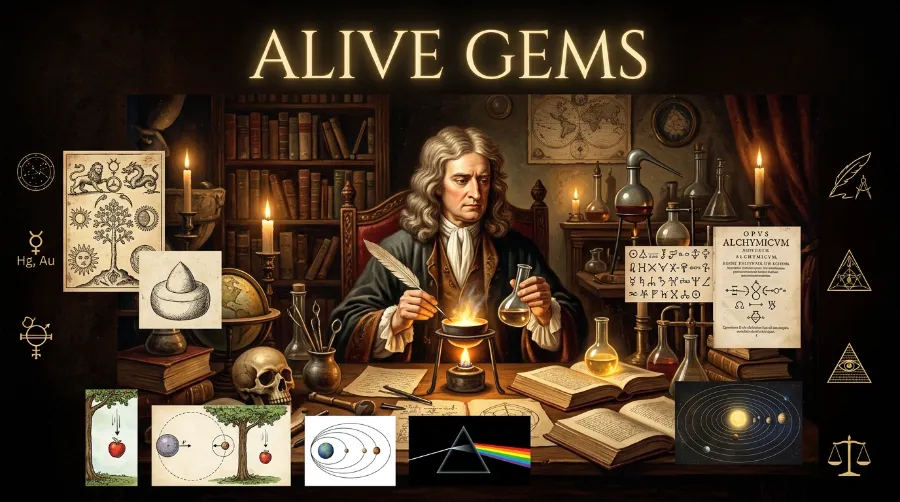
Isaac Newton Secret Alchemist the smartest man in Cambridge, hunched over a bubbling furnace at two in the morning, breathing in fumes that will slowly poison him for decades. That is not a scene from a fantasy novel. That is Isaac Newton, the same man who gave us gravity, calculus and the laws of motion, quietly practicing one of history’s most secretive crafts behind locked doors.
The story of Isaac Newton secret alchemist scientist history is not a rumor or a footnote. It is a documented, decades-long obsession that Newton hid from almost everyone he knew, and it changes everything we thought we understood about the father of modern physics. Here at AliveGems, we dig into the hidden sides of history’s biggest names, and Newton’s secret life might be the most surprising one yet.
Isaac Newton, renowned for his contributions to gravity, calculus, and motion, was also a secretive alchemist who spent decades secretly practicing his craft, often at the expense of his health. This little-known aspect of his life challenges our understanding of him as the father of modern physics and reveals a hidden obsession that he kept from nearly everyone around him.
Galileo vs the Church: The Man Rome Tried to Silence and Failed 2027 Guide
Key Takeaways
| What You’ll Learn | Quick Answer |
|---|---|
| Was Newton really an alchemist? | Yes, for roughly 30 years, starting around 1669 |
| How much did he write on alchemy? | Close to one million words, mostly unpublished |
| What was he searching for? | The Philosopher’s Stone, a legendary substance said to turn metal into gold |
| Did it harm him? | Hair samples later revealed dangerously high mercury levels |
| Why did he hide it? | Alchemy was legally and socially risky in 17th century England |
| When was this revealed? | Mostly after a 1936 Sotheby’s auction of his private papers |
TL;DR
- Newton secretly practiced alchemy for about three decades while working on gravity, optics and calculus.
- He wrote roughly a million words on alchemical theory, much of it in code, none of it published in his lifetime.
- Modern hair analysis suggests he poisoned himself with the same mercury he used in his experiments.
Who Was Isaac Newton Before The World Knew His Secret
Most people meet Isaac Newton in a science textbook, usually next to a falling apple and a stern black and white portrait. Born in Woolsthorpe, England, in 1642, he grew into the man who reshaped how humanity understood motion, light and the universe itself. His 1687 masterpiece, Philosophiæ Naturalis Principia Mathematica, still ranks among the most important books ever written.
But that textbook version of Newton leaves out a huge part of the man. For an equally engaging look at another mind who reshaped how we see genius and creativity centuries before Newton, our piece on Leonardo da Vinci and how he stayed 500 years ahead of his time makes a fascinating companion read. Both men shared something rarely mentioned in classrooms: a private obsession that polite society considered embarrassing, even dangerous.
Newton’s public triumphs were real. However, his private life told a very different, far stranger story, one that historians only began piecing together decades after his death.
Isaac Newton Secret Alchemist Life: What He Really Did Behind Closed Doors
Around 1669, while still a young fellow at Trinity College, Cambridge, Newton quietly began buying furnaces, crucibles and rare chemical reagents. By 1678, he had performed his first documented alchemical experiment, according to research from the Chymistry of Isaac Newton project at Indiana University. That project, led by historian William Newman, has spent years transcribing the handwritten evidence of Newton’s hidden life alchemy work, and the scale of it is staggering.
He did not dabble. Researchers estimate Newton wrote and transcribed close to one million words on alchemical theory over roughly 30 years, almost none of it ever published while he was alive. As explained in detail on the Kronecker Wallis breakdown of Newton’s secret alchemy research, Newton treated alchemical texts with the same relentless, systematic rigor he later applied to physics and mathematics.
A few numbers help put this in perspective:
- He built and personally operated his own laboratory furnace at Trinity College for decades.
- He owned and annotated dozens of alchemical manuscripts, some dating back centuries.
- He corresponded directly with fellow scientist Robert Boyle, one of the founders of modern chemistry, about alchemical recipes.
- He even exchanged notes on the subject with philosopher John Locke.
None of this was hidden because Newton lacked confidence in his ideas. It was hidden because the stakes were genuinely high.
Greatest Scientists Dark Secrets: Why Newton Kept It Quiet
Here is something most biographies skip. In 17th century England, certain forms of alchemy, particularly the transmutation of base metals into gold, were technically illegal under a law dating back to the 1400s, largely because rulers feared it would destabilize the currency. Practicing alchemists occasionally faced serious consequences across Europe, and Newton knew it.
There was also a reputational risk that mattered just as much to him. Newton was building a public identity as a rational, empirical natural philosopher. Admitting he spent his nights chasing the Philosopher’s Stone, a mythical substance believed capable of turning lead into gold and granting near miraculous healing, would have undermined the very authority he was working to establish. you can read : Alan Turing: The Genius Who Won the War and Paid With His Body
So he encoded his notes. He used symbolic language borrowed from older alchemical texts, referring to substances with names like the Green Lyon or the Doves of Diana instead of their real chemical identities. He signed some manuscripts with the anagram “Ieova sanctvs vnvs,” a Latin rearrangement of his own name meaning roughly “Jehovah, holy and one.” In short, he built himself a private code so that even if someone found his notes, they would struggle to understand them.
This secrecy worked remarkably well. For more than two centuries after his death, the public image of Newton stayed almost entirely untouched by his alchemical obsession.
Hedy Lamarr: The Actress Who Invented WiFi Technology
The Newton Hidden Life Alchemy Files Finally Come to Light
Everything changed in 1936, nearly 209 years after Newton’s death, when a large collection of his private papers went up for sale at a Sotheby’s auction in London. Economist John Maynard Keynes purchased a significant portion of these manuscripts and was reportedly stunned by what he found. Rather than the cold rationalist of legend, Keynes described Newton as something closer to a mystic, calling him one of the last great magicians rather than the first great scientist of the modern age.
Those manuscripts, now known as the Keynes Collection, are held at King’s College, Cambridge, and they include 59 documents written entirely in Newton’s own hand. Decades later, the Chymistry of Isaac Newton project digitized and transcribed these papers, finally making the full extent of Newton’s alchemical work searchable and public.
A short table helps show how this story unfolded across time.
| Year | Event |
|---|---|
| 1669 | Newton buys furnaces and chemicals, begins studying alchemy at Cambridge |
| 1678 | First documented alchemical experiment recorded |
| 1687 | Publishes Principia Mathematica while alchemical work continues privately |
| 1693 | Suffers a severe personal and mental health crisis |
| 1696 | Appointed Warden of the Royal Mint, moves to London |
| 1727 | Dies at age 84, alchemical papers remain in family hands |
| 1936 | Sotheby’s auction reveals the scale of his alchemical writings |
| 2010s | Chymistry of Isaac Newton project digitizes and publishes manuscripts |
Isaac Newton Biography Unknown Facts: The Breakdown Almost No One Talks About
In September 1693, at roughly age 50, Newton wrote a deeply troubling letter to a colleague. He described being unable to eat or sleep properly for nearly a year, mentioned feeling “extremely troubled,” and spoke of paranoid suspicions toward people close to him. Historians have debated the cause for decades, and the timing lines up almost exactly with his most intense years of alchemical experimentation.
This is where the story turns genuinely unsettling. In 1979, researchers analyzed strands of Newton’s exhumed hair and found mercury levels dramatically above safe modern thresholds, alongside elevated lead and arsenic. Mercury was central to Newton’s alchemical process, since alchemists believed it could dissolve and “amalgamate” other metals, including gold. Newton did not just handle mercury carefully from a distance. His own notes record him tasting it and describing its flavor, one entry calling it strong, sour and unpleasant.
Compare his documented symptoms with recognized signs of chronic mercury exposure.
| Newton’s Documented Symptoms | Classic Mercury Poisoning Signs |
|---|---|
| Severe insomnia | Sleep disturbance |
| Memory loss and confusion | Cognitive decline |
| Paranoid delusions | Irritability and psychiatric changes |
| Withdrawal from friendships | Personality change |
| Premature grey hair by age 30 | Hair and nervous system effects |
His own former roommate at Cambridge reportedly joked that Newton’s hair turned grey so early because of how often he handled mercury in the lab. It may have been meant as humor at the time. In hindsight, it reads more like an early warning sign nobody took seriously.
The Science History Institute’s detailed feature on Newton and alchemy is worth reading if you want the fuller picture of how deeply alchemical culture shaped scientific communities on both sides of the Atlantic during this period.
From the Furnace to the Universe: How Alchemy Actually Shaped Real Science
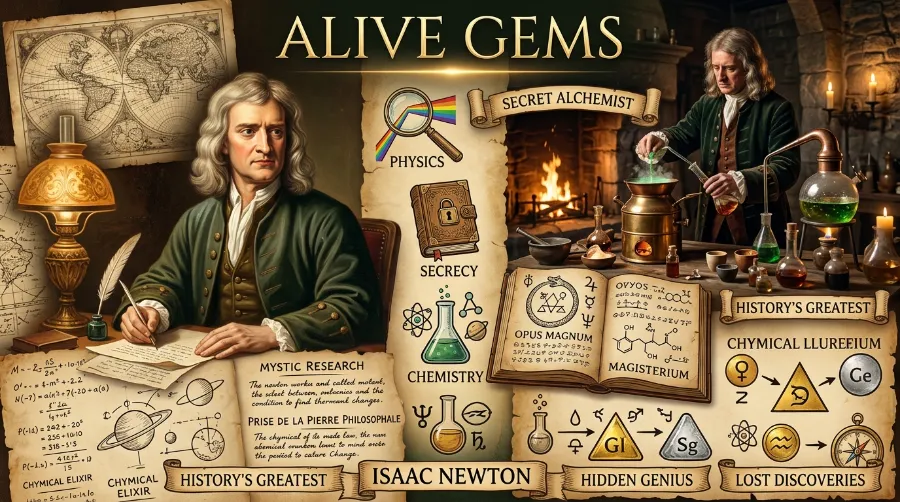
Here is the part that surprises most people. Newton’s alchemical obsession was not a wasted detour from his real work. Several historians now argue it directly fed his greatest scientific breakthroughs.
Consider a few connections:
- Newton’s belief in hidden forces acting between substances, a core alchemical idea, may have helped him imagine gravity as an invisible force acting at a distance, something many contemporaries initially found strange and unscientific.
- His obsessive alchemical note taking trained the same meticulous, evidence based habits he later used to test and refine his laws of motion.
- His optics experiments and alchemical experiments literally shared laboratory space and equipment, and his notebooks mix descriptions of light refraction with alchemical recipes on the very same pages.
According to a detailed profile from the University of Maryland Center for Environmental Science blog, Newton’s isolation and single minded focus, the same traits that made him a difficult colleague, were also what allowed him to pursue both physics and alchemy with equal intensity for decades without ever fully abandoning either one.
It’s worth remembering that Newton was hardly alone among brilliant minds who lived double lives in the name of discovery. Our guide to the real story behind the Tesla versus Edison war of currents shows how even celebrated inventors carried hidden rivalries, obsessions and secrets most textbooks leave out. The same is true of Marie Curie, the woman science tried to destroy three times, whose story reveals how genius and personal cost so often travel together.
Archimedes: The Ancient Genius Whose Inventions We Still Cannot Explain
Newton the Mint Master and Reluctant Detective
Newton’s secret life did not stop at alchemy. In 1696, he became Warden of the Royal Mint in London, a role many assumed was ceremonial. Instead, Newton threw himself into the job with startling intensity, personally investigating and helping prosecute counterfeiters, including a notorious criminal named William Chaloner, who was eventually executed in 1699 largely due to Newton’s relentless evidence gathering.
There is a strange irony here worth sitting with. The same man who spent decades secretly trying to create gold through alchemy spent his later career fiercely protecting England’s real gold currency from fraud. In 1703, he was elected President of the Royal Society, a position he held until his death, and in 1705 he became one of the first scientists ever knighted, becoming Sir Isaac Newton.
For a broader look at the visionary scientists whose personal stories shaped the modern world, our pillar guide on history’s most charismatic visionary scientists connects Newton’s story to other minds who changed everything while carrying secrets of their own.
Frequently Asked Questions
Was Isaac Newton actually an alchemist, or is this just a myth?
It is well documented, not a myth. Manuscripts in Newton’s own handwriting, now digitized by Indiana University’s Chymistry project, confirm roughly 30 years of serious alchemical research.
Did alchemy make Newton sick?
Hair analysis from 1979 found mercury, lead and arsenic levels well above safe modern ranges, and his documented symptoms closely match chronic mercury exposure, though some historians debate whether mercury alone fully explains his 1693 breakdown.
Why didn’t Newton publish his alchemical work?
Alchemy carried legal risk and social stigma in his era, and publishing it could have damaged the scientific reputation he worked so hard to build.
What was the Philosopher’s Stone Newton was searching for?
A legendary substance alchemists believed could transmute base metals into gold and possibly extend human life, one of the central goals of alchemical practice for centuries.
When did the public find out about Newton’s alchemy?
Mostly after 1936, when a large collection of his private papers surfaced at a Sotheby’s auction and were later studied in depth.
Test Your Knowledge: The Isaac Newton Secret Alchemist Quiz
- In what decade did Newton begin his documented alchemical experiments? (Multiple choice: 1650s, 1660s, 1670s, 1690s)
- True or false: Newton published most of his alchemical research during his lifetime.
- Which toxic metal was found in dangerously high levels in Newton’s exhumed hair? (Multiple choice: Lead, Mercury, Silver, Copper)
- True or false: Newton’s alchemical papers were widely known immediately after his death in 1727.
- What role did Newton take on in 1696, later using it to hunt counterfeiters? (Multiple choice: Royal Society President, Warden of the Royal Mint, Cambridge Chancellor)
Answers: 1) 1670s, 2) False, 3) Mercury, 4) False, they surfaced mainly after the 1936 Sotheby’s auction, 5) Warden of the Royal Mint
Conclusion
Isaac Newton’s story is usually told as a tidy tale of pure genius, one falling apple away from changing the world forever. The truth is messier, more human and honestly more compelling. Behind the powdered wig and the towering scientific legacy was a man who spent thirty secret years chasing gold that never came, writing a million private words most of the world would not read for centuries, and possibly poisoning himself in the process.
That does not diminish what Newton achieved. If anything, it makes his real accomplishments feel even more remarkable, because they came from a mind willing to explore every corner of the unknown, even the dangerous and unpopular ones. The next time someone mentions Isaac Newton and gravity, you’ll know there was a lot more happening in that Cambridge laboratory than falling apples.
References
- The Chymistry of Isaac Newton Project, Indiana University
- Isaac Newton’s Secret Alchemy Research: Science Meets Mysticism, Kronecker Wallis
- Isaac Newton and the American Alchemist, Science History Institute
- Isaac Newton: A Solitary Genius, University of Maryland Center for Environmental Science
- William R. Newman on Newton the Alchemist, Princeton University Press
- Newton the Alchemist, NOVA, PBS
- Mercury Poisoning: A Probable Cause of Isaac Newton’s Physical and Mental Ills, Royal Society Notes and Records