
Francis of Assisi: The Rich Rebel Who Gave Everything Away and Rebuilt Christianity
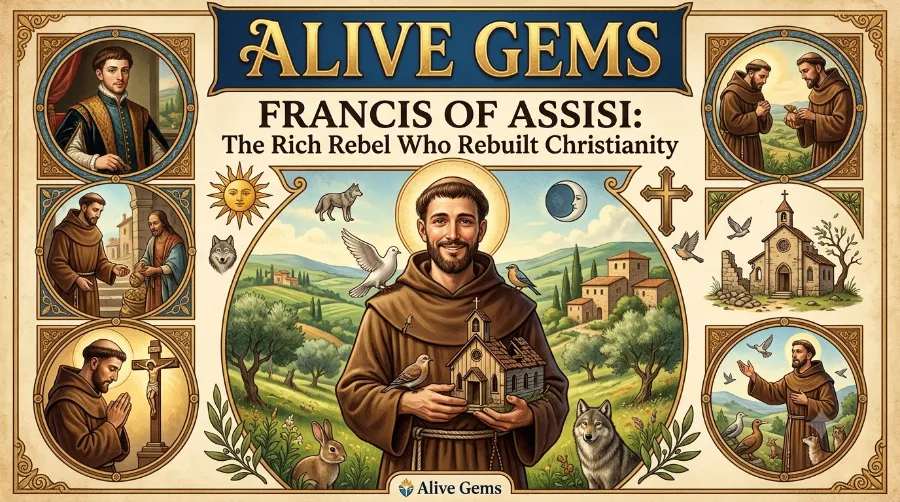
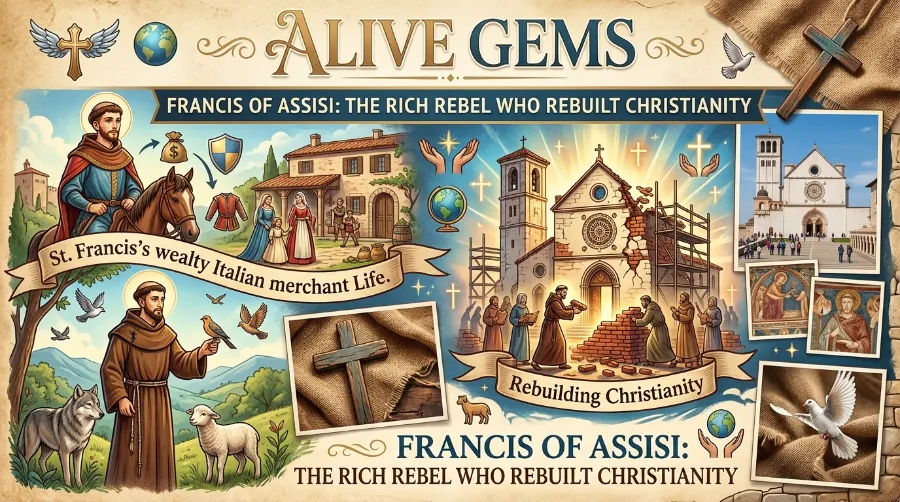
Francis of Assisi a young man in his twenties, dressed in the finest cloth his father’s shop can produce, singing love songs in the piazza and dreaming of knighthood and glory. Now picture that same man, a few years later, standing naked in that same piazza, handing his clothes back to his own father, and walking away with nothing. That is Francis of Assisi, a rich Italian merchant’s son who became one of the most beloved saints in Christian history by giving away everything he owned and, in the process, rebuilding a church that many believed was too broken to save. His story reads less like a saint’s biography and more like a rebellion, and that is exactly why it still lands so hard eight centuries later.
Guru Nanak: How He Founded the Egalitarian Sikhism Faith
TL;DR
- Francis of Assisi (1181 to 1226) was born into wealth in Assisi, Italy, renounced his inheritance publicly, and founded the Franciscan order.
- His radical embrace of poverty attracted over 5,000 followers within five years and reshaped Catholic spiritual life across Europe.
- He remains one of the most beloved saints in Christian history, known for the Prayer of Peace, the stigmata, and his love for creation.
Key Takeaways
| Fact | Detail |
|---|---|
| Birth name | Giovanni di Pietro di Bernardone |
| Born | Around 1181 or 1182, in Assisi, Italy |
| Died | October 3, 1226, in Assisi, at age 44 |
| Father’s trade | Wealthy cloth and silk merchant |
| Turning point | Vision at San Damiano chapel, told to “rebuild my church” |
| Public renunciation | Stripped off his clothes before the Bishop of Assisi and returned everything to his father |
| Order founded | Order of Friars Minor (Franciscans) |
| Growth | Over 5,000 followers within five years of the order’s founding |
| Stigmata | Received in 1224 on Mount La Verna, the first recorded case in Christian history |
| Canonized | July 16, 1228, by Pope Gregory IX, just two years after his death |
Who Was Francis of Assisi Before He Became a Saint?
Long before anyone called him a saint, Francis was known around Assisi as the life of every party. He was born around 1181 as Giovanni di Pietro di Bernardone, though his father nicknamed him Francesco, and he grew up with every advantage his father’s cloth business could buy.
Pietro di Bernardone was one of the wealthiest merchants in the Umbrian hill town of Assisi, and his son had fine clothes, good food, and a wide circle of friends. Francis dreamed of knighthood and battlefield glory, the way most privileged young men of his era did. Nothing about his early twenties suggested he would soon walk away from all of it.
That changed after he went to war, was captured, and spent roughly a year as a prisoner in Perugia. He came home sick and changed, and the illness that followed pulled him further away from the noisy, ambitious life he had always known. read out blog abput: Hildegard von Bingen: Medieval Genius Prophet Explained
From Battlefield Prisoner to Barefoot Preacher
Francis’s imprisonment in Perugia was not a minor detour. Historians point to this year in captivity, likely between 1202 and 1203, as the period when his old ambitions began to crack.
After his release, Francis drifted, unsure of what came next, spending long stretches in prayer near ruined chapels outside the city walls. One of those chapels was San Damiano, a small, crumbling building with a faded Byzantine style crucifix. Kneeling before it one day, Francis reported hearing Christ speak to him directly, instructing him to rebuild His house, which was falling into ruin.
Francis took the message literally at first. A few concrete things followed almost immediately:
- He returned to his father’s shop and took a bolt of expensive cloth along with a horse.
- He sold both in the nearby town of Foligno to raise money for repairing San Damiano.
- The parish priest, wary of Pietro’s temper, refused to accept the money.
That refusal set off a family conflict that would define the rest of Francis’s life.
The Public Break: Stripped Bare in the Town Square
Francis’s father was furious over the theft and had his own son thrown into a makeshift prison inside their home, then formally brought before the Bishop of Assisi to settle the dispute. What happened next became one of the most famous scenes in Christian history.
Standing before the bishop in the town square, Francis returned every coin and, according to multiple biographical accounts, removed his clothes as well, since even those had been paid for by his father. He declared that from that moment forward he recognized only his Father in heaven, then walked away wearing a simple pilgrim’s cloak marked with a plain cross.
This was not theater for its own sake. It was Francis formally cutting every tie to inherited wealth and status, choosing total poverty as a deliberate spiritual statement rather than a temporary sacrifice.
Francis Assisi Charisma and Personality: Why People Followed Him
What makes Francis’s charisma and personality so striking is that his appeal was not built on comfort or gentleness alone. He asked an enormous amount of the people who followed him, and they came anyway.
He called his followers the Friars Minor, meaning the Little Brothers, deliberately choosing the label used for the lowest social class of his time. As detailed by St. Francis of Assisi Catholic Church in Wichita, his first follower was Bernard, a wealthy local lawyer who sold everything he owned to join Francis, followed soon after by Clare of Assisi, a noblewoman who would go on to found the Poor Clares.
Within five years, more than 5,000 men and women across Italy and beyond had adopted Francis’s way of life. Consider what that growth meant in practice:
- Friars owned no personal property, not even the buildings they lived in.
- They begged for food when manual labor could not cover their needs.
- They were sent out to preach among the poor, the sick, and even declared enemies of the Church.
That last point led to one of the boldest moments of his life. During the Fifth Crusade, Francis crossed enemy lines and sat down directly with Sultan Malik al-Kamil to discuss Christian faith. The Sultan did not convert, but he treated Francis with unusual respect and granted him safe passage home.
Francis Assisi Biography and Leadership: Building an Order From Nothing
Francis’s biography and leadership style stand apart from most founders of major religious movements because he actively resisted the comfort and power that typically come with success. When wealthy supporters tried to donate land and buildings to his growing order, Francis frequently refused the gifts, worried that property would dull the mission.
A few leadership choices defined how the order functioned:
- He wrote a Rule of Life so demanding that some of his own friars later argued parts of it were nearly impossible to follow.
- He personally rebuilt three ruined chapels with his own hands before ever intending to found a formal religious order, including the Portiuncula, which became the spiritual heart of the Franciscans.
- He stepped back from formal leadership of the order in his final years, choosing prayer and solitude over administrative control.
This approach to leadership, refusing wealth even when it was freely offered, is central to why Francis is remembered less as an institution builder and more as a personal example people wanted to imitate. Read our blog on: Akhenaten the Pharaoh Who Destroyed Egypt’s Gods and Nearly Won. Meister Eckhart: The Mystic Too Radical Even for the Pope
The Stigmata and Francis’s Final Years
In the summer of 1224, Francis retreated to the mountain of La Verna to fast and pray for forty days. On September 14, during a vision of a six winged seraph, he reportedly received the stigmata, wounds mirroring those of the crucified Christ on his hands, feet, and side.
According to Britannica’s detailed account, Francis had already contracted a serious eye disease years earlier while preaching in the East, and by his final two years he was in near constant pain and almost completely blind. Even so, in 1225, while gravely ill at San Damiano, he composed the Canticle of the Creatures, a poetic prayer praising God through the sun, moon, wind, and even death itself.
Francis died on the evening of October 3, 1226, at the small chapel of the Portiuncula, reportedly while having brothers read aloud from the Gospel of John. He was 44 years old. Remarkably, Pope Gregory IX, his former protector, canonized him just under two years later, on July 16, 1228, one of the fastest canonizations in Church history. Buddha the Prince Who Left Everything To Save Everyone (True Story)
The Most Beloved Saints in Christian History: Where Francis Stands
Christian history has no shortage of towering spiritual figures, but Francis occupies a rare place among them. A quick comparison shows why.
| Saint | Era | Known For | Modern Recognition |
|---|---|---|---|
| Francis of Assisi | 1181 to 1226 | Radical poverty, stigmata, Franciscan order | Patron of ecology (1979), namesake of Pope Francis (2013) |
| Clare of Assisi | 1194 to 1253 | Founded the Poor Clares alongside Francis | Patron saint of television |
| Thomas Aquinas | 1225 to 1274 | Theological writing, Summa Theologica | Widely studied in Catholic education |
| Teresa of Ávila | 1515 to 1582 | Mystical writing, Carmelite reform | Declared a Doctor of the Church |
What separates Francis from this list is the sheer visual and emotional power of his story. Few saints combine a rags to riches to rags again narrative, a direct meeting with a Muslim Sultan during wartime, and a documented physical miracle like the stigmata into a single life.
Francis’s Modern Impact: From Assisi to the Vatican Today
Francis’s influence did not stay locked in the 13th century. Pope John Paul II named him the patron saint of ecology in 1979, recognizing his reputation for treating animals and nature as fellow creations of God. In 2013, a newly elected pope chose the name Francis specifically to honor his commitment to the poor and a humbler, more service-oriented Church.
His Prayer of Peace, beginning with the line asking to be made an instrument of peace, is now one of the most recited prayers in the world outside of Scripture itself, appearing at funerals, interfaith services, and public ceremonies across the US and Europe. According to The Catholic Woodworker, the Vatican has continued honoring Francis’s legacy through events like a recently declared Year of Saint Francis, showing his relevance has not faded even 800 years later.
As Fr. Michael Rennier notes in his reflection for Aleteia, the real lesson from Francis’s early failed attempt to literally rebuild a stone chapel through theft was that lasting change happens one small, honest act at a time, not through grand shortcuts. That is a message that resonates just as strongly with modern readers trying to rebuild their own lives as it did with a rebellious 13th century merchant’s son. you can also read our blog related: Zoroaster: The Forgotten Prophet Hiding Inside Every Major Religion
If Francis’s radical transformation fascinates you, his story sits naturally alongside other spiritual icons who changed the world, and readers who enjoyed learning about Rumi, the Sufi poet will likely see striking parallels between these two mystics from opposite ends of the medieval world.
Francis of Assisi’s Life Timeline (Text Chart, copy and paste ready)
Birth (Assisi, wealthy merchant family)     1181/1182
War capture, year in Perugia prison         1202-1203
San Damiano vision, "rebuild my church"     1205-1206
Public renunciation before the bishop       1206
Order of Friars Minor founded               1209
Followers grow past 5,000                   By 1216
Meeting with Sultan Malik al-Kamil          1219
Stigmata received at La Verna               1224
Canticle of the Creatures composed          1225
Death at the Portiuncula                    October 3, 1226
Canonized by Pope Gregory IX                July 16, 1228
Named patron saint of ecology               1979
Common Myths About Francis of Assisi
- Myth: Francis was always a gentle, passive figure. In reality, he was a former soldier who had been captured in battle and who later walked directly into an active war zone to confront a Sultan.
- Myth: He founded the Franciscan order right after his conversion. In truth, several years passed between his break with his father and the formal founding of the Friars Minor in 1209.
- Myth: The stigmata was widely publicized during his lifetime. According to multiple historical accounts, Francis actually tried to hide the wounds out of humility, and only close companions like Brother Leo documented them in detail.
FAQs About Francis of Assisi
Why did Francis of Assisi give away his wealth?
After a vision at the San Damiano chapel in which he believed Christ told him to rebuild the Church, Francis gradually understood this as a call to total poverty, culminating in his public renunciation of his inheritance before the Bishop of Assisi.
What order did Francis of Assisi found?
He founded the Order of Friars Minor, commonly known as the Franciscans, in 1209, built around vows of poverty, preaching, and service to the poor.
When did Francis of Assisi receive the stigmata?
He received the stigmata in September 1224 while praying on Mount La Verna, making him the first documented case of stigmata in Christian history.
How did Francis of Assisi die?
Francis died on October 3, 1226, at the small chapel of the Portiuncula near Assisi, after years of declining health and near total blindness.
Why is Francis of Assisi considered one of the most beloved saints?
His combination of radical humility, love for nature, direct engagement with people of other faiths, and rapid canonization just two years after his death has made him one of the most widely recognized and beloved saints in Christian history.want to know interesting facts about Teresa of Avila: The Mystic Who Rewrote Christianity’s Interior Life
Test Your Knowledge of Francis of Assisi (Quiz)
- What was Francis’s father’s trade? (Multiple Choice)
a) Blacksmith
b) Cloth and silk merchant
c) Vineyard owner
d) Soldier - Where did Francis receive the stigmata? (Multiple Choice)
a) Assisi town square
b) San Damiano chapel
c) Mount La Verna
d) Rome - Who canonized Francis of Assisi, and how soon after his death? (Multiple Choice)
a) Pope Gregory IX, two years later
b) Pope Innocent III, immediately
c) Pope John Paul II, centuries later
d) Pope Leo, fifty years later - True or false: Francis of Assisi personally met with a Muslim Sultan during the Fifth Crusade.
- Fill in the blank: Francis named his order the Friars ______, meaning the Little Brothers.
(Answers: 1-b, 2-c, 3-a, 4-True, 5-Minor)
Conclusion
Francis of Assisi’s story works because it refuses to stay tidy. He was not born humble, he was not naturally gentle, and he did not slide quietly into sainthood. He was a rich, ambitious young man who broke himself open in a town square, rebuilt his entire identity stone by stone, and in doing so pulled thousands of others into a completely different way of living. Eight centuries later, his name still shows up everywhere from garden statues to papal titles, not because his story got softer with age, but because the core of it, giving up everything you were told mattered in order to find what actually does, has never stopped being exactly what people need to hear. For more stories of history’s most magnetic, world altering figures, explore the full collection on Alive Gems.
References
- Aleteia, “St. Francis of Assisi on how to build a life” https://aleteia.org/2026/05/17/francis-of-assisi-on-how-to-build-a-life/
- St. Francis of Assisi Catholic Church, Wichita, “St. Francis of Assisi Transformed the Catholic Church” https://www.stfranciswichita.com/blog/2024mar03-sfa/
- The Catholic Woodworker, “St. Francis of Assisi: The Radical Who Gave Up Everything” https://catholicwoodworker.com/blogs/our-blog/st-francis-of-assisi-the-radical-who-gave-up-everything
- Encyclopedia Britannica, “St. Francis of Assisi: Miracles, Poverty, Stigmata” https://www.britannica.com/biography/Saint-Francis-of-Assisi/Franciss-vision-and-the-stigmata-of-the-Crucified
- EBSCO Research Starters, “Death of St. Francis of Assisi” https://www.ebsco.com/research-starters/history/death-st-francis-assisi