
Picture a room full of powerful men who have already decided your fate. Now picture one person standing up anyway. That single act, small and terrifying, is how almost every rebellion in human history actually begins. The rebels who rewrote history changed everything not because they had armies or money, but because they refused to accept the world as it was handed to them. Some of these forgotten revolutionaries changed history from prison cells. Others did it from jungles, plantations, and courtrooms. This is the story of twenty of them, and why their courage still matters today.
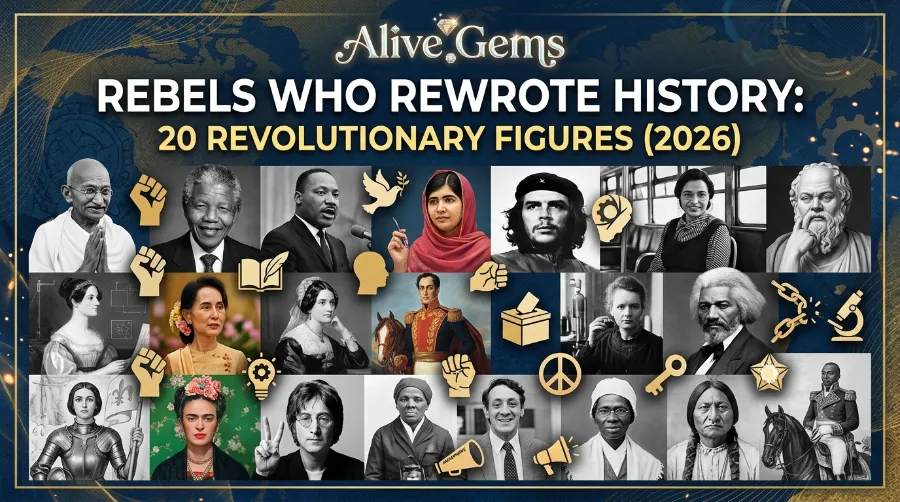
Key Takeaways
| Rebel | Country/Region | Era | What They Changed |
|---|---|---|---|
| Simón Bolívar | South America | 1783 to 1830 | Freed six nations from Spanish rule |
| Toussaint Louverture | Haiti | 1743 to 1803 | Led the only successful slave revolt that founded a nation |
| Che Guevara | Argentina/Cuba | 1928 to 1967 | Became the global symbol of armed revolution |
| Thomas Paine | England/America | 1737 to 1809 | His writing pushed colonists toward independence |
| Ho Chi Minh | Vietnam | 1890 to 1969 | Defeated two world powers through patience and strategy |
| Frederick Douglass | United States | 1818 to 1895 | Turned his own escape from slavery into a weapon against it |
| Rosa Luxemburg | Poland/Germany | 1871 to 1919 | Frightened European governments with her ideas alone |
| Emiliano Zapata | Mexico | 1879 to 1919 | Gave Mexico’s landless peasants a voice and a cause |
| Nelson Mandela | South Africa | 1918 to 2013 | Ended apartheid after 27 years in prison |
| Mahatma Gandhi | India | 1869 to 1948 | Proved that nonviolence could defeat an empire |
TL;DR
- Twenty rebels across four continents used courage, not armies, to bring down empires and unjust systems
- Many of the most courageous rebels world history remembers were ordinary people including enslaved men, peasants, and factory workers
- Their common thread was simple: they refused silence when silence was the safer, easier choice
The Rebels Who Refused to Kneel
Every one of these rebels who rewrote history changed everything by making one dangerous decision. They decided that their own comfort, safety, and sometimes their lives mattered less than the outcome they were fighting for. That is not a small thing. It is, honestly, terrifying to imagine standing where they stood. Let’s start close to home, in the Americas, where a handful of men and women reshaped the entire hemisphere.
Rebels Who Rewrote History in the Americas
Simón Bolívar: The Liberator Who Freed a Continent
Simón Bolívar was born into wealth in Caracas in 1783, yet he gave up every comfort that wealth could buy. Between 1819 and 1825, he led military campaigns that freed what is now Venezuela, Colombia, Ecuador, Peru, and Bolivia from Spanish colonial rule. His crossing of the Andes mountains in 1819, with soldiers marching through freezing altitudes in thin clothing, remains one of the boldest military gambles in history. Bolívar’s full story, including the personal cost of that ambition, is covered in more depth on alivegems.com’s profile of Simón Bolívar.
Toussaint Louverture: The Enslaved Man Who Built a Republic
Toussaint Louverture was born into slavery on a Haitian plantation around 1743. He rose to lead the only slave revolt in history that resulted in the founding of a nation. By 1801, Louverture had defeated French, Spanish, and British forces on the same island. He never lived to see Haiti’s official independence in 1804, since Napoleon’s forces captured and imprisoned him in France, where he died in a cold mountain jail in 1803. His journey from bondage to command is explored fully in this piece on Toussaint Louverture, the enslaved man who built a republic.
Che Guevara: The Revolutionary Millions Still Follow
Few faces are as recognizable as Che Guevara’s. Born in Argentina in 1928, Guevara became a central figure in the Cuban Revolution alongside Fidel Castro, helping topple the Batista government by 1959. He later attempted to spread revolution in the Congo and Bolivia, where he was captured and executed in 1967 at age 39. Decades later, his image still appears on flags at protests worldwide. You can read a deeper account in Che Guevara: millions still follow.
Emiliano Zapata: The Peasant Who Became Mexico’s Voice
Emiliano Zapata grew up among Mexican peasant farmers who had lost their land to wealthy hacienda owners. During the Mexican Revolution, his rallying cry of “Tierra y Libertad,” meaning land and liberty, became a national symbol. Zapata’s forces controlled large parts of southern Mexico between 1911 and his assassination in 1919. His life is detailed in Emiliano Zapata: the peasant who became Mexico’s voice.
Thomas Paine: The Pamphlet That Lit the American Revolution’s Fuse
Before 1776, many American colonists still hoped for reconciliation with Britain. Then Thomas Paine published Common Sense, a pamphlet that sold roughly 500,000 copies within a year, an enormous number for a colonial population of about 2.5 million people. Paine argued plainly that independence was not just possible but necessary. His words did what soldiers alone could not: they changed minds. More on this pivotal moment appears in Thomas Paine lit the American Revolution’s fuse.
Frederick Douglass: The Escaped Slave Who Became History’s Greatest Orator
Frederick Douglass escaped slavery in Maryland in 1838 and went on to become one of the most powerful public speakers of the 19th century. His autobiography, published in 1845, exposed the brutal realities of slavery to readers who had never confronted them directly. Douglass later advised Abraham Lincoln and pushed relentlessly for the enlistment of Black soldiers in the Union Army. His full story is available in Frederick Douglass, the escaped slave who became the greatest orator.
Harriet Tubman: The Conductor Who Never Lost a Passenger
Harriet Tubman escaped slavery in Maryland in 1849 and returned south at least thirteen times to guide roughly seventy enslaved people to freedom along the Underground Railroad. During the Civil War, she also served as a scout and spy for the Union Army, and in 1863 she helped lead a raid that freed more than 700 enslaved people in South Carolina. She reportedly said she never lost a single passenger on her journeys north.
Sojourner Truth: The Voice That Would Not Be Silenced
Born into slavery in New York around 1797, Sojourner Truth won her freedom in 1826 and became a fierce abolitionist and women’s rights speaker. Her 1851 speech, often remembered by the phrase “Ain’t I a Woman,” challenged both racial and gender injustice at a single Ohio convention. She spent decades traveling the country demanding rights for people society had written off entirely.
Forgotten Revolutionaries Who Changed History in Europe
Rosa Luxemburg: The Thinker Who Frightened European Governments
Rosa Luxemburg was a Polish born economist and revolutionary whose writings on capitalism and socialism unsettled governments across Europe in the early 1900s. She co-founded the Spartacist League in Germany and helped lead an uprising in Berlin in January 1919. That uprising failed, and Luxemburg was captured and killed by paramilitary forces days later, but her ideas outlived her by a century. Her story continues in Rosa Luxemburg frightened European governments.
Olympe de Gouges: The Playwright Who Demanded Equality
Olympe de Gouges published her Declaration of the Rights of Woman and the Female Citizen in 1791, directly challenging the French Revolution’s failure to include women in its promises of liberty and equality. Her outspokenness made her enemies among the revolutionary leadership, and she was executed by guillotine in November 1793. She remains one of the earliest documented voices for gender equality in modern Europe.
Joan of Arc: The Teenager Who Led an Army
Joan of Arc was a French peasant girl who, at around 17 years old, convinced a royal court that she had been called to save France from English domination during the Hundred Years’ War. In 1429, she led French forces to a decisive victory at Orléans. She was captured the following year, tried for heresy, and burned at the stake in 1431 at approximately age 19. France later declared her a national heroine, and the Catholic Church canonized her in 1920.
Spartacus: The Enslaved Gladiator Who Shook Rome
Spartacus was a Thracian gladiator who led an uprising of enslaved people against the Roman Republic beginning in 73 BCE. His forces, growing to tens of thousands, defeated multiple Roman legions over roughly two years before being crushed in 71 BCE. Rome never forgot the scare. Centuries later, his name became shorthand for any rebellion against overwhelming odds.
Lech Wałęsa: The Shipyard Electrician Who Helped Bring Down Communism
Lech Wałęsa was an electrician at the Gdańsk Shipyard in Poland when he helped found the Solidarity trade union in 1980, the first independent labor union in a Soviet bloc country. Solidarity’s strikes and negotiations eventually pressured the communist government into holding partially free elections in 1989, a turning point that helped trigger the collapse of Soviet influence across Eastern Europe. Wałęsa became Poland’s president in 1990 and later received the Nobel Peace Prize.
Most Courageous Rebels World History Remembers From Asia and Africa
Ho Chi Minh: Patience That Beat Two Superpowers
Ho Chi Minh spent decades organizing Vietnamese resistance against French colonial rule before declaring independence in 1945. He then outlasted both France, defeated at Dien Bien Phu in 1954, and later the United States, whose involvement in Vietnam ended in 1973. His strategy relied less on firepower and more on patience, something rarely celebrated in war stories but decisive in this one. Read more in Ho Chi Minh’s patience beat superpowers.
Mahatma Gandhi: Proof That Nonviolence Could Defeat an Empire
Mahatma Gandhi led India’s independence movement using nonviolent civil disobedience, most famously during the 1930 Salt March, when he walked roughly 240 miles to the sea to protest British salt taxes. India gained independence in 1947, and Gandhi’s methods later directly influenced civil rights movements around the world, including Martin Luther King Jr.’s campaigns in the United States.
Sun Yat-sen: The Doctor Who Ended an Empire
Sun Yat-sen trained as a physician before dedicating his life to overthrowing China’s Qing dynasty, which had ruled for over 250 years. He became the first provisional president of the Republic of China in 1912, ending more than two thousand years of imperial rule. He is still honored today in both mainland China and Taiwan, a rare figure claimed by both sides of a deep political divide.
Subhas Chandra Bose: The Rebel Who Sought Allies Anywhere He Could Find Them
Subhas Chandra Bose broke from Gandhi’s nonviolent approach and sought military alliances with Germany and Japan during World War II to fight British colonial rule in India. He led the Indian National Army, formed largely from Indian prisoners of war, in campaigns against British forces in 1944. He died in a plane crash in 1945, and his fate remains debated in India to this day.
Nelson Mandela: Twenty Seven Years That Could Not Break Him
Nelson Mandela spent 27 years in South African prisons, most of them on Robben Island, for his opposition to apartheid. He was released in 1990 and, remarkably, chose reconciliation over revenge, becoming South Africa’s first Black president in 1994. His ability to forgive his jailers while still dismantling the system that imprisoned him remains one of the most studied acts of political leadership in modern history.
Kwame Nkrumah: The Voice of African Independence
Kwame Nkrumah led Ghana to independence from Britain in 1957, making it the first sub-Saharan African colony to break free of European rule in the postwar era. He became a leading voice for Pan-Africanism, arguing that African nations needed to unite to resist renewed forms of foreign control. His presidency ended in a military coup in 1966, a reminder that revolutionary success does not guarantee a peaceful ending.
Túpac Amaru II: The Rebellion That Warned an Empire
Túpac Amaru II, born José Gabriel Condorcanqui, led a major indigenous uprising against Spanish colonial rule in Peru beginning in 1780. His forces, drawing tens of thousands of indigenous fighters, briefly threatened Spanish control of the entire Andean region before he was captured and executed in 1781. Spanish authorities responded with such brutal repression that historians consider the revolt a direct precursor to the independence movements Bolívar would lead decades later.
What These Revolutionary Leaders Overlooked in Biography Books Actually Teach Us
Textbooks tend to flatten these people into dates and outcomes. What gets lost is how ordinary most of them were before the moment that made them extraordinary. A few patterns show up again and again:
- Nearly all of them faced years, sometimes decades, of failure before any real success
- Most were dismissed by the powerful people around them as naive, dangerous, or simply wrong
- Several died before seeing the full result of what they started
- Almost none of them acted alone, even though history often remembers a single name
These forgotten revolutionaries changed history not through certainty but through persistence in the face of constant doubt, including their own.
Frequently Asked Questions
Who is considered the most influential rebel in world history?
There is no single answer, since influence depends on region and era. Gandhi’s nonviolent methods reshaped independence movements globally, while Bolívar’s military campaigns redrew the map of an entire continent.
Were all rebels who rewrote history successful in their own lifetimes?
No. Toussaint Louverture, Túpac Amaru II, and Olympe de Gouges all died before seeing the outcomes their actions eventually produced.
What do most courageous rebels in world history have in common?
Most began as ordinary people, faced significant personal risk, and were driven by a specific injustice they had experienced directly rather than abstract political theory.
Why are some revolutionary leaders overlooked in mainstream biography and history classes?
Historical memory tends to favor rebels connected to nations that later became powerful. Figures from smaller or colonized regions, like Túpac Amaru II or Zapata, often receive less attention outside their home countries.
Test Your Knowledge: Rebel History Quiz
- In what year did Toussaint Louverture die in a French prison?
- Which rebel’s pamphlet sold roughly 500,000 copies in colonial America?
- How many years did Nelson Mandela spend in prison?
- Which teenage girl led French forces to victory at Orléans in 1429?
Multiple Choice
- Simón Bolívar’s crossing of which mountain range is considered one of history’s boldest military gambles?
A) The Alps
B) The Andes
C) The Rockies - Rosa Luxemburg co-founded which political group in Germany?
A) The Spartacist League
B) The Bolshevik Party
C) The Fabian Society - Which rebel used the strategy of patience to defeat both France and the United States?
A) Sun Yat-sen
B) Ho Chi Minh
C) Kwame Nkrumah
Conclusion
Twenty names, four continents, over two thousand years of history, and one thread running through every single story. Each of these rebels who rewrote history changed everything because they were willing to lose what they had for a chance at something better, for themselves and for people they would never meet. Some won. Some were executed for trying. All of them proved that a single act of defiance, however small it looks in the moment, can outlast empires. If their courage still gives you chills reading about it centuries later, that is exactly the point. To explore more figures like these, visit the pillar guide to 10 charismatic revolutionary rebels on alivegems.com.