
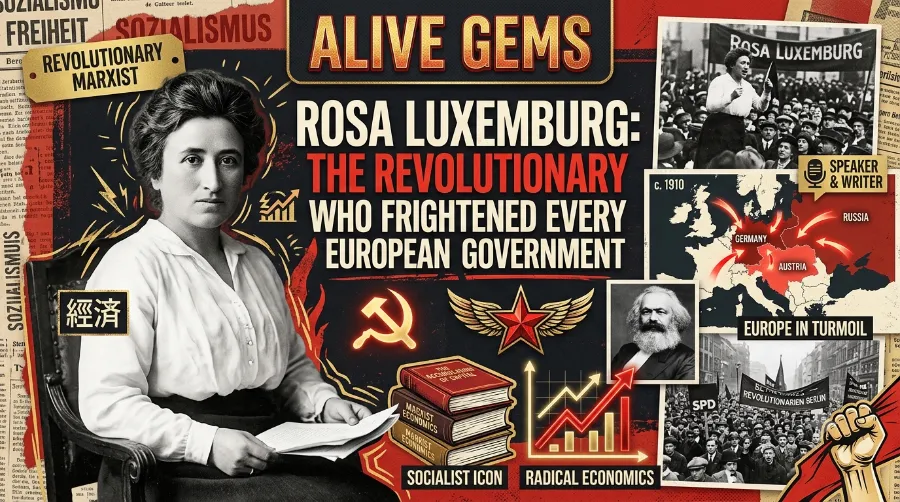
Rosa Luxemburg a woman barely five feet tall, walking with a permanent limp from a childhood illness, stepping onto a stage in front of thousands of hostile delegates. She does not raise her voice to be heard. She simply starts speaking, and within minutes, grown men twice her size are struggling to hold their ground against her. That woman was Rosa Luxemburg, and by the time European governments finally silenced her in 1919, she had already spent three decades proving that ideas, sharpened well enough, terrify empires more than armies do. This is the story of how Rosa Luxemburg frightened every European government of her era, and why her ideas still unsettle people today.
Emiliano Zapata: The Peasant Who Became Mexico’s Immortal Soul

She was not a soldier. She was not a president. She was an economist, a writer, and a prisoner more times than most people change jobs. And yet kings, chancellors, and eventually an entire post-war German government treated her like an existential threat.
Key Takeaways
| Fact | Detail |
|---|---|
| Born | March 5, 1871, Zamosc, Poland, then part of the Russian Empire |
| Fled to Zurich | 1889, escaping surveillance for underground political activity |
| Earned PhD | Law and political economy, University of Zurich, 1897 |
| Major economic work | “The Accumulation of Capital,” published 1913 |
| Movement founded | Spartacus League, 1914, with Karl Liebknecht |
| Imprisoned | Multiple times between 1904 and 1918 for anti-war and revolutionary activity |
| Died | January 15, 1919, murdered in Berlin by Freikorps paramilitaries |
TL;DR
- Rosa Luxemburg was a self-made economist and revolutionary who challenged capitalism, nationalism, and authoritarian socialism all at once.
- Her writings and speeches so alarmed European governments that she was repeatedly jailed, and was ultimately assassinated by right-wing paramilitaries in 1919.
- Her warnings about centralized power becoming dictatorship, aimed even at fellow revolutionaries like Lenin, proved eerily accurate within a decade of her death.
A Childhood That Should Have Silenced Her
Rosa Luxemburg was born in 1871 in Zamosc, a small town in what was then Russian-controlled Poland, the youngest of five children in a Jewish family of modest means. A hip ailment in early childhood left her with a limp she carried for the rest of her life, and doctors of the era assumed she would live a quiet, limited existence.
Nothing about her later life matched that prediction. By her teenage years in Warsaw, Luxemburg was already involved in underground socialist organizing, a genuinely dangerous activity under Tsarist Russia’s surveillance state. In 1889, at just eighteen, she fled the country entirely, making her way to Zurich, Switzerland, one of the few places in Europe where radical political exiles could study and organize openly.
It was in Zurich that Luxemburg completed a doctorate in law and political economy in 1897, an extraordinary achievement for a woman of that era, and one that gave her the intellectual toolkit she would later use to dismantle the economic arguments of far more powerful men.
From Economist to Threat: How Rosa Luxemburg Frightened Every European Government
Here is where her story becomes genuinely rare. Most revolutionaries of the era relied on passion and slogans. Luxemburg relied on economics. In 1913, she published “The Accumulation of Capital,” a dense, rigorous work arguing that capitalism’s survival depended on constantly expanding into new markets and colonies, and that this expansion would eventually collapse under its own contradictions.
This mattered enormously, because it meant governments could not dismiss her as merely an agitator. She was publishing academic-grade economic theory that directly threatened the intellectual justification for European imperialism. That is a very different kind of danger than a street protest, and it is exactly why officials across Germany, Russia, and Poland treated her with such alarm.
Contemporaries who watched her debate described a startling transformation the moment she took the floor. According to accounts collected by historians, her small frame seemed to grow larger the moment she began speaking, her wit sharp enough that opponents visibly struggled to respond. The Belgian socialist Emile Vandervelde recalled watching her leap onto a chair in the middle of a crowded hall simply to make sure every delegate in the room could hear her.
A few reasons her presence rattled the establishment so consistently:
- She refused to soften her positions for anyone, criticizing capitalist governments, nationalist movements, and eventually fellow socialists with equal bluntness.
- She backed her arguments with rigorous economic theory, making her far harder to dismiss than a purely emotional agitator.
- She organized across borders, rejecting the nationalism that most of her contemporaries assumed was natural, including within the socialist movement itself.
- She kept returning after every arrest, which made imprisonment an ineffective tool against her.
If you enjoy stories of revolutionaries who used conviction rather than armies to shake entire governments, our profile of Thomas Paine, the writer who lit the fuse of the American Revolution, covers a strikingly similar dynamic a century earlier.
The Woman Who Warned Lenin
One of the most remarkable parts of Luxemburg’s story is how she frightened not just capitalist governments, but her own political allies. In 1904, years before the Russian Revolution, she publicly challenged Vladimir Lenin’s model of tightly centralized party control, warning that a revolution built on strict top-down discipline would eventually calcify into dictatorship rather than genuine freedom for workers.
That warning proved chillingly accurate. Writing later in “The Russian Revolution,” composed in 1918 while she sat in a German prison, Luxemburg argued that freedom which applied only to government supporters was not freedom at all, famously insisting that real liberty had to include the freedom of those who disagreed. Within a few years of her death, the very Communist parties she helped inspire in Poland and Germany would adopt exactly the authoritarian methods she had spent her life warning against.
This is part of what makes Luxemburg such a fascinating figure for modern readers. She was not simply anti-establishment. She was a rare kind of thinker willing to criticize power in every direction it appeared, capitalist or socialist, which is one reason organizations like the Rosa Luxemburg Foundation continue to draw on her writing today when confronting the resurgence of nationalist and far-right politics across Europe.
Founding the Spartacus League
When the First World War broke out in 1914, most European socialist parties abandoned their earlier promises of international solidarity and backed their own governments’ war efforts. Luxemburg refused. Alongside her close collaborator Karl Liebknecht, she founded the Spartacus League that same year, named deliberately after the enslaved gladiator who led a rebellion against Rome, a group dedicated to ending the war through revolution rather than negotiated peace.
Her opposition to the war led directly to repeated imprisonment. Between 1915 and 1918, Luxemburg spent most of the war behind bars, yet she continued writing and smuggling out political essays that kept the anti-war movement alive within Germany.
Here is a quick look at the arc of her public life and its key turning points:
| Year | Event | Significance |
|---|---|---|
| 1889 | Fled to Zurich | Escaped Tsarist surveillance, began formal education |
| 1897 | Earned doctorate | Established her as a serious economic theorist |
| 1904 | Challenged Lenin publicly | Warned centralized revolution would become dictatorship |
| 1913 | Published “The Accumulation of Capital” | Gave Marxist economics a rigorous, original theoretical base |
| 1914 | Co-founded the Spartacus League | Organized anti-war resistance inside wartime Germany |
| 1919 | Assassinated by Freikorps | Became a martyr and lasting symbol of the European left |
Readers drawn to figures who built movements from prison cells and exile will likely appreciate our piece on Ho Chi Minh, whose patience outlasted superpowers, a leader who faced remarkably similar pressures decades later.
The Final Days: “Order Reigns in Berlin”
By January 1919, Germany was in chaos following its defeat in the First World War. The Spartacist uprising in Berlin attempted to seize power directly, and when it failed, the government relied on the Freikorps, paramilitary groups of demobilized soldiers, to crush the revolt by force. The Freikorps declared triumphantly that “order reigns in Berlin.”
Luxemburg’s response, written in what would become her final published words, was defiant to the end. She warned that the apparent order was built on sand, and that revolution would rise again despite the violence used against it. Hours later, on January 15, 1919, she and Liebknecht were arrested, beaten, and shot by Freikorps soldiers. Her body was thrown into Berlin’s Landwehr Canal, where a memorial now stands in her honor.
The essay collection “Rosa Reloaded,” published by the Historical Materialism journal, argues that Luxemburg’s murder did not end her influence so much as transform her into one of the twentieth century’s most enduring symbols of principled resistance to both fascism and authoritarian rule of any political stripe.
For a broader look at how revolutionary conviction has shaped world history across continents, our pillar article on 10 charismatic revolutionary rebels sits alongside profiles of figures such as Simon Bolivar, Toussaint Louverture, Che Guevara, and Frederick Douglass, the escaped slave who became America’s greatest orator.
Why Rosa Luxemburg Still Matters
It would be easy to file Luxemburg away as a historical footnote, a subway station name in Berlin rather than a living idea. That would badly undersell her. Her core insight, that unchecked power corrupts revolutionary movements just as thoroughly as it corrupts old empires, remains one of the sharpest political warnings of the last century.
She also modeled something genuinely rare among historical revolutionaries: intellectual honesty even when it cost her allies. Most political figures soften their criticism of their own side. Luxemburg did not, which is precisely why she frightened every European government she encountered, left, right, and everything in between.
Frequently Asked Questions
Why did Rosa Luxemburg frighten European governments?
Her combination of rigorous economic theory, cross-border organizing, and refusal to soften her criticism of any government, capitalist or socialist, made her uniquely difficult for authorities to discredit or contain.
What is Rosa Luxemburg’s most famous work?
“The Accumulation of Capital,” published in 1913, remains her most significant contribution to economic theory and Marxist thought.
Did Rosa Luxemburg support Lenin?
No. While she remained a committed Marxist, she publicly warned as early as 1904 that Lenin’s centralized approach to revolution risked producing dictatorship rather than genuine freedom.
How did Rosa Luxemburg die?
She was arrested, beaten, and shot by Freikorps paramilitary soldiers in Berlin on January 15, 1919, and her body was thrown into the Landwehr Canal.
What was the Spartacus League?
A revolutionary anti-war organization founded in 1914 by Luxemburg and Karl Liebknecht, named after the enslaved gladiator Spartacus, aimed at ending World War One through revolution.
Is Rosa Luxemburg still relevant today?
Yes. Her critiques of nationalism, authoritarianism, and unchecked power are frequently referenced by modern political theorists and organizations examining the resurgence of far-right movements in Europe.
Test Your Knowledge: Rosa Luxemburg Quiz
- In what year was Rosa Luxemburg born?
A) 1861
B) 1871
C) 1881
D) 1891 - What major economic work did Luxemburg publish in 1913?
A) “Das Kapital”
B) “The Accumulation of Capital”
C) “The Communist Manifesto”
D) “State and Revolution” - What organization did Luxemburg co-found with Karl Liebknecht in 1914?
A) The Bolshevik Party
B) The Spartacus League
C) The Social Democratic Party
D) The Third International - True or false: Rosa Luxemburg publicly agreed with Lenin’s approach to centralized revolutionary control.
- Where was Rosa Luxemburg killed in 1919?
A) Warsaw, Poland
B) Zurich, Switzerland
C) Berlin, Germany
D) Moscow, Russia
Answer key: 1) B, 2) B, 3) B, 4) False, 5) C
Conclusion
Rosa Luxemburg’s life is proof that a government does not need a rival army to feel threatened. It needs a mind sharp enough to expose its contradictions and a voice unwilling to stay quiet about them. She frightened czarist Russia, imperial Germany, and eventually even the revolutionary movements she helped build, not through violence, but through relentless, evidence based conviction. More than a century after her death, her warnings about power without accountability still read less like history and more like a mirror held up to the present.
References
- The Rosa Luxemburg Foundation, “Good Night, Far Right”
- The Wisdom Daily, “Rosa Luxemburg: The Fearless Radical Who Stood Up To Fascism Anywhere”
- Historical Materialism, “Rosa Reloaded: Rosa Luxemburg and Our Civilisational Crisis”