
Frederick Douglass a twenty year old man standing on a train platform in Baltimore in 1838, wearing a sailor’s red shirt, a black scarf tied loosely around his neck, and borrowed identification papers tucked into his pocket. His heart is pounding so hard he can hear it. If the conductor looks too closely, if anyone recognizes his face, he does not just lose his freedom. He loses his life. That man was Frederick Douglass, and within twenty years of that terrifying train ride, he would become the most powerful public speaker in America, a man whose words shook presidents, shamed slaveholders, and helped change the direction of a nation. This is the story of how Frederick Douglass, an escaped slave, became America’s greatest orator, and why his voice still matters today.
Emiliano Zapata: The Peasant Who Became Mexico’s Immortal Soul
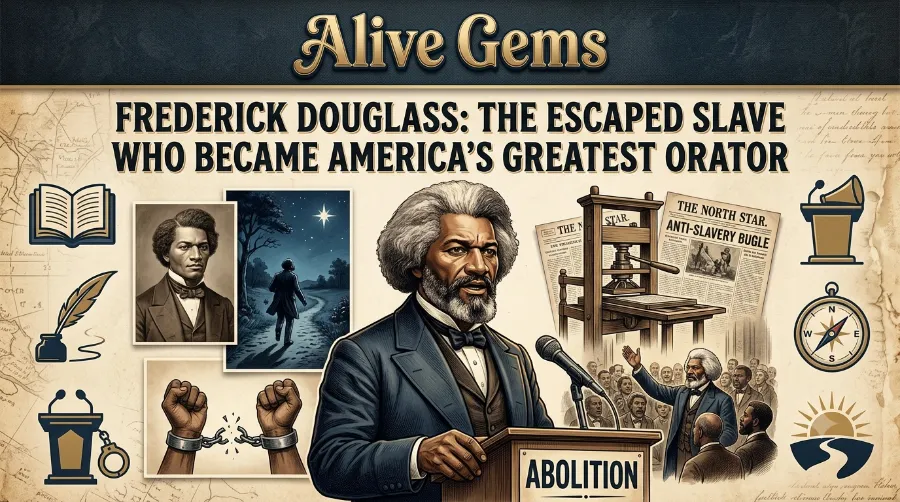
Douglass never trained at a university. Nobody handed him a script. He built himself, sentence by sentence, out of stolen scraps of literacy and raw, righteous anger. That is what makes his story so different from most of history’s famous speakers. He did not inherit his platform. He escaped into it.
Key Takeaways
| Fact | Detail |
|---|---|
| Born | Circa February 1818, Talbot County, Maryland |
| Escaped slavery | September 3, 1838, disguised as a free Black sailor |
| First major speech | 1841, Nantucket, Massachusetts, before the Massachusetts Anti-Slavery Society |
| Most famous speech | “What to the Slave is the Fourth of July?”, July 5, 1852 |
| Newspaper founded | The North Star, launched December 1847 in Rochester, New York |
| Autobiographies published | Three editions, 1845, 1855, and 1881 |
| Died | February 20, 1895, Washington, D.C. |
TL;DR: Frederick Douglass escaped slavery in 1838 and, within a few years, became the most celebrated orator of the American abolitionist movement. Through speeches, a self-published newspaper, and three autobiographies, he used his voice as a weapon against slavery and racism, influencing Abraham Lincoln and shaping the moral argument for the Thirteenth Amendment. His life remains one of the clearest examples of raw charisma built from necessity rather than privilege.
Early Life: A Boy Denied His Own Birthday
Frederick Douglass never knew his exact birth date. Enslaved people were rarely told such things, since birthdays were considered irrelevant details for property. He later chose to celebrate February 14 as his birthday, simply because his mother, Harriet Bailey, had once called him her “little valentine.” That single detail tells you everything about the conditions he grew up in. Even the basic fact of when he entered the world was taken from him. Read: Rosa Luxemburg: The Revolutionary Economist Who Frightened Every European Government
He was born around 1818 in Talbot County, Maryland, and separated from his mother as an infant, a common and deliberately cruel practice used to prevent enslaved families from forming strong bonds. He saw her only a handful of times before she died when he was about seven years old.
At age eight, Douglass was sent to Baltimore to live with the family of Hugh Auld. It was there, almost by accident, that the spark of his future greatness was lit. Sophia Auld, Hugh’s wife, began teaching young Frederick the alphabet. When Hugh found out, he forbade it immediately, famously warning that education would make a slave “unfit” for bondage. That warning backfired spectacularly. Douglass later wrote that Hugh’s angry words revealed the exact reason white enslavers feared literacy, and from that moment, he understood that reading was his path out of slavery. He continued teaching himself in secret, trading bread for lessons from poor white children in the street and studying newspapers whenever he could get his hands on one.
This is the first real key to understanding Frederick Douglass, escaped slave and future orator. His charisma was not decoration. It was survival equipment, built letter by letter in secret.
The Escape That Changed American History
By 1838, Douglass was working in the Baltimore shipyards as a caulker, a skilled trade that gave him money, some independence, and crucially, exposure to free Black sailors. On September 3, 1838, he made his move. Disguised as a sailor and carrying identification papers borrowed from a free Black seaman, he boarded a train north, as detailed in the National Constitution Center’s account of the escape. His knowledge of ships and sailor’s slang, picked up from years around the docks, helped him talk his way past suspicious eyes during the journey.
He later described arriving in New York City the next morning as the moment his free life truly began. It is worth pausing on how fragile that escape was. One wrong word, one nervous glance, and history would have lost its greatest orator before he ever spoke a public word. Douglass understood this fragility deeply, and it shaped the urgency in every speech he gave afterward. He was not speaking about an abstract injustice. He was speaking about the exact system that had almost destroyed him.
Soon after reaching New York, he married Anna Murray, a free Black woman who had helped fund his escape, and the couple settled in New Bedford, Massachusetts, where Douglass took the surname “Douglass” to help avoid slave catchers.
If you’re interested in other rebels and revolutionaries who risked everything for freedom, our piece on Toussaint Louverture, the slave who built a republic, covers a strikingly parallel story from a different corner of the Atlantic world.
From Silence to Stage: How an Escaped Slave Became America’s Greatest Orator
Here is where the story becomes genuinely remarkable. In August 1841, Douglass attended an anti-slavery convention in Nantucket, Massachusetts. Almost by chance, he was asked to speak about his experiences. He was terrified. By his own account, he had never spoken in front of a large white audience before, and he stumbled through his first sentences. But something happened in that room. The abolitionist leader William Lloyd Garrison, who was in attendance, was so moved that he stood up immediately afterward and delivered his own speech built entirely around Douglass’s testimony.
Within days, Douglass was hired as a paid lecturer for the Massachusetts Anti-Slavery Society. Within a few years, he was arguably the most in-demand abolitionist speaker in the country, drawing enormous crowds across the Northern states and eventually in Britain and Ireland.
What made him different from other speakers of his time was not just his story. It was his delivery. Contemporary accounts describe a commanding physical presence, a deep and resonant voice, and a rare ability to shift instantly between righteous fury and devastating irony. He could make an audience laugh at the absurdity of a slaveholder’s logic in one sentence and reduce them to stunned silence in the next.
A few qualities set his oratory apart:
- Personal testimony as evidence. Unlike many abolitionist speakers, Douglass had lived the horror he described, which gave his words an authority no secondhand account could match.
- Command of irony and sarcasm. He frequently used a slaveholder’s own stated values, such as liberty and Christianity, as weapons against them.
- Physical stagecraft. Observers noted his height, his booming voice, and his deliberate pacing, all of which he used to control a room.
- Total command of language. Despite having no formal education, he became one of the most literate public figures of his era, reading Cicero, Sheridan, and the Bible obsessively as a young man.
Because so many speakers of that era relied on secondhand moral arguments, Douglass’s presence alone reframed the entire abolitionist movement. He was not asking White America to imagine suffering. He was standing in front of them as proof of it.
The Speech That Still Echoes: “What to the Slave is the Fourth of July?”
If you want a single piece of evidence for Frederick Douglass’s title as America’s greatest orator, look no further than July 5, 1852. Invited to speak in Rochester, New York, on the day after Independence Day, Douglass delivered what many historians consider the single greatest speech in American history.
He opened by acknowledging the nation’s founding ideals with apparent respect, then pivoted with devastating force, asking his audience what the Fourth of July meant to an enslaved American. His answer was blistering: a day that revealed, more than any other, the gap between America’s stated principles and its actual practices. The speech ran for well over an hour and combined biting sarcasm, biblical references, and constitutional argument into a single, unified attack on hypocrisy.
According to the Library of Congress’s folklife research on Douglass, his skill as a public speaker was inseparable from his roots in oral storytelling traditions he absorbed as a young enslaved boy, long before he ever stood on a formal stage.
Here is a snapshot of Douglass’s most influential public addresses and writings:
| Year | Speech or Work | Significance |
|---|---|---|
| 1841 | Nantucket Convention speech | Launched his career as a professional abolitionist lecturer |
| 1845 | “Narrative of the Life of Frederick Douglass” | First autobiography, sold thousands of copies, exposed him to recapture risk |
| 1847 | The North Star newspaper founded | Gave Douglass an independent, unfiltered public voice |
| 1852 | “What to the Slave is the Fourth of July?” | Widely regarded as his single greatest oration |
| 1863 | Meetings and advocacy with Lincoln | Pushed for Black enlistment and equal treatment in the Union Army |
| 1881 | “Life and Times of Frederick Douglass” | Final, most reflective autobiography |
A Voice Presidents Could Not Ignore
Douglass’s influence did not stop at the lecture hall. During the Civil War, he met with President Abraham Lincoln on multiple occasions, pressing him on the treatment and pay of Black Union soldiers. Their relationship was not always easy. Douglass criticized Lincoln publicly when he felt the president moved too slowly on emancipation, yet he also came to respect him as, in his own words, someone he grew to genuinely admire by the war’s end.
After the war, Douglass continued to hold public office and advocate for civil rights, serving in roles including U.S. Marshal for the District of Columbia and Minister Resident to Haiti. He also became an early and consistent supporter of women’s suffrage, attending the 1848 Seneca Falls Convention and remaining one of its few male allies for the rest of his life.
As the Gilder Lehrman Institute notes in its historical essay on Douglass, his life traced an almost unbelievable arc from an enslaved child with no legal right to his own name, to one of the most photographed and quoted men in nineteenth century America.
For readers who enjoy stories of figures who used ideas as weapons rather than armies, our profile of Thomas Paine, the writer who lit the fuse of the American Revolution, makes an interesting companion piece to Douglass’s story.
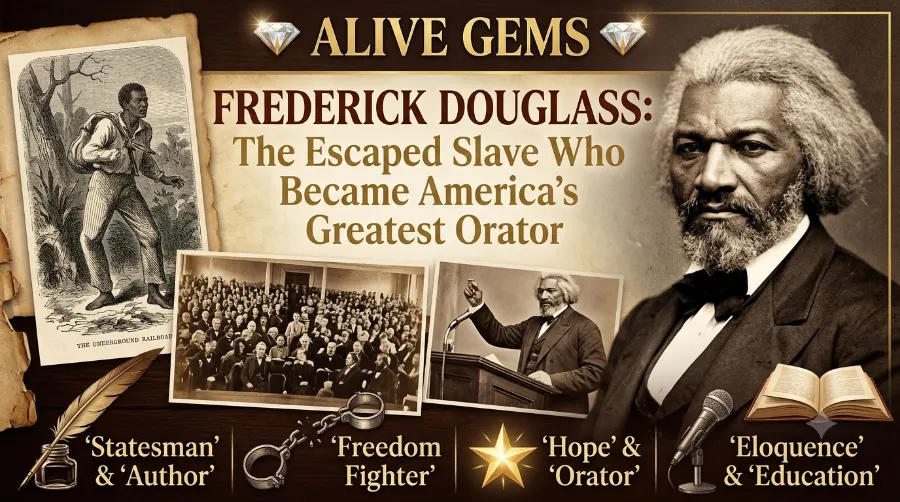
Why Douglass’s Charisma Still Matters Today
It would be easy to treat Frederick Douglass as a museum piece, a face on a stamp or a name in a textbook. That would be a mistake. His central insight, that moral authority comes from lived truth rather than polished performance, remains one of the most durable lessons in the history of public speaking. Modern communication research on persuasion consistently points to authenticity and credibility as the strongest predictors of audience trust, and Douglass was living proof of that principle more than a century before it had a name.
He also modeled something rare: the ability to be furious and precise at the same time. Many of history’s most charismatic figures relied on charm alone. Douglass relied on evidence, delivered with the force of someone who had personally paid the price for every word.
You can see similar patterns of charisma forged through hardship rather than privilege in other figures throughout history. Our pillar piece on 10 charismatic revolutionary rebels explores several of them, including Simon Bolivar, Che Guevara, and Ho Chi Minh, whose patience outlasted superpowers.
Frequently Asked Questions
Was Frederick Douglass actually an escaped slave?
Yes. Douglass escaped slavery on September 3, 1838, traveling from Baltimore to New York disguised as a free Black sailor using borrowed identification papers.
What made Frederick Douglass such a great orator?
His combination of firsthand testimony, sharp irony, commanding physical presence, and self-taught mastery of language made his speeches uniquely powerful compared to other abolitionist voices of his era.
What is Frederick Douglass’s most famous speech?
“What to the Slave is the Fourth of July?”, delivered on July 5, 1852, in Rochester, New York, is widely considered his greatest and most quoted address.
Did Frederick Douglass meet Abraham Lincoln?
Yes, Douglass met with Lincoln multiple times during the Civil War, advocating for fair treatment and pay for Black Union soldiers.
How many autobiographies did Frederick Douglass write?
Three, published in 1845, 1855, and 1881, each expanding on his earlier accounts as his life and public role evolved.
When did Frederick Douglass die?
He died on February 20, 1895, in Washington, D.C., after collapsing shortly after attending a women’s rights meeting that day.
Test Your Knowledge: Frederick Douglass Quiz
- In what year did Frederick Douglass escape slavery?
A) 1830
B) 1838
C) 1845
D) 1852 - What was the name of the newspaper Douglass founded in 1847?
A) The Liberator
B) The North Star
C) The Emancipator
D) The Freeman’s Voice - Where did Douglass deliver his most famous speech?
A) Baltimore, Maryland
B) New York City
C) Rochester, New York
D) Boston, Massachusetts - True or false: Frederick Douglass supported women’s suffrage.
- Which president did Douglass meet with during the Civil War to advocate for Black soldiers?
A) Andrew Jackson
B) Abraham Lincoln
C) Ulysses S. Grant
D) James Buchanan
Answer key: 1) B, 2) B, 3) C, 4) True, 5) B
Conclusion
Frederick Douglass’s life refuses to fit neatly into a single lesson, which is exactly what makes him worth returning to again and again. He was an escaped slave who taught himself to read in secret, a fugitive who became a national celebrity, and ultimately, America’s greatest orator, a man whose voice carried more moral force than any weapon of his era. His story is not simply about escaping bondage. It is about what happens when a person denied every advantage builds, from nothing, the single most powerful tool a human being can possess: the ability to speak the truth so clearly that an entire nation is forced to listen.
References
- National Constitution Center, “Remembering Frederick Douglass’ escape from slavery” Frederick Douglass
- Library of Congress, American Folklife Center blog, “Frederick Douglass: Free Folklorist” Frederick Douglass
- Gilder Lehrman Institute of American History, “Frederick Douglass: Slavery and Freedom” Frederick Douglass