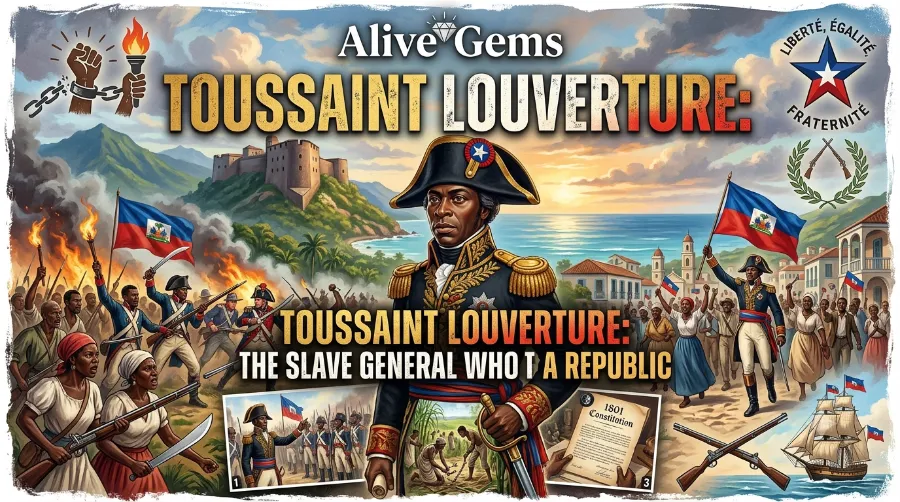
Toussaint Louverture a man born with no name of his own, owned like furniture, who grows up to out think Napoleon Bonaparte. That is not a movie pitch. That is the real life of Toussaint Louverture, and it might be the single most astonishing true story in modern history. A man enslaved until his thirties eventually commanded armies, wrote a constitution, and forced the greatest empires of his time to treat him as an equal. If you only remember one name from the story of freedom in the Americas, it should be his. This is the tale of how a Toussaint Louverture slave built republic story became the blueprint for every liberation movement that followed.
also read Che Guevara: Why Millions Still Follow a Dead Revolutionary 60 Years Later
Key Takeaways
| Fact | Detail |
|---|---|
| Full name | Francois Dominique Toussaint Louverture |
| Born | Around May 20, 1743, Bréda plantation, Saint Dominique |
| Freed from slavery | 1776, at about 33 years old |
| Rose to power | Commanded rebel forces from 1791 onward |
| Peak title | Governor General of Saint Dominique, 1797 to 1801 |
| Signature achievement | Wrote the 1801 constitution that outlawed slavery |
| Captured by | French forces under General Leclerc, June 1802 |
| Died | April 7, 1803, Fort de Joux prison, France |
| Legacy | Paved the way for Haiti, the first free Black republic, in 1804 |
TL;DR: Toussaint Louverture was born enslaved in the French colony of Saint Dominique and rose to become the most feared and respected general of the Haitian Revolution. He defeated Spanish, British, and French forces, abolished slavery in practice years before France did on paper, and wrote a constitution in 1801 that made him the de facto ruler of the island. Napoleon betrayed him, imprisoned him, and let him die in a cold French dungeon, but the revolution Toussaint built could not be undone, and Haiti became independent in 1804. Read: Rosa Luxemburg: The Revolutionary Economist Who Frightened Every European Government
Who Was Toussaint Louverture? A Haitian Revolution Leader Biography Like No Other
Most people learn about the French Revolution, the American Revolution, maybe even the Russian Revolution. Almost nobody outside of Haiti learns about the one that actually succeeded in doing what all the others only promised, ending slavery through the hands of the enslaved themselves. That is exactly why this Haitian Revolution leader biography matters so much right now.
Toussaint was born around 1743 on the Bréda plantation near Cap Français, in what the French called Saint Dominique. His father was said to be an African prince, a member of a ruling family in what is now Benin, captured and sold into bondage. That detail alone tells you something about the cruelty of the slave trade. It did not care who you were before the chains.
From Bréda Plantation to Free Man
Toussaint was not a typical enslaved man, and the reasons why still fascinate historians. He learned to read and write, likely with help from a godfather who was a priest. He absorbed ideas from Enlightenment thinkers. He also learned herbal medicine from African traditions passed down through his community, which later let him serve almost as a battlefield doctor to his own troops. Thomas Paine: The Immigrant Writer Who Lit the Fuse of the American Revolution
By 1776, at around age 33, Toussaint gained his freedom. For the next fifteen years he lived quietly, leasing a small coffee plantation and building connections across colonial society. Nobody watching him in 1790 would have guessed that within a year, he would become the single most important military figure the Caribbean had ever produced.
The Making of a Military Mind
So how does a former slave become a Black revolutionary military genius capable of humiliating three European empires? Part of the answer is simply this: he studied everything. He studied European military tactics. He studied the geography of the island better than any invading general could hope to. He studied loyalty, and how to keep an army together when supplies ran short and disease spread fast.
He also understood something his enemies underestimated for years. An army made of formerly enslaved men fighting for their own freedom will fight harder than an army of soldiers fighting for a paycheck an ocean away.
How a Toussaint Louverture Slave Built Republic Rose From Rebellion
Every great story needs a spark, and this one has a genuinely terrifying one.
The Night Saint Dominique Burned
On the night of August 22, 1791, enslaved people across the northern plains of Saint Dominique rose up in a coordinated uprising. Plantations burned for weeks. Historians estimate that within the first ten days, roughly 1,000 plantations were destroyed and hundreds of enslavers were killed. This was not a small riot. It was the beginning of the only slave revolt in world history that led directly to an independent nation.
Toussaint did not start this uprising, but he joined it within weeks. He first made sure his own family was safe, then he even helped his former enslaver’s family escape to the United States, a detail that says a great deal about the man’s character. Loyalty and mercy were never contradictions to him.
Choosing Sides: Spain, France, and a Masterstroke
Here is where the story gets genuinely clever. In the early years of the revolt, Toussaint fought alongside Spanish forces against the French, since Spain controlled the eastern half of the island and offered support to the rebels. He built his reputation here, rising from a small unit of 600 men to a disciplined force of around 4,000.
Then in 1794 France did something unexpected. Under pressure from the revolution back home, the French National Convention formally abolished slavery in all its colonies. Toussaint immediately switched sides. He judged, correctly, that a France without slavery served the rebellion’s true purpose far better than a Spain that still practiced it. This single decision changed the entire outcome of the war.
| Year | Turning Point |
|---|---|
| 1791 | Mass slave uprising begins in Saint Dominique |
| 1793 | French commissioners abolish slavery locally under pressure |
| 1794 | France abolishes slavery empire wide; Toussaint switches allegiance |
| 1795 | Spain cedes its side of the island; Toussaint expels British forces by 1798 |
| 1797 | Toussaint becomes Governor General of Saint Dominique |
| 1801 | Toussaint writes a constitution and rules as governor for life |
| 1802 | Napoleon sends 20,000 troops under General Leclerc to restore slavery |
| 1803 | Toussaint dies in a French prison; Napoleon’s army is defeated |
| 1804 | Haiti declares independence, becoming the first free Black republic |
Within a few years, Toussaint pushed British occupying forces out of the colony almost entirely by 1798, defeated a rival French general in a brutal civil war known as the War of Knives, and unified the entire island under his command. By 1801, without ever formally declaring independence from France, he ruled Saint Dominique in almost every practical sense.
Emiliano Zapata: The Peasant Who Became Mexico’s Immortal Soul
The Most Remarkable Revolutionary Leader Europe and America Underestimated
If you want to understand why historians increasingly call him the most remarkable revolutionary leader of the entire Atlantic revolutionary age, look at what he actually built once the fighting slowed down.
Governor General of Saint Dominique
Toussaint did something almost no revolutionary leader manages. He did not simply win a war. He governed. He restored the shattered plantation economy, though controversially he kept a labor system that forced former slaves to keep working the land, arguing the colony’s survival depended on export income. This decision remains one of the most debated parts of his legacy, and it deserves honest attention rather than a polished hero story. Freedom, in his hands, still came with hard compromises.
He also opened trade with the United States and Britain despite France officially forbidding it, which shows a level of political independence that terrified Napoleon back in Paris.
The Constitution of 1801
In July 1801, Toussaint issued a constitution for Saint Dominique that made him governor for life with the power to name his own successor. It formally and permanently outlawed slavery on the island, years before France would do the same across its remaining colonies. It also, notably, kept the colony nominally attached to France, a diplomatic tightrope walk meant to avoid provoking an immediate war he knew he could not yet win.
Frederick Douglass: The Escaped Slave Who Became America’s Greatest Orator
Below is a simple way to visualize how the colony’s key numbers shifted under his rule.
Sugar Export Recovery Under Toussaint's Governorship (approximate, relative scale)
1796  |####
1798  |########
1800  |##############
1801  |#################
Population Under Arms During the Haitian Revolution (approximate figures)
1791 rebel forces |### (a few thousand)
1795 Toussaint's army |########## (around 10,000)
1801 unified island army|#################### (over 20,000)These numbers come from historical estimates rather than exact census data, since colonial record keeping during a war of this scale was chaotic, but the trend line is undeniable. A man once counted as property was now commanding one of the largest and most battle hardened armies in the Western Hemisphere.
For readers who want the fuller story of how ordinary revolts became world changing movements, our pillar guide to history’s most charismatic revolutionary rebels puts Toussaint’s rise alongside other legendary figures who reshaped their nations against impossible odds.
Black Revolutionary Military Genius vs Napoleon
Every hero story needs a worthy opponent, and Toussaint’s opponent turned out to be one of the most famous military minds in human history. That same blend of stubborn patience and quiet conviction shows up again in the story of Ho Chi Minh, whose patience alone beat two global superpowers, one of the more overlooked endurance stories in modern revolutionary history.
Napoleon’s Betrayal and the Leclerc Expedition
In 1802, once Napoleon secured a temporary peace in Europe, he turned his attention back to the Caribbean. He wanted the sugar profits back, and privately, he wanted slavery restored. He sent his brother in law, General Charles Leclerc, along with around 20,000 to 40,000 troops, one of the largest expeditionary forces France had ever launched overseas.
Toussaint’s forces fought fiercely, but disease proved just as deadly as any battle. Yellow fever devastated the French army, killing thousands of soldiers within months. Still, facing overwhelming numbers, Toussaint eventually agreed to a truce in May 1802, believing Leclerc’s promises that slavery would not return.
That promise was a trap.
Capture and the Fort de Joux
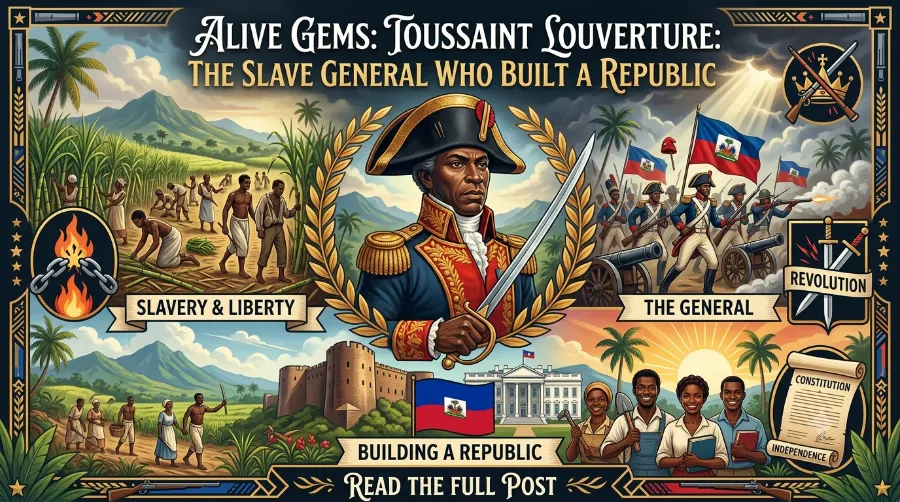
In June 1802, French officers lured Toussaint to a supposed peace meeting, arrested him, and shipped him to France in chains. He was imprisoned at Fort de Joux, a cold, remote fortress in the Jura mountains, about as far from the Caribbean heat as Napoleon could find. He reportedly told his captors that in cutting him down, they had only cut down the trunk of the tree of liberty in Saint Dominique, and that it would grow back from roots that ran deep and numerous. Historians still debate the exact wording, but the sentiment matches everything the man had spent his life proving.
He died there on April 7, 1803, likely from pneumonia and malnutrition, without ever seeing his home again.
Death, Legacy, and Haiti’s Independence
Napoleon thought removing Toussaint would end the resistance. He was catastrophically wrong.
Toussaint’s former lieutenants, especially Jean Jacques Dessalines, continued the fight. By the end of 1803, French forces were decisively defeated, devastated by both combat losses and disease. On January 1, 1804, Dessalines declared the independence of Haiti, the first nation in the modern world founded by formerly enslaved people, and only the second republic in the Western Hemisphere after the United States.
Toussaint never lived to see that flag raised, but almost nobody who studies the revolution disputes that it would not have happened without him. He built the army, the political structure, and the international respect that made Haitian independence possible.
His story also invites comparison to other legendary revolutionary figures across the Americas. Readers who enjoyed learning about Toussaint often also explore the story of Simon Bolivar, another towering figure who liberated multiple nations from colonial rule just a few decades later, though under very different circumstances.
| Leader | Region | Enemy Empire | Outcome |
|---|---|---|---|
| Toussaint Louverture | Saint Dominique (Haiti) | France | Died in prison; Haiti freed in 1804 |
| Jean Jacques Dessalines | Haiti | France | Declared independence in 1804 |
| Simon Bolivar | South America | Spain | Liberated several nations by the 1820s |
According to historical research from the New York Historical Society, Toussaint remains one of the most consequential yet underrecognized figures in the history of the Atlantic world, a gap that modern historians are actively working to close. Academic analysis from Baruch College’s Latin America blog similarly frames his leadership as a turning point that reshaped how European powers had to think about colonial control after 1804. Further scholarly commentary from Oxford University Press’s blog explores how his political thinking, particularly around citizenship and freedom, influenced revolutionary movements far beyond the Caribbean.
Why Toussaint Louverture Still Matters Today
It would be easy to file this away as an old story from over two centuries ago, but that undersells its relevance. Every modern conversation about reparations, colonial legacy, and racial justice in the Americas traces back to this single revolution. Haiti paid a brutal price for its freedom, forced by France into crushing debt payments for decades afterward, a burden historians increasingly connect to the country’s later struggles.
Understanding Toussaint is not just a history lesson. It is context for headlines you still see today about Haiti, about reparations debates in Europe, and about how nations remember, or conveniently forget, the people who built them.
Frequently Asked Questions
Was Toussaint Louverture actually a slave?
Yes. He was born enslaved around 1743 and remained enslaved until he was freed around 1776, at roughly 33 years old.
Did Toussaint Louverture ever meet Napoleon?
No, the two men never met in person. Their entire conflict played out through generals, letters, and battlefield decisions across an ocean.
Why is Toussaint Louverture important to Black history?
He led the only fully successful large scale slave uprising in modern history, one that ended in the creation of an independent nation rather than being crushed, which makes him a foundational figure in the global fight against slavery.
How did Toussaint Louverture die?
He died on April 7, 1803, in Fort de Joux prison in France, after being captured through French deception in 1802. He likely died from pneumonia worsened by cold conditions and poor treatment.
Is Haiti’s independence connected to Toussaint Louverture?
Absolutely. Although he died before Haiti’s official independence in 1804, the army, structure, and momentum he built made that independence possible.
Quick Quiz: Test What You Just Learned
- In what year did the major slave uprising in Saint Dominique begin?
A) 1789
B) 1791
C) 1804 - What did Toussaint add to his name, and what does it roughly mean?
A) Louverture, meaning opening
B) Bonaparte, meaning noble
C) Dessalines, meaning free - Who captured Toussaint through a broken truce in 1802?
A) British forces
B) Spanish forces
C) French forces under General Leclerc - What year did Haiti officially declare independence?
- Where did Toussaint Louverture die?
(Answers: 1-B, 2-A, 3-C, 4-1804, 5-Fort de Joux, France)
Conclusion
Toussaint Louverture’s life reads like something too dramatic to be real, and yet every part of it happened. A man born with no freedom of his own ended up negotiating as an equal with the empires of Europe, and forced them to reckon with an idea they desperately wanted to ignore, that enslaved people could organize, govern, and win. He did not live to see Haiti’s flag raised in 1804, but the nation that emerged was built entirely on the foundation he laid with his own hands and his own mind. If history has ever produced proof that no system of oppression is truly permanent, it is this one story, carved out of a plantation in the Caribbean by a man the world almost forgot to remember properly.
References
- New York Historical Society, “Who Was Toussaint Louverture” — https://www.nyhistory.org/blogs/who-was-toussaint-louverture
- Baruch College Latin America Blog — https://blogs.baruch.cuny.edu/latinoamerica/?p=123
- Oxford University Press Blog — https://blog.oup.com/2017/05/toussaint-louverture-haitian-revolution/
- Britannica, “Toussaint Louverture” biography and timeline
- BlackPast.org, “Toussaint L’Ouverture (1743-1803)”
- Biography.com, “Toussaint L’Ouverture”