
Simon Bolivar a man who lost his parents by age nine, buried his young wife within a year of marriage, and still found the strength to free an entire continent from an empire that had ruled it for three hundred years. That man was Simón Bolívar, and honestly, his story sounds too wild to be real.
He is the reason Simon Bolivar liberated six nations is not just a textbook line but a phrase that still gives people chills across Venezuela, Colombia, Ecuador, Panama, Peru and Bolivia. This is not a dry history lesson. This is the story of grief turned into purpose, and purpose turned into an entire continent’s freedom.
Toussaint Louverture: The Slave General Who Built a Republic
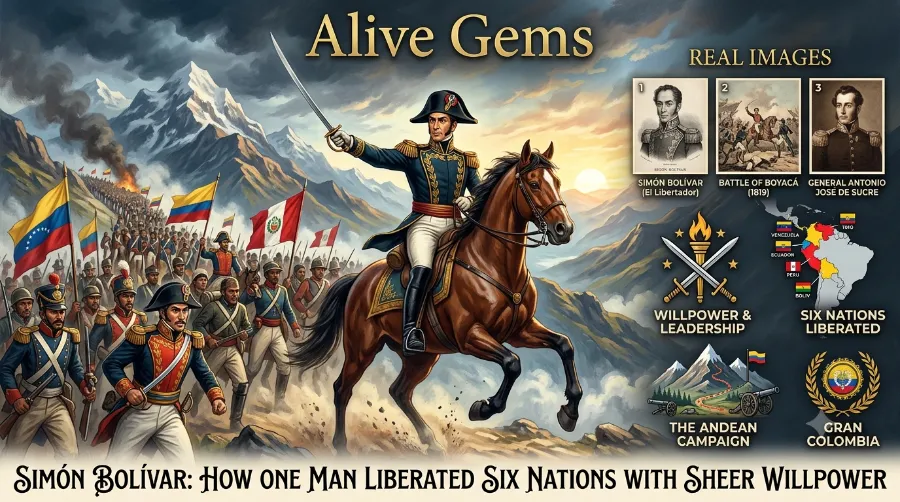
Key Takeaways
| Fact | Detail |
|---|---|
| Full name | Simón José Antonio de la Santísima Trinidad Bolívar Palacios |
| Born | July 24, 1783, Caracas, Venezuela |
| Nations liberated | Venezuela, Colombia, Ecuador, Panama, Peru, Bolivia |
| Famous campaign | The Admirable Campaign, 1813 |
| Turning point battle | Battle of Boyacá, August 7, 1819 |
| Country named after him | Bolivia, founded 1825 |
| Died | December 17, 1830, Santa Marta, Colombia |
| Nickname | El Libertador (The Liberator) |
TL;DR: Simón Bolívar was a Venezuelan revolutionary who, driven by personal loss and an unshakable belief in independence, led armies across some of the harshest terrain on earth to free six South American nations from Spanish rule between 1819 and 1825. His leadership style, marked by charisma, sacrifice and relentless persistence, still shapes Latin American identity today.
Who Was Simón Bolívar Before He Became El Libertador
Before he was a legend, Bolívar was just a rich kid from Caracas who lost everything that mattered to him. His father died when he was three. His mother died when he was nine. By the time he was a teenager, he had no living parents and a fortune he didn’t know what to do with. also read Che Guevara: Why Millions Still Follow a Dead Revolutionary 60 Years Later
At nineteen, he married a young woman named María Teresa in Madrid. She died of yellow fever less than a year later. Bolívar later said he would never marry again, and he kept that promise for the rest of his life. Grief like that either breaks a person or it forges them into something unbreakable. In his case, it became fuel.
He traveled to Europe afterward, and it was there, standing on Rome’s Monte Sacro in 1805, that he reportedly swore an oath to liberate his homeland from Spanish rule. That single moment of teenage grief and rage quietly became the spark for what historians now discuss when they talk about the moment Simon Bolivar liberated six nations decades later.
Thomas Paine: The Immigrant Writer Who Lit the Fuse of the American Revolution
The Personality That Changed a Continent
If you want to understand Bolivar leadership personality biography as a subject, you have to understand this: he was not the biggest, strongest, or most naturally gifted military man of his era. He was, however, magnetic. Soldiers who had nothing left to give somehow found the strength to keep marching because Bolívar asked them to.
He read constantly. He quoted Rousseau and Voltaire in the middle of military campaigns. He wrote letters so passionate that entire towns rose up in rebellion just from reading them aloud in public squares. This is part of why so many historians place him among the most charismatic Latin American leaders to ever exist.
His charisma was not loud or theatrical. It was rooted in conviction. People believed him because he clearly believed it first, and he was willing to lose everything, including his own health and fortune, to prove it.
The Admirable Campaign of 1813
In 1813, Bolívar did something almost reckless. With a small army, he marched from Colombia into Venezuela, issuing what became known as the Decree of War to the Death. It was blunt and brutal, but it worked as a rallying cry. Within months, he had taken Caracas.
This campaign earned him the title El Libertador, given to him by the citizens of Caracas themselves in 1813. It was the first proof that this grieving young aristocrat could actually lead men into impossible situations and come out victorious.
- He entered Caracas in August 1813 to cheering crowds
- He was formally declared El Libertador by the municipal council
- The victory was short lived, but it proved his leadership was not a fluke
Crossing the Andes: The Impossible March
If there is one moment that defines South American independence charisma, it’s the crossing of the Andes in 1819. Most military leaders would never attempt what Bolívar did next.
He led roughly 2,400 men across the flooded plains of Casanare and then over the freezing Páramo de Pisba, a mountain pass so brutal that soldiers lost toes to frostbite and horses died by the dozens. Many historians estimate that a significant portion of his troops did not survive the crossing.
Yet on the other side waited Spanish forces who never expected an army to appear from that direction. The surprise was total.
Read: Rosa Luxemburg: The Revolutionary Economist Who Frightened Every European Government
The Battle of Boyacá: The Turning Point
On August 7, 1819, Bolívar’s exhausted army met Spanish royalist forces at the Boyacá River in Colombia. The battle lasted only about two hours, but it changed everything. Bolívar’s forces captured most of the Spanish army, including its commander.
Three days later, Bolívar walked into Bogotá as a liberator. This single battle is often cited as the moment when the dream of Simon Bolivar liberated six nations stopped sounding impossible and started sounding inevitable. According to Marfa Public Radio’s coverage of his legacy, Bolívar remains one of the most invoked historical figures across the region even today, referenced by presidents, protesters and poets alike.
Frederick Douglass: The Escaped Slave Who Became America’s Greatest Orator
Building Gran Colombia
After Boyacá, Bolívar did not stop to celebrate for long. He had a bigger vision: a united South American republic. In 1819, the Congress of Angostura formally created Gran Colombia, uniting what is now Colombia, Venezuela, Ecuador and Panama under one flag.
This union did not last forever, but at the time it represented something radical. Bolívar wanted a continent that could stand as one voice against European powers, not a scattered collection of weak, separate colonies vulnerable to being picked off one by one.
Carabobo, Pichincha and the Fall of Spanish Power
The independence of Venezuela was sealed at the Battle of Carabobo on June 24, 1821. Then, under the command of Bolívar’s brilliant general Antonio José de Sucre, the Battle of Pichincha on May 24, 1822 secured the independence of Ecuador.
Each victory added another piece to the map. Each piece added weight to the phrase that historians would later use again and again: Simon Bolivar liberated six nations, and by 1822 that number was already climbing fast.
For readers who want a deeper breakdown of these individual campaigns, Students of History has an excellent detailed timeline worth reading alongside this piece.
The Final Battles: Junín and Ayacucho
Peru was the last major Spanish stronghold in South America, and it did not fall easily. The Battle of Junín in August 1824 was fought almost entirely with sabers and lances, since there was barely enough time or ammunition for gunfire.
Then came the decisive blow. On December 9, 1824, at the Battle of Ayacucho, Sucre led patriot forces to a total victory over the last major royalist army in South America. This battle effectively ended Spanish colonial rule on the continent.
Emiliano Zapata: The Peasant Who Became Mexico’s Immortal Soul
| Battle | Date | Result |
|---|---|---|
| Admirable Campaign | 1813 | Caracas liberated temporarily |
| Boyacá | August 7, 1819 | Colombia secured |
| Carabobo | June 24, 1821 | Venezuela secured |
| Pichincha | May 24, 1822 | Ecuador secured |
| Junín | August 6, 1824 | Weakened royalist forces in Peru |
| Ayacucho | December 9, 1824 | Peru secured, Spanish rule ends |
Bolivia: A Nation Named After Him
In 1825, a new republic was carved out of Upper Peru. Out of respect and admiration, its leaders named it Bolivia, in his honor. Few people in history have ever had an entire nation named after them while still alive.
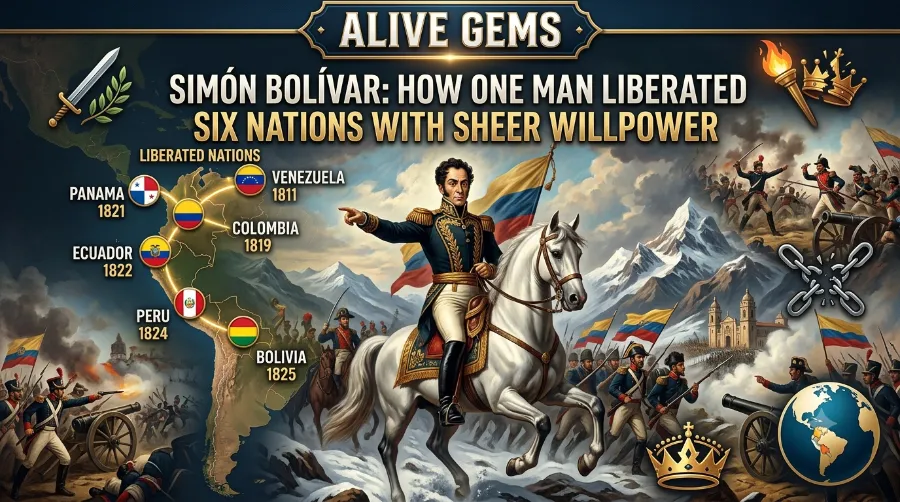
This brought the total to six: Venezuela, Colombia, Ecuador, Panama, Peru and Bolivia. It is genuinely rare in history for one person’s leadership to directly reshape the map of an entire continent, which is exactly why the story of Simon Bolivar liberated six nations still gets taught, debated and admired centuries later.
Why His Charisma Still Matters Today
There’s a reason Bolívar’s face is on currency, statues and school walls across an entire continent. His leadership style offers real lessons that still apply today.
- He led from the front, often riding alongside common soldiers rather than commanding from a safe distance
- He turned personal grief into long term purpose instead of letting it consume him
- He communicated with raw emotional honesty rather than empty political language
- He was willing to lose wealth, health and comfort for a cause bigger than himself
If you enjoy stories about bold historical figures who reshaped entire regions through willpower alone, you’ll love our deeper dive into 10 charismatic revolutionary rebels who changed history forever.
The Bittersweet End
Bolívar’s final years were painful. Gran Colombia began fracturing under political rivalries. He grew increasingly ill, likely with tuberculosis, and many of the allies he had fought alongside turned against his vision of unity.
He died on December 17, 1830, in Santa Marta, Colombia, reportedly poor and disillusioned, famously saying that those who serve a revolution plow the sea. It’s a heartbreaking irony that a man who united six nations died believing his life’s work might crumble.
For a more narrative retelling of his final chapter, Spanish Obsession’s blog post offers a beautifully written perspective worth exploring.
Quick Quiz: How Well Do You Know Simón Bolívar
- In what year was the Battle of Boyacá fought?
- Which nation was named directly after Bolívar?
- What nickname was given to Bolívar by the people of Caracas?
- Multiple choice: Which battle effectively ended Spanish rule in South America?
a) Carabobo
b) Ayacucho
c) Pichincha - Multiple choice: How many nations did Bolívar help liberate?
a) Four
b) Five
c) Six - Multiple choice: Where did Bolívar die?
a) Caracas
b) Bogotá
c) Santa Marta
Frequently Asked Questions
How many countries did Simón Bolívar actually liberate?
Six nations trace their independence directly to his leadership: Venezuela, Colombia, Ecuador, Panama, Peru and Bolivia.
Was Bolívar a king or a dictator?
He held significant power at times, including dictatorial authority in some regions, but he consistently pushed for republican government rather than monarchy, even though critics accused him of authoritarian tendencies later in life.
Why is he called El Libertador?
The people of Caracas gave him this title in 1813 after his Admirable Campaign successfully liberated the city from Spanish forces.
Did Bolívar ever remarry after his wife died?
No. He famously never remarried, though he had several long term relationships, including with Manuela Sáenz, who later helped save his life from an assassination attempt.
Is Gran Colombia still a country today?
No. It broke apart in the early 1830s into what became Venezuela, Colombia, Ecuador and eventually Panama.
That same blend of stubborn patience and quiet conviction shows up again in the story of Ho Chi Minh, whose patience alone beat two global superpowers, one of the more overlooked endurance stories in modern revolutionary history.
Conclusion
Simón Bolívar’s story is not really about maps or battles, even though those matter. It’s about a grieving young man who turned personal devastation into a promise, and then spent the rest of his life keeping that promise no matter the cost. When people talk about how Simon Bolivar liberated six nations, they’re really talking about what raw belief and stubborn willpower can accomplish when nothing else is left to lose. That’s a story worth remembering, no matter where you live.
References
- Marfa Public Radio, “Enshrined and Oft Invoked: Simon Bolivar Lives On”
- Students of History, “Simon Bolivar: The Liberator”
- Spanish Obsession Blog, “The Liberation of Simon Bolivar”
- Historical records on the Battles of Boyacá, Carabobo, Pichincha, Junín and Ayacucho
- Congress of Angostura records, 1819