
Frida Kahlo shattered body art, an 18 year old girl lying in a hospital bed, her spine broken in three places, wrapped so tightly in a plaster cast that she can barely breathe, let alone dream about her future. Most people in that position would simply try to survive the day. Frida Kahlo did something else entirely. She picked up a paintbrush and turned her shattered body into art that still stops people cold, almost a century later. That is the whole story behind Frida Kahlo shattered body art, and honestly, it might be one of the most moving comebacks in the history of creativity.
This is not a dry textbook biography. Think of it more like sitting across from a friend who has spent twenty years studying art history and cannot stop talking about the one woman who made pain look like power. Because that, in the simplest words possible, is what Frida did. She refused to hide her suffering. Instead, she painted it, nail by nail, scar by scar, until the whole world had to look.

Quick Facts Table: Frida Kahlo At a Glance
| Category | Detail |
|---|---|
| Full name | Magdalena Carmen Frida Kahlo y Calderón |
| Born | July 6, 1907, Coyoacán, Mexico |
| Died | July 13, 1954, age 47 |
| Childhood illness | Polio at age 6, left one leg thinner and shorter |
| Life changing accident | Bus and trolley collision, September 17, 1925 |
| Major injuries | Broken spine, pelvis, collarbone, ribs, leg, and foot |
| Number of surgeries in her lifetime | Around 30 operations |
| Most famous self portrait about her injuries | The Broken Column, 1944 |
| Auction record (as of November 2025) | $54.7 million for El sueño (La cama) |
| Home and museum today | Casa Azul, Mexico City |
Frida Kahlo shattered body art is not just a phrase people use for clicks. It is a literal description of what happened. Her body broke, and out of that breaking came some of the most honest paintings ever made by a human being.
Frida Kahlo Biography and Charisma: The Girl Before the Accident
Before the crash, before the fame, before the flower crowns and the bold eyebrows that now show up on tote bags and murals, Frida was simply a bright, stubborn girl growing up in Coyoacán. She was born in 1907, though she often told people she was born in 1910, so she could claim to be a child of the Mexican Revolution.
At just six years old, she caught polio. The illness left one of her legs noticeably thinner and shorter than the other, and classmates cruelly nicknamed her pegleg. Rather than shrinking from the teasing, Frida pushed back. She played soccer, boxed, and swam, and she quickly earned a reputation as tough, sharp, and impossible to ignore. That early defiance later became the emotional backbone of Frida Kahlo shattered body art, long before anyone knew what that phrase would even mean.
By her teenage years, Frida was one of only 35 girls at the National Preparatory School in Mexico City, a school of roughly 2,000 students. She studied hard, planned to become a doctor, and ran with a clever, rebellious group of friends. In other words, she was already the kind of person history would eventually remember, even before the accident that changed everything.
Readers who love stories about fearless women shaping history often find their way to the pillar guide on charismatic women who changed history, where Frida sits alongside queens, warriors, and scientists who refused to play small.
The Day Everything Broke: September 17, 1925
The Crash That Changed Art History
On the afternoon of September 17, 1925, 18 year old Frida boarded a wooden bus with her boyfriend Alejandro Gómez Arias after a day of classes. Moments later, the bus collided with an electric trolley car. Witnesses described the impact as strange, not a violent smash but a slow, grinding crush that folded the bus and threw its passengers into chaos.
A metal handrail from the bus pierced Frida’s body straight through her pelvis. Her spinal column broke in three places. Her collarbone, ribs, pelvis, one leg, and one foot were all shattered. Doctors doubted she would survive the night, and even if she lived, they doubted she would ever walk normally again.
She survived. But her body would never be the same, and neither would her life’s direction. Medical school was gone. In its place came something nobody expected, a woman lying flat on her back for months, discovering that paint could do what medicine could not.
A Body Held Together By Steel and Willpower
Over the following decades, Frida endured somewhere around 30 surgeries. She wore dozens of different back and body corsets, made from steel, leather, and plaster, just to stay upright. Anyone reading about the sheer physical toll her body carried for nearly three decades can start to understand why Frida Kahlo shattered body art feels less like a clever headline and more like the plain truth.
Her mother, hoping to keep her occupied during the endless recovery, had a special easel built so Frida could paint lying down, and fixed a mirror above her bed so she would always have a subject. That subject, of course, was herself.
Frida Kahlo Personality Story: The Mirror Above Her Bed
Here is where the real magic begins. Instead of turning her canvases into diaries of despair, Frida used them as declarations of survival. She once explained her obsession with self portraiture in the simplest possible terms, saying she painted herself because she was the subject she knew best.
That single mirror above her childhood bed produced dozens of the boldest self portraits in art history. Fabricating beauty out of physical agony, Frida painted herself again and again, not to hide her pain but to hand it directly to the viewer. This willingness to show blood, scars, and heartbreak without apology is exactly why so many historians now treat Frida Kahlo shattered body art as its own category of expression, separate from anything that came before it.
Her romance with fellow artist Diego Rivera added another layer of intensity to her personality story. They married in 1929, divorced in 1939, and remarried again in 1940. Infidelity, admiration, jealousy, and genuine creative partnership all tangled together, and all of it eventually spilled onto her canvases. If you enjoy stories of women who loved fiercely and still refused to be defined by the men beside them, the tale of Cleopatra ruling in nine languages makes a fascinating companion read.
Most Charismatic Female Artists History: Where Frida Stands
When people debate the most charismatic female artists in history, Frida’s name almost always tops the list, and not simply because of her striking look. Her charisma came from radical honesty. She refused to soften her pain, her politics, or her appearance to please anyone.
Here is a quick comparison of what made a handful of history’s most magnetic women unforgettable.
| Historical Figure | Era | Source of Her Charisma |
|---|---|---|
| Frida Kahlo | 1907 to 1954 | Turning physical pain into raw, honest self portraiture |
| Joan of Arc | 1412 to 1431 | Absolute conviction that led an army at 17 |
| Queen Nzinga | 1583 to 1663 | Fearless diplomacy against colonial powers |
| Hatshepsut | Ruled around 1479 to 1458 BCE | Confidence to rule Egypt as pharaoh in a man’s role |
| Marie Curie | 1867 to 1934 | Quiet, relentless brilliance in the face of constant rejection |
If this kind of comparison interests you, the full story of Joan of Arc leading the French army at just 17 years old shows a completely different flavor of charisma built on faith rather than pain. Meanwhile, the account of how Queen Nzinga outsmarted Portuguese colonizers proves that charisma can also look like sheer political cunning.
Frida Kahlo Shattered Body Art: The Masterpieces Born From Suffering
Now for the paintings themselves, the actual proof behind Frida Kahlo shattered body art as a real artistic legacy rather than a modern marketing phrase.
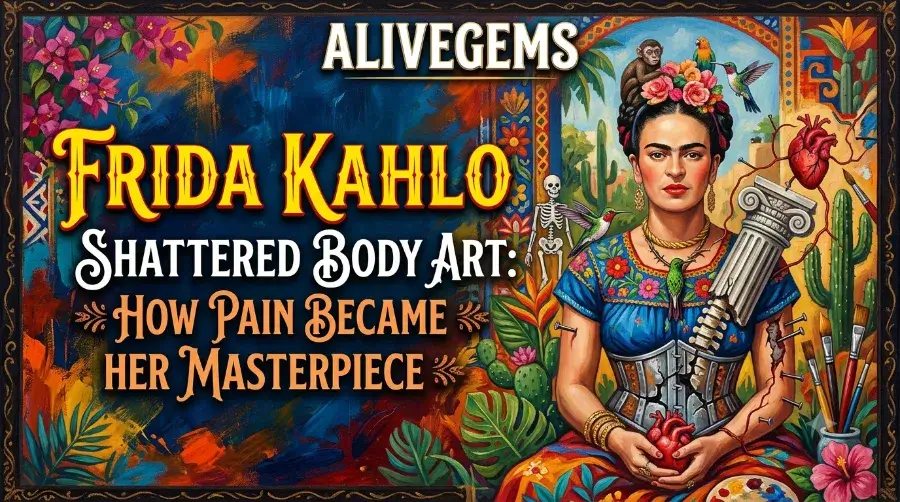
The Broken Column, painted in 1944, remains her most direct visual confession. In it, Frida stands alone against a barren, cracked landscape. Her torso is split open, and in place of her spine sits a crumbling, ancient column. Dozens of small nails pierce her skin, and tears fall from her eyes like tiny crystals, yet she stands upright, almost proud, refusing to collapse. Art historians and critics writing for outlets like Katy Hessel’s essay on The Broken Column describe the painting as one of the defining works of her entire career.
The Two Fridas, from 1939, shows two versions of the artist sitting side by side, their hearts exposed and connected by a single vein. She painted it right after her divorce from Diego Rivera, and the piece captures heartbreak with a rawness that still unsettles viewers today.
Here is a quick table of her most talked about pieces and what they represent.
| Painting | Year | What It Represents |
|---|---|---|
| The Broken Column | 1944 | Her shattered spine, physical pain, and quiet defiance |
| The Two Fridas | 1939 | Her divorce and split identity |
| Self Portrait with Thorn Necklace and Hummingbird | 1940 | Suffering disguised as symbolism |
| Diego and I | 1949 | Her obsessive love for Diego Rivera |
| El sueño (La cama) | 1940 | Her fear of death, painted as a dream |
According to the online magazine Nuestro Stories’ coverage of The Broken Column, the painting has become a feminist statement that challenges traditional ideas about beauty and strength, all while showing a woman’s resilience without flinching. That single idea, resilience without flinching, might be the best short definition of Frida Kahlo shattered body art that exists anywhere.
Anyone who wants a broader look at her full life story, including her taste for Mexican folk dress and her collection of pet monkeys and parrots, should read this detailed retrospective on her life, art, and legacy.
Why Frida Kahlo’s Market Value Keeps Climbing
Here is where the story gets genuinely current. In November 2025, Frida’s 1940 painting El sueño (La cama), which shows her sleeping beneath a skeleton wrapped in dynamite, sold at Sotheby’s in New York for $54.7 million. That sale made her the most expensive female artist ever auctioned, beating the previous record held by Georgia O’Keeffe since 2014. It also broke Frida’s own earlier record, set in 2021 when Diego y yo sold for $34.9 million.
| Rank | Painting | Artist | Sale Price | Year Sold |
|---|---|---|---|---|
| 1 | El sueño (La cama) | Frida Kahlo | $54.7 million | 2025 |
| 2 | Jimson Weed/White Flower No. 1 | Georgia O’Keeffe | $44.4 million | 2014 |
| 3 | Diego y yo | Frida Kahlo | $34.9 million | 2021 |
| 4 | Spider | Louise Bourgeois | $32.8 million | 2023 |
Her growing fame is not just about auctions either. A major retrospective titled Frida: The Making of an Icon is set to run at the Museum of Fine Arts, Houston, before transferring to Tate Modern in London, keeping her story alive for a whole new generation of museum visitors across the United States and Europe.
Frida Kahlo Personality Story: Why the World Still Falls in Love With Her
So why does Frida still matter so intensely, nearly seventy years after her death in 1954? Because she gave people permission to be honest about pain, illness, heartbreak, and identity long before it was socially acceptable to talk about any of it.
She embraced her Mexican heritage instead of chasing European beauty standards. She discussed miscarriage, disability, and desire openly, at a time when women were expected to stay silent about all three. And she did it all while managing chronic pain that would have stopped most people from ever picking up a brush again.
Women throughout history have shown this same refusal to shrink, whether it was Harriet Tubman’s iron will as a spy and conductor, Boudicca burning London and terrifying Rome, Hatshepsut ruling as Egypt’s most successful female pharaoh, or Marie Curie breaking every barrier placed in front of her. Frida simply used a paintbrush instead of a sword, a throne, or a laboratory.
Frequently Asked Questions About Frida Kahlo Shattered Body Art
What does Frida Kahlo shattered body art actually mean?
It refers to how Frida turned the real, physical damage from her 1925 accident and later surgeries into deeply personal self portraits, using her literal body as her main subject.
How many surgeries did Frida Kahlo really have?
Historians generally estimate around 30 operations across her lifetime, mostly related to her spine, pelvis, and leg injuries from the accident.
What is her most famous painting about her injuries? Frida Kahlo shattered body art
The Broken Column, painted in 1944, is widely considered her most direct depiction of physical pain and quiet strength.
Did Frida Kahlo become famous during her lifetime?
Not fully. She was often overshadowed by her husband Diego Rivera while she was alive, and her global fame grew mostly after her death in 1954.
Why do people still care about Frida Kahlo today?
Because her honesty about pain, disability, identity, and heartbreak still feels rare and refreshing, even decades later, and her paintings continue setting record breaking prices at auction.
Test Your Frida Kahlo Knowledge
1. In what year did Frida Kahlo’s life changing bus accident happen?
A) 1920
B) 1925
C) 1930
2. What replaces Frida’s spine in The Broken Column?
A) A crumbling stone column
B) A tree branch
C) A metal rod
3. How much did El sueño (La cama) sell for in November 2025?
A) $34.9 million
B) $44.4 million
C) $54.7 million
4. What childhood illness did Frida contract at age six?
Write your answer.
5. What is the name of Frida’s home, now a museum in Mexico City?
Write your answer.
Conclusion
Frida Kahlo never asked anyone to look away from her pain, and that single choice is exactly what makes her legacy so powerful today. She took a body that doctors said might never fully heal and turned it into a visual language that still speaks to millions of people across the United States and Europe. Frida Kahlo shattered body art was never about shock value. It was about telling the truth, nail by nail, scar by scar, until the whole world finally had to listen.
References
- Katy Hessel, essay on The Broken Column, The Great Women Artists Frida Kahlo shattered body art
- Nuestro Stories, Frida Fridays feature on The Broken Column Frida Kahlo shattered body art
- The Art of Cross Stitch, Frida Kahlo life and legacy retrospective Frida Kahlo shattered body art
- Sotheby’s New York, November 2025 auction records Frida Kahlo shattered body art
- CNN, NPR, Al Jazeera, and Fortune coverage of the 2025 Kahlo auction record Frida Kahlo shattered body art
- Museum of Fine Arts, Houston, upcoming Frida Kahlo retrospective details Frida Kahlo shattered body art