
Boudicca burned London terrified Rome Picture this. It is the year 60 AD. Rome believes it already owns Britain. Then a red haired queen with a spear in her hand and grief in her chest rides out of the fens of Norfolk, and within weeks three Roman cities are ash. This is the true story of how Boudicca burned London, terrified Rome, and forced an empire that never apologized to anyone to seriously consider running away.
Boudicca was not a myth. She was a real Celtic queen, a real mother, and a real military leader who came within an inch of pushing Rome out of Britain for good. Her name still gives people chills almost two thousand years later, and once you know what actually happened to her, you will understand exactly why.
Read our latest blog Marie Curie broke every barrier
This is not a dry textbook account. This is the story the way it actually happened, told the way a friend who has spent twenty years buried in Roman and Celtic history would tell it over coffee. So grab a cup, because this one is wild from start to finish.
Key Takeaways
| Fact | Detail |
|---|---|
| Who she was | Queen of the Iceni tribe in what is now Norfolk, England |
| When it happened | The revolt took place around 60 to 61 AD |
| What triggered it | Rome broke a treaty, flogged Boudicca, and assaulted her daughters |
| Cities destroyed | Camulodunum (Colchester), Londinium (London), Verulamium (St Albans) |
| Estimated deaths | Around 70,000 to 80,000 people killed during the uprising |
| How it ended | Defeated at the Battle of Watling Street by Suetonius Paulinus |
| Her legacy | Still celebrated today as Britain’s original warrior queen |
The Woman Behind the Legend
Long before Boudicca burned London and terrified Rome, she was simply the wife of a king trying to protect his people. Her husband, Prasutagus, ruled the Iceni tribe, a Celtic people who lived across present day Norfolk and parts of Cambridgeshire and Suffolk.
Prasutagus was clever. Rather than fight Rome outright, he agreed to rule as a client king, which meant his tribe kept some independence as long as they stayed loyal to the empire. It worked, for a while. Historians note that the Iceni had already tested Rome once before, rising up in 47 AD when the Romans tried to disarm every tribe in Britain, and that earlier clash set the stage for what came later.
When Prasutagus died around 60 AD, he tried to protect his family one last time. He left half his kingdom to Emperor Nero and half to his two daughters, hoping this generous gesture would keep Rome from swallowing everything. Rome did not care about his will. Not even a little.
get a better understanding of Frida Kahlo shattered body art our guide breaks down exactly what to expect.
When Rome Made Its Fatal Mistake
Here is where the story turns from tense to genuinely horrifying, and honestly, it is the moment that explains everything that followed. The Roman historian Tacitus, whose own father in law actually served in Britain during this period, recorded that Roman officials seized the Iceni kingdom by force. Boudicca was publicly flogged, and her two daughters were sexually assaulted by Roman soldiers.
Roman moneylenders also called in debts across the region at the worst possible moment, which only added fuel to a fire that was already building. This was not just personal cruelty. This was Rome treating an entire people like property, and Boudicca refused to let that be the final word.
Grief turned into fury. Fury turned into an army.
This is one of the most fascinating parts of ancient history, because we rarely get to see the exact moment a woman becomes a legend. With Boudicca, we can. She gathered the Iceni, allied with the neighboring Trinovantes tribe who had their own grudges against Rome, and within days she had assembled a force historians estimate at well over 100,000 warriors.
If you love stories about women who refused to be broken by empire, you will also want to read about Queen Nzinga, who outsmarted Portuguese colonizers for decades using nothing but wit and iron will.
Boudicca Burned London to the Ground: How It Actually Happened
The revolt did not start in London. It started in Camulodunum, modern day Colchester, which was Rome’s proud showcase colony in Britain. Roman veterans had settled there, and a massive temple to the deified Emperor Claudius stood at its center as a symbol of Roman permanence.
Boudicca’s army arrived and gave the Romans almost no warning. The garrison sent barely 200 poorly armed men to defend the entire city, which tells you how badly Rome underestimated her. The survivors fled into the Temple of Claudius, held out for two days, and were then overrun completely.
Colchester burned so thoroughly that archaeologists today can still find a bright red layer of scorched clay and ash in the soil, a physical scar from that single afternoon of destruction almost two thousand years ago.
Next came Londinium.
At the time, London was not yet the capital it would become. It was a young, twenty year old trading town, but it was already busy and wealthy. The Roman governor, Suetonius Paulinus, rushed back from a campaign in Wales the moment he heard the news. When he reached London, he realized the brutal truth: he did not have enough soldiers to defend it.
So he made a cold, calculated decision. He evacuated whoever could travel with his troops, and he left the rest of the population behind.
Then Boudicca burned London completely.
Roman writers describe scenes of pure chaos, families begging soldiers not to leave, people trying to flee down muddy roads while others stayed behind, unable or unwilling to abandon their homes. When Boudicca’s forces arrived, the city was essentially defenseless. According to historians who have studied the layer of destruction beneath modern London, the fire was so intense it left a distinct band of burnt red debris that archaeologists still uncover during construction projects in the City of London today.
The scale of destruction terrified Rome in a way few events ever had. This was not a border skirmish. This was a queen erasing Roman cities from the map one at a time.
After London came Verulamium, modern St Albans, and it suffered the exact same fate.
By the time the smoke cleared across all three cities, historians estimate that somewhere between 70,000 and 80,000 people, both Romans and Britons loyal to Rome, had been killed. That number alone explains why Boudicca is remembered as one of the most feared women warriors in history.
If you want to learn more about Hatshepsut most successful female pharaoh check out our detailed guide for practical tips and expert advice.
Why This Rebellion Terrified an Empire Used to Winning
Rome had conquered most of the known world by this point. Losing to a queen from a small tribe in a cold, wet corner of the empire was almost unthinkable to Roman pride.
According to the historian Suetonius, writing decades later, the crisis was so severe that Emperor Nero seriously considered abandoning Britain entirely. Think about that for a moment. An empire that had crushed nations across three continents nearly walked away from an entire province because one furious queen refused to accept defeat.
A few things made this rebellion uniquely terrifying for Rome, and they are worth breaking down clearly.
- Boudicca united multiple rival tribes under a single cause, something Rome had assumed was impossible in Britain
- She struck three major cities in rapid succession before Rome could properly organize a defense
- Her army was reportedly massive, dwarfing the Roman forces stationed on the island at the time
- The financial and political damage was severe enough to shake confidence at the very top of the empire
This is exactly why her story sits alongside other legendary figures who challenged empires against impossible odds, women like Joan of Arc, who led the French army at just seventeen, or Cleopatra, who wielded real power fluently in nine languages.
The Real Boudicca Biography and Personality
So who was she really, underneath the legend? Most of what we know about the real Boudicca comes from two Roman historians, Tacitus and Cassius Dio, and it is important to remember they were writing about their own enemy, so some exaggeration is likely.
Still, certain details appear consistently enough to feel genuine. Cassius Dio described her as tall, with a harsh voice and a mass of bright red hair falling past her waist. He wrote that she wore a large golden torc around her neck and a tunic of many colors, with a thick cloak fastened over it, which matches what historians know of Celtic aristocratic dress at the time.
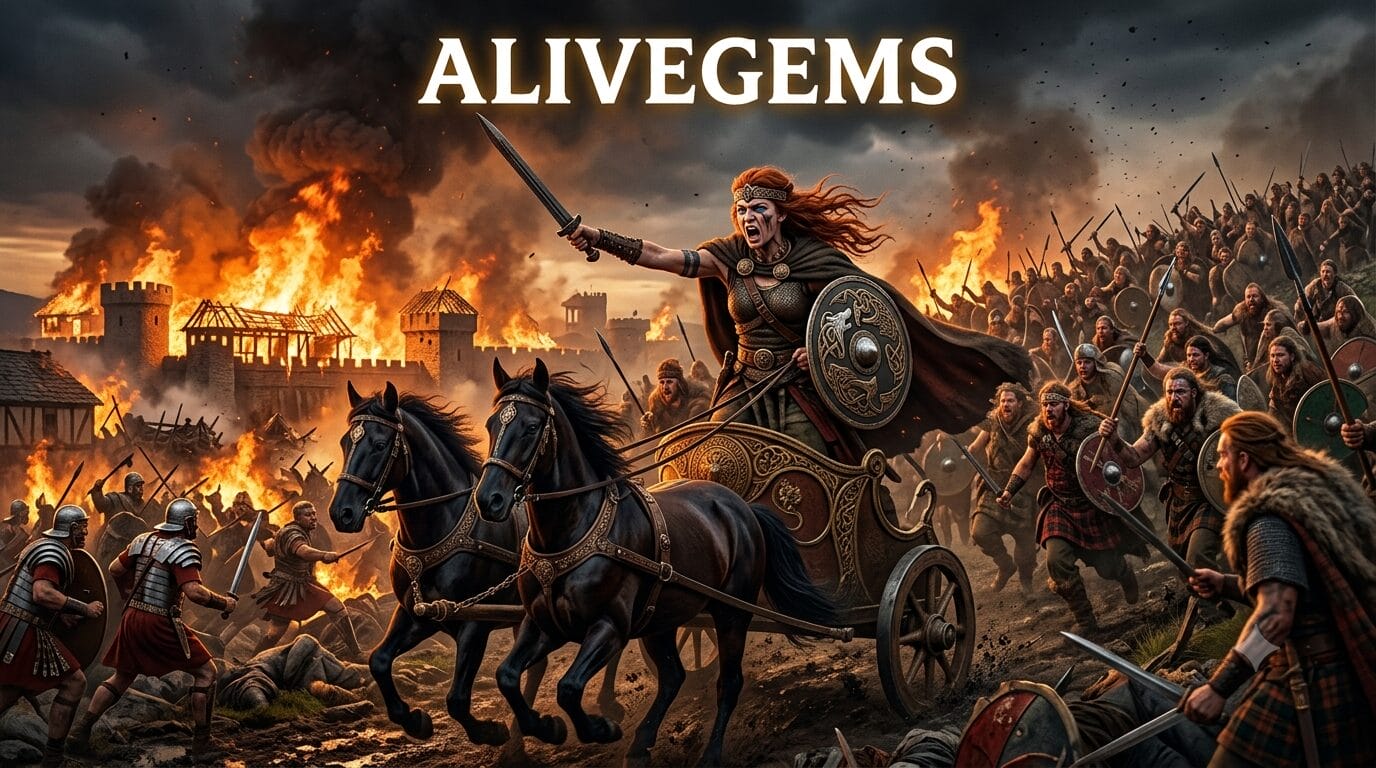
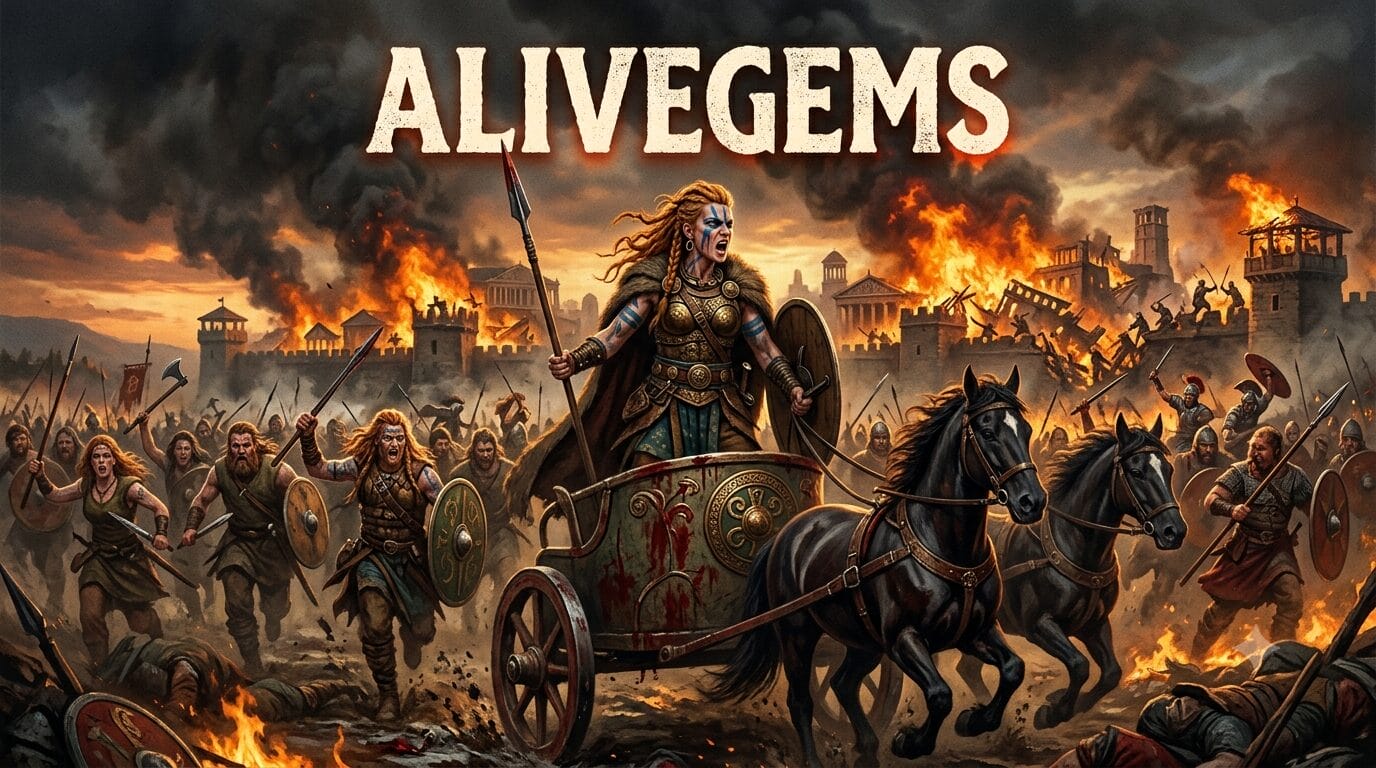
More important than her appearance was her presence. According to Roman accounts, before the final battle she rode in a chariot with her daughters beside her, delivering a speech to her assembled warriors that framed the fight as one for freedom, dignity, and vengeance against an occupier who had humiliated her family in the worst way imaginable.
Whether every word of that speech is accurate is debatable, since Roman historians loved putting dramatic dialogue in the mouths of their enemies. But the core of it, a woman refusing to accept humiliation and choosing war instead, lines up with everything else we know about her actions.
If her personality reminds you of other women who refused to play by the rules society gave them, you might enjoy reading about Harriet Tubman’s iron will and secret life as a spy, another figure whose courage reshaped history against brutal odds.
The Battle That Ended Everything
Rome eventually recovered its footing. Suetonius Paulinus regrouped his forces, reportedly somewhere in the West Midlands, and chose his ground carefully. He picked a narrow location with a forest at his back, which prevented Boudicca’s much larger army from surrounding his troops.
This single tactical decision changed the entire outcome of the war.
Historians still debate the exact location of this final clash, known as the Battle of Watling Street, with candidates including sites near Mancetter in Warwickshire. What is not debated is the outcome. Despite being massively outnumbered, disciplined Roman legions cut through Boudicca’s forces in a devastating defeat.
Tacitus claims Roman losses were shockingly low compared to British casualties, which, even accounting for typical Roman exaggeration, tells you how one sided the final battle became once Suetonius controlled the terrain.
Boudicca did not survive long afterward. Tacitus wrote that she took poison rather than surrender. Cassius Dio instead claimed she fell ill and died, receiving a lavish burial from her people. Nobody knows where she was buried, and despite centuries of folklore, including one persistent legend that she lies somewhere beneath London’s King’s Cross station, there is no solid archaeological evidence confirming any specific location.
What Archaeology Has Confirmed
This is not just a story preserved in old scrolls. The ground itself remembers what happened.
- A distinct layer of burnt red clay beneath modern Colchester, London, and St Albans confirms fires so intense they left permanent scars in the soil
- Excavations on Fenchurch Street in the City of London uncovered a Roman fort built in 63 AD, constructed specifically in response to the destruction Boudicca caused, showing just how seriously Rome took the threat afterward
- Sites in Essex have revealed Iron Age settlements linked to the aftermath of the rebellion, including pottery, coins, and jewelry that help historians understand daily Iceni life before the uprising
- Burnt archaeological layers found in areas like Brentford suggest Boudicca’s forces or Roman troops passed through additional towns during the campaign
For a deeper visual walk through the physical evidence buried beneath Colchester, Heritage Calling’s detailed account of the Boudica revolt is genuinely worth your time. The London Museum’s archive on Boudica as London’s original rebel queen also does a wonderful job connecting the physical city to her story. And if you want a fun, sharp, well researched breakdown of her whole life, Vulgar History’s episode on Boudica is one of the better modern retellings available online.
Boudicca’s Death Toll Compared to Other Ancient Rebellions
A quick chart helps put the scale of this rebellion into perspective against other famous ancient uprisings.
| Rebellion | Approximate Year | Estimated Deaths | Outcome |
|---|---|---|---|
| Boudicca’s Revolt | 60 to 61 AD | 70,000 to 80,000 | Suppressed by Rome |
| Spartacus Slave Revolt | 73 to 71 BC | 60,000 to 100,000 | Suppressed by Rome |
| Jewish Revolt | 66 to 73 AD | Estimated over 1 million | Suppressed, Jerusalem destroyed |
| Gallic Revolt under Vercingetorix | 52 BC | Tens of thousands | Suppressed by Julius Caesar |
Even sitting next to these massive uprisings, Boudicca’s rebellion stands out because of how fast it happened and how close it came to actually working. Most rebellions against Rome dragged on for years. Hers nearly succeeded within a matter of weeks.
Why Boudicca Still Matters Today
Centuries later, Boudicca remains one of the most feared women warriors in history precisely because her story refuses to fade. During the Victorian era, Queen Victoria was even compared to her directly, since both names share the same root meaning, victory. A bronze statue of Boudicca in her chariot still stands proudly near the Houses of Parliament in London, a permanent reminder of a queen who once tried to burn that very city to the ground.
Her story resonates because it is fundamentally human. It is not really about Celts versus Romans. It is about what happens when an empire humiliates someone who refuses to stay humiliated.
That theme never gets old, which is exactly why Boudicca fits so naturally alongside our full collection of charismatic women who changed history, women who took the worst thing that ever happened to them and turned it into something the world could never forget.
Quick Quiz: Test Your Boudicca Knowledge
1. What tribe did Boudicca rule?
A) The Trinovantes
B) The Iceni
C) The Brigantes
2. Which three cities did Boudicca’s forces destroy?
A) Colchester, London, St Albans
B) York, Bath, Chester
C) Cardiff, Bristol, Exeter
3. What ended the rebellion?
A) A peace treaty
B) The Battle of Watling Street
C) Boudicca’s surrender
Try answering these on your own before scrolling further. If you got all three, you already know this story better than most history students do.
Answers: 1) B, 2) A, 3) B
Frequently Asked Questions
Did Boudicca really burn London to the ground?
Yes. Archaeological evidence, including a thick layer of burnt red clay found beneath the modern City of London, confirms that Londinium was destroyed by fire during her revolt around 60 to 61 AD.
Why did Rome fear Boudicca so much?
She united multiple rival tribes, destroyed three major Roman settlements in quick succession, and killed tens of thousands of people, all of which nearly convinced Emperor Nero to abandon Britain entirely.
How did Boudicca die?
Ancient sources disagree. Tacitus claims she took poison after her defeat, while Cassius Dio wrote that she died from illness shortly afterward.
Where is Boudicca buried?
Nobody knows for certain. Despite popular legends placing her grave beneath London’s King’s Cross station, there is no verified archaeological evidence supporting any specific burial site.
Is Boudicca considered one of the most feared women warriors in history?
Absolutely. Her ability to nearly drive Rome out of Britain, combined with the sheer scale of destruction she caused, places her among the most formidable military leaders of the ancient world, regardless of gender.
Conclusion
Boudicca burned London, terrified Rome, and very nearly changed the course of British history entirely on her own terms. She was not a myth invented for entertainment. She was a real queen who lost everything, refused to accept it quietly, and turned her grief into one of the most devastating rebellions the Roman Empire ever faced. Her story reminds us that empires, no matter how powerful, are never as invincible as they appear, and sometimes it only takes one person who has been pushed too far to prove it.
References
- Tacitus, Annals and Agricola
Boudicca burned London terrified Rome
- Cassius Dio, Roman History Boudicca burned London terrified Rome
- Wikipedia, “Boudica” and “Boudican revolt” Boudicca burned London terrified Rome
- MOLA (Museum of London Archaeology), findings on the Roman fort built after the revolt Boudicca burned London terrified Rome
- Ancient Origins, coverage of Boudicca era archaeological discoveries Boudicca burned London terrified Rome
- Heritage Calling, “Boudica: Revolt Against Rome” Boudicca burned London terrified Rome
- London Museum, “Boudica: Rebel Queen of the Iceni” Boudicca burned London terrified Rome
- Vulgar History podcast, episode on Boudica Boudicca burned London terrified Rome