
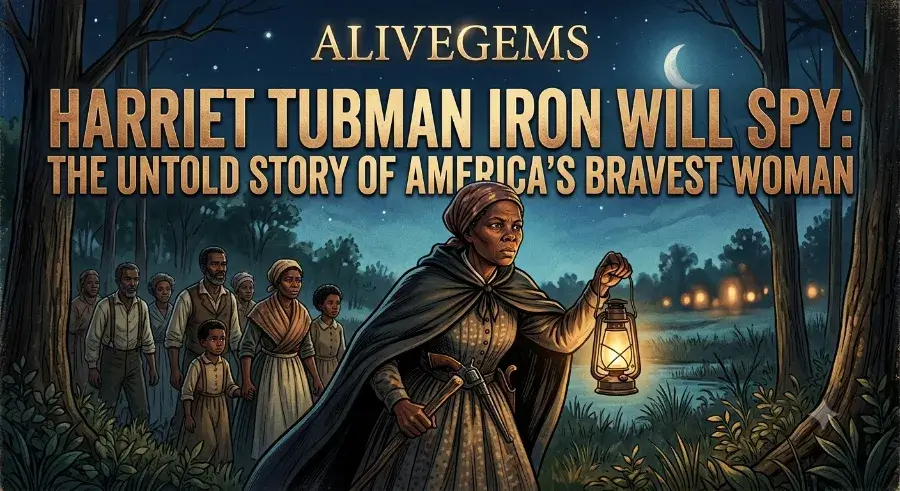
Harriet Tubman iron will spy Picture a woman barely five feet tall, walking through swamps at midnight, a pistol tucked into her dress, guiding terrified strangers toward a freedom they could barely imagine. That woman never lost a single passenger. Her name was Harriet Tubman, and the story of Harriet Tubman iron will spy history is one of the most astonishing tales America has ever produced.
She was small in stature but carried a will of pure iron, the kind that bends fear itself into obedience. Long before she became a spy for the Union Army, she was already a legend among the enslaved communities of Maryland, whispered about as “Moses,” the woman who came back again and again to lead her people out of bondage.
This is not a dry textbook chapter. This is the real, full, breathing story of a woman who chose courage over comfort every single time. If you have ever wondered how one person managed to outsmart bounty hunters, spy networks, and an entire slaveholding system, you are about to find out.
get a better understanding of Frida Kahlo shattered body art our guide breaks down exactly what to expect.
Key Takeaways
| Fact | Detail |
|---|---|
| Real name | Araminta “Minty” Ross |
| Born | Around 1822, Dorchester County, Maryland |
| Escaped slavery | 1849 |
| Underground Railroad trips | About 13 missions back into slave territory |
| People personally freed | Roughly 70, plus dozens more given instructions to escape alone |
| Civil War role | Union Army scout, nurse, and spy |
| Combahee Ferry Raid | June 1863, freed more than 700 enslaved people |
| Historic milestone | First woman in U.S. history to plan and lead a military raid |
| Died | 1913, Auburn, New York |
| $20 bill effort | Proposed in 2016, still not finalized as of July 2026 |
The Girl Who Refused to Break
Harriet Tubman was born into slavery around 1822 and given the name Araminta Ross, though everyone called her Minty. She grew up on Maryland’s Eastern Shore, in Dorchester County, where enslaved children were routinely rented out to other households and beaten for the smallest mistakes. By the time she was a teenager, Minty had already survived whippings, starvation, and forced labor in freezing rivers.
To get a better understanding of Boudicca burned London terrified Rome our guide breaks down exactly what to expect.
One incident nearly killed her and shaped everything that came after. Around age twelve or thirteen, an overseer threw a heavy metal weight at another enslaved man who was trying to escape, and it struck Tubman in the head instead. She suffered a severe skull fracture, and for the rest of her life she experienced seizures, headaches, and sudden sleeping spells, a condition modern doctors associate with temporal lobe epilepsy. Most people would have been permanently limited by such an injury. Instead, Tubman later described having vivid visions and a deepened religious faith that she believed guided her decisions, including the exact routes she chose during her rescue missions, a detail explored well in the Smithsonian’s profile of Harriet Tubman.
This early trauma is often glossed over, but it matters enormously for understanding her later career. A woman who survives a fractured skull, ongoing seizures, and years of forced labor, and still chooses to walk back into danger repeatedly, is not simply brave. She is someone whose will has been tested and hardened like iron in a forge. That distinction is central to understanding the full Harriet Tubman full biography story, because her courage was not naive. It was earned through suffering most of us can barely imagine.
Escaping Slavery and Becoming Moses
In 1849, fearing she was about to be sold further south, Tubman made her escape. She traveled roughly 90 miles from Maryland to Philadelphia, following the North Star and relying on a network of abolitionists, free Black communities, and sympathetic white Quakers who formed the loosely organized Underground Railroad. As the Library of Congress explains in detail, this system relied on coded language, safe houses, and enormous personal risk on the part of every single person involved.
Freedom alone was not enough for her. Within a year, Tubman turned around and went back into slave territory, risking capture and death, to bring out her family members one by one. Over roughly eleven years, she made about 13 separate trips back into Maryland, personally guiding approximately 70 enslaved people, including her elderly parents, to freedom in the North and later into Canada after the Fugitive Slave Act of 1850 made the northern United States unsafe for escapees.
She became known simply as Moses. Slaveholders in the region grew so furious that rewards for her capture reportedly reached as high as 40,000 dollars, an almost unimaginable sum for the era. Yet she was never caught, and according to her own later claims, she never lost a single passenger on any of her missions. This kind of quiet, disciplined defiance places her alongside other charismatic women who changed history, women whose willpower reshaped entire nations.
Here is a quick breakdown of her Underground Railroad career:
- Escaped alone in 1849, traveling roughly 90 miles to Philadelphia
- Returned to Maryland at least 13 times over the following decade
- Personally freed close to 70 enslaved people, including family members
- Gave detailed instructions that helped an additional 50 to 60 people escape independently
- Never lost a single person under her direct guidance
This chapter alone would secure her place in history. But the most astonishing part of her story, the part that most people never learn in school, was still ahead of her.
If you want to learn more about Hatshepsut most successful female pharaoh check out our detailed guide for practical tips and expert advice.
Harriet Tubman the Spy: America’s First Female Combat Strategist
When the Civil War broke out in 1861, Tubman did not sit on the sidelines. She traveled to Union-controlled areas of South Carolina and offered her skills to the Army, first as a nurse treating soldiers and formerly enslaved refugees suffering from dysentery and smallpox. Her knowledge of herbal remedies, learned from her mother and community elders, reportedly saved dozens of lives when conventional medicine failed.
But nursing was only the beginning. Because Tubman had spent years memorizing terrain, waterways, and the movement patterns of slave patrols, Union officers quickly realized she possessed something far rarer than medical skill. She had the instincts of a natural intelligence operative. She began recruiting a network of formerly enslaved men who knew the swamps, rivers, and plantations of the Carolina Lowcountry, and she coordinated their reconnaissance directly with Union commanders, a chapter of her life covered thoroughly by National Geographic’s history desk.
This is where the phrase Harriet Tubman iron will spy earns its full meaning. She was not merely gathering rumors. She was running an organized scouting operation behind Confederate lines, mapping torpedo placements in the rivers, tracking troop movements, and identifying which plantations held the largest numbers of enslaved people ready to flee toward Union lines the moment soldiers arrived.
The Combahee Ferry Raid: Her Greatest Triumph
On the night of June 1 to June 2, 1863, Tubman did something no woman in American history had done before. She planned and led a military raid. Working alongside Colonel James Montgomery and roughly 150 Black Union soldiers of the 2nd South Carolina Volunteers, she guided three gunboats up the Combahee River in South Carolina, using her own intelligence about torpedo locations to avoid Confederate mines.
The raid destroyed Confederate supply depots and, most remarkably, liberated more than 700 enslaved people in a single night. According to the National Museum of African American History and Culture, the operation was so successful that newspapers across the North celebrated it, though Tubman herself received almost no pay or formal recognition for years afterward.
Think about that number for a moment. More than 700 people, entire families, walked into freedom in a single night because of a raid this woman helped design and lead. That is not folklore. That is documented military history, and it makes Tubman, by any reasonable definition, the first woman in United States history to plan and execute an armed military operation. Encyclopedia Britannica’s entry on Harriet Tubman corroborates this milestone in detail. Harriet Tubman iron will spy
Here are the raw numbers from that single night:
- Gunboats involved: 3
- Union soldiers participating: approximately 150
- Enslaved people freed: more than 700
- Confederate property destroyed: rice plantations and stockpiles worth an estimated 1 million dollars in Civil War-era currency
The Cost of Being Overlooked
Despite her extraordinary service, Tubman spent decades fighting for recognition and fair compensation. She was paid irregularly during the war, often receiving far less than her male counterparts, and it took until 1899, more than three decades after the war ended, for Congress to approve her a monthly pension of 20 dollars for her military service. National Geographic’s coverage of her decades-long fight for recognition highlights how bureaucratic indifference and racial prejudice repeatedly delayed the honors she had earned on the battlefield.
She spent her later years in Auburn, New York, where she had purchased a home and cared for aging and formerly enslaved people who had nowhere else to go. She helped found a home for the elderly and indigent, funded largely out of her own limited pension. The National Women’s History Museum also documents this final chapter of her life, noting how her generosity continued long after her official military service ended. Tubman died in 1913, surrounded by family, having lived to see the passage of the 19th Amendment debate begin, though she did not live long enough to vote herself.
If you want to understand just how rare her kind of resolve was among women of her era, it helps to look at other charismatic women who changed history, women who also refused to accept the limitations placed on them by their time. Tubman’s story sits comfortably beside figures like Joan of Arc, who at just 17 led the French army into battle, or Cleopatra, whose command of nine languages made her one of the most formidable rulers in the ancient world, or Queen Nzinga, who outsmarted Portuguese colonizers for decades in West Africa. Each of these women shared a version of Tubman’s iron will, though their battles looked different, and you can explore many more such stories on alivegems.com.
Why Her Story Still Matters in 2026
Tubman’s legacy remains a live topic even today. In July 2026, Treasury Secretary Scott Bessent confirmed that the federal government is not currently moving forward with plans, first proposed under the Obama administration in 2016, to place Tubman’s portrait on the redesigned 20 dollar bill. The announcement drew sharp criticism from lawmakers, including Senator Jeanne Shaheen of New Hampshire, who called the decision a missed opportunity to honor Tubman’s sacrifice.
This ongoing debate shows something important. Tubman is not a closed chapter in a history book. She remains part of active national conversation about who gets remembered, who gets honored on our currency, and how we choose to teach the most courageous women American history has ever produced. Her name still moves lawmakers, historians, and everyday readers because her actions were simply too significant to fade quietly into the past.
Read our latest blog Marie Curie broke every barrier
Lessons From an Unbreakable Will
What can modern readers actually take from Tubman’s life, beyond admiration? A few lessons stand out clearly.
- Courage is a habit, not a single moment. Tubman returned to danger repeatedly, proving that bravery compounds the more you practice it.
- Preparation beats luck. Her success on the Underground Railroad and during the Combahee raid came from meticulous planning, not blind chance.
- Recognition often lags far behind contribution. Tubman waited decades for even modest financial acknowledgment of her service.
- Physical limitation does not have to define destiny. Despite chronic seizures and pain from her head injury, she accomplished more than most people without any such burden.
Frequently Asked Questions
Was Harriet Tubman really a spy for the Union Army?
Yes. Beyond her Underground Railroad work, Tubman served as an armed scout and intelligence gatherer for Union forces in South Carolina, coordinating reconnaissance missions that directly informed military strategy. Harriet Tubman iron will spy
How many enslaved people did Harriet Tubman personally free?
She personally guided roughly 70 enslaved people to freedom across about 13 trips, and her instructions helped dozens more escape independently.
Harriet Tubman iron will spy What was the Combahee Ferry Raid?
It was a Union military operation on June 1 and 2, 1863, that Tubman helped plan and lead, resulting in the liberation of more than 700 enslaved people in a single night.
Did Harriet Tubman ever get paid fairly for her military service?
Not really. She received irregular wartime pay and had to wait until 1899, over 30 years later, to secure a modest government pension.
Is Harriet Tubman still going to appear on the 20 dollar bill?
As of July 2026, the Treasury Department has stated there are no current plans to move forward with the redesign featuring her portrait, despite the proposal originating in 2016.
Test Your Knowledge: The Harriet Tubman Quiz
- What nickname was Harriet Tubman given for her Underground Railroad work?
- Approximately how many enslaved people did Tubman personally guide to freedom?
- In what year did Tubman lead the Combahee Ferry Raid?
- True or false: Tubman never lost a single passenger during her rescue missions.
- What childhood injury caused Tubman’s lifelong seizures?
Multiple choice bonus round:
A) How many people were freed during the Combahee Ferry Raid?
- About 100
- More than 700
- Exactly 50
B) What role did Tubman hold during the Civil War besides spy?
- General
- Nurse and scout
- Naval officer
C) Where did Harriet Tubman spend her final years?
- Philadelphia
- Auburn, New York
- Washington, D.C.
Conclusion
Harriet Tubman’s life reads like something too extraordinary for fiction, yet every detail is documented, verified, and taught in serious historical scholarship. She survived a fractured skull, walked back into the jaws of slavery more than a dozen times, and eventually became the first woman in American history to plan and lead an armed military raid, freeing hundreds in a single night.
Her iron will was not a metaphor. It was a lived, tested, unbreakable force that reshaped the lives of hundreds of people and continues to influence national conversations about memory and recognition even now, in 2026. If you take one thing from her story, let it be this. Fear did not disappear for Harriet Tubman. She simply decided, again and again, that freedom mattered more.
References
- National Geographic, on Tubman’s military service and the $20 bill debate
- Library of Congress, Headlines and Heroes blog on Tubman as Underground Railroad conductor
- Smithsonian National Museum of African American History and Culture, biographical profile
- National Women’s History Museum, Harriet Tubman biography
- Encyclopedia Britannica, Harriet Tubman entry
- Reporting from Spectrum News, Forbes, and TheGrio on the 2026 Treasury Department announcement regarding the redesigned 20 dollar bill Harriet Tubman iron will spy