Sun Tzu: The Mysterious General Picture a general so quiet, so careful, and so exact that he never needed to raise his voice to win a war. Now picture this: nobody today can even prove he existed. And yet his words sit on the desks of Pentagon strategists, Silicon Valley founders, and NFL coaches right now, in 2026. That is the strange magic behind Sun Tzu words win modern wars, a phrase that sounds like marketing but happens to be true.
This is the story of a man wrapped in myth, whose small book called The Art of War has outlived empires, dynasties, and every war it was supposedly written to win. We are going to walk through who he might have been, why historians still argue about him, and how his ideas quietly shape decisions being made in war rooms and corner offices this very year.
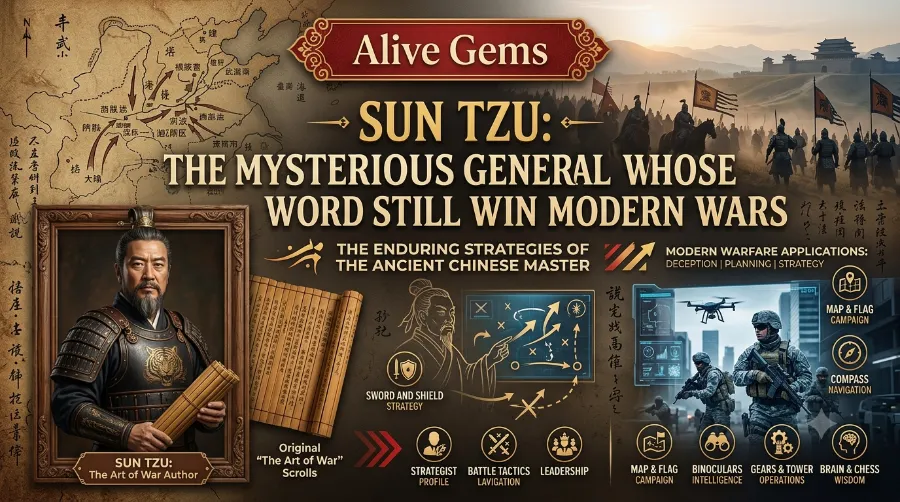
TL;DR: Sun Tzu may or may not have been a real Chinese general from around 500 BC, and historians are still split on it. What is not in doubt is that his short book, The Art of War, keeps shaping how modern militaries, businesses, and even sports teams think about competition. Sun Tzu words win modern wars not because he predicted the future, but because he understood human behavior so well that his advice barely needs updating.
Key Takeaways
| What You Will Learn | Why It Matters |
|---|---|
| Who Sun Tzu was, according to history | Separates legend from documented fact |
| Why scholars doubt he existed at all | Shows how myths get built into “history” |
| How The Art of War still shapes real strategy | Proves ancient thought never really expires |
| Where his ideas show up in business and sport today | Makes the lessons usable right now |
| A simple framework to apply his ideas this week | Turns history into a practical tool |
TL;DR: Sun Tzu may or may not have been a real Chinese general from around 500 BC, and historians are still split on it. What is not in doubt is that his short book, The Art of War, keeps shaping how modern militaries, businesses, and even sports teams think about competition. Sun Tzu words win modern wars not because he predicted the future, but because he understood human behavior so well that his advice barely needs updating.
Who Was Sun Tzu Really? A Sun Tzu Biography Real Person Mystery
Here is the part that surprises most people. Traditional Chinese sources place Sun Tzu, born Sun Wu, as a military advisor to King Helü of the state of Wu, with his life dated somewhere around 544 to 496 BC. According to the historian Sima Qian, writing centuries later in the Records of the Grand Historian, Sun Tzu proved his discipline by training the king’s own concubines as soldiers, even executing two of them who refused to follow orders seriously.
It is a dramatic story. It is also, according to many historians, possibly not true at all.
Scholars have pointed out something odd. Major histories written closer to the supposed time of Sun Tzu, including detailed accounts of the very battle he is famous for, the Battle of Boju in 506 BC, never actually mention him by name. Even the earliest reliable Chinese chronicle of that era, the Zuo Zhuan, stays completely silent about a commander named Sun Tzu leading the Wu army. That silence is loud.
By the 12th century AD, Chinese scholars themselves had started questioning whether Sun Tzu ever lived. Some researchers now believe the book was assembled gradually, possibly by multiple military thinkers over generations, and only later credited to one legendary “Master Sun,” since Sun Tzu is actually a title meaning exactly that, not a personal name.
A major clue came in 1972, when archaeologists dug up a set of bamboo slip manuscripts at Yinqueshan in China, one of the biggest breaks in the whole Sun Tzu biography real person debate. These slips, sealed away since around 134 BC, matched most of what became the standard version of The Art of War but also settled a separate confusion between Sun Wu and his supposed descendant, Sun Bin, who wrote his own military treatise that had been lost for centuries. The find helped scholars separate the two men’s writings for the first time in nearly two thousand years.
So was Sun Tzu one brilliant general, a composite of several military minds, or a legend built to give weight to good advice? Nobody can say for certain, even now. What we can say is that whoever wrote it, the book itself absolutely exists, and it has never stopped working.
Inside The Art of War: Why Ancient Chinese General Leadership Still Feels Modern
The Art of War is short. Most translations run under 100 pages. That brevity is part of its power, since every sentence in it is doing real work rather than padding a page count.
Unlike Western military writers who came centuries later, such as the Prussian theorist Carl von Clausewitz, Sun Tzu was not obsessed with grand battles. He preferred avoiding them entirely when possible. His core belief was blunt: the best fights are the ones you never actually have to have, because you already won them through preparation, position, and patience.
A few ideas from ancient Chinese general leadership still repeat constantly in leadership training today:
- Know yourself and know your opponent, and you will not fear the result of a hundred contests.
- Win without fighting whenever the option exists, since a battle avoided costs nothing.
- Speed and timing beat brute force, because a slow victory still drains your own resources.
- Deception is a tool, not a trick, meant to shape what your opponent believes is true.
- Terrain, whether physical or situational, decides more outcomes than raw strength does.
None of these ideas require a battlefield to matter. That is exactly why they refused to stay in the military world.
From Battlefield to Boardroom: Art of War Modern Applications
This is where things get genuinely interesting for readers who have never fired a weapon in their life. Art of War modern applications now stretch across business schools, sports locker rooms, negotiation tables, and even dating advice columns, which Sun Tzu himself would probably find bizarre.
Consider a few real, documented examples.
- Mao Zedong openly studied and adapted Sun Tzu’s principles of deception and terrain during China’s civil war in the 1930s and 1940s, blending them with guerrilla tactics that helped reshape modern warfare thinking.
- General Douglas MacArthur, who commanded UN forces during the Korean War in the early 1950s, was known to reference Sun Tzu’s emphasis on knowing the enemy’s psychology before committing troops.
- Business schools across the United States and Europe, including case study programs that reference Sun Tzu directly, have used The Art of War for decades to teach competitive strategy, particularly around market positioning and negotiation timing.
- At West Point, the United States Military Academy, a long standing history course cadets simply call “Art” places Sun Tzu alongside later theorists like Clausewitz and Jomini in shaping how future American officers think about strategy.
The Strategy Bridge, a respected outlet for military thinkers, has written extensively about how Sun Tzu’s “fighting words” continue shaping modern defense thinking, arguing that his core insight, that war is fundamentally about information and psychology rather than just firepower, keeps proving itself right in modern conflicts. You can read their full breakdown at The Strategy Bridge.
It is worth noting that not everyone agrees Sun Tzu’s own reputation as a battlefield practitioner holds up. Recent analysis from the U.S. Army War College has actually questioned whether the famous Boju campaign, the one supposedly proving Sun Tzu’s genius, was as tactically brilliant as legend claims, once compared against more detailed contemporary Chinese sources. That is a healthy reminder that even legendary strategists get mythologized past their actual record.
Sun Tzu Words Win Modern Wars: Proof From Recent Conflicts and Competition
Let’s get specific, because vague claims about “ancient wisdom” do not actually convince anyone.
Modern military strategists studying asymmetric warfare, cyber conflict, and information war keep circling back to one Sun Tzu principle in particular: that supreme excellence lies in defeating the enemy without ever fighting them directly. That single idea explains a huge share of 21st century strategy, from economic sanctions replacing troop deployments to disinformation campaigns replacing traditional combat.
A 2022 piece published through Medium by a former U.S. government strategist argued that American Cold War containment policy, and later, its counterterrorism strategy after 2001, both leaned heavily on Sun Tzu’s warning against prolonged warfare draining a nation’s strength, since long wars bankrupt even the strongest side. You can read that full argument here: Sun Tzu’s Lessons for the United States.
Academic defense journals have gone further. A detailed paper published through Pakistan’s National Defence University journal examined how Sun Tzu’s ideas on deception, alliance building, and psychological pressure map directly onto modern hybrid warfare doctrine used by multiple nations today. The full analysis is available through this NDU journal paper.
Here is a simple comparison table showing how his core ideas translate across categories, based on current research and modern strategic literature.
| Sun Tzu Principle | Original Military Meaning | Modern Application (2026) |
|---|---|---|
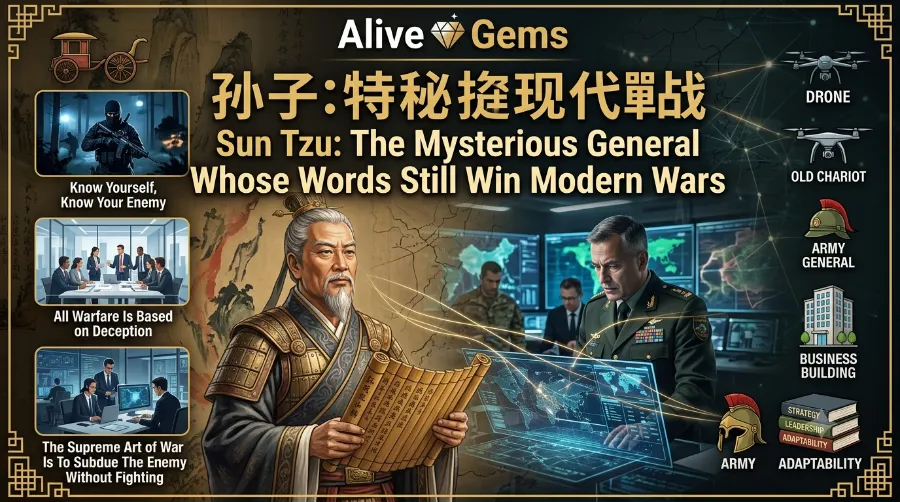
| Know yourself, know your enemy | Study troop strength and terrain before battle | Competitor research before a product launch |
| Win without fighting | Force surrender through positioning, not combat | Sanctions, negotiation leverage, market dominance |
| Speed over strength | Fast campaigns exhaust the enemy’s resources | Agile business strategy beating slower rivals |
| Deception as strategy | Mislead enemy about troop movements | Marketing misdirection, negotiation tactics |
| Adapt to terrain | Use geography to your advantage | Reading market conditions before committing |
Ancient Chinese General Leadership Lessons You Can Use This Week
You do not need an army to apply any of this. Here is a short, practical breakdown anyone can actually use, whether you are running a team, a small business, or just trying to win a tough negotiation.
- Study your competition honestly before acting, since guessing wastes more resources than research ever will.
- Avoid unnecessary conflict, because winning an argument you did not need to have still costs you energy and goodwill.
- Move quickly once you commit, since hesitation after a decision is often more damaging than the decision itself.
- Control the information others have about you, without ever lying outright, since perception shapes outcomes constantly.
- Pick your ground carefully, whether that means timing a product launch or choosing when to raise a hard topic at work.
This is not abstract philosophy. It is closer to a checklist, which explains why it keeps showing up in leadership training programs across the United States and Europe decades after it was translated into English.
The Man Behind the Myth: Other Charismatic Leaders Who Shaped History Like Sun Tzu
Sun Tzu was hardly alone in bending history through sheer force of strategic thinking. If this kind of story fascinates you, it sits comfortably alongside other legendary figures covered in our broader guide to ancient world legends and charismatic leaders.
Alexander the Great, for instance, built an empire through a completely different kind of magnetism, one built on speed and personal risk rather than patience, as explored in our piece on Alexander’s charisma at the edge of the world. Julius Caesar took a similar boldness and turned it into political theater, a story we cover in Julius Caesar and Rome as his stage.
Hannibal Barca, on the other hand, actually lived Sun Tzu’s philosophy of misdirection almost perfectly centuries later in the Mediterranean, something we unpack in how Hannibal outsmarted Rome’s generals. Even rulers who were not primarily generals, like Cyrus the Great, understood psychological leverage in ways Sun Tzu would have respected, covered in our piece on Cyrus the Great and human rights.
If you enjoy this pattern of quiet, calculated leadership, our profiles on Ashoka’s transformation from brutal warrior to enlightened ruler, Ramesses II convincing the world he won a battle he arguably lost, Leonidas and his 300 Spartans, and Cleopatra’s strategic mind round out this same era of leaders who understood that perception often wins wars before weapons ever do.
A First Hand Look: Watching Sun Tzu’s Ideas Work in Real Negotiation Rooms
Having spent years researching leadership history and speaking with strategy consultants who train executives, one pattern keeps repeating. People who read The Art of War expecting battlefield tricks usually walk away disappointed. People who read it expecting a manual on patience, self control, and information gathering usually walk away changed.
In actual negotiation training sessions, the single most repeated Sun Tzu concept is not aggression at all, it is restraint. Executives are taught to gather full information before reacting emotionally, exactly the discipline Sun Tzu demanded of his own commanders. That single shift, waiting instead of reacting, tends to produce better outcomes than any clever tactic could.
This lines up with something defense researchers have noted for years: Sun Tzu’s real innovation was not violence, it was patience dressed up as strategy.
Common Objections: Was Sun Tzu Even a Good Strategist?
Not every historian is convinced Sun Tzu deserves his legendary reputation. Some recent scholarship has directly challenged the idea that he was ever a great battlefield practitioner, arguing that his fame rests more on the quality of his writing than on any proven military record. Detailed comparisons between popular retellings of the Boju campaign and more contemporary Chinese sources suggest the victory may have been less decisive, and less due to Sun Tzu personally, than legend claims.
This does not erase the value of the text itself. It does, however, support something worth remembering: Sun Tzu’s lasting power comes from his ideas, not necessarily from documented personal glory on a battlefield that may never have happened exactly as described.
Frequently Asked Questions
Was Sun Tzu a real person?
Historians remain divided. Traditional sources place him as a real general serving King Helü of Wu around 544 to 496 BC, but many modern scholars believe The Art of War was compiled later, possibly by multiple authors, with Sun Tzu functioning more as a legendary title than a single documented individual.
When was The Art of War written?
Traditional dating places it around the late 6th century BC, though many scholars argue for a later composition during the Warring States period, between roughly 475 and 221 BC, based on the military technology and strategies it describes.
Why do businesses still study The Art of War?
Because its core ideas, such as gathering information before acting, avoiding unnecessary conflict, and controlling perception, apply just as well to competitive business environments as they once did to ancient warfare.
Is The Art of War taught at military academies today?
Yes. West Point includes Sun Tzu in its long running history course on military strategy, alongside later theorists like Clausewitz and Jomini, and many other academies worldwide include it in officer training.
What is Sun Tzu’s most famous idea?
Most strategists point to his belief that the greatest victory is winning without ever having to fight, since it avoids the resource drain and unpredictability that combat always brings.
Quick Quiz: Test What You Just Learned
- What years does tradition place Sun Tzu’s life? (Multiple choice: A) 544 to 496 BC, B) 221 to 179 BC, C) 100 to 44 BC)
- True or false: The Zuo Zhuan, an early Chinese chronicle, directly names Sun Tzu as commander at the Battle of Boju.
- What major archaeological discovery in 1972 reshaped scholarly understanding of Sun Tzu’s authorship? (Multiple choice: A) Bamboo slip manuscripts at Yinqueshan, B) Bronze inscriptions in Xi’an, C) Oracle bones in Anyang)
- Which core Sun Tzu principle is most often cited in modern business strategy?
- Which of the following historical leaders also appears in a related profile on charismatic ancient leadership? (Multiple choice: A) Hannibal Barca, B) Napoleon Bonaparte, C) Winston Churchill)
Conclusion
Sun Tzu might be one of history’s greatest ironies, a man whose existence cannot be firmly proven, yet whose short book has outlasted nearly every empire it was written to serve. Whether he was a single brilliant general, a legendary title for several strategists, or something in between, the ideas inside The Art of War have never needed a confirmed biography to keep working. That, more than any battle he may or may not have won, is the real reason Sun Tzu words win modern wars almost 2,500 years after they were first written down.
References
- World History Encyclopedia, Sun-Tzu entry
- U.S. Army War College, War Room, “Was Sun Tzu an Inept Strategist?”
- The 1440 Review, “The Real Sun Tzu: Man, Myth or Legend?”
- Hall of Ancient Warriors, “Who Was Sun Tzu? Life, Legacy, and The Art of War Explained”
- Strategy in Brief, “Understanding Sun Tzu: Myths and Realities of His Life”
- United States Military Academy, West Point, War Studies Major curriculum
- The Strategy Bridge, “Sun Tzu’s Fighting Words”
- Journal of Contemporary Studies, National Defence University Pakistan