
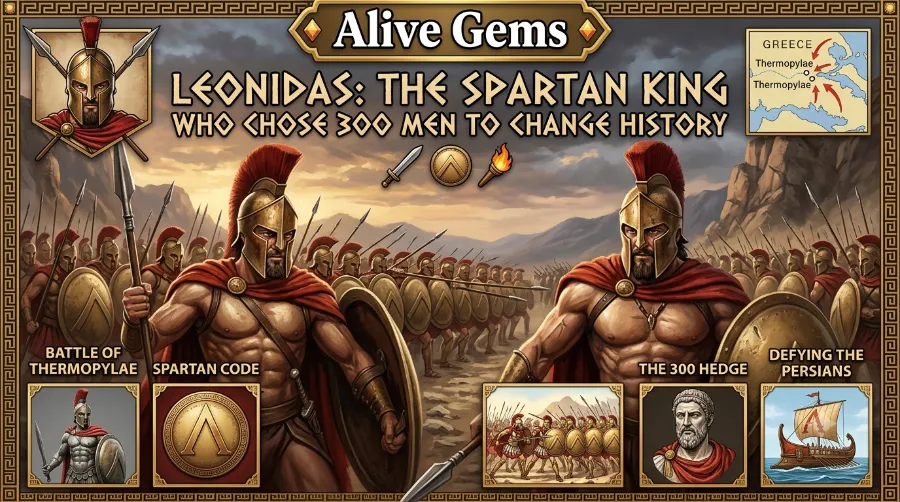
Leonidas The Spartan King Picture a narrow strip of rock between a mountain and the sea, so tight that two wagons could barely pass side by side. Now picture one man standing there, knowing he will die, and choosing to stay anyway. That man was Leonidas, and the story of how Leonidas 300 Spartans changed history still gives people chills more than 2,500 years later. This is not just a war story. It is a story about choice, loyalty, and what one person can do when everyone else has given up.
Cleopatra’s Strategic Mind: The Real Story Behind History’s Most Famous Romance
Key Takeaways
| Fact | Detail |
|---|---|
| Who | King Leonidas I of Sparta |
| Event | Battle of Thermopylae |
| Year | 480 BC |
| Spartan force | 300 elite hoplites (plus around 700 to 1,000 allied Spartan-led troops) |
| Total Greek army | Roughly 7,000 soldiers from 14 Greek city-states |
| Persian army | Estimated 70,000 to 300,000 troops under King Xerxes I |
| Duration | 3 days |
| Outcome | Greeks defeated militarily, but bought critical time for Greece |
| Legacy | Became a symbol of courage, sacrifice, and resistance against overwhelming odds |
TL;DR: Leonidas 300 Spartans changed history by holding a narrow mountain pass at Thermopylae against a Persian army many times their size in 480 BC. They lost the battle, but their stand bought Greece time to regroup, and it turned Leonidas into one of the most quoted, most studied, and most inspiring leaders in world history.
Who Was Leonidas Before He Became a Legend Leonidas The Spartan King
Leonidas was not born expecting to be king. He was actually the third son of King Anaxandridas II, and in Sparta, that usually meant a quiet life outside the throne room. But fate has a strange sense of humor. When his older brothers died without leaving heirs who could rule, the crown landed on Leonidas almost by accident, sometime around 490 BC.
By the time he took power, Leonidas was already in his 50s or 60s, not the young, chiseled warrior Hollywood later imagined. He had trained since childhood in the agoge, the brutal Spartan education system that turned boys into soldiers through hunger, discipline, and hardship. This was normal in Sparta. Every Spartan man was raised to see war not as an event but as a lifestyle.
If you’re curious how other ancient rulers built their legendary reputations, Alexander the Great took a completely different path, using charisma and conquest rather than defense and sacrifice.
Why Thermopylae Mattered So Much
By 480 BC, the Persian Empire under King Xerxes I was the largest and most powerful empire on earth. Xerxes wanted revenge. His father, Darius, had been humiliated by the Greeks at the Battle of Marathon ten years earlier, and Xerxes intended to finish what his father started. He raised an enormous army, somewhere between 70,000 and possibly 300,000 troops depending on which historian you trust, and marched toward Greece.
The Greek city-states, who normally spent more time fighting each other than cooperating, realized they had to unite or be erased. They chose Thermopylae, a narrow coastal pass in central Greece, as their chokepoint. It was the perfect place for a small force to hold back a giant one, because the terrain made numbers almost meaningless.
This is where Leonidas 300 Spartans changed history in a way nobody expected. Instead of sending a massive Spartan army, Leonidas selected exactly 300 men, all of whom already had living sons to carry on their family lines. This detail matters. Leonidas knew, on some level, that this mission might not end in victory. Sun Tzu: The Mysterious General Whose Words Still Win Modern Wars
The Battle of Thermopylae: Day by Day
The fighting began around August 480 BC and lasted three brutal days.
Day One: Xerxes waited four days before attacking, hoping the Greeks would simply retreat when they saw the size of his army. When they didn’t, he sent his soldiers, including elite fighters called the Immortals, straight into the pass. The narrow terrain meant only a small number of Persians could fight at once, and the Spartans, fighting in tight phalanx formation, cut them down efficiently.
Day Two: Xerxes tried again with fresh troops, expecting the Greeks to be exhausted. They weren’t. The Spartans rotated their front lines and kept the Persians locked out of the pass for a second day, a result nobody in the Persian camp expected.
Day Three: This is the turning point that changed everything. A local Greek man named Ephialtes betrayed the Greeks by showing Xerxes a hidden mountain trail called the Anopaea Path, which curved around the pass and came out behind the Greek position. Once Leonidas learned the Persians were circling around, he made his final decision.
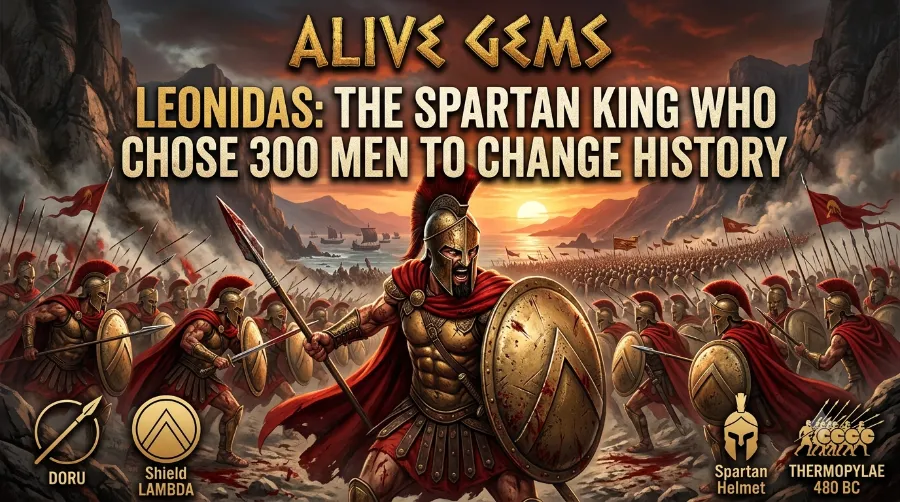
He sent most of the allied Greek soldiers away to survive and fight another day. Leonidas himself stayed, along with his 300 Spartans and a smaller group of Thespians and Thebans, to hold the line and allow the retreat. They fought until they were surrounded and killed, a last stand that has echoed through history ever since.
For readers who enjoy comparing legendary military minds, Hannibal Barca later used a similar mix of terrain and tactics to outsmart much larger Roman armies.
Persian Army vs Greek Forces at Thermopylae
| Category | Persian Forces | Greek Forces |
|---|---|---|
| Estimated troops | 70,000 to 300,000 | About 7,000 total |
| Elite unit | The Immortals | 300 Spartans |
| Commander | Xerxes I | King Leonidas I |
| Terrain advantage | None, forced into a narrow pass | Massive, pass limited Persian numbers |
| Days of resistance | N/A | 3 full days |
| Outcome | Eventually broke through | Suffered near total losses in final stand |
What Made Leonidas So Different From Other Kings
Leonidas is remembered not just because he fought bravely but because of how he led. He didn’t send others to die while he stayed safe. He didn’t hide behind rank. He stood in the front line with his men, ate the same simple food, and slept in the same conditions.
Historians and military strategists still study this leadership style today. A few things stand out:
- He led from the front, not from behind a wall of guards
- He chose men based on legacy and loyalty, not just physical strength
- He made a calculated sacrifice rather than a reckless one, saving most of his army by giving up his own life
- He understood psychological warfare, using confidence and defiance to unsettle a much larger enemy
There’s a famous exchange where Xerxes demanded the Spartans surrender their weapons. Leonidas is said to have replied with two words that are still printed on t shirts and tattooed on soldiers today: “Molon labe,” meaning come and take them. Whether or not he said it exactly that way, it captures who he was.
If you want to see how a completely different kind of ruler built power through generosity instead of defiance, Cyrus the Great is a fascinating contrast worth reading.
Real Numbers, Real Dates, Real Impact
It’s easy for ancient battles to feel like myths, so let’s ground this in verified numbers.
- The battle took place in August 480 BC, most likely between August 17 and August 20
- Leonidas selected exactly 300 Spartan citizens, though total Greek forces at the pass numbered close to 7,000
- Modern historians estimate the Persian army at 70,000 to 300,000, far smaller than the ancient historian Herodotus originally claimed
- The stand lasted approximately 3 days before the Greeks were outflanked
- Just one month later, the Greeks won a decisive naval victory at Salamis, and within a year, they defeated the Persians on land at Plataea
This is the part people often miss. Leonidas 300 Spartans changed history not by winning the battle, but by buying Greece enough time to prepare, unite, and eventually defeat the Persian Empire entirely. Without those three days, the outcome for Athens, Sparta, and the future of Western civilization could have looked very different.
The Myth vs the Real Leonidas: Leonidas The Spartan King
Pop culture, especially the 2006 film “300,” turned Leonidas into a young, muscular action hero. The real Leonidas was likely in his 50s or 60s, not his 30s. The film also simplifies the Persian army and skips over the fact that thousands of other Greek soldiers, not just Spartans, fought and died at Thermopylae too.
That doesn’t make the real story less impressive. If anything, an older king choosing to physically fight alongside younger soldiers, knowing he wouldn’t survive, is arguably more powerful than the movie version.
For more on how this real story compares to the dramatized version, this breakdown from Athens Taxi Tour does a great job separating fact from Hollywood fiction, and Celebrate Greece offers a solid overview of the historical background as well.
Leonidas Compared to Other Legendary Ancient Leaders
Leonidas The Spartan King wasn’t the only ancient leader who reshaped history through sheer force of personality and decision making. Julius Caesar transformed Rome through political theater and ambition, while Ashoka the Great went from brutal conqueror to a ruler who embraced peace after witnessing the horror of war. Even Ramesses II understood that legacy is often shaped by story as much as fact, something Leonidas achieved without even trying.
If you enjoy exploring these kinds of larger than life figures, our full guide to ancient world legends and charismatic leaders is a great next stop.
Why This Story Still Matters Today
You don’t need to be a history buff to feel something when you read about Thermopylae. Leadership experts, military strategists, and even business coaches still reference this battle when talking about sacrifice, small teams outperforming larger ones, and the power of a leader who’s willing to go first.
In a world full of leaders who avoid accountability, the image of Leonidas standing at the front line, sharing every risk with his men, still hits differently. That is the real reason Leonidas 300 Spartans changed history in a way that outlasted the empire that defeated him.
Test Your Knowledge: Leonidas and Thermopylae Quiz
1. In what year did the Battle of Thermopylae take place?
A) 490 BC
B) 480 BC
C) 460 BC
2. What was the name of the hidden path that led the Persians around the Greek position?
A) Anopaea Path
B) Sacred Way
C) Kolonos Trail
3. Roughly how many Spartans did Leonidas bring to Thermopylae?
A) 100
B) 300
C) 1,000
4. True or false: Leonidas was a young man in his 30s during the battle.
5. What later naval battle helped the Greeks turn the tide against Persia shortly after Thermopylae?
(Answers: 1-B, 2-A, 3-B, 4-False, he was likely in his 50s or 60s, 5-The Battle of Salamis)
Frequently Asked Questions
Did Leonidas actually die at Thermopylae?
Yes. Leonidas was killed on the third day of battle after choosing to stay behind with a small force while the rest of the Greek army retreated safely.
Why did Leonidas only bring 300 Spartans?
Leonidas The Spartan King Spartan law restricted how many full citizen soldiers could be sent on a single mission, and Leonidas reportedly chose men who already had living sons to continue their family lines, a sign he expected the mission to end in death.
Was the movie 300 historically accurate?
Leonidas The Spartan King Not entirely. It exaggerated the age and appearance of Leonidas, simplified the size and diversity of the Greek army, and dramatized several details for entertainment rather than historical accuracy.
Did the Spartans win the Battle of Thermopylae?
No, militarily the Persians won and pushed further into Greece. However, the delay allowed Greek forces to regroup and eventually defeat Persia at Salamis and Plataea.
How many soldiers total fought on the Greek side at Thermopylae? Leonidas The Spartan King
Around 7,000 soldiers from roughly 14 Greek city-states fought at Thermopylae, though the 300 Spartans became the most remembered part of that force.
Conclusion
Leonidas The Spartan King didn’t win the Battle of Thermopylae, and yet somehow he won something bigger. He proved that a small group of people, led by someone willing to stand at the very front, can change the direction of history even in defeat. More than two thousand years later, we’re still telling his story, still quoting his defiance, and still asking ourselves whether we’d have the courage to make the same choice. That’s the real reason Leonidas 300 Spartans changed history, and why his name still means something today.
References
- Britannica, Battle of Thermopylae Leonidas The Spartan King
- History Cooperative, The Battle of Thermopylae: 300 Spartans vs the World Leonidas The Spartan King
- History Defined, The Truth Behind the 300 Spartans at Thermopylae Leonidas The Spartan King
- Bad Ancient, Did 300 Spartans Try to Halt the Persian Advance at Thermopylae Leonidas The Spartan King
- Timpanogos Blog, Leonidas and the 300 Spartans Died August 11, 480 BC Leonidas The Spartan King
- Athens Taxi Tour, The 300 Spartans in Film vs History Leonidas The Spartan King
- Celebrate Greece, 300 Spartans: The Real Story Leonidas The Spartan King