
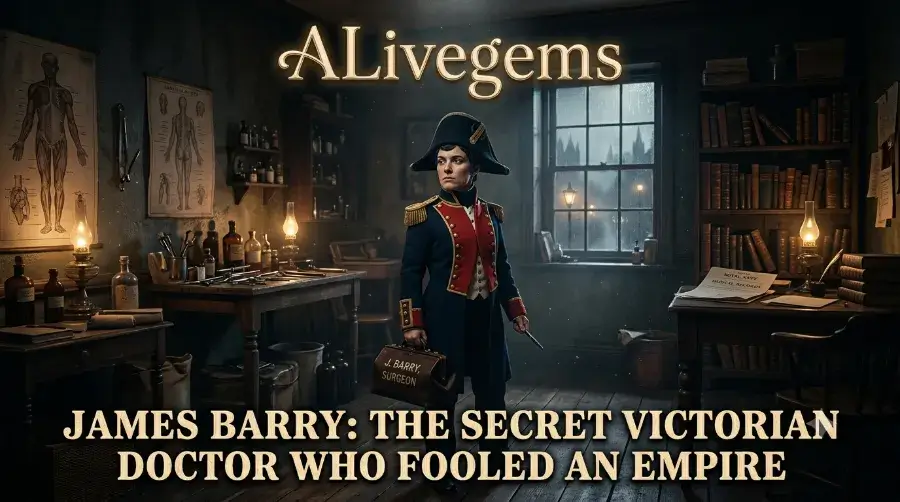
James Barry Picture a doctor so brilliant that Queen Victoria’s own army trusted him with hospitals across three continents. Now picture that same doctor keeping a secret so enormous that even his closest friends never guessed it, right up until the moment he died. That is the true story of James Barry, the secret Victorian doctor whose hidden identity remained unknown for 56 years. His life reads like fiction, yet every detail is backed by military records, letters and medical archives. This is one of those forgotten historical identity stories that deserves far more attention than it gets, and once you know it, you will never forget it.
Quick Facts: James Barry at a Glance
| Detail | Information |
|---|---|
| Real name | Margaret Ann Bulkley |
| Chosen identity | James Barry |
| Born | Around 1789, Cork, Ireland |
| Died | 25 July 1865, London |
| Secret kept for | Roughly 56 years |
| Profession | British Army military surgeon |
| Highest rank | Inspector General of Hospitals |
| Famous first | First recorded successful caesarean in Africa by a European surgeon |
| Discovery | Revealed only after death, by a charwoman preparing the body |
Now let’s get into how this remarkable story actually unfolded, because the details are even stranger than the summary above suggests.
Who Was James Barry? The Secret Victorian Doctor Behind the Uniform
Long before the name James Barry meant anything to anyone, there was a girl named Margaret Ann Bulkley growing up in Cork, Ireland. Life was not kind to her family. Her father landed in debtors’ prison after a string of financial troubles, and by 1804, Margaret and her mother had no choice but to leave Ireland for London. To get a better understanding of Ada Lovelace invented computer programming our guide breaks down exactly what to expect.
That move changed everything. Because in London, the family had one important connection: Margaret’s uncle, a well known painter named James Barry who mixed with artists, doctors and free thinkers of the day. His social circle planted an idea in young Margaret’s head, one that would have been unthinkable for almost any other Victorian era woman. She wanted to study medicine.
A Childhood Marked by Hardship in Cork, Ireland
There is also a darker layer to this story. Some historians believe Margaret gave birth as a teenager after being assaulted by a relative, and that the child was quietly raised by her mother. Whatever pain she carried from those years, she channeled it into an unstoppable drive to build a different life, one where nobody could tell her what she was allowed to become.
By the time her uncle passed away, Margaret had inherited enough money to fund an education. Around the age of eighteen, she made the boldest decision of her life. She would no longer be Margaret Bulkley. She would become James Barry, the secret Victorian doctor the world had not yet met, and she would use her uncle’s name to do it.
Becoming James Barry: A Hidden Identity History Would Almost Forget
In 1809, “James Barry” walked into the University of Edinburgh wearing a heavy overcoat, padded shoulders and raised heel inserts to appear taller. Standing under five feet tall with a smooth face and a high voice, Barry looked so young that university officials assumed he was a boy far too immature for medical school. They nearly blocked his final exams over it.
Luckily, a powerful patron named the Earl of Buchan stepped in to vouch for him. In 1812, at around 22 years old, James Barry earned a Doctor of Medicine degree, becoming, in effect, the first person raised as a woman to legally qualify as a British doctor. Nobody in that lecture hall had any idea what they had just witnessed.
If this kind of quiet, overlooked breakthrough fascinates you, it sits comfortably alongside other forgotten charismatic figures whose achievements were buried by the prejudices of their era, much like Hypatia of Alexandria, a brilliant mind history nearly erased simply because of her gender.
Inside the Life of One of History’s Most Remarkable Hidden Identity Figures
After qualifying, Barry trained briefly at St Thomas’ Hospital in London before joining the British Army in 1813 as a Hospital Assistant. Three years later, in 1816, he was posted to Cape Town, South Africa, where his career truly took flight. For the next decade, Barry served the colony not just as a physician for the wealthy, but as a doctor for enslaved people, prisoners and the poor, groups most Victorian society doctors simply ignored.
He also became close with the Cape Colony’s governor, Lord Charles Somerset, a friendship so intense it sparked gossip that never fully died down. Barry did not seem to care much what people whispered. He was there to fix broken sanitation systems, expand access to clean water and push back against officials who resisted change.
The First Successful Caesarean Section in the British Empire
Somewhere around 1826, Barry performed one of the most remarkable surgical feats of the entire century. He carried out a caesarean section in which both the mother and the baby survived, one of the first such successes recorded anywhere in the British Empire. In an era when this operation almost always cost the mother her life, that outcome alone would have made most surgeons famous.
Barry, however, was not chasing fame. Wherever the British Army sent him, from Mauritius to Jamaica to Malta to Corfu, he kept doing the same thing: demanding better food, better hygiene and better treatment for people the empire preferred to overlook, including lepers, prisoners and common soldiers.
A Reformer Who Fought For the Powerless
Here is a quick look at the pattern that defined Barry’s entire military career:
- Improved water supply systems for Cape Town during his ten year posting there
- Managed a serious cholera threat while stationed in Malta in the 1840s
- Pushed for better food and medical care for prisoners suffering from leprosy in Canada
- Clashed repeatedly with officials over unsanitary barracks and hospital conditions
- Reached the rank of Deputy Inspector General of Hospitals while serving on Corfu in 1851
This relentless advocacy did not make Barry popular with everyone. He was arrested more than once and court martialed on at least one occasion for conduct considered inappropriate for an officer. Each time, he was cleared, and each time, he kept pushing forward anyway.
Life Among Victorian Era Secret Figures: Friendships, Rumors and Scandal
Barry crossed paths with several major names of the century. While stationed on the remote island of St Helena, he was reportedly summoned to treat a member of Napoleon Bonaparte’s household staff. During the Crimean War, he even had a famously tense encounter with Florence Nightingale, who later described him as one of the harshest characters she had ever dealt with, unaware she was speaking to a fellow trailblazer hiding an equally extraordinary secret.
It is worth pausing here to appreciate how many quietly consequential people history almost lost entirely. Just as Vasily Arkhipov single handedly helped prevent nuclear war without public recognition for decades, Barry’s contributions to military medicine went unrecognized for the very same reason: nobody knew the full truth of who he really was.
Barry also kept a small, loyal circle of companions throughout his travels, including a beloved poodle he brought nearly everywhere. He was famously strict about his diet too, staying almost entirely vegetarian and avoiding alcohol at a time when neither habit was common among British officers.
Key Facts About James Barry: Numbers That Tell the Story
Numbers rarely capture emotion, but in this case, they do a remarkable job of showing just how extraordinary this secret Victorian doctor’s career actually was.
| Milestone | Year | Detail |
|---|---|---|
| Born as Margaret Ann Bulkley | c. 1789 | Cork, Ireland |
| Enrolled at Edinburgh as “James Barry” | 1809 | Disguised as a young man |
| Earned Doctor of Medicine | 1812 | Around age 22 |
| Joined the British Army | 1813 | As Hospital Assistant |
| First posting to Cape Town | 1816 | Served roughly 10 years |
| Pioneering survival caesarean | c. 1826 | Mother and child both survived |
| Promoted to Deputy Inspector General | 1851 | Stationed on Corfu |
| Reached Inspector General of Hospitals | 1857 | Posted in Canada, second highest medical rank in the army |
| Retired from active service | 1859 to 1864 | Due to declining health |
| Died in London | 25 July 1865 | True identity revealed after death |
| Military records sealed | 100 years | Fully accessible only decades later |
Nearly every entry on that table represents a moment when James Barry could have been exposed and chose to push forward anyway. That kind of quiet courage rarely gets a monument, though it absolutely deserves one.
The Truth Comes Out: Death, Discovery and Legacy
By 1859, years of hard travel and illness had worn Barry down considerably. Bronchitis picked up in Canada’s harsh climate weakened him badly, and he eventually returned to London to retire. He lived out his final years quietly, still giving strict instructions about what should happen to his body after death.
Barry insisted he be buried in the clothes he died in, without any physical examination. It was a final, desperate attempt to protect the secret he had carried for over five decades. Sadly for him, that instruction was not followed.
The Charwoman Who Found the Truth
When Barry died on 25 July 1865, a woman named Sophia Bishop was hired to prepare his body for burial. While doing so, she discovered something nobody expected. The body appeared to be that of a woman, and by some accounts, showed signs consistent with having given birth at some point.
Word spread quickly. Letters exchanged between officials, including Barry’s own physician Major D. R. McKinnon, eventually leaked to the press. McKinnon reportedly said the matter of Barry’s sex was simply none of his business, a surprisingly modern attitude for 1865. The British Army, mortified by the scandal, sealed Barry’s service records for a full century, and the story faded into obscurity for generations.
Why James Barry Still Matters Today
James Barry is now remembered as one of the most remarkable hidden identity history has ever produced, a person who, depending on how you read the evidence, may have been a woman forced by circumstance to live as a man, or a transgender man decades ahead of any language that existed to describe his own experience. Either way, his medical accomplishments were entirely real and entirely his own.
His story sits comfortably beside other underappreciated pioneers whose brilliance outpaced the recognition they received in their own lifetimes. Consider Eratosthenes, who calculated the Earth’s circumference using nothing but shadows and math, or Rosalind Franklin, whose DNA research was credited to others for far too long. Barry belongs firmly in that same club of genius the establishment was slow to properly honor.
In 2017, officials in the United Kingdom recognized Barry’s grave as a site of historical significance in LGBT history, a quiet but meaningful acknowledgment of just how far ahead of his time this secret Victorian doctor truly was.
A Life of Firsts, Hidden in Plain Sight
Here is a simple breakdown of just how many barriers this one person managed to break, often without anyone realizing it at the time:
- First person raised as a woman to earn a medical degree in the United Kingdom
- First woman to become a member of the Royal College of Surgeons, nearly a century before women were formally admitted
- Performer of one of the earliest successful caesarean sections in the British Empire
- Highest ranking military medical officer of female birth in British Army history
- First recognized transgender figure to reach general officer rank in British military medicine
Few figures in the sprawling history of secret Victorian doctor stories accomplished this much while risking this much. Barry did it for nearly six decades without a single confirmed slip.
For readers who enjoy discovering people history tried to bury, alivegems.com has covered several other jaw dropping examples, including Ching Shih, the most powerful pirate to ever sail, teenage messenger Sybil Ludington, and Ibn Battuta, the explorer who quietly outdid Marco Polo. Each of these stories, much like Barry’s, proves that history’s most extraordinary people are not always the ones we were taught about in school.
Frequently Asked Questions About James Barry
Was James Barry really a woman? Most historians agree Barry was born and raised as Margaret Ann Bulkley. However, since Barry lived his entire adult life identifying and presenting as male, many modern researchers now describe him as an early transgender figure rather than simply a woman in disguise.
How long did James Barry keep the secret? Barry maintained his identity as a man from around 1809, when he enrolled at Edinburgh, until his death in 1865. That works out to roughly 56 years of an unbroken secret.
What was James Barry’s biggest medical achievement? Barry is best remembered for performing one of the first successful caesarean sections in the British Empire, at a time when the mother’s survival during this operation was extremely rare.
Did anyone know about Barry’s secret while he was alive? A small handful of people may have suspected the truth, including possibly Lord Charles Somerset in Cape Town, but there is no solid proof anyone confirmed it before Barry’s death.
Why did the British Army seal Barry’s records? The Army was reportedly embarrassed that a person born female had reached one of its highest medical ranks, so officials sealed his service files for around 100 years rather than confront the story publicly.
Test Your Knowledge: The James Barry Quiz
- In what year did James Barry earn his Doctor of Medicine degree? A) 1809 B) 1812 C) 1826 D) 1857
- What was the highest military rank James Barry achieved? A) Colonel B) Major General C) Inspector General of Hospitals D) Field Marshal
- Where was James Barry born? A) Edinburgh, Scotland B) Cork, Ireland C) London, England D) Cape Town, South Africa
- Who discovered Barry’s secret after his death? A) A fellow army surgeon B) A charwoman preparing his body C) Florence Nightingale D) Queen Victoria
- How long did the British Army seal Barry’s military records? A) 10 years B) 25 years C) 50 years D) 100 years
(Answers: 1-B, 2-C, 3-B, 4-B, 5-D)
Final Thoughts
James Barry spent nearly six decades outsmarting an empire that would never have let him practice medicine as himself. He treated slaves and generals with the same care, performed surgeries that saved lives history nearly forgot, and pushed institutions to treat the powerless with basic dignity. Along the way, he built one of the most remarkable hidden identity history has ever recorded, and he did it without a single confirmed slip until the day he died.
Stories like this matter because they remind us that talent has never respected the boundaries society tries to draw around it. James Barry, the secret Victorian doctor who fooled an empire for 56 years, proves that some of history’s greatest minds were hiding in plain sight all along, waiting for the rest of us to finally notice.
References
- Wikipedia, “James Barry (surgeon)”
- HISTORY.com, “The Extraordinary Secret Life of Dr. James Barry”
- The Royal College of Surgeons of England, Bulletin, “Dr James Barry: The Woman Who Fooled the RCS and Deceived the World”
- Guide London, “The Extraordinary Life of Margaret Ann Bulkley aka Dr James Barry”
- Caroline Warfield, “James Barry, Physician”
- Kristine Shields, Author Blog