
Eratosthenes calculated Earth circumference Picture this. It’s around 240 BC. There are no satellites, no airplanes, no spinning globes sitting on office desks. Most people on Earth still believe, quite reasonably, that the ground beneath them is flat. Yet in the sun baked city of Alexandria, a librarian pokes a wooden stick into the sand, watches its shadow, and works out the size of the entire planet. He gets it almost right. Not close. Almost exactly right.
That librarian was Eratosthenes, and his story is one of the greatest comebacks in the history of forgotten ancient world scientists. He never sailed around the Earth. He never left Egypt. All he had was curiosity, a bit of geometry, and the courage to trust his own eyes over popular opinion. If you love stories about charismatic figures history overlooked, this one belongs right at the top of the list.
Key Takeaways
| What Eratosthenes Did | The Detail |
|---|---|
| Time period | Around 240 to 194 BC, in Ptolemaic Egypt |
| Tools used | A stick (gnomon), a well, and simple geometry |
| Cities compared | Alexandria and Syene (modern Aswan) |
| Distance between cities | About 5,000 stadia, roughly 780 to 800 km |
| Shadow angle measured | About 7.2 degrees, or 1/50th of a circle |
| His final answer | About 250,000 stadia for Earth’s circumference |
| Modern equivalent | Roughly 39,000 to 40,000 km, depending on the ancient stadium used |
| Actual Earth circumference | 40,075 km at the equator |
| Margin of error | Less than 2 percent, by most modern estimates |
| His job title | Chief librarian at the Library of Alexandria |
Who Was Eratosthenes, Really?
Eratosthenes was born around 276 BC in Cyrene, a Greek colony on the coast of what is now Libya. As a young man, he traveled to Athens to study philosophy, literature, and mathematics, soaking up the best education the Greek world had to offer at the time. He was not a narrow specialist. He wrote about geography, poetry, music theory, and pure mathematics, and he still found time to invent a clever method for identifying prime numbers, known today as the Sieve of Eratosthenes and still taught in classrooms around the world.
His wide-ranging talents eventually reached the ears of the Ptolemaic rulers of Egypt. Around 245 BC, King Ptolemy III invited him to Alexandria to tutor the royal family. Soon after, he was appointed head librarian of the Library of Alexandria, arguably the most influential research institution the ancient world ever produced. Because he excelled at so many subjects without being the undisputed top name in any single one, fellow scholars nicknamed him “Beta,” meaning second-best. History has judged him far more kindly than that nickname suggests.
This was the same intellectual hub where, centuries later, another brilliant mind named Hypatia would teach mathematics and astronomy before meeting a tragic end. If Eratosthenes fascinates you, Hypatia’s story is a natural next stop, because Alexandria kept producing minds that were centuries ahead of their era.
Life Inside the Greatest Library on Earth
As chief librarian, Eratosthenes had access to something almost nobody else on the planet could touch: a vast collection of scrolls, travel reports, astronomical records, and trade route documents gathered from across the known world. Merchants and sailors passing through Alexandria’s busy port were required to hand over any books aboard their ships so scribes could copy them for the library. To get a better understanding of Ibn Battuta forgotten greatest explorer our guide breaks down exactly what to expect.
This meant Eratosthenes was not working in isolation. He had access to secondhand accounts from travelers who had visited far-flung places, including the peculiar story about a well in Syene that would eventually change everything. Being the head of the world’s largest information archive gave him a unique advantage that few other ancient thinkers ever had.
He used this position to attempt something almost nobody had tried before: drawing a map of the entire known world, complete with parallel lines of latitude, based on real travel distances rather than guesswork. Long before modern cartography existed, Eratosthenes was already thinking in terms of coordinates and grids. To get a better understanding of Rosalind Franklin DNA credit stolen our guide breaks down exactly what to expect.
The Well That Started Everything
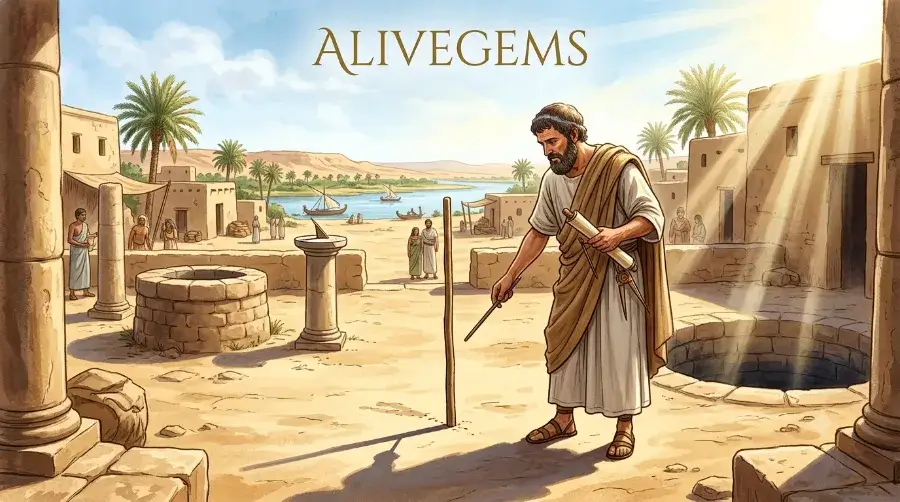
Here is where the story gets genuinely delightful. Eratosthenes had heard travelers describe something strange happening in Syene, far south along the Nile. On the summer solstice, at exactly noon, sunlight would shine straight down a deep well and light up the water at the bottom without casting a single shadow on the walls.
Most people would have filed that away as a fun travel anecdote and moved on with their day. Eratosthenes did not. He wondered why the same thing never happened in Alexandria, even at noon on that very same day. If the sun always shone straight down everywhere, wells in both cities should have lit up equally. They did not, and that tiny inconsistency became the seed of one of the most important discoveries in ancient science.
If you want to learn more about James Barry secret Victorian doctor check out our detailed guide for practical tips and expert advice.
He reasoned that this could only happen if:
- The Earth’s surface was curved rather than flat
- Sunlight traveled in essentially parallel rays because the sun was extremely far away
- The angle of that sunlight would differ depending on exactly where you stood on the curve
That last idea is the entire trick behind his experiment. If you can measure how much the angle differs between two spots a known distance apart, you can calculate the size of the whole sphere without ever leaving home.
The Stick, the Shadow, and the Math That Changed History
On the next summer solstice, Eratosthenes placed a vertical stick, known as a gnomon, into the ground in Alexandria. At the exact moment the sun was reported to sit directly overhead in Syene, he measured the shadow that same stick cast in Alexandria.
The shadow’s angle came out to roughly 7.2 degrees. That number might look random at first glance, but it happens to equal exactly 1 divided by 50 of a full 360 degree circle. Eratosthenes then relied on professional pacers called bematists, whose job was to walk known distances while counting their steps with remarkable consistency, and their measurement placed Alexandria and Syene about 5,000 stadia apart.
From there, the logic is almost embarrassingly simple:
- If 7.2 degrees of Earth’s curve corresponds to 5,000 stadia
- Then a full 360 degrees, the entire circumference, equals 5,000 multiplied by 50
- That calculation gives 250,000 stadia as the circumference of the entire planet
No spacecraft. No satellites. Just one stick, one well story, and a mind willing to trust the math over intuition. It’s the kind of ancient genius Earth calculation that still leaves modern physicists a little stunned, which is why the American Physical Society still writes about it as one of history’s cleanest scientific experiments.
So How Accurate Was He, Really?
This is where things get interesting, because the honest answer is “it depends,” and historians love arguing over the details. The stadium, the unit of length Eratosthenes used, was not standardized across the ancient Mediterranean world. Different Greek cities used slightly different lengths for a stadium, ranging anywhere from about 157 to 210 meters.
Here is a comparison table showing how his result stacks up depending on which stadium length is assumed:
| Stadium Length Assumption | Eratosthenes’ Circumference | Actual Modern Circumference | Error Margin |
|---|---|---|---|
| Attic stadium (about 185 m) | Roughly 46,250 km | 40,075 km | About 15 percent too high |
| Egyptian stadium (about 157.5 m) | Roughly 39,375 km | 40,075 km | Less than 2 percent |
| Olympic stadium (about 176 m) | Roughly 44,000 km | 40,075 km | About 10 percent too high |
Most historians who specialize in ancient Egyptian units of measurement lean toward the Egyptian stadium interpretation, since Eratosthenes was living and measuring inside Egypt at the time. Under that reading, his estimate lands remarkably close to the true figure, a margin that would make plenty of modern first-year physics students jealous. For readers who enjoy digging into the primary Greek and Latin sources behind this calculation, the technical breakdown on the Kiwi Hellenist blog is an excellent deeper read.
Even under the most pessimistic interpretation, landing within 15 percent of the correct answer using nothing but a stick, a well, sunlight, and geometry is a staggering achievement for 240 BC. A separate step-by-step walkthrough of the underlying math, including the geometry behind the parallel-line assumption, is also available on Medium for readers who want to work through the numbers themselves. To get a better understanding of Ada Lovelace invented computer programming our guide breaks down exactly what to expect.
More Than Just the Earth’s Size
It is easy to remember Eratosthenes for one single achievement, but his curiosity did not stop at geography. Consider a short list of his other contributions:
- He calculated the tilt of the Earth’s axis with impressive precision for his era
- He proposed a calendar system that included leap years, centuries before the Julian calendar formalized the idea
- He attempted to estimate the distance from the Earth to the sun
- He compiled a chronological history of literature and events stretching back to the Trojan War
- He created one of the earliest known maps of the world based on real travel data rather than myth
Each of these projects on its own would have made for a respectable career. Taken together, they show a mind that treated the entire universe as something worth measuring, questioning, and mapping.
Why This Story Still Matters Today
Eratosthenes did not just calculate a number. He proved that observation and logic could unlock truths about an entire planet without ever leaving home. That mindset forms the foundation of the scientific method itself, centuries before anyone gave it that name.
His work also quietly influenced navigation and mapmaking for nearly two thousand years afterward. Christopher Columbus, sailing in 1492, relied on a smaller and less accurate estimate of Earth’s size than Eratosthenes had produced. That underestimate is part of why Columbus believed Asia sat much closer to Europe than it actually does. Ironically, the ancient Alexandria scholars history had already gotten closer to the truth than the explorer who sailed centuries after them.
Eratosthenes also reminds us of something bigger. History is full of brilliant people who never received a monument, a coin, or a national holiday. Sometimes it is a naval officer like Vasily Arkhipov, who quietly prevented nuclear war with a single calm decision nobody heard about for decades. Sometimes it is a teenager on horseback like Sybil Ludington, riding through the night to warn her town of danger. Sometimes it is a woman who commanded thousands of pirates, like Ching Shih, and built an empire the history books nearly erased. And sometimes it is a librarian with a stick, quietly measuring the Earth while the rest of the world assumed it was flat.
A Few Numbers Worth Remembering
To put his achievement in perspective, here are some figures worth sitting with:
- 5,000 stadia was the measured distance between Alexandria and Syene
- 7.2 degrees was the shadow angle he recorded at noon
- 250,000 stadia was his final circumference estimate
- Less than 2 percent was his likely margin of error using Egyptian stadium units
- Over 2,260 years have passed since he made this calculation, and it still holds up
Lessons From a Man Who Measured the World
There is something almost humbling about how little Eratosthenes actually needed to accomplish something so enormous. He did not wait for better instruments. He did not need permission or funding beyond his existing position. He simply paid attention to a detail that everyone else had dismissed as a curiosity, and he followed it through with careful reasoning.
That is a lesson that still applies far beyond ancient science. Curiosity, paired with patience and a willingness to test an idea rather than just talk about it, can produce results that outlast the person who discovered them by thousands of years.
Frequently Asked Questions
Did Eratosthenes actually prove the Earth was round?
Not exactly. Educated Greeks already suspected the Earth was spherical based on other observations, such as ships disappearing hull-first over the horizon. Eratosthenes’ real achievement was calculating the size of that sphere, not discovering its shape.
What tools did Eratosthenes actually use?
Just a gnomon, a simple vertical stick or rod used to cast a shadow, along with knowledge of the well in Syene and the paced-out distance between the two cities.
How close was his answer to the truth?
Depending on which ancient stadium length historians assume he used, his estimate ranges from remarkably accurate, within about 2 percent, to reasonably close, within about 15 percent.
Why is he sometimes called “Beta”?
Fellow scholars in Alexandria gave him that nickname because he excelled across many fields, including math, geography, poetry, and philosophy, but was rarely considered the single greatest expert in any one of them.
Did anyone try to repeat his experiment later Eratosthenes calculated Earth circumference?
Yes. Several historians and scientists over the centuries have repeated versions of his method using modern tools, and many arrive at results strikingly close to the true circumference, confirming that his logic, not just his luck, was sound.
Is the Library of Alexandria where he worked still standing?
No. The original library was destroyed over time through fires, wars, and neglect. A modern library called the Bibliotheca Alexandrina now stands in Alexandria, Egypt, honoring that original institution.
Quick Quiz: Test What You Just Learned
- What city did Eratosthenes compare Alexandria to?
- What tool did he use to measure the sun’s angle?
- What shadow angle did he record in Alexandria at noon?
- Roughly how many stadia did he calculate for Earth’s circumference?
- What nickname did fellow scholars give him?
(Answers: 1. Syene, modern Aswan / 2. A gnomon, a vertical stick / 3. About 7.2 degrees / 4. About 250,000 stadia / 5. “Beta”)
Conclusion
Eratosthenes never needed a spaceship to understand the planet he lived on. He needed patience, a willingness to question a strange travel story about a well, and the confidence to follow simple math wherever it led. Nearly 2,300 years later, his number still holds up astonishingly well, which says something remarkable about human curiosity when it is pointed in the right direction. The next time you notice a shadow on the ground, remember that one man once used exactly that to measure the whole world, and got it right.
References
- American Physical Society, “Eratosthenes Measures Earth” Eratosthenes calculated Earth circumference
- Kiwi Hellenist, “Eratosthenes” series Eratosthenes calculated Earth circumference
- Medium, “How Eratosthenes Measured the Earth” Eratosthenes calculated Earth circumference
- Additional historical background drawn from classical sources including Cleomedes, Strabo, and Pliny the Elder Eratosthenes calculated Earth circumference