
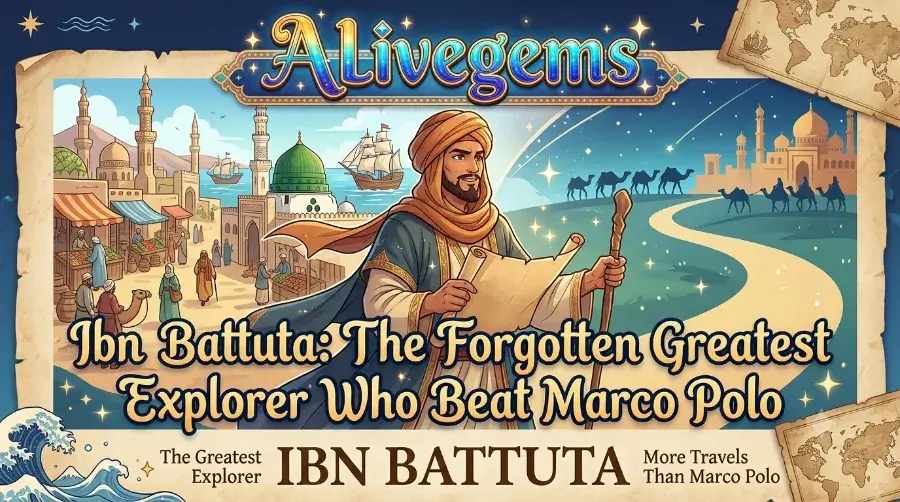
Ibn Battuta forgotten greatest explorer Picture a twenty one year old law student leaving home for a short pilgrimage to Mecca. He tells his parents he will be back in a year, maybe two. Instead, he keeps going. For the next twenty nine years, he crosses deserts, survives shipwrecks, marries into royal families, gets robbed by bandits, and somehow becomes a judge in the Maldives. By the time he finally returns home, he has covered roughly 75,000 miles, a distance that outpaces Marco Polo by a wide margin. Yet ask most people in the United States or Europe who this man is, and you will likely get a blank stare. That man is Ibn Battuta, and he might be the greatest explorer nobody remembers.
This is not a dusty textbook tale. This is one of the wildest true stories in human history, and it deserves a spot next to the names we already know. You can explore more stories like his over on alivegems.com, especially inside our full collection of forgotten charismatic figures.
Key Takeaways
| Fact | Detail |
|---|---|
| Full name | Abu Abdullah Muhammad ibn Battuta |
| Born | 1304, Tangier, Morocco |
| Died | 1368 or 1369, Morocco |
| Total distance traveled | Approximately 75,000 miles (120,000 km) |
| Years traveling | About 29 years (1325 to 1354) |
| Countries or regions visited | Over 40 modern day countries |
| Famous book | The Rihla (translated as “The Journey”) |
| Compared to | Marco Polo, who traveled roughly 15,000 miles |
Who Was Ibn Battuta and Why Did He Start Walking
Ibn Battuta forgotten greatest explorer was born in 1304 in Tangier, Morocco, into a family of Islamic legal scholars. He was trained to become a qadi, a judge who interprets Islamic law. In 1325, he set out on the Hajj, the pilgrimage to Mecca that every devout Muslim aims to complete once in their life.
He did not plan to become a world traveler. That decision found him on the road. Somewhere between the deserts of North Africa and the markets of Cairo, something shifted in him. He later wrote that he decided never to travel any route twice if he could help it. That single choice turned a religious pilgrimage into one of the most ambitious journeys in world history.
If you enjoy stories about people who quietly reshaped history without getting the credit they deserved, you will love reading about Hypatia of Alexandria, another forgotten genius whose brilliance was nearly erased from memory.
Ibn Battuta vs Marco Polo: Who Really Traveled Further
This comparison comes up constantly, and for good reason. Marco Polo is a household name in the United States and Europe, taught in schools and referenced in pop culture. Ibn Battuta is barely mentioned, even though the numbers tell a very different story.
| Category | Ibn Battuta | Marco Polo |
|---|---|---|
| Distance traveled | About 75,000 miles | About 15,000 miles |
| Years on the road | 29 years | 24 years |
| Regions covered | North Africa, Middle East, East Africa, Central Asia, India, Southeast Asia, China | Middle East, Central Asia, China |
| Written account | The Rihla | The Travels of Marco Polo |
| Western recognition today | Low | Very high |
The gap in recognition is not about achievement. It is about who told the story, who translated it, and which cultures preserved and promoted it in the centuries that followed. This is exactly why Ibn Battuta deserves to be called the greatest explorer nobody remembers. A detailed breakdown of this comparison is also covered well by Historic Mysteries, if you want to dig even deeper.
The Journey: Deserts, Shipwrecks, and Royal Courts
Ibn Battuta forgotten greatest explorer did not simply walk from place to place. His journey reads like an adventure novel, except every word of it actually happened.
Here are a few standout moments from his three decade odyssey.
- Egypt and the Mamluk Sultanate (1326): He explored Cairo, then one of the largest and wealthiest cities on earth, before pushing on toward Mecca.
- The Ilkhanate and Persia (1327 to 1330): He traveled through Iraq and Persia, meeting scholars, mystics, and local rulers along the way.
- East Africa (1331): He sailed down the Swahili Coast, visiting Mogadishu and Kilwa, then a thriving trade city in modern day Tanzania.
- The Golden Horde and Constantinople (1332 to 1334): He journeyed into the lands of the Mongol successor states and even visited Constantinople with a Byzantine princess.
- India and the Delhi Sultanate (1334 to 1341): He served as a qadi under Sultan Muhammad bin Tughluq, a position of real political power.
- The Maldives (1341 to 1344): He became chief judge on the islands and married into the local elite, a chapter almost nobody outside academic circles has ever heard of.
- China (1345 to 1346): He reached the Yuan Dynasty, becoming one of the few travelers from the western Islamic world to document firsthand accounts of China at that time.
Along the way, he survived a shipwreck off the coast of India that cost him nearly everything he owned. He was ambushed by bandits more than once. He buried children he lost to illness far from home. This was not a leisurely tour. It was a life lived at full risk, over and over again.
His courage reminds me of another underappreciated figure from history, the naval officer Vasily Arkhipov, whose single decision quietly prevented a nuclear war. Some people change the world simply by refusing to back down when it matters most.
The Rihla: How We Even Know About Him Today
When Ibn Battuta finally returned to Morocco in 1354, the Sultan of Morocco ordered him to dictate his travels to a scholar named Ibn Juzayy. The result was a manuscript called the Rihla, which simply means “The Journey.” If you want to learn more about James Barry secret Victorian doctor check out our detailed guide for practical tips and expert advice.
Without this book, we would likely know almost nothing about him. Unlike Marco Polo’s account, which spread quickly through medieval Europe thanks to printing and translation, the Rihla remained largely within Islamic scholarly circles for centuries. It was not widely translated into European languages until the 1800s, long after Marco Polo had already become a household name in the West.
This delay in translation is a major reason why Ibn Battuta remains one of the most overlooked figures when people discuss Muslim explorers world history. His story was always there. The West simply was not reading it. Muslim Heritage has done excellent work preserving this legacy in detail, and it is worth a visit if this era fascinates you.
Why Ibn Battuta Was Erased From Popular Western Memory
There are a few clear reasons this happened, and none of them relate to the size of his achievement.
- Translation timing: European scholars translated Marco Polo’s account centuries before Ibn Battuta’s Rihla reached wide Western audiences.
- Cultural framing: Western history curriculums historically centered European figures, sidelining major contributions from Islamic, African, and Asian travelers.
- Lack of a single dramatic myth: Marco Polo’s tale got wrapped in legend and controversy, which kept his name alive in public conversation, while Ibn Battuta’s account, though richer in detail, stayed academic.
This pattern of erasure is not unique to him. It echoes what happened to Rosalind Franklin, whose critical role in discovering the structure of DNA was stolen from public memory for decades. History has a long habit of forgetting the people who did the most.
A Legacy Written in Distance and Detail
Ibn Battuta’s Rihla is not just a travel diary. It is one of the richest primary sources historians have for understanding the 14th century world, its trade routes, its politics, and its daily life across three continents.
Modern historians studying medieval globalization, the spread of Islam, and pre colonial trade networks in Africa and Asia rely heavily on his firsthand descriptions. Cities he described in detail, like Kilwa and Calicut, have been partially verified through archaeology, matching his accounts with real physical evidence.
He also gave us rare insight into how women held power in certain 14th century courts, how legal systems operated across vastly different Islamic regions, and how interconnected the medieval world truly was, long before anyone used the word globalization. If you prefer listening over reading, the Explorers Podcast covers his full route in an engaging episode format.
If you find yourself drawn to figures who quietly redefined what was possible in their era, you might also enjoy the story of Eratosthenes, who calculated the earth’s circumference with stunning accuracy using nothing but shadows and math.
FAQ: Quick Answers About Ibn Battuta
How far did Ibn Battuta actually travel?
Historians estimate his total journey covered close to 75,000 miles, spanning more than 40 modern day countries across Africa, the Middle East, Asia, and Europe.
Did Ibn Battuta travel further than Marco Polo?
Yes. Most estimates place Marco Polo’s journey at around 15,000 miles, while Ibn Battuta covered roughly five times that distance over nearly three decades.
Why is Ibn Battuta not as famous as Marco Polo in the West?
The Rihla was not widely translated into European languages until the 19th century, while Marco Polo’s account spread through Europe centuries earlier, giving him a major head start in Western public memory.
Is the Rihla considered historically accurate?
Most historians view it as a largely reliable primary source, though scholars have identified a few sections, particularly regarding China, that may include exaggeration or secondhand information.
Where can I read Ibn Battuta’s original account?
Translated editions of the Rihla are widely available, and several universities have published annotated versions for general readers.
Quick Quiz: How Well Do You Know Ibn Battuta
Test yourself with these five quick questions before you go.
- In what year did Ibn Battuta begin his travels?
A) 1298
B) 1325
C) 1350 - Approximately how many miles did Ibn Battuta travel in his lifetime?
A) 15,000
B) 40,000
C) 75,000 - What is the name of the book that documents his travels?
A) The Odyssey
B) The Rihla
C) The Travels - In which country did Ibn Battuta serve as chief judge?
A) The Maldives
B) Portugal
C) England - Who is often compared to Ibn Battuta in Western history books?
A) Christopher Columbus
B) Marco Polo
C) Vasco da Gama
Answers: 1-B, 2-C, 3-B, 4-A, 5-B
To get a better understanding of Ada Lovelace invented computer programming our guide breaks down exactly what to expect.
Conclusion
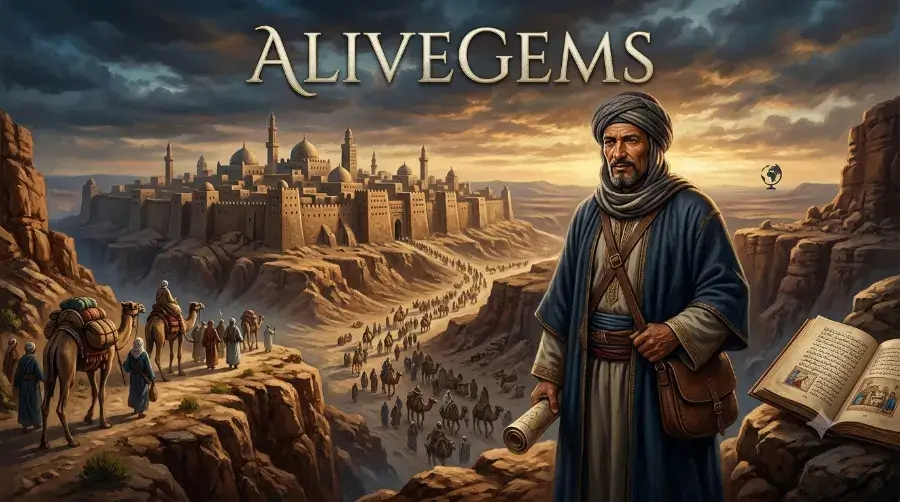
Ibn Battuta lived a life so vast and so bold that it almost sounds invented, yet every mile of it happened. He crossed deserts, survived the sea, served kings, and quietly documented a connected medieval world long before anyone had a word for globalization. He deserves to sit beside the most celebrated explorers in history, not behind them. The next time someone brings up the great travelers of the past, you now know a name that belongs firmly in that conversation. Explore more stories of history’s most overlooked and charismatic figures, including Ching Shih, the most powerful pirate to ever sail the seas, and Sybil Ludington, the teenage rider history nearly forgot.
References
- Historic Mysteries. “Ibn Battuta: The Greatest Explorer You’ve Never Heard Of.” Ibn Battuta forgotten greatest explorer https://www.historicmysteries.com/history/ibn-battuta/36148/
- Muslim Heritage. “Ibn Battuta forgotten greatest explorer: The Greatest Explorer.” https://muslimheritage.com/ibn-battuta-greatest-explorer-kj-vids/
- Explorers Podcast. “Ibn Battuta Episode.” https://explorerspodcast.com/ibn-battuta/
- Britannica. “Ibn Battutah.” https://www.britannica.com/biography/Ibn-Battutah
- Smithsonian Magazine. Articles on medieval Islamic exploration and trade routes. Ibn Battuta forgotten greatest explorer
- UNESCO. Historical documentation on Swahili Coast trade cities including Kilwa. Ibn Battuta forgotten greatest explorer