
Sybil Ludington teenage Picture this. It’s pouring rain, it’s pitch dark, and you’re sixteen years old. Somewhere out there, British soldiers are burning a town to the ground, and the only thing standing between chaos and warning is you, a horse, and forty miles of muddy backroads. That’s not a movie scene. That’s the true story of Sybil Ludington, a teenage American hero whose midnight ride has quietly rivaled one of the most famous rides in American history. Most people learn about Paul Revere in school. Almost nobody hears about the girl who rode further, alone, and through far more danger. Today, we’re fixing that.
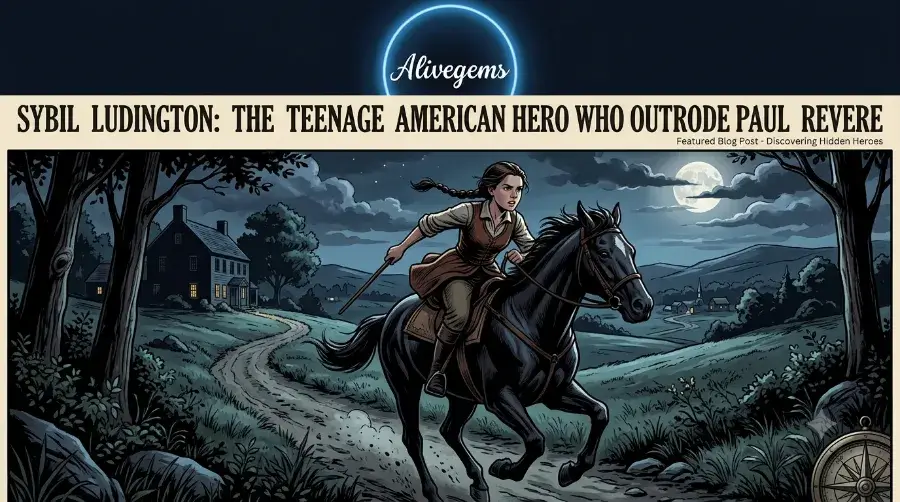
Before we dive into her story, here’s a quick snapshot of what makes Sybil Ludington’s tale so unforgettable.
| Key Takeaway | Detail |
|---|---|
| Who she was | Daughter of Colonel Henry Ludington, a militia leader in Putnam County, New York |
| The event | An all-night ride on April 26, 1777, to warn militia of the British attack on Danbury, Connecticut |
| Distance covered | Roughly 40 miles, compared to Paul Revere’s famous 12 to 20 mile ride |
| Age at the time | Just 16 years old |
| Why she’s debated | Historians have found limited primary evidence, though the story remains a powerful symbol |
| Legacy today | Statues, a 1975 U.S. postage stamp, and continued recognition during America’s 250th anniversary in 2026 |
Who Was Sybil Ludington, Really?
Sybil Ludington was born on April 5, 1761, in Fredericksburg, New York, the first of twelve children born to Henry and Abigail Ludington. Her father wasn’t just any farmer. He commanded the 7th Regiment of Dutchess County militia, which meant the family lived close to the front lines of the Revolutionary War, even though no major battles were fought in their backyard. Growing up in that household, Sybil absorbed lessons in courage and duty long before she ever climbed onto a horse that fateful night.
Henry Ludington had already survived threats from loyalist raiders who wanted him dead for his rebel sympathies. So when danger came knocking again in April 1777, the family was no stranger to fear. However, nothing could have prepared them for the scale of what was about to unfold just across the border in Connecticut.
Her story fits into a much bigger pattern that we love exploring here on AliveGems, the pattern of forgotten charismatic figures whose courage shaped history yet somehow slipped through the cracks of popular memory. Sybil is one of many overlooked names, and her tale deserves the same spotlight we’ve given to other remarkable and often forgotten heroes throughout history. To get a better understanding of Eratosthenes calculated Earth circumference our guide breaks down exactly what to expect.
The Night Danbury Burned
On the evening of April 26, 1777, a rider arrived at the Ludington home, soaked and exhausted, with devastating news. British troops had landed near Fairfield, Connecticut, and were marching toward Danbury, where the Continental Army stored critical supplies. The soldiers set fire to homes, warehouses, and food stockpiles, leaving destruction behind them as they moved.
Colonel Ludington needed to muster his scattered militia, but there was a problem. His men were spread across the countryside, and the messenger who brought the news was too tired to ride further. So Sybil, at just sixteen, volunteered. She saddled her horse and rode out into the darkness, alone, through a landscape crawling with loyalist sympathizers and British scouts. To get a better understanding of Ada Lovelace invented computer programming our guide breaks down exactly what to expect.
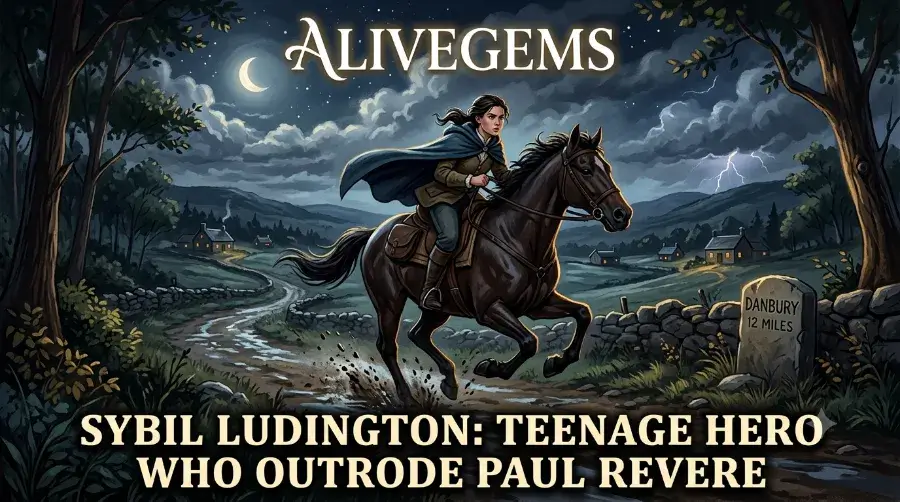
According to the traditional account, Sybil used a long stick to knock on farmhouse doors and shutters, calling out that the British were burning Danbury and that militia needed to gather at her father’s home. She reportedly covered close to 40 miles that night, roughly twice the distance historians usually credit to Paul Revere’s ride. By morning, hundreds of militia had assembled, and many of them marched to join the fight at the Battle of Ridgefield the following day.
If you want to learn more about James Barry secret Victorian doctor check out our detailed guide for practical tips and expert advice.
Here’s how the two famous rides stack up when placed side by side.
| Comparison | Sybil Ludington | Paul Revere |
|---|---|---|
| Date of ride | April 26, 1777 | April 18, 1775 |
| Distance | Approximately 40 miles | Approximately 12 to 20 miles |
| Age | 16 years old | 40 years old |
| Outcome | Militia rallied to fight at the Battle of Ridgefield | Militia warned of British troop movement toward Lexington and Concord |
| Captured that night | No | Yes, briefly detained by British troops |
Sybil Ludington teenage Even though the numbers favor Sybil in terms of distance and danger, Paul Revere became a household name largely thanks to Henry Wadsworth Longfellow’s 1861 poem, which turned his ride into American legend. Sybil never got that kind of literary spotlight, at least not until much later.
Female Paul Revere Story: Fact, Folklore, or Both?
Sybil Ludington teenage Here’s where things get interesting, and honestly, this is the part most blogs skip over. Serious historians have spent decades digging into whether Sybil’s ride actually happened the way it’s been told. A landmark 2015 study published in The New England Quarterly by historian Paula D. Hunt found little primary source evidence from 1777 itself confirming the details of the ride. Instead, the earliest written account traces back to an 1854 letter from Sybil’s own nephew, nearly eighty years after the event supposedly took place.
That doesn’t necessarily mean the ride never happened. Family stories in the 1700s were often passed down orally for generations before anyone wrote them down, especially stories involving women, whose contributions were rarely documented at the time. Meanwhile, historians like J.L. Bell have pointed out that many Revolutionary era heroines, including Betsy Ross, share this same pattern of family-driven storytelling that later hardened into accepted history.
What we do know for certain is that Sybil Ludington existed, that her father truly led a militia regiment, and that the Battle of Ridgefield truly happened just one day after her alleged ride. In fact, interest in her story has only grown recently. As America celebrated its 250th anniversary in 2026, Sybil’s bronze statue in Carmel, New York, sculpted by Anna Hyatt Huntington in 1961, underwent a major restoration funded by over $100,000 in community and state grants, and it returned proudly to its home beside Lake Gleneida on July 3, 2026, just in time for Independence Day celebrations.
For readers who want to explore even more primary source material and firsthand community research, the folks at the Sybil Ludington history blog have compiled detailed timelines worth reading. Similarly, A Mighty Girl’s feature on Sybil offers a wonderful angle on why her story matters for young readers today, especially girls looking for real historical role models.
Why Forgotten American Revolution Heroes Matter
Sybil isn’t alone in being overshadowed by history’s bigger names. Countless ordinary people made extraordinary choices during moments of crisis, only to be pushed to the footnotes while a handful of famous figures got all the credit. That’s honestly one of the reasons we started AliveGems in the first place, to shine a light on these forgotten American Revolution heroes and the incredible risks they took.
Consider a few examples that mirror Sybil’s story of quiet, unrecognized courage:
- Vasily Arkhipov, a Soviet naval officer, single handedly prevented what could have become nuclear war during the Cuban Missile Crisis, a story we cover in detail in our piece on Vasily Arkhipov and how he prevented nuclear war.
- Hypatia of Alexandria, a brilliant mathematician and philosopher, changed the course of ancient scholarship yet remains largely unknown outside academic circles, a story explored in our article on Hypatia of Alexandria’s forgotten genius.
- Ching Shih, once the most powerful pirate in history, commanded a fleet larger than most national navies, a remarkable tale detailed in our feature on Ching Shih, the most powerful pirate who ever lived.
Each of these figures, much like Sybil, proves that history’s most compelling stories often come from people who never sought fame in the first place. They simply acted, because someone had to.
Women Heroes American History Often Overlooks
Women heroes in American history have long faced an uphill battle for recognition, and Sybil’s story is a textbook example of why. For nearly a century after her supposed ride, almost nobody outside her immediate family knew her name. It wasn’t until the 1930s, when the Daughters of the American Revolution placed historical markers along her rumored route, that public interest truly began to build.
By 1975, Sybil appeared on a United States postage stamp, cementing her place in the national imagination even as academic debate about her story continued quietly in the background. Arcadia Publishing captured this beautifully in their piece describing how a 16-year-old became a Revolutionary War MVP, a phrase that perfectly captures why her legend endures.
Whether every detail of the ride happened exactly as told, Sybil’s story represents something bigger than one girl on one horse. It represents the thousands of women whose sacrifices during the Revolutionary War went unrecorded simply because nobody thought to write them down. That gap in the historical record is finally starting to close, thanks to historians, museums, and communities determined to keep her memory alive. To get a better understanding of Rosalind Franklin DNA credit stolen our guide breaks down exactly what to expect.
Frequently Asked Questions
Did Sybil Ludington really ride 40 miles alone?
According to family accounts passed down through generations, yes, she rode roughly 40 miles through the night. However, modern historians note that no contemporary 1777 document confirms the exact distance, so the number is likely an estimate shaped over time.
Why is Sybil Ludington called the female Paul Revere?
The comparison stuck because both riders warned local militia of British troop movements during pivotal moments of the Revolutionary War. Sybil’s ride, though, covered a significantly longer distance and happened without the capture that interrupted Revere’s famous journey.
Is there solid historical proof of her ride?
Direct evidence is limited, and the earliest written account only surfaced in 1854. Even so, her father’s documented militia leadership and the confirmed Battle of Ridgefield the next day lend circumstantial support to the story.
Where can I see the Sybil Ludington statue today?
Her bronze statue stands proudly beside Lake Gleneida in Carmel, New York. It was fully restored in 2026 and returned to its original location just before America’s Independence Day celebrations.
The Legacy That Refuses to Fade
Sybil Ludington eventually married Edmond Ogden in 1784 and lived a relatively quiet life afterward, passing away on February 26, 1839. Yet nearly two centuries later, her name still sparks debate, admiration, and curiosity in equal measure. That, in itself, says something powerful about the story’s staying power. To get a better understanding of Ibn Battuta forgotten greatest explorer our guide breaks down exactly what to expect.
Whether every mile of that midnight ride happened exactly as passed down through her family, Sybil Ludington represents a truth that matters far beyond the details. Teenagers, especially teenage girls, have always been capable of extraordinary courage, even when history forgets to write it down properly. Her story reminds us that heroism doesn’t always come with cameras rolling or witnesses documenting every step, and sometimes the bravest acts in history are the ones we almost lose entirely.
References
- Hunt, Paula D. “Sybil Ludington, the Female Paul Revere: The Making of a Revolutionary War Heroine.” The New England Quarterly, 2015. Sybil Ludington teenage
- Putnam County, New York Government, official press release on the Sybil Ludington statue restoration, 2026. Sybil Ludington teenage
- Spectrum News, “Sybil Ludington’s Revolutionary War Ride Is Still Debated,” June 2026. Sybil Ludington teenage
- Mid Hudson News, “Sybil Ludington Rides Home for REV250,” July 2026. Sybil Ludington teenage
- Wikipedia, “Sybil Ludington,” accessed July 2026. Sybil Ludington teenage