
Ho Chi Minh a 21 year old kitchen worker peeling potatoes on a French steamship in 1911, scrubbing pots for pennies, with no army, no country, and no power of any kind behind him. He spends the next three decades drifting between Paris, London, Moscow, and New York, working odd jobs, sleeping in cheap rooms, and quietly writing letters that almost nobody in power bothers to read. Nobody watching that tired young man would have guessed he was about to spend the rest of his life proving something extraordinary. That patience, not firepower, can outlast even the two biggest superpowers on earth. That man became known to history as Ho Chi Minh, and the story of how Ho Chi Minh’s patience beat two superpowers is one of the most quietly stubborn stories the twentieth century ever produced. This is not a tale about tanks winning battles. It is a tale about a man who was willing to wait longer than France and the United States combined were willing to fight.
Frederick Douglass: The Escaped Slave Who Became America’s Greatest Orator
TL;DR
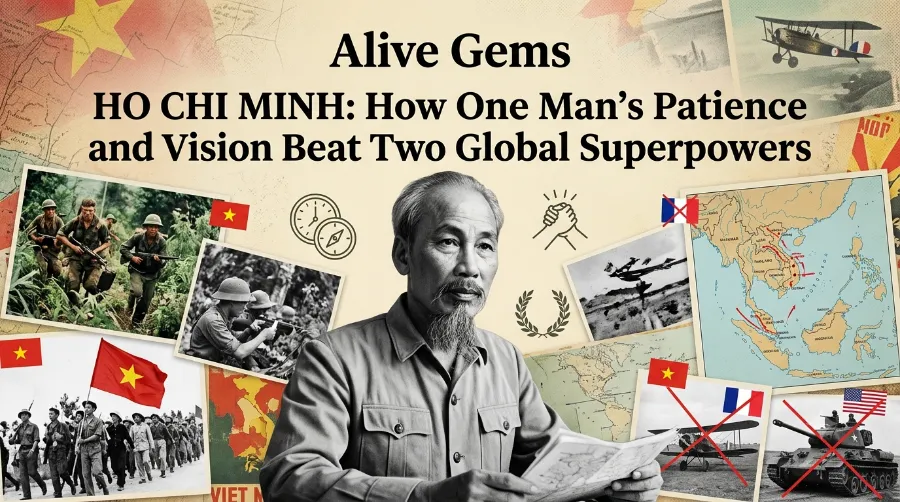
Ho Chi Minh spent almost thirty years abroad as an exile before returning to Vietnam to lead a revolution most world leaders never took seriously. He beat France at Dien Bien Phu in 1954 and outlasted the United States in a war that dragged on until 1975, six years after his own death. His real weapon was never military strength. It was an almost unbelievable willingness to keep going long after his opponents ran out of patience.
Key Takeaways
| Fact | Detail |
|---|---|
| Birth name | Nguyen Sinh Cung |
| Born | May 19, 1890, Nghe An province, French Indochina |
| Left Vietnam | 1911, working as a galley cook on a French steamship |
| Years spent abroad | Roughly 30 years, across France, Britain, the Soviet Union, and China |
| Declared independence | September 2, 1945, in Hanoi’s Ba Dinh Square |
| Defeated France | May 7, 1954, at the Battle of Dien Bien Phu |
| War with the United States | Roughly 1955 to 1975, the Vietnam War |
| Died | September 2, 1969, exactly 24 years after declaring independence |
| War actually ended | April 30, 1975, six years after his death |
| 2026 milestone | July 2, 2026 marked 50 years since Saigon was renamed Ho Chi Minh City |
Who Was Ho Chi Minh Before He Became a Symbol of Patience?
Long before he became one of the most resilient revolutionary figures in modern history, Ho Chi Minh was a restless young man with no clear future. He was born Nguyen Sinh Cung in a small village in Nghe An province in 1890, the son of a minor scholar official who lost his government post for defying French colonial authorities.
He tried a formal education and it did not fully take. He left Vietnam in 1911, at just 21 years old, working as a cook’s assistant aboard a French ocean liner simply to see the wider world. Over the next three decades he worked as a photo retoucher in Paris, a pastry assistant reportedly trained under the famous chef Auguste Escoffier in London, and a laborer in cities as far apart as Boston and New York. Read: Rosa Luxemburg: The Revolutionary Economist Who Frightened Every European Government
Here is the part that rarely makes it into simplified versions of his Vietnam revolutionary leader biography. He was not born into power, and nobody handed him a movement to lead. He built his following one letter, one pamphlet, and one patient conversation at a time, over decades most people would have given up in far less time.
The Rejection That Shaped Everything
In 1919, calling himself Nguyen Ai Quoc, meaning Nguyen the Patriot, he traveled to the Paris Peace Conference following the end of the First World War. He carried a modest eight point petition asking for basic rights and self determination for the Vietnamese people under French colonial rule.
World leaders, including President Woodrow Wilson, never responded to him. He was not even granted a meeting. That single, humiliating rejection is often cited by historians as the moment he concluded that colonial powers would never grant freedom voluntarily, and that only sustained, patient pressure over years, not polite petitions, would ever work.
If this kind of slow burning transformation from outsider to revolutionary fascinates you, you will notice the same pattern across our full collection of the most charismatic revolutionary rebels history has ever produced, where rejection often becomes the real starting point of the story.
The Long Road Home: Thirty Years Before the First Real Victory
By 1941, after roughly three decades away from Vietnam, Ho Chi Minh finally returned home and helped found the Viet Minh, a coalition aimed at winning independence first from Japanese occupation and then from returning French colonial rule. He was over 50 years old by this point, an age when most revolutionary movements are led by much younger men.
On September 2, 1945, standing in Hanoi’s Ba Dinh Square, he declared Vietnamese independence in front of a massive crowd. In a striking moment that surprised many Western observers, he opened his declaration by quoting the American Declaration of Independence almost word for word, stating that all men are created equal and endowed with certain unalienable rights.
That single choice, borrowing directly from the American founding document to justify Vietnamese independence from a European colonial power, is exactly how Ho Chi Minh’s patience beat two superpowers before either superpower had even fully entered the story. He was already thinking several moves ahead, appealing to ideals the West itself claimed to champion.
What Made His Patience So Effective
A few specific traits explain why Ho Chi Minh outlasted opponents with vastly more money, weapons, and manpower than his own forces ever had.
- He was willing to accept enormous short term losses in exchange for long term political and psychological victory, a strategy his own military commanders openly discussed in later writings.
- He built support gradually across rural villages rather than relying only on urban elites, giving his movement a base that outside powers found nearly impossible to fully uproot.
- He treated propaganda and international opinion as seriously as battlefield tactics, understanding that a distant democracy’s patience for a costly war would eventually run out even if its army never lost a major battle.
- He personally lived modestly, often in simple sandals and plain cotton clothing, which reinforced his image among ordinary Vietnamese as someone who shared their hardship rather than ruling above it.
Dien Bien Phu: The Day Patience Beat the First Superpower
By the early 1950s, France was pouring enormous resources into holding onto its Indochinese colony, believing a decisive battlefield victory would finally crush the Viet Minh once and for all. French commanders chose a remote valley called Dien Bien Phu, believing their fortified position was nearly impregnable.
They badly underestimated how patient their opponents could be. Viet Minh forces, under General Vo Nguyen Giap, spent months hauling heavy artillery piece by piece through dense jungle and up steep hillsides overlooking the French base, a logistical feat French intelligence considered close to impossible.
The siege began on March 13, 1954, and lasted 56 days. On May 7, 1954, French forces surrendered, marking one of the most significant defeats a European colonial power had ever suffered against what it had dismissed as an inferior guerrilla army. The PBS documentary series American Experience, in its own detailed profile of Ho Chi Minh’s life, describes how this single battle shattered French confidence in the entire colonial war and forced France to the negotiating table within weeks. You can watch original archival footage of that era, including rare recordings of Ho Chi Minh himself, in this historical newsreel footage preserved on YouTube.
Chart: French Military Strength Versus Outcome at Dien Bien Phu, 1954
French Troops Committed to the Battle        ##############            ~16,000
French Troops Killed, Wounded, or Captured   #############             ~15,000+
Length of the Siege in Days                  #####                     56 days
Years France Had Held Vietnam as a Colony    ###################       Nearly 80
Table: Timeline From Rejection to Independence
| Year | Event |
|---|---|
| 1890 | Born in Nghe An province, French Indochina |
| 1911 | Leaves Vietnam as a ship’s galley cook |
| 1919 | Petitions the Paris Peace Conference and is ignored |
| 1930 | Helps found the Communist Party of Vietnam |
| 1941 | Returns to Vietnam and helps found the Viet Minh |
| 1945 | Declares Vietnamese independence on September 2 |
| 1954 | Defeats France at Dien Bien Phu on May 7 |
| 1969 | Dies on September 2, exactly 24 years after independence |
| 1975 | War ends on April 30, six years after his death |
Vietnam Revolutionary Leader Biography: The Second Superpower Enters
After the French defeat, the 1954 Geneva Accords split Vietnam at the 17th parallel, with Ho Chi Minh’s government controlling the North while a separate government, increasingly backed by the United States, controlled the South. What followed became one of the defining conflicts of the entire Cold War era.
Emiliano Zapata: The Peasant Who Became Mexico’s Immortal Soul
The United States eventually committed enormous resources to preventing what officials called the spread of communism across Southeast Asia. American troop levels in Vietnam peaked at roughly 543,000 in 1969, supported by overwhelming air power and financial resources that dwarfed anything Ho Chi Minh’s government could match.
Yet the same patient strategy that wore down France began wearing down American political will as well. Years of mounting casualties, rising financial costs, and growing protests back home in the United States slowly eroded public support for the war, even as battlefield reports often described American and South Vietnamese forces performing well tactically. This is the second half of how Ho Chi Minh’s patience beat two superpowers, not through matching American firepower, but through simply refusing to stop for longer than Washington was willing to keep paying the price.
The Irish publication Magill has explored this exact dynamic in its own retrospective piece describing Ho Chi Minh as a symbol of world revolution, arguing that his real genius was less about military brilliance and far more about correctly reading how long each of his opponents could realistically sustain a costly, distant war.
A Sobering Note on His Legacy
No honest account of Ho Chi Minh leadership charisma can skip over the harder parts of his record. Land reform campaigns carried out in North Vietnam during the mid 1950s led to widespread violence against landlords and accused class enemies, and historians still debate the exact death toll, with estimates ranging broadly depending on the source. Ho Chi Minh himself later publicly acknowledged that the campaign had gone too far and issued a rare public apology in 1956.
That complicated mix, a man capable of extraordinary patience and genuine popular affection, but also responsible for policies that caused real suffering, is part of why his legacy remains so fiercely debated in different parts of the world today. Readers who enjoy grappling with similarly complicated legacies may find familiar echoes in the story of Toussaint Louverture, the enslaved man who built an entire republic, a leader whose own reputation has shifted dramatically depending on who is telling the story.
He Never Lived to See the War End
Ho Chi Minh died on September 2, 1969, the same calendar date he had chosen for Vietnam’s declaration of independence 24 years earlier. He never saw the final result of the war he had spent his entire adult life working toward.
The war he started dragged on for another six years without him. On April 30, 1975, Saigon fell to North Vietnamese forces, finally ending a conflict that had already outlasted both France’s colonial ambitions and America’s willingness to keep fighting. The following year, on July 2, 1976, the newly reunified government renamed Saigon in his honor, calling it Ho Chi Minh City.
That renaming reached a major milestone recently. On July 2, 2026, Ho Chi Minh City marked exactly 50 years since that renaming took place, with ceremonies, fireworks displays across the city, and public commemorations honoring the man whose patience had outlasted two of the most powerful nations on earth. The fact that a city of over nine million people still carries his name half a century later says something about how deeply his strategy of endurance over speed reshaped an entire nation’s identity.
Ho Chi Minh Leadership Charisma: What Made People Follow an Exile for Decades
Unlike many revolutionary leaders who built their following through dramatic speeches or battlefield heroics, Ho Chi Minh’s charisma worked differently. He was famously approachable, often photographed in simple clothing, chatting informally with farmers and soldiers rather than maintaining a distant, formal image.
That accessible, almost grandfatherly persona, Vietnamese supporters affectionately called him Uncle Ho, built a kind of loyalty that raw military strength alone could never purchase. People were willing to endure decades of hardship partly because their leader appeared to be enduring right alongside them rather than issuing orders from comfortable distance.
A few practical lessons from his approach still apply well beyond military history.
- Patience often outperforms raw strength when the opponent has a shorter attention span or a shallower stake in the outcome.
- A leader who appears to share the hardship of their followers usually earns loyalty that pure authority cannot buy.
- Framing your cause in language your opponent already claims to believe in, as he did by quoting America’s own Declaration of Independence, can be a far sharper tool than direct confrontation.
If you are drawn to stories where sheer conviction outlasted overwhelming force, the story of Simon Bolivar and his decades long fight to liberate an entire continent from Spanish rule follows a remarkably similar emotional arc, just as the story of how Thomas Paine lit the fuse of the American Revolution shows how patient, plain spoken persuasion can move an entire population toward a cause once thought impossible.
Quick Quiz: How Well Do You Know Ho Chi Minh?
Test yourself with these five questions before you move on.
- What year did Ho Chi Minh leave Vietnam to work as a ship’s galley cook?
- A) 1901
- B) 1911
- C) 1925
- At which 1954 battle did Viet Minh forces defeat France?
- A) Dien Bien Phu
- B) Hue
- C) Khe Sanh
- True or False: Ho Chi Minh lived to see the fall of Saigon in 1975.
- Which document did Ho Chi Minh quote when declaring Vietnamese independence in 1945?
- A) The Magna Carta
- B) The American Declaration of Independence
- C) The French Constitution
- True or False: Ho Chi Minh City was named after him while he was still alive.
Answers: 1) B, 2) A, 3) False, he died in 1969, six years before the war ended, 4) B, 5) False, the renaming happened in 1976, seven years after his death.
Frequently Asked Questions
How did Ho Chi Minh’s patience beat two superpowers?
He avoided direct confrontations his forces could not win, absorbed heavy losses in exchange for long term political advantage, and correctly judged that both France and the United States would eventually lose public and political will for a costly, distant war before he would lose his own resolve.
Did Ho Chi Minh live to see Vietnam reunified?
No. He died on September 2, 1969, and the war did not officially end until April 30, 1975, when Saigon fell to North Vietnamese forces.
Why did Ho Chi Minh quote the American Declaration of Independence?
He wanted to frame Vietnamese independence in language the West itself already claimed to value, making it harder for democratic nations to dismiss his cause as illegitimate.
Was Ho Chi Minh’s leadership entirely positive?
No. Land reform campaigns in the 1950s caused significant suffering and loss of life, and Ho Chi Minh himself publicly apologized for the excesses of that campaign in 1956, a fact that complicates his otherwise widely admired legacy.
Why is Saigon now called Ho Chi Minh City?
The government renamed the city in his honor on July 2, 1976, following reunification, and July 2026 marked the 50th anniversary of that renaming.
Conclusion
Ho Chi Minh never had the largest army, the deepest treasury, or the newest weapons in either of the wars that defined his life. What he had instead was an almost unnatural willingness to keep going long after two of the most powerful nations on earth expected him to quit. He waited nearly thirty years in exile before returning home, waited nine more years before beating France, and waited even longer, past his own death, before his cause finally won. Fifty years after Saigon took his name in 2026, that patience remains the single most striking part of his story. Sometimes the deciding factor in history is not who has the most firepower, but who is simply willing to outlast everyone else.
References
- PBS American Experience, “Ho Chi Minh” historical profile.
- Magill, “Ho Chi Minh: Symbol of World Revolution,” archival feature.
- Archival newsreel footage of Ho Chi Minh and the First Indochina War, YouTube historical archive.
- Vietnam News Agency and VOV, coverage of the 50th anniversary of Ho Chi Minh City’s renaming, July 2026.
- Geneva Accords historical records, 1954.
- United States Department of Defense troop level records, Vietnam War era.