
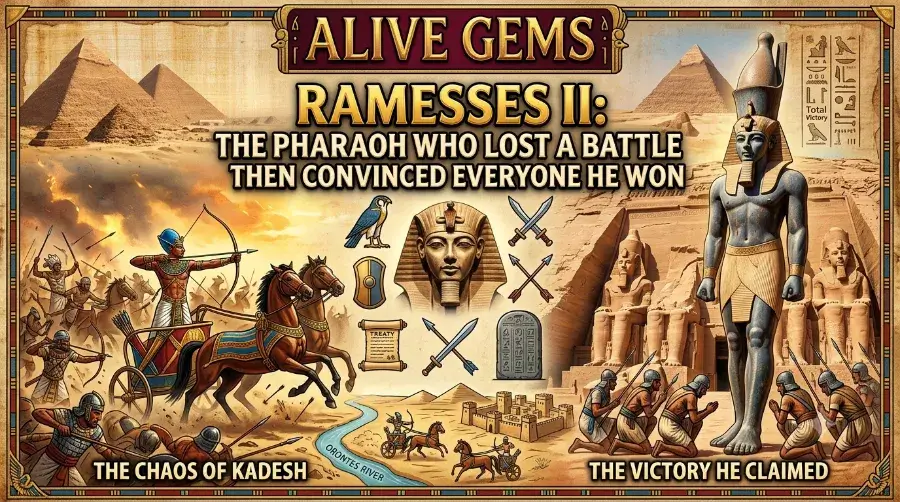
Picture this. A young king rides into an ambush so bad that his own army nearly falls apart around him. He should have died that afternoon by the Orontes River. Instead, he went home, carved his version of events onto seven temple walls, and turned the worst day of his military career into the greatest victory story in Egyptian history. This is the real story of how Ramesses II lost battle convinced won became one of the boldest public relations moves in the ancient world. It is not just a war story. It is a masterclass in charisma, image control, and knowing exactly what people want to believe.
If you want to learn more about Leonidas 300 Spartans changed history check out our detailed guide for practical tips and expert advice.
Key Takeaways
| Fact | Detail |
|---|---|
| Battle | Battle of Kadesh, fought around 1274 BC |
| Opponent | Hittite King Muwatalli II |
| Real outcome | Tactical draw, Egypt failed to take Kadesh |
| Ramesses’ version | Total personal victory, carved on temple walls |
| Peace deal | Treaty of Kadesh, signed around 1259 BC, oldest surviving peace treaty |
| Legacy | Ramesses II ruled for 66 years and became Egypt’s most celebrated pharaoh |
TL;DR: Ramesses II fought the Battle of Kadesh around 1274 BC against the Hittites and it ended in a draw at best, with Egypt never capturing its target city. He went home and carved a completely different version of the story across Egypt, claiming he single handedly crushed the enemy. That single act of self promotion is a big reason he is remembered today as one of the most charismatic Egyptian pharaohs who ever lived. Sun Tzu: The Mysterious General Whose Words Still Win Modern Wars
Who Was Ramesses II Before Kadesh
Ramesses II was not born a legend. He was born a prince with a father, Seti I, who had already rebuilt much of Egypt’s military reputation. Seti groomed his son early, giving him command roles and military exposure while he was still a teenager. By the time Ramesses took the throne around 1279 BC, he was young, ambitious, and hungry to prove that Egypt’s golden age had not ended with his ancestors.
A Young King Building an Image
Even before Kadesh, Ramesses understood something most rulers never fully grasp. People do not just follow strength, they follow a story. He commissioned statues taller than most buildings of his time. He renamed cities after himself. He married strategically and often. Every decision was part of a slow, deliberate build toward becoming untouchable in the public imagination.
This instinct is exactly what places him among the most charismatic Egyptian pharaohs in history, and it explains why, when disaster struck on the battlefield, he did not panic. He adapted.
The Battle of Kadesh: What Really Happened
Here are the numbers historians generally agree on. Ramesses led roughly 20,000 troops split into four divisions, named Amun, Ra, Ptah, and Seth, marching toward the city of Kadesh in modern day Syria. Muwatalli II, the Hittite king, had gathered a coalition force, possibly larger, hidden just behind the city walls.
- Egyptian spies captured near the march route fed Ramesses false information, claiming the Hittite army was still far away.
- Believing this, Ramesses pushed his own Amun division ahead of the rest, dangerously separating his forces.
- The Hittites struck the exposed Ra division in a devastating ambush, scattering it almost instantly.
- Ramesses himself, according to most accounts, was nearly surrounded before reinforcements arrived just in time.
This is not a small detail. Ancient warfare depended heavily on intelligence and deception, and getting outmaneuvered by enemy misinformation was a real and recurring threat, a pattern explored well in modern military history writing like War on the Rocks’ look at spies and battlefield deception. Ramesses fell for exactly this kind of trap.
By the end of the day, neither side had won a clear military victory. Kadesh remained in Hittite hands. Egypt’s army limped home having failed its main objective. In any honest military assessment, this was, at best, a draw, and arguably a strategic failure for Egypt.
Ramesses Personality Propaganda Genius: Turning Defeat into Myth
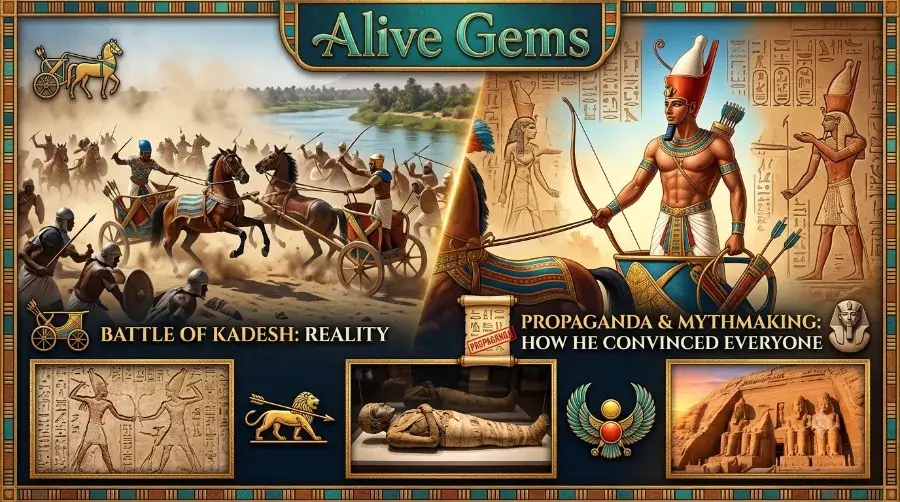
This is where the story becomes genuinely fascinating, and it is the heart of why Ramesses II lost battle convinced won is still discussed thousands of years later. Instead of quietly absorbing the loss, Ramesses commissioned an enormous literary and artistic campaign to rewrite what happened.
Two major texts were created and repeated across Egypt.
- The Poem of Pentaur, a dramatic account describing Ramesses as abandoned by his own soldiers, fighting off the entire Hittite army almost single handedly through sheer divine favor.
- The Bulletin, a more official record still framed heavily in Ramesses’ favor, emphasizing his personal bravery over any factual account of the battle’s actual outcome.
These were not private journal entries. They were carved in massive hieroglyphic reliefs at some of Egypt’s most visited religious sites, meaning millions of people over centuries would see and absorb this version as history.
Cleopatra’s Strategic Mind: The Real Story Behind History’s Most Famous Romance
| Monument | Location | Content Carved |
|---|---|---|
| Abu Simbel | Nubia, southern Egypt | Full battle relief showing Ramesses charging alone |
| Karnak Temple | Luxor | Detailed inscriptions of the Poem and Bulletin |
| Luxor Temple | Luxor | Battle scenes with Ramesses in heroic pose |
| Ramesseum | Western Thebes | Additional Kadesh battle reliefs and text |
Modern commentators have even compared this instinct for turning any outcome into a personal triumph to political figures we recognize today. The Guardian once drew exactly this comparison between Ramesses II and modern leaders who reframe setbacks as victories, and the parallel holds up remarkably well.
Ancient Ruler Self-Promotion: Lessons for Charisma
What makes this ancient ruler self-promotion so effective is that it was not a single lie. It was layered, repeated, and physically permanent, carved into stone that would outlast every eyewitness who actually knew the truth.
Ramesses was not alone in understanding this kind of image control among history’s most magnetic leaders.
- Alexander the Great built his legend through relentless forward momentum and calculated myth making about his own destiny.
- Julius Caesar turned his own military campaigns into bestselling written accounts that shaped Roman public opinion in his favor.
- Hannibal Barca used psychological pressure and reputation as weapons nearly as powerful as his actual army.
- Cyrus the Great crafted an image of merciful rule that spread across an empire larger than any before it.
- Ashoka the Great transformed his own violent past into a story of moral transformation carved onto pillars across India.
Ramesses fits naturally into this list, and according to National Geographic’s overview of his reign, his ability to control his public image was just as central to his 66 year rule as any battlefield decision he ever made.
The First Peace Treaty in History
Here is the twist that actually redeems Ramesses somewhat. Around 1259 BC, roughly 15 years after Kadesh, Ramesses and the new Hittite king Hattusili III signed a formal peace agreement. Historians consider the Treaty of Kadesh the oldest surviving peace treaty in recorded history, with copies preserved in both Egyptian hieroglyphics and Hittite cuneiform.
This treaty proves something important. Whatever really happened on the battlefield, both empires eventually recognized that neither side had truly won, and lasting peace mattered more than lingering pride.
Timeline Chart: Ramesses’ PR Campaign
| Year (approx) | Event |
|---|---|
| 1279 BC | Ramesses II becomes Pharaoh of Egypt |
| 1274 BC | Battle of Kadesh takes place, result is a draw |
| 1274 to 1265 BC | Poem of Pentaur and the Bulletin composed and circulated |
| 1265 to 1250 BC | Kadesh reliefs carved at Abu Simbel, Karnak, Luxor, and the Ramesseum |
| 1259 BC | Treaty of Kadesh signed with Hattusili III |
| 1213 BC | Ramesses II dies after a 66 year reign |
Quick Quiz: Test What You Just Learned
- In what approximate year was the Battle of Kadesh fought?
- A) 1350 BC
- B) 1274 BC
- C) 1190 BC
- Who was the Hittite king Ramesses fought at Kadesh?
- A) Suppiluliuma I
- B) Muwatalli II
- C) Hattusili III
- What is the name of the oldest surviving peace treaty in history, signed by Ramesses II?
- A) The Treaty of Karnak
- B) The Treaty of Kadesh
- C) The Pact of Thebes
- True or false, Egypt captured the city of Kadesh after the battle.
- Name one temple where Ramesses carved his version of the Kadesh battle.
FAQ
Did Ramesses II actually win the Battle of Kadesh?
No. Most historians agree the battle ended in a tactical draw, with Egypt failing to capture Kadesh, though Ramesses avoided a total disaster thanks to reinforcements.
Why is Ramesses II called a propaganda genius?
Because he commissioned detailed texts and massive stone carvings across Egypt describing Kadesh as a personal, decisive victory, shaping public memory for generations.
What is the Poem of Pentaur?
It is a dramatic literary account of the Battle of Kadesh, portraying Ramesses as a nearly abandoned hero saved by divine favor.
Is the Treaty of Kadesh really the oldest peace treaty in history?
Yes, it is widely recognized as the oldest surviving written peace treaty, with copies found in both Egyptian and Hittite archives.
How long did Ramesses II rule Egypt?
He ruled for about 66 years, from around 1279 BC to 1213 BC, making him one of Egypt’s longest reigning pharaohs.
Conclusion
The story of Ramesses II lost battle convinced won is not really about warfare at all. It is about the power of narrative, repetition, and knowing your audience well enough to shape how they remember you. Ramesses did not just survive Kadesh, he outlived the truth of it, carving a version of events so bold and so widespread that it became the accepted story for thousands of years. In many ways, that single decision tells us more about real charisma than any battlefield victory ever could.
References
- National Geographic, overview of Ramesses II’s life and reign
- The Guardian, commentary comparing Ramesses II’s self mythologizing to modern political figures
- War on the Rocks, analysis of espionage and deception in historical military campaigns
- Alivegems.com, Ancient World Legends and Charismatic Leaders series