
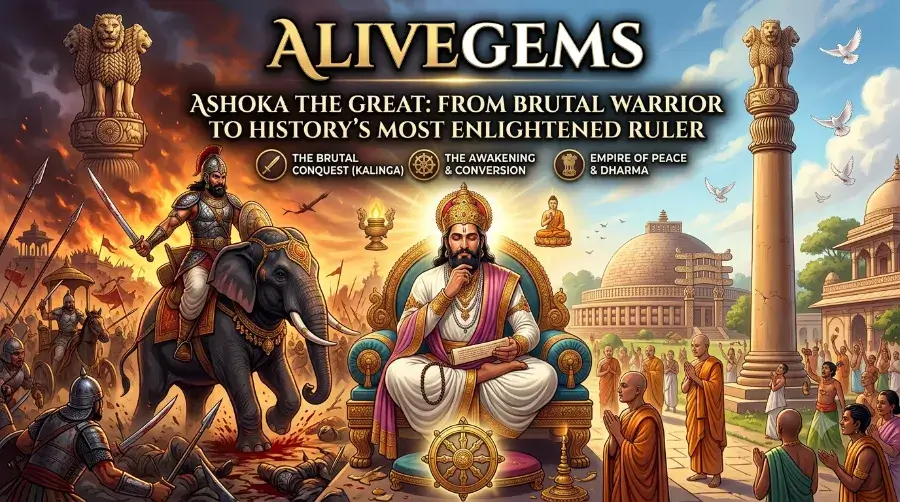
Ashoka the Great a battlefield soaked in blood, one hundred thousand corpses scattered across the plains, and a king standing in the middle of it all, staring at what he had done. That king was not haunted by fear of losing power. He was haunted by guilt. This is the true story of Ashoka Great brutal warrior enlightened king.
A man who conquered an empire with fire and swords, then turned around and conquered the world instead with kindness. Few rulers in human history have lived two completely different lives inside one lifetime, yet Ashoka did exactly that, and his transformation still teaches leaders, parents, and everyday people something powerful today. Sun Tzu: The Mysterious General Whose Words Still Win Modern Wars
If you love true stories about legendary rulers who shaped the ancient world, you will also enjoy our complete guide to the most charismatic leaders in ancient history, where Ashoka sits alongside some of the boldest names ever recorded.
Key Takeaways Table
| Fact | Detail |
|---|---|
| Full Name | Ashoka Maurya |
| Reign | Around 268 BCE to 232 BCE |
| Empire | Mauryan Empire, most of the Indian subcontinent |
| Turning Point | The Kalinga War, fought around 261 BCE |
| Casualties | Roughly 100,000 killed, 150,000 deported, per his own Rock Edict XIII |
| Transformation | Converted to Buddhism, embraced nonviolence and moral rule |
| Legacy | Rock and pillar edicts, spread of Buddhism across Asia, symbol on India’s national flag |
Who Was Ashoka Before He Became Great
Ashoka was born around 304 BCE into the Mauryan royal family, the grandson of Chandragupta Maurya, the man who first united much of India under one crown. Ashoka’s early life was nothing like a fairy tale. He was not even the obvious heir. Historical accounts suggest he had to fight his own brothers for the throne, and some legends claim he had rivals eliminated to secure his position. Consequently, by the time Ashoka sat on the throne around 268 BCE, he had already proven he could be ruthless when he needed to be.
To get a better understanding of Ramesses II: The Pharaoh Who Lost a Battle our guide breaks down exactly what to expect.
As a young prince, Ashoka served as a governor in regions like Ujjain and Taxila, where he learned how to manage rebellions and control unruly territories. Because of this, he entered kingship already trained in the art of dominance. Furthermore, the Mauryan Empire he inherited was massive, stretching across most of modern day India, Pakistan, Bangladesh, and parts of Afghanistan. Ashoka wanted more. He wanted Kalinga, a wealthy coastal kingdom that had somehow resisted Mauryan control for generations.
If you are curious how other ancient conquerors expanded their empires through sheer will, our piece on Alexander the Great and his relentless charisma at the edge of the world shows a similar hunger for conquest, just centuries earlier and thousands of miles away.
The Kalinga War That Changed Everything
In 261 BCE, Ashoka launched his invasion of Kalinga, located in what is now the Indian state of Odisha. This single decision became the hinge point of his entire life. The Kalinga army was smaller than the massive Mauryan war machine, yet it fought with incredible ferocity to protect its homeland.
According to Ashoka’s own Rock Edict XIII, discovered carved into stone at sites like Shahbazgarhi, the numbers were staggering:
- Around 100,000 soldiers and civilians were killed in the fighting
- Approximately 150,000 people were captured and deported from their homes
- Countless others died afterward from famine, disease, and displacement
Some historians even estimate the total human cost, including the aftermath, may have reached closer to 250,000 lives lost or ruined. Whichever figure is closest to the truth, the devastation was enormous. Ashoka won. He annexed Kalinga into his empire. However, something inside him broke that day, and he never seemed to recover his taste for war again.
Cleopatra’s Strategic Mind: The Real Story Behind History’s Most Famous Romance
What Ashoka Actually Saw on the Battlefield
Standing among the dead, Ashoka reportedly walked through the ruins of Kalinga and witnessed the true cost of his ambition firsthand. Burned villages. Grieving widows. Orphaned children. Rivers that ran red instead of clear. This was not a distant report delivered by a messenger. This was Ashoka experiencing the human wreckage of his own decisions with his own eyes, and that direct experience is exactly what makes his later transformation so believable rather than performative.
If you want to learn more about Leonidas 300 Spartans changed history check out our detailed guide for practical tips and expert advice.
Ashoka Transformation Leadership Story: From Killer to Sage
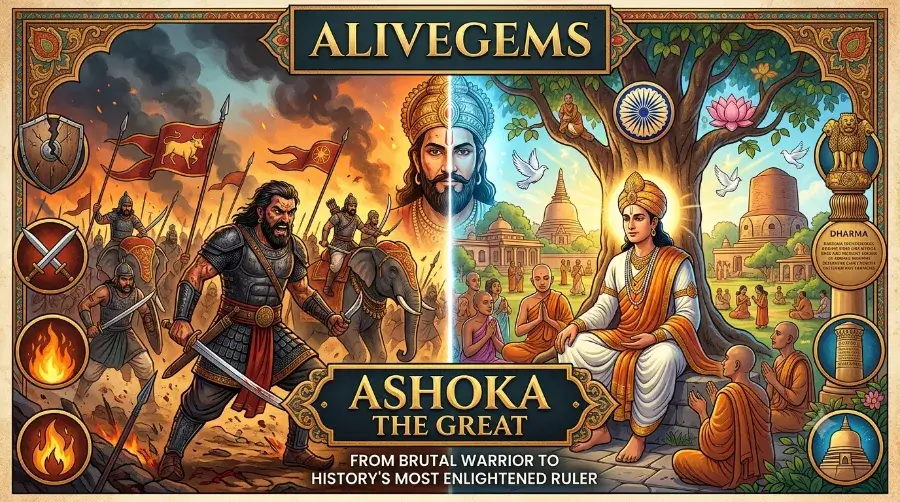
This is where the Ashoka transformation leadership story truly begins, and it remains one of the most remarkable personal transformations ever recorded in ancient history. Instead of celebrating his victory, Ashoka fell into deep remorse. He later carved his own confession into stone for the entire empire to read, admitting that the conquest of Kalinga filled him with intense sorrow and regret.
Rather than hiding his guilt, Ashoka did something almost unheard of for a ruler of his era. He publicly declared that he would never again seek victory through violence. Instead, he pledged to pursue what he called “victory through Dhamma,” meaning victory through righteousness, compassion, and moral example rather than the sword.
A few reasons made this shift possible:
- His direct exposure to mass suffering created genuine psychological impact rather than distant guilt
- His growing connection with Buddhist teachings offered him a framework to process that guilt
- His political intelligence recognized that a stable empire needed loyalty, not just fear
- His personal grief over the scale of death pushed him toward a search for meaning
Consequently, Ashoka did not simply retire quietly. He rebuilt his entire philosophy of leadership from the ground up.
Most Enlightened Ancient Ruler: How Ashoka Embraced Buddhism
Many historians consider Ashoka the most enlightened ancient ruler of the ancient world precisely because he did not just adopt a religion privately. He restructured an entire empire around its principles. After the Kalinga War, Ashoka converted to Buddhism and began actively promoting its values of nonviolence, compassion, and moral responsibility across his territories.
He did not force his subjects to convert. Instead, Ashoka encouraged tolerance among all faiths, an idea that was remarkably progressive for a ruler in the third century BCE. He funded the building of monasteries, supported Buddhist missionaries, and reportedly sent his own children, Mahinda and Sanghamitta, to spread Buddhism to Sri Lanka. This single decision helped Buddhism grow from a regional Indian philosophy into a major world religion that today has hundreds of millions of followers across Asia.
For comparison, other ancient leaders sought immortality through conquest rather than conscience. Our article on Julius Caesar turning Rome into his personal stage shows how differently power could be used when a ruler chose spectacle over spiritual reform.
Buddhist King Changed Empire: The Edicts of Ashoka
Perhaps the most extraordinary evidence of Ashoka’s transformation survives in stone even today. As the Buddhist king changed empire policy took shape, Ashoka ordered edicts, moral instructions and reflections, to be carved onto rocks and massive stone pillars across his territory. These edicts were written in accessible language so that ordinary people, not just scholars, could understand them.
The edicts covered topics such as:
- Respect for all religions and communities living under Mauryan rule
- Kindness toward animals and restrictions on unnecessary slaughter
- Care for the elderly, the poor, and prisoners
- Fair treatment of women and support for social welfare programs
- Encouragement of honesty, non violence, and self control in daily life
More than thirty of these edicts still survive today across India, Pakistan, Nepal, and Afghanistan. Several are recognized by UNESCO for their historical and cultural significance. One of Ashoka’s stone pillars, topped with four lions facing in different directions, was later adopted by modern India as its national emblem. That same lion capital’s wheel symbol, known as the Ashoka Chakra, now sits at the center of the Indian national flag, a permanent reminder of how deeply his legacy still shapes the present.
Comparing Ashoka’s Two Lifetimes
| Aspect | Warrior Ashoka | Enlightened Ashoka |
|---|---|---|
| Core Motivation | Territorial expansion and dominance | Moral reform and public welfare |
| Method of Rule | Military conquest and fear | Persuasion, edicts, and example |
| Religious Stance | Traditional Vedic practices | Buddhism with religious tolerance |
| Treatment of Enemies | Brutal suppression | Diplomacy and reconciliation |
| Legacy Symbol | The bloody Kalinga campaign | The Lion Capital and Ashoka Chakra |
This table alone shows why Ashoka’s story resonates so strongly even in 2026. Very few leaders in any century have publicly admitted fault at this scale, let alone restructured their entire governing philosophy because of it.
Why Ashoka’s Story Still Matters Today
Ashoka’s example offers something rare in leadership history: proof that power and conscience do not have to be enemies. Modern leadership researchers and historians frequently reference Ashoka when discussing ethical governance, restorative justice, and the idea that true strength includes the ability to admit wrongdoing. One insightful modern take on this dynamic can be found in this thoughtful piece exploring Ashoka as the emperor who won the world without a sword, which frames his choice for peace as a strategic and moral masterstroke rather than a weakness.
Business and leadership circles have also drawn direct lessons from his life. This detailed leadership conversation on Ashoka the conqueror who chose peace explores how his post war reforms mirror modern conflict resolution strategies used by organizations today. Meanwhile, readers interested in the spiritual dimension of his transformation can explore this reflection on Emperor Ashoka and the Dharma he embraced, which examines how Buddhist compassion reshaped his entire worldview.
Other ancient commanders faced brutal choices too, though few responded the way Ashoka did. Hannibal, for instance, built his legend purely on tactical brilliance rather than moral reinvention, as explored in our piece on Hannibal Barca and how he outsmarted Rome’s generals. Similarly, if you want to see an even earlier example of humane governance in the ancient world, our article on Cyrus the Great and how he essentially invented early human rights pairs beautifully with Ashoka’s own reforms, since both men proved that ancient rulers could be remembered for compassion rather than only conquest.
Lasting Legacy of the Buddhist King
By the time Ashoka died around 232 BCE, he had ruled for roughly 36 years, and his empire stretched across nearly the entire Indian subcontinent. His edicts, monuments, and reforms outlived him by more than two thousand years, still standing today as some of the oldest deciphered inscriptions in world history.
His legacy includes:
- The spread of Buddhism from a regional Indian faith into a major global religion
- Some of the earliest known government sponsored welfare programs, including hospitals for humans and animals
- An enduring symbol of peace and governance that modern India still uses on its flag and emblem
- A case study still taught in history and leadership courses about redemption and moral courage
Frequently Asked Questions About Ashoka the Great
Was Ashoka really a violent ruler before his transformation?
Yes, historical records and his own edicts confirm that Ashoka was known as a fierce and sometimes ruthless military leader before the Kalinga War changed his outlook completely.
What caused Ashoka to change so dramatically?
The overwhelming devastation of the Kalinga War in 261 BCE, combined with his growing interest in Buddhist teachings, pushed Ashoka toward deep remorse and a completely new moral direction.
Did Ashoka force people to become Buddhist?
No, Ashoka actually promoted religious tolerance across his empire and specifically encouraged respect for all faiths rather than forced conversion.
Where can people see Ashoka’s edicts today?
Several of Ashoka’s rock and pillar edicts still exist across modern India, Pakistan, Nepal, and Afghanistan, with some recognized for their historical significance by UNESCO.
How does Ashoka’s legacy appear in modern life?
The Lion Capital from one of Ashoka’s pillars became India’s national emblem, and the wheel symbol from that same pillar, the Ashoka Chakra, sits at the center of the Indian national flag today.
Quick History Quiz
1. What ancient kingdom did Ashoka invade in 261 BCE?
A) Persia
B) Kalinga
C) Macedonia
2. What religion did Ashoka adopt after his transformation?
A) Hinduism
B) Zoroastrianism
C) Buddhism
3. What symbol from Ashoka’s pillar appears on India’s national flag today?
A) The lotus flower
B) The Ashoka Chakra
C) The golden eagle
- What made Ashoka’s transformation so historically significant compared to other ancient rulers?
- How did Ashoka use stone edicts to communicate directly with ordinary citizens across his empire?
- Why do modern leadership experts still study Ashoka’s response to the Kalinga War?
- In what ways did Ashoka’s religious tolerance policy differ from typical ancient governance?
- How did Ashoka’s personal guilt translate into lasting institutional reform across his empire?
Conclusion
Ashoka’s life proves something rare and deeply human. A person can build their name on destruction and still choose, deliberately and publicly, to become someone entirely different. He did not erase his past. He carved it into stone for the world to remember, then spent the rest of his life trying to make amends through compassion, tolerance, and genuine reform. Nearly 2,300 years later, his story still asks every reader a simple but powerful question: if a man who once commanded the deaths of a hundred thousand people could choose peace, what is stopping any of us from choosing a little more kindness today.
References
- Rock Edict XIII, Ashoka Maurya, Mauryan Empire inscriptions Ashoka the Great
- Historical records on the Kalinga War, 261 BCE Ashoka the Great
- UNESCO documentation on Ashoka’s pillar and rock edicts Ashoka the Great
- Historical accounts of Mauryan administration and Buddhist expansion under Ashoka Ashoka the Great