
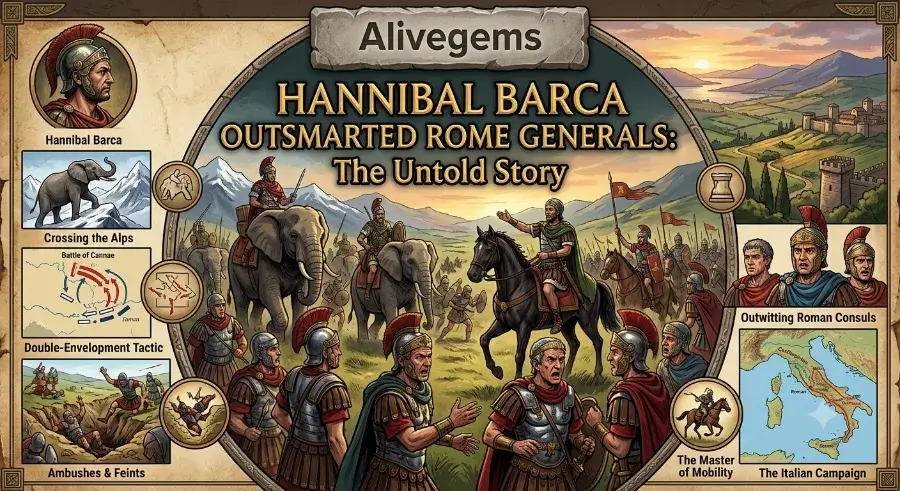
Hannibal Barca outsmarted Rome generals You are Rome, the most feared power in the ancient Mediterranean, and a young general from a rival city you barely respect just walked an army of men, horses, and elephants over the Alps in winter. You did not think it was possible. Nobody did. Yet here he comes, and for the next fifteen years he will make your best commanders look like amateurs. That is the story of how Hannibal Barca outsmarted Rome generals not once, but again and again, in a war that almost ended the Roman Republic before it truly began.
This is not a dry textbook account. This is the story of a man raised on hatred and brilliance in equal measure, a man who turned mountains into weapons and turned Roman confidence into ash at a place called Cannae. If you love the kind of history that reads like a thriller, you are in the right place, because few figures in the ancient world earned their fame the way Hannibal did. If you have already read about the magnetic pull of Alexander the Great’s charisma or how Julius Caesar turned Rome into his own stage, you will find Hannibal belongs right beside them as one of the ancient world’s most charismatic and dangerous leaders.
To get a better understanding of Cyrus the Great Invented Human Rights our guide breaks down exactly what to expect.
Key Takeaways
| Fact | Detail |
|---|---|
| Born | 247 B.C., Carthage (modern day Tunisia) |
| Famous feat | Crossed the Alps in 218 B.C. with roughly 40,000 to 46,000 men and 37 war elephants |
| Signature victory | Battle of Cannae, 216 B.C., one of the deadliest single day defeats in Roman history |
| Years in Italy | Stayed undefeated on Roman soil for about 15 years |
| Final defeat | Battle of Zama, 202 B.C., against Scipio Africanus |
| Legacy | Still studied at military academies today as a master of tactics |
Who Was Hannibal Barca, Really?
Hannibal Barca was born in 247 B.C. in Carthage, a wealthy trading city on the coast of North Africa and Rome’s greatest rival. His father, Hamilcar Barca, was a general himself, and according to ancient historians, he made young Hannibal swear an oath of eternal hostility toward Rome. Whether that story is fully true or slightly exaggerated by later writers, one thing is certain. Hannibal grew up surrounded by war, politics, and a deep family grudge against the Roman Republic.
By the time he was in his twenties, Hannibal was already commanding armies in Spain, learning the terrain, the tribes, and the logistics that would later help him outmaneuver Rome’s finest commanders. He was not just a soldier. He was a student of psychology, geography, and human weakness, and that combination is exactly why Hannibal Barca outsmarted Rome generals so consistently for over a decade.
To get a better understanding of Ramesses II: The Pharaoh Who Lost a Battle our guide breaks down exactly what to expect.
The Impossible March: Crossing the Alps
In 218 B.C., Hannibal did something that Roman leaders considered laughable. He marched an army from Spain, through southern Gaul, and over the Alps into northern Italy, aiming to strike Rome where it least expected an attack. Ancient sources describe an army of around 40,000 to 46,000 soldiers, thousands of horses, and 37 war elephants making this brutal fifteen day crossing through snow, ice, and hostile mountain tribes.
Cleopatra’s Strategic Mind: The Real Story Behind History’s Most Famous Romance
For centuries, historians argued about exactly which mountain pass Hannibal used. Interestingly, recent research published in 2026 in the Proceedings of the National Academy of Sciences finally added real scientific weight to this old debate. A team from the University of Oxford and the German Centre for Integrative Biodiversity Research modeled the energy costs of moving thousands of men, horses, and multi ton elephants across different Alpine routes.
Their calculations point strongly toward the Col de la Traversette as the most likely path, since it would have demanded the least brutal energy cost for an army already pushed to its limits. The same study even suggests the elephants may have lost only a small percentage of their body fat during the crossing, which helps explain why several of them actually survived to fight in Italy.
Sun Tzu: The Mysterious General Whose Words Still Win Modern Wars
This detail matters because it shows Hannibal was not reckless. Every decision he made, even which mountain pass to choose, was calculated around logistics and survival. That is precisely the mindset behind how Hannibal Barca outsmarted Rome generals from the very first weeks of the war.
Quick Facts About the Alps Crossing
- Hannibal began the crossing in the autumn of 218 B.C.
- The journey through the mountains alone took about 15 days.
- Ancient writers Polybius and Livy remain the two main sources for the event.
- Modern bioenergetic research from 2026 supports the Col de la Traversette as the most probable route.
- Only a fraction of the original war elephants survived the following winter in Italy.
Trebia and Trasimene: The First Humiliations
Rome sent its consuls to crush this invader before he could gain a foothold, and both times they walked straight into traps. At the Battle of the Trebia River in December of 218 B.C., Hannibal hid part of his army in the freezing riverbed overnight, then lured the Roman army into a frontal attack across icy water before springing his ambush from the flanks and rear. The Roman force, led by consul Sempronius Longus, suffered devastating losses that day.
A few months later, in June of 217 B.C., Hannibal repeated the trick with an even bolder plan. He lured the army of consul Gaius Flaminius along the misty shores of Lake Trasimene, then attacked from the surrounding hills before the Romans even realized they were surrounded. Nearly the entire Roman force was wiped out in just a few hours, and Flaminius himself was killed. These early clashes prove that this was no lucky invader stumbling into victories. This was one of the most brilliant ancient military strategist minds Rome had ever faced, and the pattern was only just beginning.
Cannae: The Battle That Changed Warfare Forever
If there is one single moment that defines why people still study Hannibal today, it is the Battle of Cannae in August of 216 B.C. Rome, desperate to finally crush this invader, assembled a massive army, some ancient estimates suggest around 80,000 soldiers, led by consuls Paullus and Varro. Hannibal had roughly half that number.
On paper, Rome should have won easily. Instead, Hannibal arranged his weaker center to bend backward slowly under Roman pressure, drawing the legions deep into a trap shaped like a crescent. As the Romans pushed forward, believing they were winning, Hannibal’s cavalry and stronger flanks closed in from both sides, and his African infantry wrapped around the rear. The Roman army was completely surrounded and slaughtered from every direction.
Historians still debate the exact casualty numbers, but most agree tens of thousands of Roman soldiers died in a single day, making Cannae one of the bloodiest defeats in the history of Western warfare. Military academies around the world, including West Point, still teach the double envelopment tactic used at Cannae as a textbook example of tactical genius. This single battle is often the strongest proof point people search for when they want to understand Hannibal crossed Alps biography and legacy in full context.
Battle Comparison Table
| Battle | Year | Roman Losses (approx.) | Outcome |
|---|---|---|---|
| Trebia | 218 B.C. | Tens of thousands | Decisive Carthaginian victory |
| Lake Trasimene | 217 B.C. | Around 15,000 killed | Decisive Carthaginian victory |
| Cannae | 216 B.C. | Estimated 50,000 or more | Catastrophic Roman defeat |
| Zama | 202 B.C. | Carthaginian side lost | Decisive Roman victory under Scipio |
Why Rome Struggled So Badly Against Him
It is worth pausing here to ask a simple question. Why did so many talented Roman commanders fail against one general? A few reasons stand out clearly when you study the record closely.
- Hannibal understood terrain better than his enemies and constantly chose ground that favored his smaller, more flexible army.
- He studied the personalities of opposing consuls and exploited their pride, especially impulsive leaders like Flaminius and Varro.
- His use of combined cavalry, infantry, and deception created tactical flexibility Rome had never faced before.
- He kept his multicultural army, made up of Africans, Spaniards, and Gauls, loyal and coordinated despite language and cultural differences.
This is exactly the pattern people refer to when they talk about ancient generals outsmarted Rome, because Hannibal was not simply stronger. He was smarter, more patient, and far more willing to take calculated risks than the men sent against him.
If you want to learn more about Ashoka Great brutal warrior enlightened check out our detailed guide for practical tips and expert advice.
The Fabian Strategy: Rome Finally Adapts
After Cannae, Rome could not keep feeding fresh armies into direct battles against Hannibal, since every direct fight seemed to end the same way. A general named Quintus Fabius Maximus proposed something almost embarrassing for Roman pride. Avoid open battle entirely. Instead, harass Hannibal’s supply lines, wear him down slowly, and refuse to give him the decisive fight he wanted.
This approach, later called the Fabian strategy, was deeply unpopular at first because it looked like cowardice to many Romans. However, it worked. Hannibal, brilliant as he was, could not force Rome into another Cannae if Rome simply refused to fight on his terms. This slow, grinding stalemate stretched on for years, proving that even the greatest tactician in the ancient world could be neutralized, though never truly defeated, through patience rather than direct confrontation.
Zama: The End of an Unbeaten Streak
For fifteen years, Hannibal remained on Italian soil, undefeated in major battle, yet increasingly cut off from reinforcements and supplies from Carthage. Eventually, a young Roman general named Scipio, who had studied Hannibal’s tactics closely, took the war directly to North Africa, forcing Carthage to recall Hannibal home to defend the city itself.
In 202 B.C., at the Battle of Zama, Scipio finally did what no Roman had managed in over a decade. He anticipated Hannibal’s famous elephant charge and trained his soldiers to create lanes that let the panicked animals pass harmlessly through the ranks instead of crashing into them. Combined with superior cavalry, Scipio’s army defeated Hannibal decisively, ending the Second Punic War and Carthage’s hopes of matching Roman power.
It is a strangely poetic ending. The very tactics of deception, terrain use, and psychological pressure that once made Hannibal Barca outsmarted Rome generals eventually became the tools Rome used to finally beat him.
If you want to learn more about Leonidas 300 Spartans changed history check out our detailed guide for practical tips and expert advice.
Life After Rome and Lasting Legacy
After his defeat, Hannibal did not simply fade away. He became a political reformer in Carthage, then later a military advisor to eastern kings who still feared Roman expansion. Rome, however, never stopped pursuing him, and around 183 B.C., facing certain capture, Hannibal took his own life rather than be handed over to his lifelong enemy.
Even in death, his influence never disappeared. Roman writers themselves, despite being his enemies, could not help but admire his brilliance, and centuries later, military leaders from Napoleon to modern day war college instructors have studied his battles as essential lessons in strategy, psychology, and leadership under pressure. As detailed in reader accounts like this reflection on Hannibal as Rome’s greatest enemy, his story continues to fascinate history lovers who see him as proof that intelligence can outweigh raw military size.
Organizations focused on history education, including resources like this overview from Grateful American Kids, continue to highlight Hannibal as one of antiquity’s greatest generals, a reputation that has genuinely earned its place across more than two thousand years of military scholarship. For readers who want an easy visual breakdown of his campaigns, this summary from Fexingo’s history archive is also a solid additional resource.
If Hannibal’s story pulled you in, you may also enjoy exploring the wider guide to ancient charismatic leaders here on Alivegems, where we cover the most magnetic and unforgettable figures from the ancient world.
Test Your Hannibal Knowledge: Quick Quiz
True or False Questions
- Hannibal crossed the Alps with war elephants in 218 B.C. (True)
- Hannibal lost the Battle of Cannae. (False)
- Hannibal was born in Rome. (False)
- Scipio Africanus defeated Hannibal at the Battle of Zama. (True)
- Hannibal remained undefeated in Italy for around 15 years. (True)
Multiple Choice Questions
- Which battle is considered Hannibal’s greatest tactical masterpiece?
A) Trebia
B) Cannae
C) Zama - Which mountain pass does recent 2026 research suggest Hannibal likely used?
A) Col du Clapier
B) Col de la Traversette
C) Little St. Bernard Pass - Who finally defeated Hannibal at the Battle of Zama?
A) Fabius Maximus
B) Scipio Africanus
C) Gaius Flaminius
Frequently Asked Questions
How did Hannibal Barca outsmarted Rome generals so many times in a row?
He combined deep knowledge of terrain, psychological insight into his opponents, and flexible battlefield tactics that Roman commanders had never encountered before.
Why is Hannibal called one of the most brilliant ancient military strategist figures in history?
His victories at Trebia, Trasimene, and especially Cannae are still studied today as textbook examples of tactical genius, and his double envelopment maneuver remains a benchmark in military education worldwide.
Did Hannibal actually cross the Alps with elephants?
Yes, ancient sources and modern scientific research both confirm that Hannibal brought around 37 war elephants across the Alps in 218 B.C., though only a small number survived the following winter.
Why did Rome eventually stop losing to Hannibal?
Rome adapted by adopting the Fabian strategy of avoiding direct battle, and later by training a new generation of commanders like Scipio Africanus, who studied and countered Hannibal’s own methods.
Is Hannibal considered more skilled than Alexander the Great or Julius Caesar?
Historians debate this endlessly, but many military scholars rank Hannibal among the very top tacticians of the ancient world specifically because he achieved so much while commanding smaller, more diverse forces far from home.
Conclusion
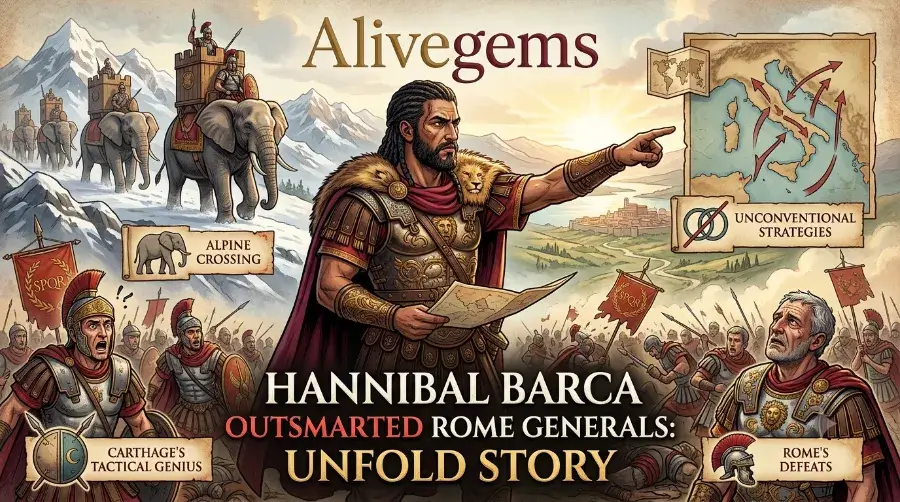
Hannibal Barca’s story is not simply a list of battles and dates. It is proof that intelligence, patience, and psychological insight can overpower raw military size, even against the most powerful army of the ancient world. Time and again, Hannibal Barca outsmarted Rome generals who underestimated him, until Rome itself was forced to change everything about how it trained and thought about warfare. His legacy still echoes today, not just in history books, but in the strategy lessons taught in military academies around the world. Few leaders in human history managed to be feared, respected, and studied in equal measure the way Hannibal was, and that is exactly why his name still commands attention over two thousand years later.
References
- Polybius, The Histories, ancient primary source on the Second Punic War
- Livy, Ab Urbe Condita, ancient primary source on Roman military history
- Proceedings of the National Academy of Sciences, 2026 bioenergetic study on Hannibal’s Alpine route
- University of Oxford and German Centre for Integrative Biodiversity Research, joint 2026 research publication
- Smithsonian Magazine, historical reporting on Hannibal’s Alpine crossing research