
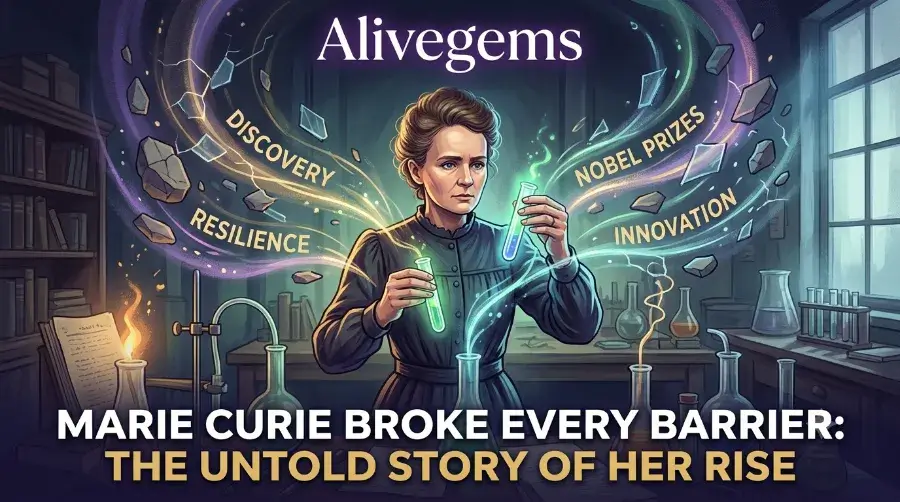
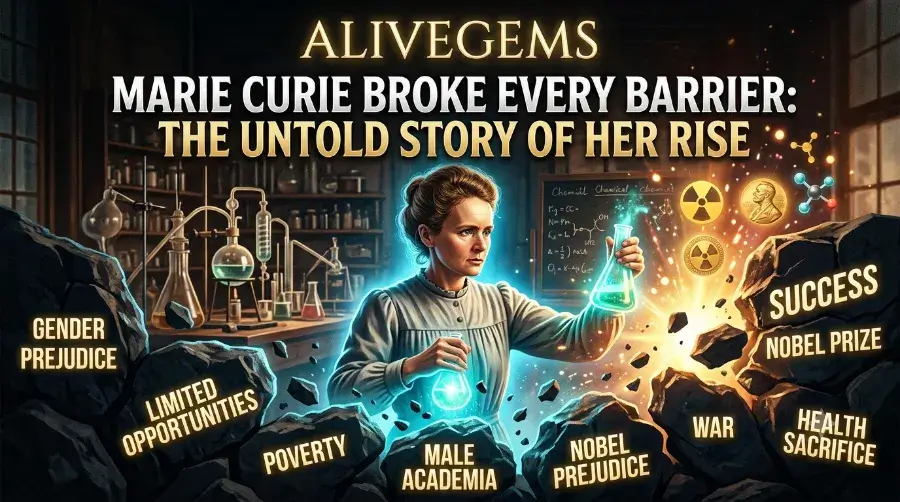
Marie Curie broke every barrier Picture a young woman in Warsaw in the 1880s. She wants to study science. The law says no, because she is a woman. Her own country will not let her walk through a university door. So what does she do? She studies in secret, in a moving underground school that changes locations every week so the police cannot catch it. That woman grew up to become the only person in history to win two Nobel Prizes in two different sciences. Her name was Marie Curie, and honestly, once you learn her story, you start to understand why alivegems.com calls her one of the most charismatic women who changed history. Marie Curie broke every barrier that Warsaw, Paris, and even her own body tried to put in front of her, and this story still gives people chills more than a century later.
Marie Curie broke every barrier This is not a dusty textbook retelling. This is the real story, with real dates, real numbers, and real heartbreak, told the way you would hear it from a friend who cannot stop talking about history at dinner parties. So grab a coffee, because we are about to go back to a freezing laboratory in Paris where a woman changed science forever.
get a better understanding of Frida Kahlo shattered body art our guide breaks down exactly what to expect.
Key Takeaways
| Milestone | Year | Why It Mattered |
|---|---|---|
| Secret education at the “Flying University” | 1880s | Women were banned from Polish universities under Russian rule |
| Moved to Paris, enrolled at the Sorbonne | 1891 | Became one of the first women to study physics there |
| Discovered polonium and radium with Pierre | 1898 | Opened the entire field of radioactivity |
| First Nobel Prize, Physics | 1903 | First woman ever to win a Nobel Prize |
| Second Nobel Prize, Chemistry | 1911 | Still the only person with Nobels in two different sciences |
| Ran mobile X-ray units in World War I | 1914 to 1918 | Helped treat roughly one million wounded soldiers |
| Ashes moved to the Panthéon | 1995 | First woman honored there for her own achievements |
From Warsaw’s Forbidden Classrooms to Paris
Marie Curie was born Maria Sklodowska on November 7, 1867, in Warsaw, in a part of Poland then controlled by the Russian Empire. Her parents were both teachers, and they believed deeply in education, even though the Russian government tried to erase Polish culture from schools. When she was only eleven, her mother died of tuberculosis, and not long after, her oldest sister died of typhus. Grief hit her early, and it hit hard.
Despite that loss, or maybe because of it, young Maria threw herself into learning. Since women were shut out of Polish universities at the time, she and her sister Bronya made a pact. Maria would work as a governess to fund Bronya’s medical studies in Paris, and later Bronya would help Maria do the same. It is one of the earliest examples of sisters literally building each other’s futures brick by brick.
In 1891, at 24 years old, Maria finally arrived in Paris and enrolled at the Sorbonne. She changed her name to Marie. She was poor, she was cold most winters, and she sometimes forgot to eat properly while studying. But she graduated first in her class in physics in 1893, then second in mathematics a year later. If you enjoy stories about women who refused to accept “no” for an answer, you might also love reading about Joan of Arc, who led the French army at just seventeen, another young woman who simply would not be told what she could not do.
A Love Story Built on Science
In 1894, Marie met Pierre Curie, a physicist working on magnetism. They connected over lab work and long bicycle rides, and married in 1895. Their wedding gift money literally went toward buying bicycles. It sounds almost too simple for two people who would go on to change the world, but that is part of what makes their story so human.
Pierre was not just a husband. He became her scientific partner, and later, he was the one who insisted her name be added to the Nobel nomination when the French Academy initially only wanted to credit him and Henri Becquerel.
The Discovery That Rewrote Physics
In 1896, Henri Becquerel discovered that uranium gave off strange rays. Marie Curie decided to make this the topic of her doctoral thesis, a decision that would define the rest of her life. Working with a mineral called pitchblende, she noticed something odd. The mineral was far more radioactive than its uranium content could explain.
That single observation led her, with Pierre’s help, to a massive discovery. In 1898, the Curies announced two new elements: polonium, named after Marie’s beloved Poland, and radium. Extracting a usable amount of radium chloride took four brutal years of processing tons of raw ore in a leaky shed that barely qualified as a laboratory.
Here is a number that still shocks people. To get just one decigram of pure radium chloride, Marie processed several tons of pitchblende by hand. No fume hood. No radiation suit. Just grit.
In 1903, Marie, Pierre, and Becquerel shared the Nobel Prize in Physics for their work on radioactivity, a term Marie herself coined. She became the first woman in history to win a Nobel Prize. On top of that, on June 25, 1903, she defended her doctoral thesis at the Sorbonne, becoming the first woman in France to earn a doctorate in science.
Marie Curie broke every barrier Then tragedy struck. On April 19, 1906, Pierre was killed in a street accident, run over by a horse drawn cart in Paris. Marie was devastated, yet she did something almost unthinkable for the era. She took over his professorship at the Sorbonne, becoming the university’s first female professor, and kept the research going alone.
In 1911, she won a second Nobel Prize, this time in Chemistry, for isolating pure radium. To this day, she remains the only woman to win a Nobel Prize in two different fields, and one of very few people, male or female, to ever do so. It is a fact that still amazes scientists, and you can read more thoughtful analysis of what made her mind so exceptional over on American Scientist’s profile of her inner life. NobelPrize.org
Marie Curie Charisma and Leadership on the Battlefield
People often assume charisma means charm on a stage. Marie Curie’s charisma looked different. It was quiet, stubborn, and deeply practical, and it showed up most powerfully during World War I.
When the war broke out in 1914, wounded soldiers were dying because doctors on the front lines had no way to locate bullets or shrapnel quickly. Marie Curie had an idea. She designed mobile X-ray vehicles, which soldiers affectionately nicknamed “petites Curies,” or little Curies.
She personally learned to drive, learned basic anatomy, and trained young women, including her own teenage daughter Irène, to operate these units near the front. Historians estimate that Curie’s Red Cross Radiology Service, which she directed, helped treat over one million wounded soldiers using X-ray technology she helped bring to the battlefield. France Travel Tips
This is real leadership, the kind Harvard Business Review has actually studied. Their case study on Marie Curie’s leadership style points out how she led not through charm or authority, but through relentless competence and calm under pressure.
A few things stand out about her leadership style during this period:
- She turned abstract scientific research into something that saved lives immediately, not decades later.
- She trusted young women with real responsibility, at a time when almost nobody else did.
- She financed some of the war effort herself, even offering to convert her Nobel Prize money into war bonds, though she later admitted she expected the money would probably be lost.
- She kept working through grief, war, and physical exhaustion without ever asking for special treatment.
This kind of grounded, no nonsense leadership echoes other women covered on alivegems, like Queen Nzinga, who outmaneuvered Portuguese colonizers through sheer strategic patience rather than flash.
The Price of Genius
Marie Curie broke every barrier It would be dishonest to tell this story without talking about the cost. Marie Curie worked with radioactive materials for decades before anyone understood the danger. She carried test tubes of radium in her pockets. She kept glowing samples on her nightstand because she loved the eerie light.
On July 4, 1934, Marie Curie died near Sallanches, France, from aplastic anemia, a bone marrow disease almost certainly caused by decades of radiation exposure. She was 66 years old. Even her old notebooks are still radioactive today and are kept in lead lined boxes at the French National Library, requiring a protective suit to handle.
There is something quietly tragic and quietly heroic about that. The very thing that made her famous is the thing that killed her, and she likely knew the risk yet kept going anyway.
Women Who Broke Science Barriers After Her
Marie Curie did not just win awards. She rewired what people believed a woman could accomplish in science, and the ripple effects are enormous.
Consider this short list of what came after her:
- Her daughter Irène Joliot-Curie won her own Nobel Prize in Chemistry in 1935, alongside her husband Frédéric Joliot, for discovering artificial radioactivity.
- In total, the Curie family has earned five Nobel Prizes combined, an achievement no other family has matched.
- Marie Curie became, in 1995, the first woman honored in the Paris Panthéon for her own achievements, not because of a husband or father.
- Only two other women have ever won a Nobel Prize in Physics since her, decades apart, showing just how steep the climb still is.
If you enjoy reading about women who reshaped entire fields against impossible odds, you will probably also like the story of Harriet Tubman’s work as an iron willed spy, someone who, like Curie, turned personal risk into a tool for changing history.
Today, the Institut Curie in Paris continues her original mission, combining cancer research with patient care, exactly the blend of science and human compassion she believed in. And interestingly, in 2025 the European Central Bank shortlisted Curie’s portrait for a redesign of the future twenty euro banknote, and in 2026 she was proposed as one of the historical women whose names should be added to the Eiffel Tower alongside the 72 men already honored there. Her story keeps finding new ways to matter.
Marie Curie Double Nobel Biography: The Numbers That Still Stun People
Sometimes numbers explain a legacy better than adjectives ever could. Here is a simple chart of her most eye opening statistics.
| Statistic | Number |
|---|---|
| Years spent processing pitchblende for pure radium | 4 years |
| Tons of raw ore processed to get one decigram of radium chloride | Several tons |
| Nobel Prizes won by Marie Curie | 2 (Physics 1903, Chemistry 1911) |
| Nobel Prizes won across the Curie family total | 5 |
| Estimated soldiers treated with her mobile X-ray units | Around 1,000,000 |
| Years until her research notebooks are considered safe from radiation | Still radioactive after over 130 years |
Radium has a half life of roughly 1,600 years, which is exactly why her notebooks from the 1890s are still measurably radioactive today. That single fact tends to stop people mid sentence when they hear it for the first time.
FAQ
Did Marie Curie really win two Nobel Prizes?
Yes, she won the Nobel Prize in Physics in 1903 and the Nobel Prize in Chemistry in 1911, making her the only person ever to win Nobel Prizes in two different scientific fields.
What elements did Marie Curie discover?
She and Pierre Curie discovered polonium and radium in 1898, both far more radioactive than uranium.
How did Marie Curie die?
She died in 1934 from aplastic anemia, a blood disorder caused by long term exposure to radiation during her research and wartime X-ray work.
Why are her notebooks still dangerous today?
Radium has an extremely long half life, so her personal notebooks and papers remain radioactive and are stored in lead lined boxes, only viewable with protective gear.
Was Marie Curie the first woman to earn a doctorate in France?
Yes, she became the first woman in France to earn a doctorate in science after defending her thesis at the Sorbonne in 1903.
Quick Quiz: How Much Do You Really Know About Marie Curie?
- In what year did Marie Curie win her first Nobel Prize?
a) 1898
b) 1903
c) 1911 - What element did Marie Curie name after her home country?
a) Radium
b) Curium
c) Polonium - What nickname did soldiers give her mobile X-ray vehicles during World War I?
a) Little Curies
b) Radium Rovers
c) Sorbonne Specials - True or False: Marie Curie’s research notebooks are still radioactive today.
- True or False: Marie Curie is the only person to ever win Nobel Prizes in two different scientific fields.
(Answers: 1-b, 2-c, 3-a, 4-True, 5-True)
Conclusion
Marie Curie never set out to become a legend. She just kept walking through doors that were supposedly locked, one after another, from a secret classroom in Warsaw all the way to a Nobel podium in Stockholm, twice. She lost her mother young, lost her husband suddenly, and eventually lost her own health to the very science she loved. Yet she never stopped working, never stopped teaching her daughters, and never let anyone convince her that her mind belonged to anyone but herself. That is really what makes her story so timeless. It is not just about radium or Nobel medals. It is about refusing to shrink, even when the whole world seems built to make you feel small. If you want to keep exploring stories like hers, visit the full collection of charismatic women who changed history right here on alivegems.com, including the incredible story of Hatshepsut, the most successful female pharaoh and Boudicca, who burned London and terrified Rome.
References
- Nobel Prize official website, biography and facts on Marie Curie Marie Curie broke every barrier
- Britannica, biography of Marie Curie Marie Curie broke every barrier
- HISTORY.com, facts about Marie Curie Marie Curie broke every barrier
- American Scientist, “The Inner Marie Curie” Marie Curie broke every barrier
- Harvard Business Review, case study on Marie Curie’s leadership Marie Curie broke every barrier
- Institut Curie, legacy of Marie Curie Marie Curie broke every barrier
- Nuclear Museum, Atomic Heritage Foundation profile of Marie Curie Marie Curie broke every barrier