
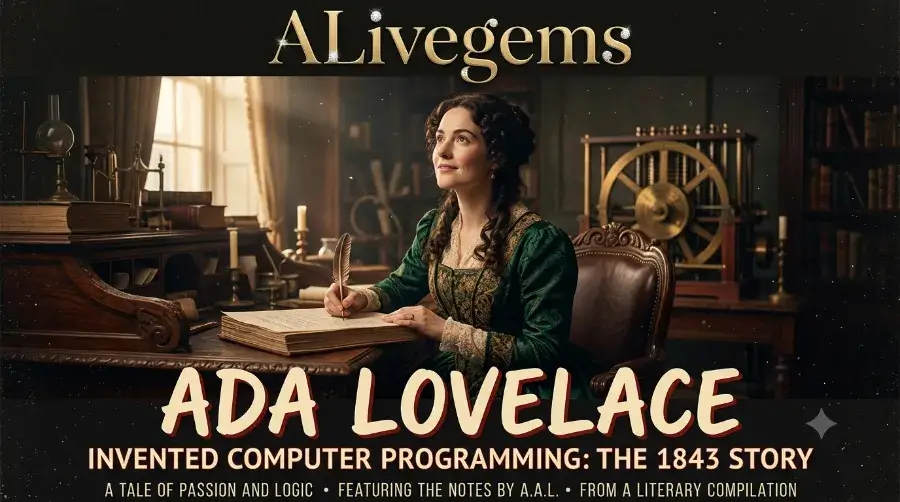
Ada Lovelace invented computer programming Picture a candlelit study in London, the year is 1843, and a young woman is scribbling notes that no one else on Earth could have written. She is not a scientist by trade. She is not even allowed to attend university because of her gender. Yet what she puts on paper that year becomes the first computer program in human history, written for a machine that would not be fully built for another century.
That woman was Ada Lovelace, and her story is one of the most quietly explosive moments in the history of technology. Ada Lovelace invented computer programming before the word computer even meant what it means today, and her leap of imagination still shapes the phone in your pocket right now.
If you have ever wondered how the first computer programmer woman in history managed to out-think an entire era, you are about to find out.
Key Takeaways
| Fact | Detail |
|---|---|
| Who she was | Ada Lovelace, mathematician and writer, daughter of poet Lord Byron |
| What she did | Wrote the first published algorithm meant for a machine, in 1843 |
| The machine | Charles Babbage’s Analytical Engine, a mechanical computer never fully built in her lifetime |
| Her big idea | Machines could process more than numbers, they could process symbols, music, and art |
| Legacy | The US Department of Defense named a programming language ADA in her honor in 1980 |
| Lifespan | 1815 to 1852, she died at just 36 years old |
Who Was Ada Lovelace, Really
Ada Lovelace was born Augusta Ada Byron in December 1815 in London. Her father was the famous poet Lord Byron, but he left the family when Ada was just a baby. Her mother, Annabella Milbanke, was terrified that Ada might inherit her father’s wild, poetic temperament.
So her mother did something unusual for the time. She pushed Ada hard into mathematics and logic, hoping numbers would keep her daughter’s imagination in check. It backfired beautifully. Ada grew up loving both poetry and math, and she called her unique blend of the two poetical science.
This upbringing turned her into one of the most fascinating Victorian women scientists biography subjects in history, because she never saw art and logic as opposites. If you enjoy stories about brilliant people overlooked by history, you might also love reading about Hypatia of Alexandria, another forgotten genius whose mind outpaced her era by centuries.
Meeting the Man Who Built Machines
In 1833, when Ada was just seventeen, she met Charles Babbage at a party in London. Babbage was a mathematician obsessed with an idea that sounded almost like science fiction. He wanted to build a machine that could calculate anything, a machine he called the Analytical Engine.
Most people at that party probably nodded politely and moved on. Ada did not. She understood instantly what Babbage was trying to do, and more importantly, she saw something Babbage himself had not fully grasped.
She saw that his machine was not just a giant calculator. She saw that it could think in patterns.
The Translation That Changed Everything
Here is where the story gets genuinely thrilling. In 1842, an Italian engineer named Luigi Menabrea wrote a paper in French describing Babbage’s Analytical Engine. Babbage asked Ada to translate it into English.
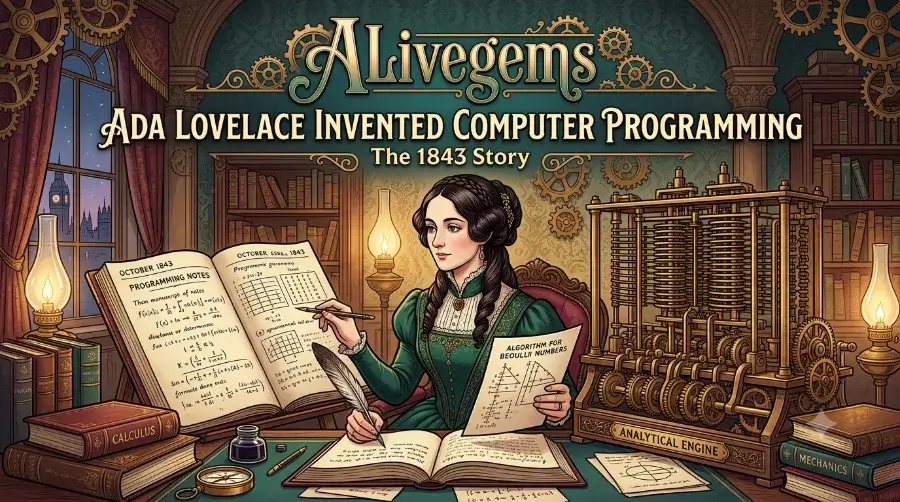
Ada did translate it, but then she did something nobody expected. She added her own notes to the translation, and her notes ended up three times longer than the original paper. These notes, published in 1843, contained what historians now recognize as the world’s first computer program.
Her most famous note, simply labeled Note G, laid out a step by step method for the Analytical Engine to calculate a sequence of numbers called Bernoulli numbers. This was not just math homework. It was an actual algorithm, written specifically to be run on a machine.
What Made Her Algorithm Different
Ada’s Note G was not simply a set of calculations. It included:
- A clear sequence of operations the machine needed to follow in order
- Instructions for looping, so the machine could repeat steps rather than starting over
- A way of storing intermediate results for later use
- Recognition that the machine could work with symbols, not just numbers
This kind of thinking is exactly what modern coders do every single day, whether they are writing Python, JavaScript, or C++. That is why so many historians credit Ada Lovelace invented computer programming as more than a catchy headline. It is a fact backed by primary sources, including her handwritten notes preserved at Oxford’s Bodleian Library, which you can explore in more detail through the Bodleian’s Ada Lovelace archive.
The Idea Nobody Else Had in 1843
Charles Babbage saw his Analytical Engine as a number cruncher, a faster and smarter calculator. Ada saw further. She wrote that the machine could one day compose music or manipulate any symbols according to rules, not just crunch numbers.
Think about that for a second. In 1843, more than 170 years before AI generated music and art became common, a twenty-seven-year-old woman predicted that machines could create, not just calculate. This single insight is why the National Institute of Standards and Technology has called her the world’s first computer programmer who predicted artificial intelligence, a claim explored thoroughly on NIST’s official blog.
Her vision connects directly to the Ada Lovelace algorithm story that inspires computer scientists today. She did not just automate arithmetic. She imagined a future where machines could touch nearly every creative and analytical field, and she was right.
A World That Was Not Ready For Her
Despite her brilliance, Ada Lovelace lived in a society that barred women from universities, scientific societies, and most professional recognition. She could not publish her notes under her own full name at first. Instead, they were signed simply with the initials A.A.L.
She also battled serious health problems for most of her adult life, including chronic illness that worsened as she got older. She died in 1852 from uterine cancer, at only thirty-six years old, the very same age her father Lord Byron had died at.
For decades afterward, her contribution was mostly forgotten, buried in old journals and private letters. It took until the mid-twentieth century, when computer scientists rediscovered her notes, for the world to understand what she had actually done.
This pattern of brilliant women being erased from scientific history is sadly common. You can see similar echoes in the story of Rosalind Franklin, whose DNA discovery credit was stolen, or in the secret life of James Barry, the Victorian doctor who hid an extraordinary truth.
Why She Finally Got Her Due
In 1980, the United States Department of Defense named a new programming language ADA in her honor, a language still used today in aerospace, defense, and safety-critical systems. This was not a small gesture. It was official recognition, from one of the most powerful institutions in the world, that Ada Lovelace invented computer programming decades before anyone built a working computer.
Since then, her legacy has only grown:
- Ada Lovelace Day is now celebrated every October, honoring women in science, technology, engineering, and math
- Her handwritten notes are preserved and studied at Oxford University
- Museums including the Science Museum in London have dedicated permanent exhibits to her work
- Countless computer science programs teach her story as the origin point of modern coding
If you want to see her actual notes and understand the full timeline of her achievement, the San Diego Model Railroad Museum’s education blog offers an excellent walkthrough of her pioneering role.
How Ada Lovelace Compares to Other Underestimated Geniuses
History is full of people who saw further than their time allowed, yet were overlooked. Ada Lovelace fits into a small, remarkable group of thinkers whose ideas outran their century.
| Person | Era | Overlooked Achievement |
|---|---|---|
| Ada Lovelace | 1815-1852 | Wrote the first computer algorithm, decades before computers existed |
| Hypatia of Alexandria | 4th century | Advanced mathematics and astronomy, silenced by mob violence |
| Eratosthenes | 3rd century BC | Calculated Earth’s circumference using only shadows and geometry |
| Rosalind Franklin | 1920-1958 | Captured the key image proving DNA’s double helix structure |
Speaking of overlooked brilliance, mathematics itself has a long history of quiet geniuses. You can read about how Eratosthenes calculated Earth’s circumference using nothing but sticks and shadows, another story of ancient logic outpacing its era.
The Charisma Behind the Code
Ada Lovelace invented computer programming What made Ada Lovelace so magnetic was not just her intelligence. It was her refusal to separate imagination from precision. She wrote letters full of poetic language about mathematics, once describing herself as an Analyst and Metaphysician. She had the confidence to challenge one of the smartest engineers of her generation and add her own vision on top of his.
That kind of quiet, unstoppable confidence links her to other charismatic figures throughout history who defied expectations, from teenage heroes to accidental world changers. If bold historical figures fascinate you, do not miss the story of Sybil Ludington, the teenage rider who outrode Paul Revere, or Vasily Arkhipov, the man who quietly prevented nuclear war with a single calm decision.
For more forgotten figures who changed the world without getting proper credit, explore our full collection on forgotten charismatic figures.
Quick Quiz: Test What You Just Learned
- In what year did Ada Lovelace publish her famous notes containing the first algorithm?
A) 1830
B) 1843
C) 1860 - What was the name of the machine Ada Lovelace wrote her algorithm for?
A) The Difference Engine
B) The Analytical Engine
C) The Calculating Clock - What did Ada Lovelace predict the machine could do beyond simple math?
A) Predict the weather
B) Compose music and process symbols
C) Translate languages instantly - True or false: A programming language was named after Ada Lovelace in 1980.
- True or false: Ada Lovelace attended university to study mathematics formally.
(Answers: 1-B, 2-B, 3-B, 4-True, 5-False)
Frequently Asked Questions
Did Ada Lovelace actually invent computer programming?
Yes, her 1843 notes on the Analytical Engine included a complete algorithm meant to run on a machine, which historians widely recognize as the first computer program ever published.
Was Ada Lovelace the daughter of Lord Byron?
Yes, she was the only legitimate child of the poet Lord Byron, though he left the family when she was an infant and she never really knew him.
Why is Ada Lovelace called the first computer programmer?
Because her notes on the Analytical Engine contained a step by step method for calculating Bernoulli numbers, complete with loops and stored variables, features still used in coding today.
How did Ada Lovelace die?
She died in 1852 from uterine cancer at the age of thirty-six, the same age her father passed away.
Is there a programming language named after her?
Yes, the United States Department of Defense created the ADA programming language in 1980 in her honor, and it is still used in aerospace and defense systems.
Conclusion
Ada Lovelace invented computer programming saw a future that would not fully arrive for over a hundred years, and she wrote it down anyway. She looked at a pile of gears and levers and saw something almost alive, a machine that could create rather than just calculate. That single leap of imagination is why we still say Ada Lovelace invented computer programming, and why her name sits quietly behind every line of code written today. Her life reminds us that genius does not always wait for permission, recognition, or even the right century to prove itself.
References
- National Institute of Standards and Technology, Ada Lovelace blog Ada Lovelace invented computer programming
- San Diego Model Railroad Museum, Ada Lovelace educational blog Ada Lovelace invented computer programming
- Bodleian Libraries, University of Oxford, Ada Lovelace archive Ada Lovelace invented computer programming
- Historical records on Charles Babbage and the Analytical Engine Ada Lovelace invented computer programming