
Zoroaster is a strange thought to sit with for a moment. Every time you hear someone talk about heaven and hell, a final day of judgment, or angels battling demons, you are hearing an idea that started with a man almost nobody outside a small community has heard of. Zoroaster ideas inside major religions shaped Judaism, Christianity, and Islam so deeply that scholars still debate exactly how much of the Abrahamic worldview actually began in ancient Persia. He never built an empire and never wrote a bestselling book, yet his fingerprints are all over the belief systems of billions of people today. This is the story of the prophet history somehow managed to forget.
Meister Eckhart: The Mystic Too Radical Even for the Pope
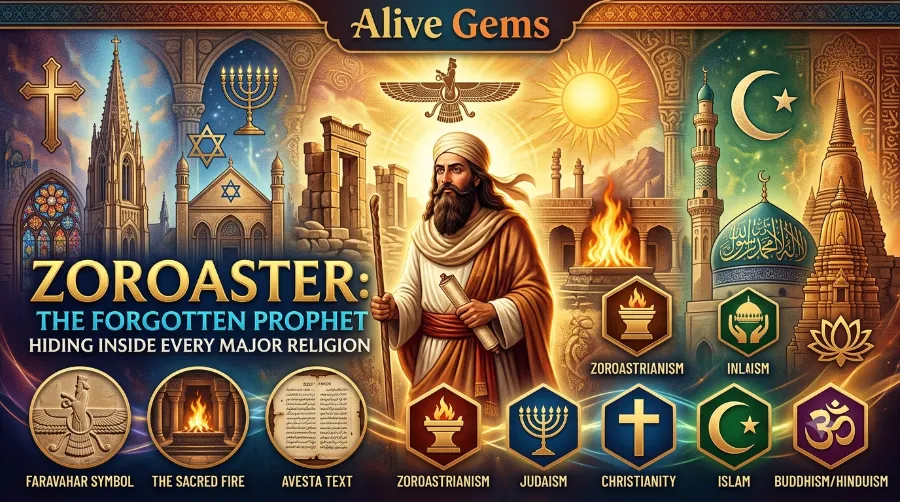
Key Takeaways
| Fact | Detail |
|---|---|
| Real Name | Zarathustra, known in Greek as Zoroaster |
| Birthplace | Likely eastern Iran or Central Asia, exact location debated |
| Estimated Era | Anywhere from the 2nd millennium BCE to around the 7th century BCE |
| Core Teaching | One supreme god, Ahura Mazda, locked in a struggle between good and evil |
| Sacred Text | The Gathas, part of the larger Avesta |
| Major Influence | Judaism, Christianity, and Islam all show traces of his ideas |
| Modern Followers | Around 100,000 to 200,000 worldwide, mostly Parsis in India |
| Historical Turning Point | Muslim conquest of Persia in the 7th century CE forced mass migration |
TL;DR
- Zoroaster taught one of the earliest versions of a single supreme god locked in a cosmic fight between good and evil.
- Many core ideas found in Judaism, Christianity, and Islam, including heaven, hell, judgment day, and angels versus demons, closely echo his teachings.
- His original religion nearly vanished after the Muslim conquest of Persia, yet a small dedicated community, the Parsis, kept it alive for over a thousand years.
Who Was Zoroaster and Why Is He So Hard to Pin Down?
Unlike most famous prophets, Zoroaster does not come with a tidy biography. Historians still argue about when he actually lived, and the estimates swing wildly, anywhere from the second millennium BCE to as late as the seventh century BCE. Most scholars now lean toward the idea that he lived somewhere in eastern Iran, possibly near modern day Uzbekistan or Tajikistan, long before the rise of the Persian Empire most people picture today.
What makes this even more fascinating is that almost everything we know about him comes from hymns he supposedly wrote himself, called the Gathas. These verses form the oldest section of the Avesta, Zoroastrianism’s sacred scripture, and they read less like myth and more like the raw, personal reflections of a man wrestling with faith in real time.
A Prophet Who Broke With His Own Culture
Before Zoroaster, the people of ancient Iran worshipped a wide range of gods, spirits, and nature deities, similar to many polytheistic cultures of the ancient world. Zoroaster rejected that entire system and instead pointed toward one supreme being, Ahura Mazda, meaning roughly “Wise Lord.” This was not a small tweak to tradition. It was a direct challenge to the religious establishment of his time, in much the same way Guru Nanak later challenged rigid caste and religious hierarchy thousands of years later in a completely different part of the world.
The Core Ideas That Would Eventually Echo Through History
Zoroaster’s theology centered on a cosmic battle between Ahura Mazda, representing truth and light, and a destructive force often called Angra Mainyu, representing chaos and lies. However, this was not just an abstract myth. He taught that every single human being had to actively choose a side through their thoughts, words, and actions.
This idea, that a person’s moral choices directly determine their fate, was genuinely revolutionary for its time. Consider these core teachings that later show up almost everywhere in world religion:
- A single, supreme, benevolent god ruling over creation.
- A powerful opposing force of evil actively working against that god.
- Judgment after death based on a person’s moral conduct during life.
- The concepts of heaven, hell, and eventual resurrection.
- A promised final confrontation between good and evil at the end of time.
Look at that list again, because it reads almost like a checklist for later religious traditions. According to Britannica, Zoroastrianism contains both monotheistic and dualistic features and likely influenced the development of the other major Western religions, including Judaism, Christianity, and Islam.
Fire as a Symbol, Not an Object of Worship
One detail people often misunderstand is Zoroastrian fire worship. Zoroastrians did not worship fire itself. Fire represented purity, truth, and the presence of Ahura Mazda, similar to how light functions symbolically in many other faiths. Temples built around sacred fires became central gathering places, and some of these flames have reportedly been kept burning continuously for well over a thousand years in certain Zoroastrian communities.
How Zoroaster’s Ideas Slipped Into Judaism
This is where the story gets genuinely remarkable. In 586 BCE, Babylonian forces destroyed the First Temple in Jerusalem and forced much of the Jewish population into exile. Decades later, in 539 BCE, the Persian king Cyrus the Great conquered Babylon and freed the exiled Jewish community, allowing many to return home to Jerusalem.
During those decades in Babylon, under Persian rule and heavy Zoroastrian cultural influence, Jewish religious thought appears to have absorbed several new concepts that were not prominent before the exile. Historians point to ideas like a clearer heaven and hell, a more developed concept of Satan as an active adversary, and a stronger emphasis on a coming day of judgment.
- Before the exile, Jewish scripture rarely described a detailed afterlife with distinct heaven and hell.
- After returning from Babylon, texts increasingly reflect more structured ideas about the soul’s fate after death.
- Many scholars trace this shift directly to prolonged contact with Zoroastrian belief during the Persian period.
If you enjoy tracing how one spiritual tradition quietly reshapes another, this pattern repeats constantly throughout history. It shows up again centuries later when Hildegard von Bingen reshaped medieval Christian mysticism from inside a convent, proving that religious influence rarely travels in one straight, obvious line.
Christianity and Islam Inherited More Than People Realize
Once these Zoroastrian influenced ideas settled into Jewish thought, they traveled naturally into Christianity, which emerged directly from that same religious tradition centuries later. The concept of a devil actively opposing God, a final apocalyptic battle, and a clear division between the saved and the damned all carry unmistakable echoes of Zoroastrian dualism.
Islam, arriving roughly a thousand years after Zoroaster’s teachings had already spread across Persia, also inherited many of these same structural ideas, including judgment day, paradise, and a fiery place of punishment. In fact, when Muslim armies conquered Persia in the seventh century CE, they encountered a fully developed Zoroastrian civilization that had already been shaping regional religious thought for over a thousand years.
A Closer Look at Shared Themes
| Concept | Zoroastrianism | Later Appears In |
|---|---|---|
| One supreme god | Ahura Mazda | Judaism, Christianity, Islam |
| Cosmic evil force | Angra Mainyu | Satan, Iblis, the Devil |
| Judgment after death | Weighing of deeds | Christian and Islamic judgment day |
| Heaven and hell | Realms of reward and punishment | Central to all three Abrahamic faiths |
| Final battle of good vs evil | End times confrontation | Christian apocalypse, Islamic eschatology |
Seeing it laid out this plainly makes the connection almost impossible to ignore, even though many people today have never heard Zoroaster’s name in a church, synagogue, or mosque.
Why Zoroaster Deserves a Spot Among History’s Most Radical Spiritual Reformers
Most people assume the earliest ethical monotheism came from the Hebrew Bible, yet Zoroaster’s teachings likely predate significant portions of that development by centuries. He introduced the radical notion that morality itself, not bloodline or ritual sacrifice alone, determined a person’s spiritual fate. That single shift quietly influenced how billions of people would eventually think about right, wrong, and personal responsibility.
This puts him firmly among the oldest religions world founders history has to offer, right alongside figures who reshaped entire civilizations through spiritual conviction rather than military conquest. Much like Rumi later used poetry to express a mystical, deeply personal relationship with the divine, Zoroaster used direct, passionate hymns to express his own spiritual struggle, centuries before mysticism became a defined religious category.
You can explore more figures like this on our full pillar guide to spiritual icons who changed the world, including how Akhenaten attempted his own radical religious reformation in ancient Egypt around a similar drive toward a single divine authority, though through very different methods and with a far less lasting outcome.
The Slow Fade and Surprising Survival of Zoroastrianism
Zoroastrianism eventually became the state religion of two major Persian dynasties, the Parthian and Sassanian Empires, dominating the region for centuries. Everything changed after the Muslim conquest of Persia in the seventh century CE. Zoroastrians faced waves of pressure, taxation, and forced conversion under various Islamic regimes that followed.
By the tenth century, a wave of Zoroastrian refugees fled Persia entirely and settled in India, where they became known as Parsis. This community preserved Zoroastrian rituals, fire temples, and scripture for over a thousand years, largely protected from the persecution their ancestors faced back home.
Zoroastrianism Today, By the Numbers
- Estimates suggest only around 100,000 to 200,000 Zoroastrians remain worldwide today.
- The largest concentrated community, the Parsis, live mainly around Mumbai, India.
- Small but active Zoroastrian communities also exist across the United States and Europe, including growing populations in states like California and New York.
According to a detailed look at Zoroastrian life in America, small but determined communities continue practicing this ancient faith while adapting to modern life, a genuinely moving example of religious resilience across thousands of years and thousands of miles. You can read more about that ongoing story in this piece on Zoroastrianism in the United States.
What Modern Scholars and Practitioners Say Today
Recent scholarship continues debating Zoroaster’s exact timeline, and that uncertainty itself says something powerful about how deeply this story has been buried by history. Researchers studying Indo-Iranian languages generally place him somewhere in the late second millennium BCE, while a smaller group of scholars argue for a later date closer to the sixth or seventh century BCE, nearer the time of Cyrus the Great.
Modern Zoroastrian voices add an important perspective often missing from purely academic accounts. Practicing Zoroastrians frequently describe Zarathustra not as a divine figure but simply as a wise human teacher, someone who pointed toward truth rather than demanding worship of himself personally. This distinction matters enormously, since it separates Zoroaster’s original teaching from centuries of later religious elaboration added by priests and empires that followed him.
For a warm, accessible look at how this ancient fire centered faith still functions today, including its rituals and enduring symbolism, this overview of Zoroastrianism’s religion of fire offers a genuinely engaging starting point, and this reflection on Zoroastrian tradition captures how deeply personal this ancient belief system still feels to those who carry it forward.
A Quick Comparison Chart of Zoroaster’s Global Reach
| Region | Zoroastrian Presence Today |
|---|---|
| Iran | Small isolated communities, protected minority status |
| India | Largest population, known as Parsis, centered near Mumbai |
| United States | Growing diaspora communities, active temples and cultural centers |
| United Kingdom and Europe | Smaller but active communities, mainly in major cities |
| Central Asia | Minimal direct practice, though historical roots remain strong |
Frequently Asked Questions About Zoroaster
Was Zoroaster the first person to teach belief in one god?
He is widely considered one of the earliest figures to teach a form of ethical monotheism, though scholars debate whether his system was fully monotheistic or a strong form of dualism centered on one supreme god.
Did Zoroaster directly influence the Bible?
Direct authorship influence is unlikely, but many scholars believe Jewish thought absorbed Zoroastrian concepts, including heaven, hell, and a more defined adversary figure, during the Babylonian exile and Persian period.
Why don’t more people know about Zoroaster today?
Zoroastrianism shrank dramatically after the Muslim conquest of Persia, and its remaining followers became a small, geographically scattered minority, which naturally reduced public awareness compared to larger world religions.
Are there still Zoroastrians alive today?
Yes, though the global population is small, estimated between 100,000 and 200,000, with the largest community, the Parsis, based in India and smaller communities across Europe and the United States.
What is the difference between Zoroaster and Zarathustra?
They are the same person. Zarathustra is his original Iranian name, while Zoroaster is the Greek adaptation of that name commonly used in Western texts.
Quick Quiz: Test What You Learned About Zoroaster
- What is the Greek version of Zoroaster’s original name?
- A) Ahura Mazda
- B) Zarathustra
- C) Cyrus
- What is the name of Zoroastrianism’s central sacred text?
- A) The Torah
- B) The Avesta
- C) The Gathas Bible
- Which empire’s conquest caused mass Zoroastrian migration to India?
- A) The Roman conquest
- B) The Mongol conquest
- C) The Muslim conquest of Persia
- True or False: Zoroastrians literally worship fire as a god.
- What are Zoroastrian followers in India commonly known as?
(Answers: 1-B, 2-B, 3-C, 4-False, 5-Parsis)
Conclusion
Zoroaster ideas inside major religions reveal something genuinely humbling about the history of human belief, namely that almost nothing we consider spiritually original truly stands alone. A largely forgotten prophet from ancient Persia quietly shaped how billions of people today think about good, evil, judgment, and the afterlife, even though most of them have never once heard his name. His story is a powerful reminder that history’s most influential figures are not always the most remembered ones, and sometimes the deepest spiritual roots hide in the places we least expect to look.
References
- Britannica, “Zoroastrianism”
- Britannica, “Zarathustra”
- HowStuffWorks, “Before Christianity, Judaism and Islam, There Was Zoroastrianism”
- History.com, “Zoroastrianism”
- EBSCO Research Starters, “Zoroaster”