
Cleopatra’s Strategic Mind Picture a young woman, barely eighteen years old, smuggled into a palace wrapped inside a bedroll just to get a private audience with the most powerful man in the Mediterranean. That was not a romantic gesture. That was a calculated move by someone who understood risk, timing, and leverage better than most generals of her era. Her name was Cleopatra VII, and long before she became a symbol of seduction, she was a ruler fighting for her throne, her country, and her family’s survival.
Most people know Cleopatra as the woman who loved Julius Caesar and then Mark Antony. Hollywood, painters, and centuries of storytellers have painted her as a temptress who used beauty as her only weapon. But that story leaves out the real Cleopatra. The one who spoke up to nine languages, ran a kingdom’s economy during a famine, negotiated with Rome as an equal, and outlived three of her own siblings in a family notorious for murdering each other. This is not a love story wearing a crown. It is a survival story wearing perfume.
Sun Tzu: The Mysterious General Whose Words Still Win Modern Wars
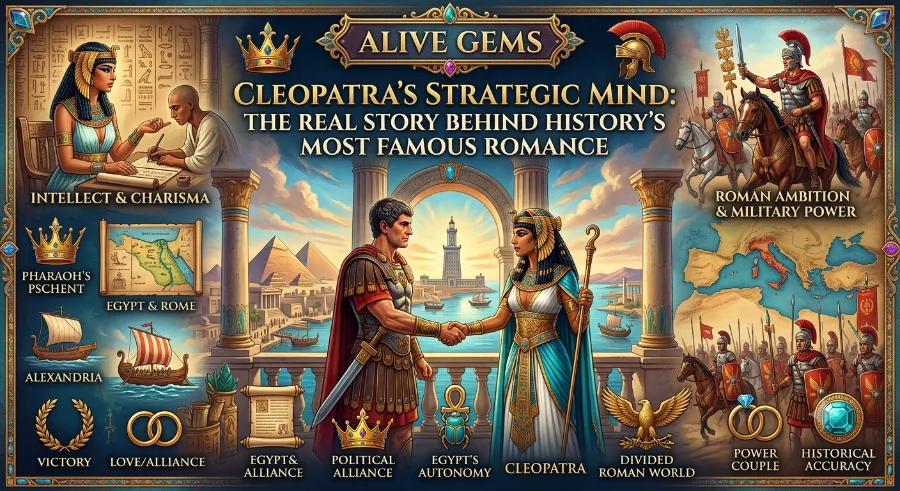
Key Takeaways
| Topic | Quick Insight |
|---|---|
| Real Skillset | Cleopatra spoke multiple languages and managed Egypt’s economy, trade, and military alliances directly |
| Caesar Relationship | Their alliance was rooted in mutual political benefit, not just romance, securing her throne and Rome’s grain supply |
| Antony Alliance | Cleopatra financed Antony’s military campaigns and shaped a joint eastern power base against Rome |
| Public Image | She styled herself as the goddess Isis to unify Egyptians and legitimize her rule |
| Legacy | Her death marked the end of the Ptolemaic dynasty and the beginning of Egypt as a Roman province in 30 BC |
TL;DR: Cleopatra VII was not just a romantic figure but a shrewd political strategist who used language, diplomacy, religion, and economic power to keep Egypt independent for nearly two decades. Her relationships with Julius Caesar and Mark Antony were built on real political calculation, not just attraction. Her downfall came from a war she lost, not a love story that failed.
Who Was Cleopatra Really, Beyond the Beauty Myth
Cleopatra leadership beyond beauty starts with a fact most people never learn in school. She was actually Greek, not Egyptian by blood. She descended from Ptolemy I, a general under Alexander the Great who took control of Egypt after Alexander’s death in 323 BC. For nearly 300 years, her family ruled Egypt while mostly staying separate from local Egyptian culture and language.
Cleopatra broke that pattern. According to ancient historian Plutarch, she was the first Ptolemaic ruler in three centuries to actually learn the Egyptian language. She also reportedly learned Ethiopian, Hebrew, Arabic, Syriac, Median, and Parthian, on top of her native Greek. That alone tells you something important. This was a woman preparing herself to negotiate directly with different peoples without needing translators standing between her and power.
She came to the throne in 51 BC at just 18 years old, ruling jointly with her younger brother Ptolemy XIII, as Egyptian tradition required siblings to co-rule and often marry. Within a few years, palace advisors pushed her out and she was forced into exile. This is the part most romance-focused retellings skip entirely. Before there was ever a Caesar or an Antony, there was a teenage queen fighting to reclaim a throne that was legally hers.
If you enjoyed learning about rulers who rebuilt their power from nothing, Cyrus the Great did something similar centuries earlier, turning conquest into a surprisingly progressive system of governance.
The Family Business of Betrayal
The Ptolemaic dynasty was, honestly, brutal. Siblings killed siblings. Parents exiled children. Cleopatra’s own father, Ptolemy XII, executed her older sister Berenice IV for taking the throne while he was away. So when Cleopatra found herself exiled by her brother’s advisors, she understood the stakes immediately. In her family, losing power usually meant losing your life.
This is the emotional core that gets lost in popular retellings. Cleopatra was not playing games. She was surviving a system where failure often ended in death.
Cleopatra Caesar Antony Real Relationships Explained
The Caesar Alliance: A Political Masterstroke
In 48 BC, Julius Caesar arrived in Alexandria chasing his rival Pompey, who had just been murdered by Egyptian officials trying to win Caesar’s favor. Cleopatra, exiled and desperate to reclaim her throne, needed Caesar’s backing. According to tradition, she had herself smuggled into the palace rolled inside a carpet or bedroll to reach Caesar without her brother’s guards intercepting her.
This single act shows real strategic thinking. She bypassed an entire hostile court and put herself directly in front of the one man who could restore her power. Within a year, Caesar backed her claim, her brother Ptolemy XIII drowned fleeing battle, and Cleopatra was firmly back on the throne, this time with Rome’s most powerful general as her ally.
Their relationship produced a son, Caesarion, born around 47 BC. She later traveled to Rome and stayed there during Caesar’s dictatorship, which was a bold and controversial move for a foreign queen. Ancient female rulers political genius often gets reduced to bedroom stories, but Cleopatra’s real genius was recognizing that Egypt’s independence depended on being useful, not just charming, to Rome. Egypt supplied enormous amounts of grain that fed the Roman population, and that leverage mattered just as much as any personal connection.
For readers curious how another towering Roman figure operated behind the political curtain, Julius Caesar turned Rome into his stage in ways that mirror Cleopatra’s own theater of power.
After Caesar’s Death: Rebuilding From Chaos
Caesar was assassinated in 44 BC, and Cleopatra’s position suddenly became fragile again. She returned to Egypt and had to navigate a Roman civil war between Caesar’s allies and his assassins, all while managing a kingdom hit by drought and famine. Ancient sources describe severe Nile flooding failures during this period, which devastated Egyptian grain production, Egypt’s primary economic engine.
This is a part of her story that rarely gets attention. While Rome tore itself apart, Cleopatra was managing an actual humanitarian and economic crisis at home. She reportedly opened royal granaries to feed her people during the famine, a move any modern crisis manager would recognize as smart, necessary leadership.
The Antony Alliance: Love, Money, and Military Strategy
In 41 BC, Mark Antony summoned Cleopatra to Tarsus to answer questions about her loyalty during the civil war. Instead of arriving as a nervous subject, she sailed in on an extravagantly decorated barge, dressed as the goddess Aphrodite, according to Plutarch’s famous account. It was theater, but it was also strategy. She was reminding Antony, and everyone watching, that she was untouchable royalty, not a vassal begging for mercy.
Their alliance quickly became both personal and political. Cleopatra funded Antony’s military campaigns, including his costly and ultimately disastrous invasion of Parthia in 36 BC. In return, Antony granted Cleopatra and her children control over territories including Cyprus, parts of Lebanon, and sections of Judea, expanding Egyptian influence far beyond its borders.
They had three children together, and in 34 BC, during an event historians call the Donations of Alexandria, Antony publicly declared Cleopatra “Queen of Kings” and divided vast eastern territories among her children. This was not romantic indulgence. This was empire-building, using a genuine partnership between two rulers who each needed something the other could provide.
Rome saw it very differently. Octavian, Caesar’s adopted heir, used the Donations as propaganda, framing Antony as a Roman general who had abandoned Rome for an eastern queen. That narrative eventually fueled the war that ended everything.
If military overreach and alliance politics interest you, Hannibal Barca outsmarted Rome’s generals using a completely different but equally daring strategic mindset against the same empire.
How Cleopatra Used Religion and Image as Political Tools
Here is something most textbooks barely mention. Cleopatra deliberately presented herself as the living embodiment of the goddess Isis. She appeared at public events wearing Isis’s traditional dress and headdress, reinforcing to Egyptian citizens that her rule was sacred, not just political.
This mattered enormously because most of her Ptolemaic ancestors never bothered learning Egyptian customs or religion. They ruled as outsiders. Cleopatra flipped that entirely, positioning herself as a genuinely Egyptian queen blessed by the gods, which built loyalty among ordinary citizens in a way pure military force never could.
She also minted coins showing her own image, sometimes alongside Antony, which was a deliberate propaganda tool. Coins traveled across trade routes and marketplaces, meaning her image and message reached far beyond the palace walls.
A few key strategic tools Cleopatra relied on throughout her reign:
- Mastery of multiple languages to negotiate directly with foreign powers
- Religious symbolism, particularly association with Isis, to secure domestic loyalty
- Control of Egypt’s grain supply as economic leverage over Rome
- Strategic alliances with Rome’s most powerful men to protect Egyptian independence
- Public spectacle and image control, essentially ancient-world personal branding
The Final War and the End of an Independent Egypt
By 32 BC, Octavian declared war, technically against Cleopatra rather than Antony, framing it as Rome defending itself against a foreign queen rather than admitting it was really a Roman civil war. The decisive naval Battle of Actium happened in September of 31 BC, off the coast of Greece. Antony and Cleopatra’s combined fleet lost badly to Octavian’s forces led by his general Agrippa.
The couple retreated to Alexandria, but their position kept collapsing. In August of 30 BC, with Octavian’s forces closing in and no realistic path to victory, Antony took his own life after receiving false news that Cleopatra had already died. Cleopatra, according to most ancient accounts, died shortly after, reportedly by allowing an asp, a venomous snake, to bite her, though some modern historians debate whether poison was actually used instead.
Her death marked the end of the nearly 300 year old Ptolemaic dynasty and the moment Egypt officially became a province of the Roman Empire. The independent line of pharaohs that had ruled Egypt for thousands of years, in one form or another, was finished.
For readers who enjoy exploring how ancient rulers handled defeat and legacy, Ramesses II lost a battle but convinced everyone he won, which offers a fascinating contrast in how ancient leaders managed narrative even in failure.
Cleopatra by the Numbers
| Event | Year | Age of Cleopatra |
|---|---|---|
| Became co-ruler of Egypt | 51 BC | 18 years old |
| Exiled by palace advisors | 49 BC | 20 years old |
| Allied with Julius Caesar | 48 BC | 21 years old |
| Son Caesarion born | 47 BC | 22 years old |
| Caesar assassinated | 44 BC | 25 years old |
| Alliance with Mark Antony begins | 41 BC | 28 years old |
| Donations of Alexandria | 34 BC | 35 years old |
| Battle of Actium | 31 BC | 38 years old |
| Death, end of Ptolemaic Egypt | 30 BC | 39 years old |
What Modern Leadership Can Still Learn From Cleopatra
Working through primary accounts from Plutarch, along with modern historical analysis, a pattern becomes obvious. Cleopatra rarely relied on force alone. She built coalitions, she controlled her public image with intention, and she made herself economically indispensable to the most powerful empire on earth. That is a genuinely modern leadership playbook, executed over 2,000 years ago.
Historians studying ancient female rulers political genius often point out that Cleopatra’s real innovation was blending soft power, cultural legitimacy, and hard economic leverage into one cohesive strategy. Few rulers, male or female, managed all three at once as effectively as she did.
She also understood something many modern leaders forget. Alliances built purely on affection rarely survive pressure. Her partnerships with both Caesar and Antony worked because each side gained something concrete, protection and legitimacy for her, resources and eastern territory for them.
If you want to explore the broader world of ancient leaders who used charisma as a genuine strategic tool rather than just personality, the ultimate guide to ancient world legends and charismatic leaders breaks down several figures who shaped history far beyond their popular myths, including Alexander the Great’s charisma that pushed him to the edge of the known world and Ashoka the Great’s transformation from brutal warrior to enlightened ruler.
For those wanting a deeper academic breakdown of her actual reign and administrative decisions, this detailed analysis on Cleopatra’s reign is worth reading, along with this thoughtful piece on Cleopatra’s love, power, and propaganda. If you are interested in visiting the actual historical sites connected to her story, this Egypt travel guide covers locations tied directly to her reign.
Quick Quiz: How Well Do You Know Cleopatra’s Real Story
- What languages did Cleopatra reportedly speak fluently?
- In what year did Cleopatra ally with Julius Caesar?
- What goddess did Cleopatra associate herself with publicly?
- Where did the decisive naval battle against Octavian take place?
- In what year did Egypt officially become a Roman province?
Multiple Choice Bonus Questions
- Cleopatra’s alliance with Mark Antony was primarily:
a) Purely romantic with no political benefit
b) A mutually beneficial political and military partnership
c) Forced upon her against her will - The Donations of Alexandria involved:
a) Antony giving Roman citizenship to Egyptians
b) Antony granting eastern territories to Cleopatra and her children
c) Cleopatra donating grain to Rome - Cleopatra’s death occurred shortly after:
a) The Battle of Actium
b) Her coronation
c) Caesar’s assassination
Frequently Asked Questions
Was Cleopatra actually Egyptian?
No, she descended from Ptolemy I, a Macedonian Greek general under Alexander the Great. She was the first in her dynasty to genuinely embrace Egyptian language and culture.
Did Cleopatra really die from a snake bite?
Most ancient sources, including Plutarch, describe death by an asp bite, but modern historians debate this, with some suggesting poison was more likely the actual method.
Was Cleopatra known for extraordinary beauty?
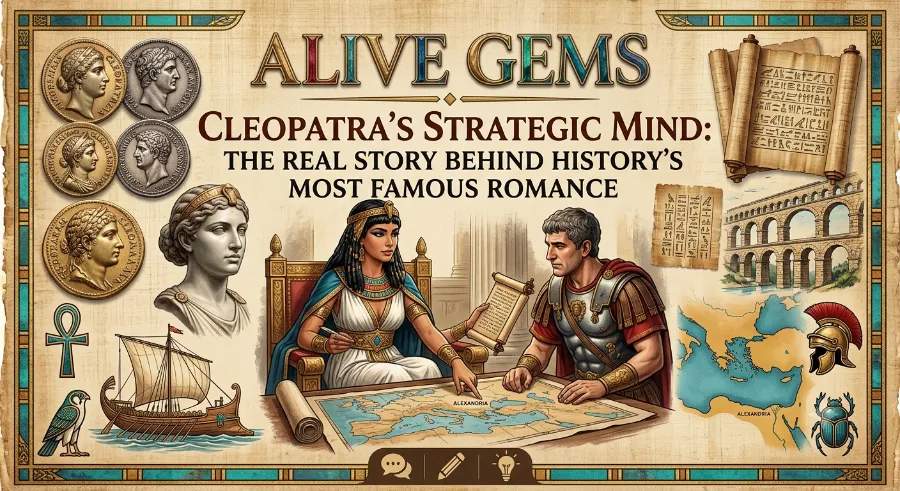
Ancient coins depicting her show fairly ordinary features by classical standards. Historians increasingly argue her real influence came from intelligence, charm, and political skill rather than physical beauty alone.
How many children did Cleopatra have?
She had one son, Caesarion, with Julius Caesar, and three children with Mark Antony, including twins Alexander Helios and Cleopatra Selene II, plus a younger son, Ptolemy Philadelphus.
Why did Rome go to war against Cleopatra specifically?
Octavian framed the conflict as Rome defending itself against a foreign queen rather than admitting it was fundamentally a Roman civil war against Antony, making Cleopatra a convenient political target.
Conclusion
Cleopatra VII was not simply a woman who charmed powerful men into loving her. She was a queen who used every tool available, language, religion, economics, and yes, personal alliances, to keep her kingdom independent against the growing weight of Rome. Her story deserves to be remembered as one of political genius under enormous pressure, not just a romance that ended in tragedy. When you strip away the myths, what remains is a young ruler who fought fiercely, adapted constantly, and nearly outmaneuvered the most powerful empire the ancient world had ever seen.
References
- Plutarch, “Life of Antony,” Parallel Lives Cleopatra’s Strategic Mind
- Cassius Dio, Roman History, Book 51 Cleopatra’s Strategic Mind
- Suetonius, “The Twelve Caesars,” Life of Julius Caesar Cleopatra’s Strategic Mind
- Duane W. Roller, “Cleopatra: A Biography,” Oxford University Press Cleopatra’s Strategic Mind
- Stacy Schiff, “Cleopatra: A Life,” Little, Brown and Company Cleopatra’s Strategic Mind
- Ancient coinage archives, various Ptolemaic and Roman numismatic collections Cleopatra’s Strategic Mind