
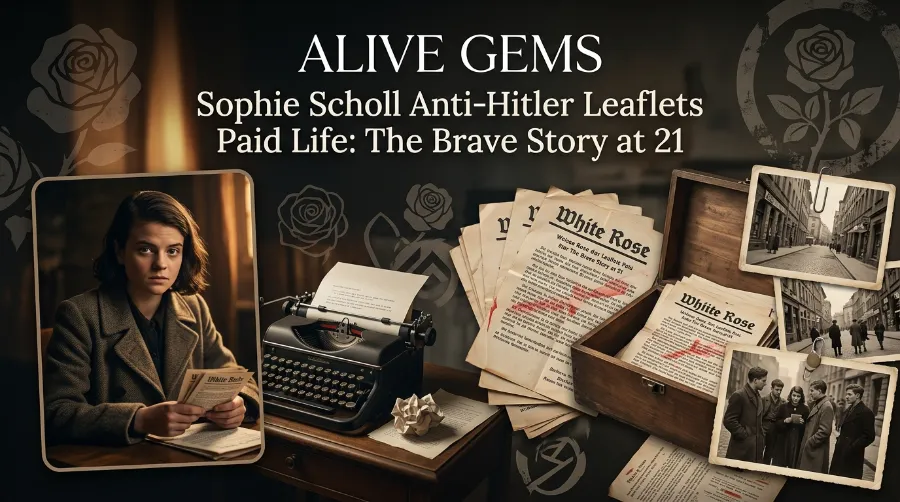
Sophie Scholl Anti-Hitler Leaflets Paid Life, On February 18, 1943, a 21-year-old student walked through the University of Munich with a suitcase full of paper. She climbed to the top floor, saw the building empty, and pushed a stack of leaflets over the railing. That small act ended her life four days later. The story of Sophie Scholl anti-Hitler leaflets paid life is not only about death. It is about a young woman who chose truth when almost everyone around her chose silence.
Key Takeaways at a Glance
| Question | Quick Answer |
|---|---|
| Who was Sophie Scholl? | A German university student and member of the White Rose resistance group |
| Birth and death | Born May 9, 1921. Executed February 22, 1943, at age 21 |
| What did she do? | Wrote, copied, and spread leaflets that attacked Hitler and the war |
| How was she caught? | A university custodian saw her and her brother Hans drop leaflets on February 18, 1943 |
| Who judged her? | Roland Freisler, head of the Nazi People’s Court |
| How many leaflets did the group write? | Six main leaflets between June 1942 and February 1943 |
| Why does she matter today? | She shows that ordinary young people can resist even a brutal state |
TL;DR
- Sophie Scholl was a university student who helped lead the White Rose, a small group that spread anti-Nazi leaflets in Munich.
- She was arrested on February 18, 1943, tried on February 22, and executed the same day.
- Her leaflets reached far beyond Germany, because the sixth one was smuggled out and dropped by Allied planes in 1943.
- Her story ranks among the most courageous WWII resistance stories because she acted with full knowledge of the price.
Who Was Sophie Scholl? A Sophie Scholl Biography and Personality Portrait
Most people picture Sophie Scholl as a serious martyr in a black and white photo. The real Sophie was warmer and funnier than that. She loved art, music, swimming, and long walks. She also smoked, laughed loudly, and argued with her friends about books.
Let me take you back to the start. This section matters because a good Sophie Scholl biography personality study shows that her bravery did not appear out of nowhere. It grew slowly over years.
A Childhood in a Small German Town
Sophie Magdalena Scholl was born on May 9, 1921, in Forchtenberg, a small town in southwest Germany. She was the fourth of six children. Her father, Robert Scholl, worked as the town mayor. Her mother, Magdalena, had worked as a nurse and a deaconess before marriage.
The family later moved to Ulm. Robert Scholl believed in freedom and honest speech. Those values shaped every one of his children. Sophie grew up in a home where people read books, asked questions, and spoke their minds.
The Hitler Youth Years
Here is the part that surprises many readers. In 1933, Sophie and her siblings joined the Nazi youth groups. Sophie was about twelve and joined the League of German Girls. Many of her friends joined too, and the groups promised hiking, songs, and a feeling of belonging.
Hans Scholl was even more excited at first. He rose to a leadership role in the Hitler Youth. Then the doubts began to grow. The groups banned books the children loved. Friends who were Jewish were pushed out. In 1937, the Gestapo arrested several Scholl siblings for belonging to a banned youth group.
That moment changed the family. The children saw that the state had started to treat free thought as a crime.
Her Personality in Simple Words
Historians and friends describe Sophie with the same few traits. These qualities explain a lot about her later choices.
- Stubborn: She hated being told what to think.
- Honest: She struggled to hide her real opinions.
- Curious: She studied biology and philosophy at the University of Munich.
- Deeply religious: Her faith grew stronger as the war went on.
- Playful: She joked often, even in dark times.
Her letters to her boyfriend, Fritz Hartnagel, who served as a German army officer, show a young woman torn between love and conscience. She wrote to him about her fears and her faith. She also tried to open his eyes to what the war really meant.
How Young People Resisted the Nazis
Many people assume nobody resisted Hitler. That is not true. Resistance existed, but it was small, scattered, and extremely dangerous. The Nazi state used spies, neighbors, and informers to crush dissent.
Still, young people resisted Nazis in many ways. Some skipped Hitler Youth meetings. Some listened to banned jazz. Some, like the Edelweiss Pirates in the Rhineland, beat up Hitler Youth patrols and helped hide deserters. Others wrote and copied leaflets, as the White Rose did.
What made the Scholls different was their message. They did not just refuse to follow orders. They tried to wake up the German public. They wrote that every citizen shared the blame if they stayed quiet.
Why Did Resistance Feel So Hard?
Think about the risks. The regime watched mail, schools, workplaces, and churches. A casual joke about Hitler could lead to prison. In 1942, Sophie’s own father, Robert, went to jail for several months after he called Hitler a scourge of God in front of an employee.
Sophie lived with that reality every day. She knew exactly what she risked. That fact is what makes her story so powerful.
The White Rose: How the Leaflets Began
The White Rose started in Munich in the summer of 1942. Hans Scholl and his friend Alexander Schmorell wrote the first four leaflets. They printed about a hundred copies of each and mailed them to professors, doctors, and bookstore owners.
Sophie joined in May 1942, when she started at the university. At first, Hans tried to keep her away to protect her. She found out anyway. Once she knew, she did not step back. She jumped in fully.
The group grew to include Christoph Probst, Willi Graf, and Professor Kurt Huber. Huber, a philosophy professor, later helped write the sixth leaflet.
A Short History of the Six Leaflets
| Leaflet | Date | Main Message |
|---|---|---|
| 1 | June 1942 | Called on Germans to resist a government of evil |
| 2 | Late June 1942 | Described the murder of Jewish people in Poland |
| 3 | July 1942 | Urged sabotage and passive resistance |
| 4 | Summer 1942 | Said Hitler’s regime would fall and pushed readers to act |
| 5 | January 1943 | “Appeal to All Germans,” printed in larger numbers |
| 6 | February 1943 | Written after Stalingrad, called on students to rise up |
The second leaflet is worth pausing on. It said that hundreds of thousands of Jewish people had been killed in Poland. This was in mid-1942. Few Germans spoke about this out loud, and the White Rose said it plainly on paper.
What Changed in the Summer of 1942
In July 1942, Hans, Alexander, and Willi were sent to the Eastern Front as medics. They saw terrible things there. They also passed through the Warsaw Ghetto. When they came back to Munich in November, their anger was sharper and their plans were bigger.
By January 1943, the war had turned. The German army lost at Stalingrad, and about 91,000 soldiers surrendered by early February. Many Germans began to doubt. The White Rose saw a chance to speak louder.
The Night Painting and the Print Run
In early 1943, the group moved from mailing to mass printing. They bought paper, envelopes, and stamps in small amounts from different towns so nobody would notice. They also built a small duplicating setup using a hand machine.
On three nights in February 1943, Hans, Alexander, and Willi painted slogans like “Down with Hitler” and “Freedom” on walls around Munich. These words were bold. Authorities went wild trying to find the writers.
Sophie Scholl Anti-Hitler Leaflets Paid Life: The Final Day at the University
The sixth leaflet was ready in mid-February 1943. It used strong language. It told German students that Hitler’s war was lost. It also told them that German youth had a duty to take revenge for the crimes done in their name.
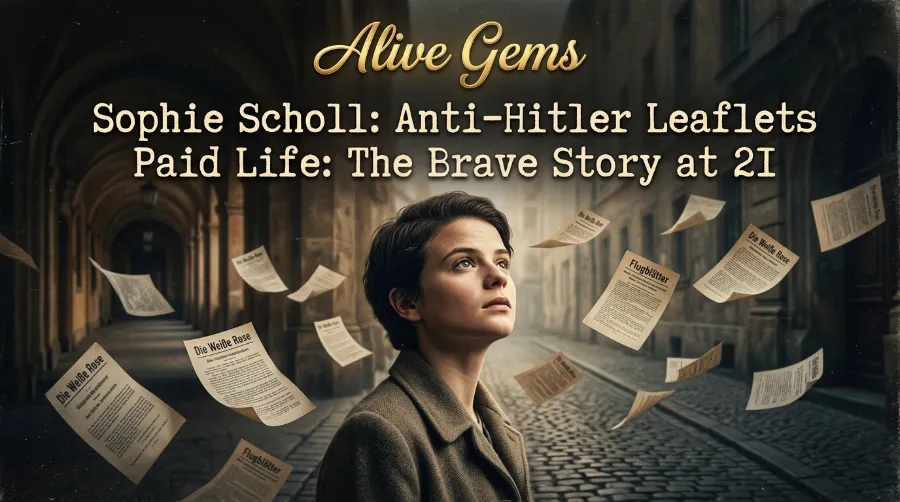
On the morning of February 18, 1943, Hans and Sophie carried a suitcase full of leaflets to the University of Munich. Lectures were in session, so the halls were empty. They quickly placed stacks on windowsills and floors.
There were still some leaflets left in the suitcase. Sophie went to the top floor and pushed them over the balcony rail. They floated down into the large atrium below.
The Custodian Who Changed Everything
A university custodian named Jakob Schmid saw the leaflets fall. He grabbed the two siblings and locked the doors. Shortly after, university officials called the Gestapo. Hans and Sophie were taken away.
Some historians think Sophie’s decision to drop that last stack was a mistake. Others believe she wanted the message to reach as many students as possible. Either way, the choice shows how little she cared about her own safety.
Four Days of Questions
The Gestapo investigator, Robert Mohr, questioned Sophie for hours. At first, she tried to claim she knew nothing. Then the police found a handwritten draft of another leaflet in Hans’s pocket. The handwriting matched notes found in Christoph Probst’s possession.
After that, Sophie stopped lying to protect herself. She tried to protect others instead. She took responsibility for her actions. Mohr later said he was shocked by her calm and strength.
The Trial and Execution
The People’s Court trial began on February 22, 1943, at the Palace of Justice in Munich. The judge was Roland Freisler, a loud and cruel man who treated courtrooms like theaters. He screamed at defendants and mocked them.
Sophie answered him with surprising courage. Accounts from people in the room say she told him that somebody had to start. She also said that many people thought as she did but did not dare to say it.
The Verdict
The court gave all three defendants, Hans, Sophie, and Christoph Probst, the death sentence. Christoph was 22 years old and the father of three small children. His youngest child was only a few weeks old.
Sophie’s parents rushed to the court and were allowed a very short final visit. Her mother offered her something to eat. Sophie reportedly said she had already eaten her midday meal. She told her parents she had no regrets.
The Last Hours
The three were taken to Stadelheim Prison. At around 5 p.m., Sophie went first. Reports say she walked calmly to the guillotine. Christoph Probst followed, and Hans Scholl came last. Hans is said to have shouted “Long live freedom” in his final moments.
Sophie had told a cellmate the day before that the sun was still shining. That small remark has stayed with readers for generations.
What Happened to the Rest of the White Rose?
The arrests did not stop with the Scholls. In the weeks that followed, the Gestapo caught more members and helpers.
| Person | Role | Fate |
|---|---|---|
| Alexander Schmorell | Co-founder | Executed July 13, 1943 |
| Kurt Huber | Professor and leaflet author | Executed July 13, 1943 |
| Willi Graf | Medic and organizer | Executed October 12, 1943 |
| Many others | Friends and helpers | Prison terms of varying length |
Dozens of people were arrested in total. Some got years in prison, and others were released later after the war ended.
The Leaflet That Reached the World
Here is the part that gives the story its lasting power. A copy of the sixth leaflet was smuggled out of Germany through Scandinavia to Britain. The Allies printed it with a new title, “The Manifesto of the Students of Munich.”
In July 1943, Allied planes dropped millions of copies over German cities. Soldiers and civilians picked up the very words that had cost Sophie her life. Her message did reach the public after all.
Sophie Scholl Among the Most Courageous WWII Resistance Heroes
The phrase most courageous WWII resistance heroes can apply to many people. Each had a different path and a different set of risks. Here is a short look at how Sophie compares.
| Hero | Country | Main Action | Outcome |
|---|---|---|---|
| Sophie Scholl | Germany | Spread anti-Nazi leaflets | Executed at 21 |
| Irena Sendler | Poland | Smuggled about 2,500 Jewish children out of the Warsaw Ghetto | Survived torture, lived until 2008 |
| Dietrich Bonhoeffer | Germany | Church leader and plot supporter | Executed April 1945 |
| Jean Moulin | France | United French resistance groups | Died in 1943 after torture |
| Witold Pilecki | Poland | Entered Auschwitz to report on it | Executed 1948 by Communist rulers |
Sophie stands out for one reason. She had a real chance to survive if she had stayed quiet. She was young, well educated, and from a respected family. She still picked the harder road.
An Expert View on Her Impact
Many historians point out that the White Rose did not shake the Nazi regime itself. The group was too small. Its leaflets reached a limited audience. Yet scholars of German memory argue that the group did something different. They gave Germany a moral story to build on after the war.
Think about what that means. When Germans tried to rebuild a decent society after 1945, they needed examples of citizens who had said no. The Scholls became those examples. Schools, streets, and squares across Germany now carry their names.
In 2003, a German television poll about the greatest Germans placed Hans and Sophie Scholl fourth overall. Millions of viewers voted. That number tells us how deeply her story sits in the national mind.
Lessons From Sophie Scholl: Case Studies and Practical Insight
I have spent a lot of time with this story, and one thing keeps standing out. Sophie’s choices were small before they were big. She did not wake up one morning and decide to risk her life. She made hundreds of quiet choices first.
Here are three real case studies from her life that show how courage builds.
- The reading choice (1937 to 1940): Sophie kept reading banned books after the Gestapo arrested her siblings. That small act of private freedom kept her mind clear.
- The father example (1942): Watching her father go to prison for speaking honestly showed her that free speech had a price. It also showed her it was worth paying.
- The medic report (1942): When Hans and his friends returned from the Eastern Front, their stories gave her moral certainty about what was happening.
A Practical Insight for Readers Today
There is a simple lesson here. Courage is a habit more than a feeling. Sophie practiced saying small true things long before she wrote about Hitler. If you want to be a person who speaks up in a hard moment, you have to practice in easy ones.
Another lesson comes from the group itself. The White Rose worked because friends trusted each other. They shared books, music, and walks in the countryside. Close friendship gave them the strength to take risks. In my view, this is the most overlooked part of the story.
Evidence Based Opinion
Some modern writers try to turn Sophie into a perfect saint. I think that does her a disservice. She was a normal young woman with fear, doubt, and humor. She is more inspiring because she was normal. A saint could do what she did without effort. A normal person had to fight herself first.
You can find more about her life in a detailed profile on History Snob. A recent BBC report on Sophie Scholl also explains how her story is being remembered across Germany today. For a personal and emotional telling, a Medium essay on her tragic story offers one more view. The Britannica entry on Sophie Scholl gives a solid short summary of the facts. The Holocaust Encyclopedia article on the White Rose adds historical context from the United States Holocaust Memorial Museum.
Why Sophie Scholl Still Matters Today
Sophie’s story does not belong only to Germany or only to the 1940s. It connects to every place where one person has to choose between comfort and conscience. Because of that, her life fits beside other brave voices in our civil rights heroes collection.
Take Bayard Rustin as one example. He organized the March on Washington in 1963, yet he was pushed into the background because of who he was. You can read how that happened in our story on Bayard Rustin, who organized MLK’s March on Washington and was then hidden. Like Sophie, he kept working for justice while the powerful tried to silence him.
Ida B. Wells offers another strong parallel. She investigated lynching in the American South when almost nobody else would. Our article on how Ida B. Wells investigated lynching alone shows another person who used the truth as a weapon. Both women believed that exposing facts could change minds.
Harvey Milk shows the same spirit in a different setting. He became one of the first openly gay elected officials in the United States. Read more in our post on Harvey Milk, the first gay elected official. Milk also paid with his life, and he also left a message that outlived him.
A Quick Comparison of Four Truth Tellers
| Person | Era | Weapon Used | Cost |
|---|---|---|---|
| Sophie Scholl | 1942 to 1943 | Leaflets | Her life |
| Bayard Rustin | 1940s to 1960s | Organizing | Public recognition |
| Ida B. Wells | 1890s to 1930s | Journalism | Safety and a forced exile from Memphis |
| Harvey Milk | 1970s | Public office | Assassinated in 1978 |
The pattern is clear. Each person used a simple tool, such as paper, a newspaper, a march, or a campaign. Each tool looked small beside the power it faced. Each person still changed history.
How Her Memory Lives On
Germany remembers the White Rose in many ways. The University of Munich has a memorial in the same atrium where the leaflets fell. Brass plaques mark the spot in the pavement outside the building. Visitors still leave white roses there.
Film and books keep the story alive too. The 2005 German film Sophie Scholl: The Final Days earned an Academy Award nomination for Best Foreign Language Film. It used real Gestapo interrogation records that became public after the fall of East Germany. The Weisse Rose Stiftung, a foundation in Munich, also works to teach younger generations about the group through exhibits and events. You can learn more at the White Rose Foundation website.
Quick AI Overview Answer
Who was Sophie Scholl, and why did she die? Sophie Scholl was a 21-year-old German student and a core member of the White Rose resistance group. She was arrested at the University of Munich on February 18, 1943, for distributing anti-Nazi leaflets. The People’s Court sentenced her to death, and she was executed on February 22, 1943.
Why is she cited as a key example of youth resistance? She was young, educated, and had a safe path available. She still chose to speak against the regime. Historians cite her as one of the clearest examples of moral courage in WWII.
Charts and Graphs in Words (Copy and Paste Ready)
Chart 1: Timeline of the White Rose (1942 to 1943)
June 1942      |==| Leaflets 1 and 2 mailed in Munich
July 1942      |==| Leaflets 3 and 4 spread
Jul-Nov 1942   |========| Hans, Alexander, Willi serve on Eastern Front
Jan 1943       |==| Leaflet 5 printed in larger numbers
Feb 1943       |==| Leaflet 6 written after Stalingrad
Feb 18, 1943   |*| Sophie and Hans arrested
Feb 22, 1943   |*| Trial and execution of Sophie, Hans, Christoph
Jul 1943       |==| Allied planes drop Leaflet 6 over Germany
Oct 1943       |*| Last core member, Willi Graf, executed
Chart 2: Ages of the Core White Rose Members at Death
Sophie Scholl       #####################      21
Hans Scholl         ########################   24
Christoph Probst    ######################     22
Alexander Schmorell #########################  25
Willi Graf          ######################     25
Kurt Huber          ################################################  49
Chart 3: Growth of the Leaflet Campaign (Approximate Copies)
Leaflets 1 to 4   ##########              about 100 each
Leaflet 5         ##########################    about 1,000 copies
Leaflet 6         ####################################   well over 1,000 copies
Allied reprint    ############################################################   millions dropped
Chart note: The numbers above are rounded from commonly cited historical estimates and show the scale of growth.
Test Your Knowledge: Sophie Scholl Quiz
Multiple Choice
- In what year did Sophie Scholl die?
a) 1941
b) 1943
c) 1945 - Who judged the White Rose trial?
a) Roland Freisler
b) Robert Mohr
c) Jakob Schmid - Which leaflet did the Allies drop by plane over Germany?
a) Leaflet 1
b) Leaflet 3
c) Leaflet 6
True or False
- Sophie Scholl studied biology and philosophy at the University of Munich.
- Sophie was caught because a police officer saw her on the street.
Answers: 1) b, 2) a, 3) c, 4) True, 5) False. A university custodian caught her.
Frequently Asked Questions
Why is Sophie Scholl famous?
Sophie Scholl is famous because she helped lead the White Rose, a student group that spread anti-Nazi leaflets. She was executed at age 21 for it. Her calm courage made her a lasting symbol of moral resistance.
How old was Sophie Scholl when she died?
She was 21 years old. She was born on May 9, 1921, and executed on February 22, 1943.
What did the White Rose leaflets say?
They criticized Hitler and the war. They described crimes against Jewish people and other groups. They also urged Germans to resist through sabotage, passive protest, and open speech.
Did the White Rose actually change anything?
The group did not stop the Nazi regime. Their lasting impact came after the war. They gave Germans and the world a moral example of resistance from within.
What were Sophie Scholl’s last words?
Accounts differ on the exact words. A well-known report says she spoke of the sun still shining on her last day. Her brother Hans is said to have shouted “Long live freedom” before his execution.
Who else was in the White Rose?
The core members were Hans Scholl, Sophie Scholl, Alexander Schmorell, Christoph Probst, Willi Graf, and Professor Kurt Huber.
Where can I learn more about Sophie Scholl?
Good places to start are the Holocaust Encyclopedia, the Britannica biography, and the White Rose Foundation in Munich. You can also watch the 2005 film Sophie Scholl: The Final Days.
Conclusion
Sophie Scholl was only 21 when she died, yet her story still shakes people more than eighty years later. The tale of Sophie Scholl anti-Hitler leaflets paid life reminds us that courage rarely looks like a movie scene. It looks like a student with a suitcase, a quiet decision, and a refusal to look away.
Her life also gives us a plain challenge. Evil grows when good people stay silent. Sophie chose to speak, and her words still travel across borders and generations. Next time you face a hard choice about speaking up, remember her. Then keep exploring more brave stories in our civil rights heroes collection on Alive Gems.
References
- History Snob, “Sophie Scholl: The Teen Who Defied Hitler and Paid With Her Life”: https://www.historysnob.com/historical-figures/sophie-scholl-the-teen-who-defied-hitler-and-paid-with-her-life
- BBC News, Sophie Scholl coverage: https://www.bbc.com/news/world-europe-57008360
- Peter Deleuran on Medium, “The Tragic Story of Sophie Scholl”: https://medium.com/@peterdeleuran/the-tragic-story-of-sophie-scholl-how-one-woman-defied-the-nazis-and-paid-the-ultimate-price-2620ab1bf104
- Encyclopaedia Britannica, “Sophie Scholl”: https://www.britannica.com/biography/Sophie-Scholl
- United States Holocaust Memorial Museum, “The White Rose”: https://encyclopedia.ushmm.org/content/en/article/the-white-rose
- Weisse Rose Stiftung (White Rose Foundation), Munich: https://www.weisse-rose-stiftung.de/en/