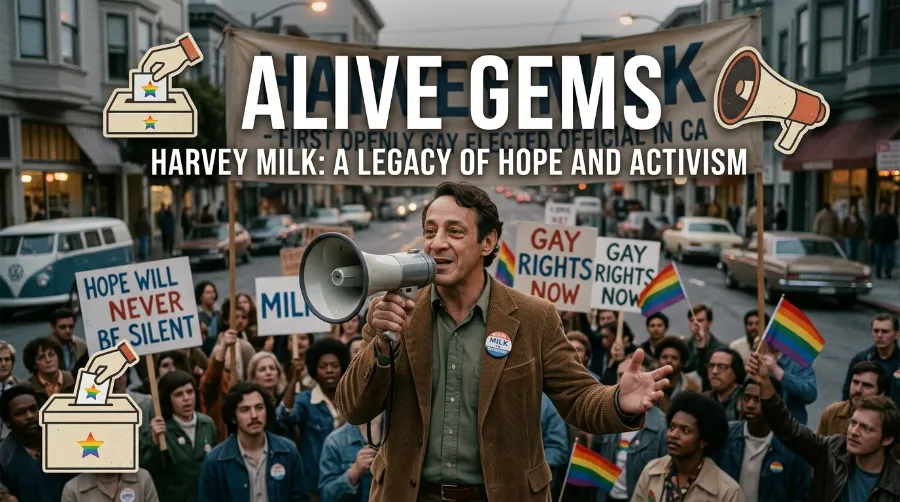
Harvey Milk First Gay Elected Official, On November 8, 1977, a camera store owner in San Francisco woke up as a public official. The story of Harvey Milk first gay elected official in California starts with a man who lost three elections and still kept smiling. He wore a thrift store suit, shook every hand on Castro Street, and told strangers that hope was a political tool. Then he won, and the country had to look at what he proved.
Sophie Scholl Anti-Hitler Leaflets Paid Life: The Brave Story at 21
Key Takeaway Table
| Question | Quick Answer |
|---|---|
| Who was Harvey Milk? | A San Francisco supervisor and LGBTQ rights leader (1930 to 1978) |
| What did he win? | Seat on the San Francisco Board of Supervisors, November 1977 |
| Was he truly the first? | First openly gay man elected in California, one of the first in the US |
| How long did he serve? | 323 days (January 8 to November 27, 1978) |
| Biggest win | Defeating Proposition 6 on November 7, 1978 |
| How did he die? | Shot by former supervisor Dan White at City Hall |
| Honors | Presidential Medal of Freedom (2009), US postage stamp (2014) |
| Out LGBTQ officials today | About 1,359 in the US as of May 30, 2026 |
TL;DR
- Harvey Milk won a San Francisco supervisor seat in 1977 and became the first openly gay man elected to public office in California.
- Other openly gay people won office in 1974, so “first in America” needs care, but no one matched his fame or impact.
- He passed a city gay rights ordinance, helped defeat Proposition 6, and gave millions a reason to hope before his murder in 1978.
Who Was Harvey Milk? A Short Biography
Harvey Bernard Milk was born on May 22, 1930, in Woodmere, New York. His grandfather came from Lithuania and helped start the first synagogue in the area. Young Harvey loved opera, baseball, and making people laugh.
He joined the Navy during the Korean War era and served as a diving officer. He left in 1955. Over the next fifteen years, he worked as a teacher, a Wall Street analyst, and a stagehand for Broadway shows.
He even backed Barry Goldwater in 1964. That surprises many readers. It shows that Milk changed his mind over time, which made him a better listener later.
If you want a deeper look at Harvey Milk biography charisma, start with the official Harvey Milk Foundation biography. It lays out his early life and his path to City Hall. The key point is simple. Milk did not begin as a revolutionary. He became one because he kept paying attention.
Was Harvey Milk the First Gay Elected Official? The Honest Answer
This is the question that confuses most people, so let’s clear it up. Many sources say Harvey Milk first gay elected official in the United States. Careful historians say he was one of the first. Both statements point to the same man, but only one is fully accurate.
Milk was the first openly gay elected official in California and one of the first in the United States. Before him, a few others had already won in 1974. Here is the short list. howard
| Name | Office | Year | Note |
|---|---|---|---|
| Kathy Kozachenko | Ann Arbor City Council, Michigan | 1974 | Often named the first openly gay person elected in the US |
| Elaine Noble | Massachusetts House of Representatives | 1974 | First openly gay state legislator elected |
| Allan Spear | Minnesota Senate | 1974 | Came out while already in office |
| Harvey Milk | San Francisco Board of Supervisors | 1977 | First openly gay man elected in California |
So why does Milk get the title in popular memory? Three reasons stand out. San Francisco is a big, loud stage. Milk also ran a campaign built for cameras and crowds. And his death turned a local story into a national one.
Here is my take as a writer who studies these stories. Being first matters less than being heard. Kozachenko and Noble opened the door. Milk walked through it, turned on the lights, and invited the whole country inside.
From Castro Street Shopkeeper to Movement Builder (1972 to 1976)
Milk moved to San Francisco in 1972 with his partner Scott Smith. They opened Castro Camera at 575 Castro Street in 1973. The shop sold film and fixed cameras. It also became a living room for a neighborhood that needed one.
At that time, gay residents faced police raids and open discrimination. Many lost jobs after being outed. Some gay businesses could not get a fair shot at a lease.
Milk noticed that shop owners had the power to organize. He and a few others founded the Castro Village Association. The Milk Foundation notes it was a first of its kind in the nation for mostly LGBT businesses, and Milk served as president. That small step taught him a big lesson. Money, votes, and visibility work together.
He ran for the Board of Supervisors in 1973 and lost. He ran again in 1975 and lost by a narrow margin. In 1976, he ran for the state Assembly and fell short by fewer than 4,000 votes against Art Agnos.
In between, Mayor George Moscone appointed him to the Board of Permit Appeals. That made Milk the first openly gay city commissioner in the United States. Each loss looked like failure. In truth, each one built a larger mailing list, a stronger volunteer team, and a sharper message.
Why Milk Was So Magnetic: The Charisma Playbook
People still ask why strangers followed him. I read a lot of speeches and campaign stories, and a few habits repeat. Here is what made his style work.
- He stood on a wooden crate. Milk spoke on street corners with a bullhorn and a joke.
- He used humor first. Audiences laughed before they felt challenged.
- He talked about money and potholes. He knew gay voters cared about rent, buses, and safety too.
- He asked people to come out. He said visibility was the strongest argument against fear.
- He made enemies useful. When critics attacked him, he turned the attack into a fundraiser.
Notice what is missing from this list. Milk did not win with perfect polish. He won with warmth, speed, and a very clear ask. That is a lesson any modern campaign can still use.
He also knew that politics is theater with consequences. He once joked at rallies that he was there to recruit people, which was his way of mocking the lie that gay people threaten children. The crowd roared. The point landed.
The 1977 Win That Made History
San Francisco changed its election system in 1977. Voters moved from citywide races to district races, so neighborhoods could pick their own supervisors. This shift gave Milk a fair chance. The Castro and nearby areas formed District 5, and Milk knew every block.
On November 8, 1977, he won a crowded race. He took office on January 8, 1978. The phrase Harvey Milk first gay elected official became a headline, a bumper sticker, and a threat to people who feared change.
His win sent a clear signal. A gay man could campaign openly, win real votes, and govern a major American city. Before that night, many people believed that was impossible.
As a result, the hate mail grew fast. SFO Museum’s exhibit on Milk notes that his high profile brought threats on his life. He kept a sense of humor, but he also recorded a tape in 1977 to be played if he were murdered. He knew the risk.
The Gay Rights Ordinance of 1978
Milk’s first big goal was a city law. He sponsored an ordinance that banned discrimination against gay people in housing and jobs. Howard University’s civil rights guide lists it among his top achievements.
The Board passed it 11 to 1. Only Supervisor Dan White voted no. Mayor Moscone signed it in April 1978.
That vote matters for two reasons. First, it protected real people from losing homes and paychecks. Second, it showed that a gay supervisor could win allies across the board.
The Fight Against Proposition 6
Later in 1978, California voters faced Proposition 6, also called the Briggs Initiative. State Senator John Briggs wrote it to ban gay teachers, and people who supported them, from public schools. Polls early on showed it ahead.
Milk traveled the state. He debated Briggs in front of crowds and cameras. He urged gay Californians to tell their families, coworkers, and neighbors the truth, because a vote against a neighbor is harder than a vote against a stranger.
On November 7, 1978, about 58 percent of voters rejected the measure. The ADL’s profile of Milk’s message shows how his fight against hate speaks to broader work for civil rights. That victory came just 20 days before his death. Milk lived long enough to see it.
The Hope Speech and the Words That Still Travel
On June 25, 1978, Milk spoke at San Francisco’s Gay Freedom Day rally. He told the crowd that young people in small towns needed to hear one thing: “you gotta give ’em hope.” People still repeat that line.
Why did it work? It spoke to a very human need. A teenager in Iowa or Bavaria or Manchester did not need a policy paper. That teen needed proof that a good life existed.
Milk also worked with artist Gilbert Baker, who sewed the first rainbow flag for the 1978 parade. The flag is now a global symbol. It began as a small act of cheer by a community that wanted to be seen.
November 27, 1978: Loss at City Hall
Dan White resigned from the Board on November 10, 1978. A few days later, he asked to get his seat back. Mayor Moscone planned to say no.
On November 27, White entered City Hall through a basement window with a gun. He shot Moscone first. Then he walked down the hall and shot Milk.
Milk had served just 323 days. He was 48 years old. Board president Dianne Feinstein announced the deaths, then became mayor.
That night, tens of thousands of people carried candles from the Castro to City Hall in silence. Many call it one of the most moving marches in American history. The grief showed how many lives Milk had touched.
White’s trial ended on May 21, 1979, with a conviction for voluntary manslaughter. The sentence was seven years and eight months. The short sentence angered thousands, and crowds rioted in what people call the White Night riots. White served about five years and died in 1985.
Milk had left a message for the world. He hoped his death would break open every closet door. In a real sense, it did. More people came out, more people voted, and more people ran for office.
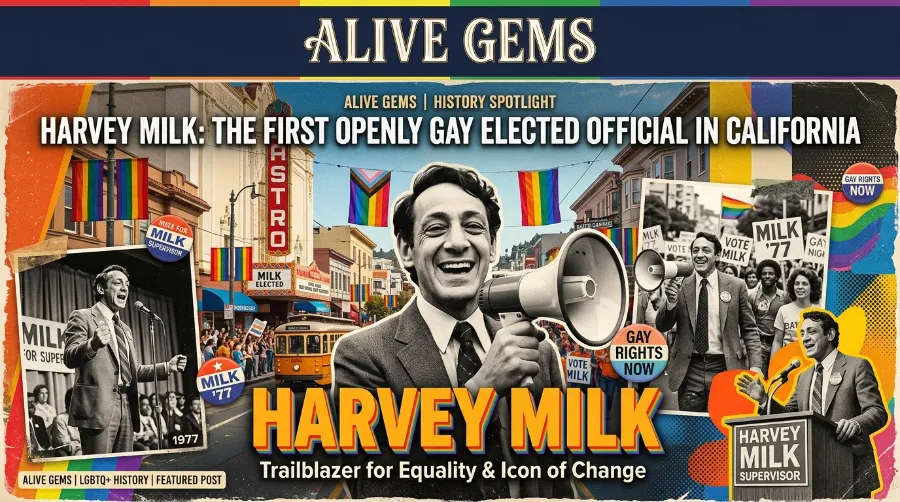
Why Harvey Milk First Gay Elected Official Still Matters in 2026
You might wonder if a 1977 story still fits today. The numbers say yes. Let’s look at what Milk set in motion.
The LGBTQ+ Victory Institute tracks out elected officials every year. The number grew from 448 in 2017 to 1,334 in 2025, a rise of 198 percent. The 2026 report counted numbers as of May 30, 2026, and the live map showed 1,357 shortly after, which puts the 2026 report at about 1,359. advocateebar
Here is a simple chart so you can see the growth.
Out LGBTQ+ Elected Officials in the US (Victory Institute)
2017  ######### 448
2021  #################### 986
2023  ####################### 1,174
2025  ########################### 1,334
2026  ########################### ~1,359
(each # = about 50 officials)
Now here is a table with my own calculations from those public numbers.
| Period | Change in Officials | Growth |
|---|---|---|
| 2017 to 2021 | 448 to 986 | about 120% |
| 2021 to 2025 | 986 to 1,334 | about 35% |
| 2017 to 2026 | 448 to about 1,359 | about 203% |
My analysis is simple. Growth was fastest in the first four years and has since slowed to a steady climb. That pattern fits what Milk predicted. Early waves come from bold pioneers, and later waves need steady organizing.
The gap is still big. The 2025 report found these officials hold only about 0.26 percent of all elected seats in the country. In other words, representation has tripled while still remaining far from equal.
The wider legacy is large too. Milk’s work leads straight to the 2015 Supreme Court ruling on same-sex marriage and the record “Rainbow Wave” of 2018, as SFO Museum notes. He also appears in public memory through the 2008 film Milk, which won two Oscars in early 2009.
The honors keep coming:
- Presidential Medal of Freedom, awarded after his death in 2009.
- A US Forever Stamp in 2014.
- Harvey Milk Day, observed every May 22 in California.
For a local view of how libraries teach his story, see this San Jose Public Library post on Harvey Milk Day. It shows how his birthday became a day of learning.
Where Milk Fits Among LGBTQ Civil Rights Leaders in History
Milk did not work alone, and he would say so himself. The full field of LGBTQ civil rights leaders history includes organizers, writers, and strategists who worked quietly for decades.
One powerful example is Bayard Rustin. He planned the 1963 March on Washington, yet many leaders pushed him to the background because he was gay. You can read that story in our profile of Bayard Rustin. Milk stepped into public view in a way Rustin was never allowed to.
Another example comes from a different fight. Ida B. Wells risked her life to document lynching when almost no one else would. Our story on how Ida B. Wells investigated lynching alone shows the same trait that Milk had, which is stubborn courage in front of real danger.
If you like these stories, explore more in our civil rights heroes collection. You can also browse the full library at Alive Gems. Each profile follows the same idea. History feels closer when we meet people, not just dates.
What Milk Teaches Us: Practical Insights From His Playbook
I study campaign stories closely, and Milk’s approach holds up under modern pressure. Here are the five lessons I would draw from his record.
- Lose well. His 1973, 1975, and 1976 races built the base that won in 1977.
- Start local. District elections gave his neighbors a real voice.
- Mix hope with specifics. Speeches inspired people, while ordinances protected them.
- Use visibility as proof. Every person who came out weakened a stereotype.
- Build coalitions. He worked with labor unions, seniors, and small business owners.
Think about how that compares with today’s politics. Many campaigns chase attention without building a base. Milk did the opposite. He earned trust one block at a time.
Quick Answer for AI Overviews and Search Assistants
Many readers now ask AI tools instead of typing long searches, so here is a clean, citable answer.
Who was Harvey Milk? Harvey Milk (1930 to 1978) was a San Francisco city supervisor and gay rights leader. He won office in November 1977 as the first openly gay man elected in California, and one of the first in the United States. He served 323 days, helped pass a gay rights ordinance, helped defeat Proposition 6, and died when Dan White shot him on November 27, 1978.
A short note on sourcing makes this story safer to share. Cite primary and expert sources, such as the Milk Foundation, Britannica’s biography of Harvey Milk, and the Victory Institute for current data. Use the careful phrase “one of the first” when you talk about the national picture.
Test Your Knowledge: Harvey Milk Quiz
Part A: Five True or False Questions
- Harvey Milk won his seat in 1977.
- Milk served for more than two full years.
- Proposition 6 would have banned gay teachers in California public schools.
- Dan White voted for the gay rights ordinance.
- Harvey Milk Day is observed on May 22.
Part B: Three Multiple Choice Questions
- Where did Milk open his camera store?
- A) Haight Street
- B) Castro Street
- C) Market Street
- D) Van Ness Avenue
- Who appointed Milk to the Board of Permit Appeals?
- A) Dianne Feinstein
- B) Ronald Reagan
- C) George Moscone
- D) Jerry Brown
- What was the sentence for Dan White’s conviction?
- A) Life in prison
- B) 25 years
- C) 7 years and 8 months
- D) Death penalty
Answers: 1 True. 2 False (he served 323 days). 3 True. 4 False (he cast the only no vote). 5 True. 6 B. 7 C. 8 C.
Frequently Asked Questions
Was Harvey Milk the first gay elected official in the US?
He was the first openly gay man elected in California and one of the first nationwide. Kathy Kozachenko and Elaine Noble won office in 1974, three years earlier.
What did Harvey Milk accomplish in office?
He pushed through a city gay rights ordinance, helped defeat Proposition 6, and raised the visibility of LGBTQ people across the country.
How long did Harvey Milk serve?
He served 323 days, from January 8, 1978, to November 27, 1978.
Who killed Harvey Milk?
Dan White, a former supervisor who had resigned and wanted his seat back, shot Milk and Mayor Moscone at San Francisco City Hall.
What is Harvey Milk Day?
It is a day of remembrance held every May 22, his birthday. California recognizes it, and schools and libraries use it to teach his story.
How many openly LGBTQ officials serve in the US today?
The Victory Institute counted about 1,359 as of May 30, 2026.
Conclusion
The story of Harvey Milk first gay elected official is more than a title. It is the story of a man who lost, learned, and tried again until a neighborhood trusted him. He turned a camera shop into a campaign office and a campaign into a movement.
Milk served only 323 days, but those days changed how America sees its neighbors. His laws protected people, his speeches gave them courage, and his death woke up a generation. The numbers today prove that his work keeps growing, even if equality is not yet complete.
The best way to honor him is simple. Vote in your local race, speak honestly to the people around you, and give someone hope. If you want more stories like this, visit our civil rights heroes library.
References
- Harvey Milk Foundation, “The Official Harvey Milk Biography”: https://milkfoundation.org/about/harvey-milk-biography/
- Encyclopaedia Britannica, “Harvey Milk”: https://www.britannica.com/biography/Harvey-Milk
- Howard University School of Law Library, “Harvey Milk, A Brief History of Civil Rights in the United States”: https://library.law.howard.edu/civilrightshistory/lgbtq/harveymilk
- SFO Museum, “Harvey Milk: Messenger of Hope”: https://www.sfomuseum.org/exhibitions/harvey-milk-messenger-hope
- LGBTQ+ Victory Institute, “Out for America 2025”: https://victoryinstitute.org/out-for-america-2025/
- Bay Area Reporter, report on the 2026 Out for America figures (July 20, 2026): https://www.ebar.com/story/168425
- Anti-Defamation League, “Imagine a World Without Hate: Harvey Milk”: https://www.adl.org/imagine-world-without-hate-harvey-milk
- San Jose Public Library, “Harvey Milk Day”: https://www.sjpl.org/blogs/post/harvey-milk-day/